
BuddhistCatholicContemplativeEvangelicalGeneral ChristianHinduJewishLatter-day SaintMuslimNew VisionsProgressive Christian
Beliefs
- Buddhist
- Catholic
- Contemplative
- Evangelical
- General Christian
- Hindu
- Jewish
- Latter-day Saint
- More Voices
- Muslim
- New Visions
- Pagan
- Progressive Christian
Topics
- Religion News
- Food and Religion
- Sports and Religion
- Religious Art
- Religious Music and Entertainment
- Religious Events
- History and Religion
- Style and Religion
- Politics and Religion
- Women in Religion
- Recreation Outdoors and Religion
- Business Finance and Religion
- Careers Workplace and Religion
- Education and Religion
- Family Parenting and Religion
- Health Fitness and Religion
- Home and Religion
- Relationships and Religion
- Technology and Religion
- Travel and Religion
Columnists
- Buddhist Columnists
- Business Finance and Religion Columnists
- Careers Workplace and Religion Columnists
- Catholic Columnists
- Contemplative Columnists
- Education and Religion Columnists
- Evangelists Columnists
- Family Parenting and Religion Columnists
- General Christian Columnists
- Health Fitness and Religion Columnists
- Hindu Columnists
- History and Religion Columnists
- Home and Religion Columnists
- Jewish Columnists
- More Voices Columnists
- Latter Day Columnists
- Muslim Columnists
- New Visions Columnists
- Nonreligious Columnists
- Pagan Columnists
- Politics and Religion Columnists
- Progressive Columnists
- Recreation Outdoors and Religion Columnists
- Relationships and Religion Columnists
- Religion News Columnists
- Religious Art Columnists
- Religious Events Columnists
- Religious Music and Entertainment Columnists
- Sports and Religion Columnists
- Style and Religion Columnists
- Technology and Religion Columnists
- Travel and Religion Columnists
- Women in Religion Columnists
Resource Library
- 2026 Calendar
- Library of World Religions
- The 100 Most Holy Places on Earth
- Patheos Answers
- Podcasts
- Videos
- Faith Leaders Database
- Anglican Episcopalian
- Bahai
- Baptist
- Buddhism
- Christianity
- Confucianism
- Eastern Orthodoxy
- Hinduism
- Holiness and Pentecostal
- ISKCON
- Islam
- Judaism
- Lutheran
- Methodist
- The Church of Jesus Christ of Latter-day Saints
- New Age
- Paganism
- Presbytarian and Reformed
- Protestantism
- Religion Behind the Scenes
- Roman Catholic
- Scientology
- Shia Islam
- Sikhism
- Sufism
- Sunni Islam
- Taoism
- Zen
- See all religions
Research Tools
 Ad-Free & Subscriber Log-In Subscription Support
Ad-Free & Subscriber Log-In Subscription Support
Follow Patheos 

- Trending:
- Forgiveness
- |
- Marriage
- |
- Consciousness
- |
- Death Penalty
- |
- Election
- |
- Halloween

- Home
- Latter-day Saint
- Thoughts on the Fourth of July
Thoughts on the Fourth of July
Last updated on: July 5, 2021 at 3:09 pm by Dan Peterson
Thoughts on the Fourth of July 2021-07-05T15:09:33-06:00 Dan Peterson
Patheos Explore the world's faith through different perspectives on religion and spirituality! Patheos has the views of the prevalent religions and spiritualities of the world.
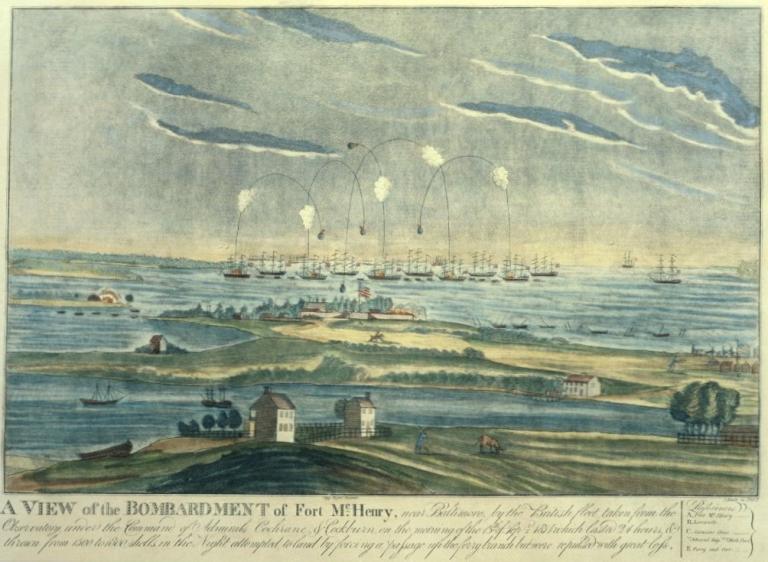
The caption reads “A VIEW of the BOMBARDMENT of Fort McHenry, near Baltimore, by the British fleet taken from the Observatory under the Command of Admirals Cochrane & Cockburn on the morning of the 13th of Sept 1814 which lasted 24 hours & thrown from 1500 to 1800 shells in the Night attempted to land by forcing a passage up the ferry branch but were repulsed with great loss.”
(Wikimedia Commons public domain image)
***
It’s the Fourth of July, American Independence Day. In our sacrament meeting today, we sang all of the verses of “The Star Spangled Banner” — not merely the first verse, which is customarily followed by the words “Play ball!” — and we sang “America the Beautiful.” Singing the entirety of the national anthem allows one to think about the actual story behind Francis Scott Key’s lyrics, which were inspired by his seeing (from his enforced position aboard an enemy vessel) that the flag of the United States was still flying above Fort McHenry when the sun rose following a lengthy British bombardment during the War of 1812.
But the ward that meets after us sang the great Union anthem from the American Civil War, “The Battle Hymn of the Republic,” and I envied them:
-
Mine eyes have seen the glory of the coming of the Lord;
He is trampling out the vintage where the grapes of wrath are stored.
He hath loosed the fateful lightning of his terrible, swift sword;
His truth is marching on.
-
[Chorus]
Glory, glory, hallelujah!
Glory, glory, hallelujah!
Glory, glory, hallelujah!
His truth is marching on.
-
He has sounded forth the trumpet that shall never call retreat;
He is sifting out the hearts of men before his judgment seat.
Oh, be swift, my soul, to answer him; be jubilant my feet!
Our God is marching on.
-
In the beauty of the lilies, Christ was born across the sea,
With a glory in his bosom that transfigures you and me.
As he died to make men holy, let us live to make men free,
While God is marching on.
Here is a stirring video of the Tabernacle Choir, the Orchestra at Temple Square Strings, and the United States Military Academy Band at West Point performing “The Battle Hymn of the Republic” on 4 July 2015, on the bank of the Hudson River at the United States Military Academy at West Point, New York:
Battle Hymn of the Republic (Live from West Point)
I’ve been thinking about patriotism for the last three or four days, not merely because of the holiday weekend but on account of some reading (or listening) that we’ve been doing. It occurs to me that mine is no longer the simple flag-waving kind of patriotism that it perhaps once was, when I was quite young. If my children or grandchildren aren’t around, I just don’t care that much about fireworks and I would probably rather avoid huge crowds at a public holiday event. I respect the flag, of course, and I consider myself a patriot, but I’ve come to concentrate with much greater focus but also rather quietly upon the ideas that make America worth defending rather than upon mere nationalism.
This has brought me to considering a quotation that is often but, it seems, quite falsely attributed to Alexis de Tocqueville:
I sought for the greatness and genius of America in her commodious harbors and her ample rivers, and it was not there. I sought for the greatness and genius of America in her fertile fields and boundless forests, and it was not there. I sought for the greatness and genius of America in her rich mines and her vast world commerce, and it was not there. I sought for the greatness and genius of America in her public school system and her institutions of learning, and it was not there. I sought for the greatness and genius of America in her democratic Congress and her matchless Constitution, and it was not there. Not until I went into the churches of America and heard her pulpits flame with righteousness did I understand the secret of her genius and power. America is great because she is good, and if America ever ceases to be good, she will cease to be great.
I don’t much care who originally said it or wrote it. I like it because what it says is true.
And now, we can behold the decrees of God concerning this land, that it is a land of promise; and whatsoever nation shall possess it shall serve God, or they shall be swept off when the fulness of his wrath shall come upon them. And the fulness of his wrath cometh upon them when they are ripened in iniquity.
For behold, this is a land which is choice above all other lands; wherefore he that doth possess it shall serve God or shall be swept off; for it is the everlasting decree of God. And it is not until the fulness of iniquity among the children of the land, that they are swept off.
And this cometh unto you, O ye Gentiles, that ye may know the decrees of God—that ye may repent, and not continue in your iniquities until the fulness come, that ye may not bring down the fulness of the wrath of God upon you as the inhabitants of the land have hitherto done.
Behold, this is a choice land, and whatsoever nation shall possess it shall be free from bondage, and from captivity, and from all other nations under heaven, if they will but serve the God of the land, who is Jesus Christ, who hath been manifested by the things which we have written. (Ether 2:9-12)
Well, what pseudo-Tocqueville says is largely true: I do happen to think that a substantial portion of “the greatness and genius of America” is to be found “in her democratic Congress and” especially in “her matchless Constitution.” And I’m deeply concerned that many (including many in Congress) seem to have forgotten that.
In this connection, although it doesn’t cover all of my reasons for treasuring the Constitution, please see this very good article in the Deseret News by Professor Justin Collings of Brigham Young University’s J. Reuben Clark Law School:
But the other substantial portion, and the even more important portion, of “the greatness and genius of America” is surely to be found in the nation’s goodness. I’ve come, therefore, to dislike the famous 1816 toast offered by the daring naval hero Stephen Decatur:
Our country! In her intercourse with foreign nations may she always be in the right; but our country, right or wrong!
In 1871, the German-born Senator Carl Schurz (R-MO) was a bit closer to the right sentiment, but still not quite there:
My country, right or wrong; if right, to be kept right; and if wrong, to be set right.
This is important to me, and no mere quibble, because it seems clearly necessary to recognize loyalties that transcend the nation if the nation is not to become an idol. If our loyalty is always to the nation or the state, there can never be valid grounds for dissent from what the nation or the state has decreed. This is the kind of thing that, at its worst, gets us into the territory of Nazi Germany or Fascist Italy. “Well but, surely,” an American might respond, “America is neither Hitler’s Third Reich nor Mussolini’s attempted restoration of the Roman Empire.” True. However, America is not without blemish. Not even close. Slavery, to choose the most glaringly obvious example, was a gross wrong, a violation of our fundamental founding beliefs, and not so very much better than the racial policies of German anti-Semitism.
We hold these truths to be self-evident, that all men are created equal, that they are endowed by their Creator with certain unalienable Rights, that among these are Life, Liberty and the pursuit of Happiness.–That to secure these rights, Governments are instituted among Men, deriving their just powers from the consent of the governed, –That whenever any Form of Government becomes destructive of these ends, it is the Right of the People to alter or to abolish it, and to institute new Government, laying its foundation on such principles and organizing its powers in such form, as to them shall seem most likely to effect their Safety and Happiness.
That’s not Karl Marx or some Antifa lunatic. That’s the Declaration of Independence, which we celebrate on this very day (however obscured it may sometimes be by fireworks and the smell of barbecue). And, to make things just a bit ambiguous, those words were largely penned by Thomas Jefferson, who, like Francis Scott Key, owned slaves.
But back to my claim that we must have a loyalty, a vantage point, higher than the nation or the state: If what is lawful is by definition right, and if what is unlawful is by definition wrong, there can be no solid basis for seeking reform. The state becomes the ultimate arbiter of wrong and right, good and evil. To resist Hitler would be clearly wrong, because it was illegal. But was it wrong to seek to end human servitude? Was it wrong for women to seek the vote? Were the Latter-day Saints of the nineteenth century wrong to try to preserve their religious freedom in the face of government oppression? Was Governor Boggs within his rights to decree their extermination? (He spoke for the state, after all. ) Is it wrong today to oppose late-term abortions or to defend the right of a cake decorator to free expression or to oppose the destruction of women’s sports by government edict? Is the principle really “Whatever is, is right?”
I love a statement from Edmund Burke, the English parliamentarian, a sympathizer with the American colonists and yet a fierce critic of the French Revolution who is revered by many conservative intellectuals as the very founder of modern conservatism. In 1790, in his classic Reflections on the Revolution in France, he said:
To make us love our country, our country ought to be lovely.
And, I’m happy to say, America has mostly been lovely. (See Theresa Dear’s fine Deseret News column “Perspective: America is not perfect, but she is certainly beautiful.” Theresa Dear is certainly someone with grounds for complaint, but she doesn’t.)
We were caught up for a while — too long — in colonialism, in places like Cuba and the Philippines and, yes, to an unfortunate and shameful degree, Hawaii. (On this, see Daniel Immerwahr’s 2019 book How to Hide an Empire: A History of the Greater United States.) And there is always the matter of slavery and then of segregation. Moreover, our adherence to our ideals has always been imperfect, a matter of effort often falling short and of aspirations sometimes altogether forgotten. (See Jill Lepore’s book, also published in 2019, These Truths: A History of the United States.) But it has been a good place, on the whole, and a good system. It has been, on balance, a very great blessing to the world. It has freed and made prosperous hundreds of millions of men, women, and children, not only immigrants and those born within its borders but people in other countries. Ending the vicious reign of Hitler and Mussolini, for instance, was an unambiguously good thing. Ending American slavery was an unambiguously good thing.
Even in celebrating our country and the glories of its landscapes and history, the famous lyrics to “America the Beautiful” by Katherine Lee Bates recognize that our nation can still be better and implores God’s help in becoming what we ought to be:
America! America!
God mend thine ev’ry flaw,
Confirm thy soul in self-control,
Thy liberty in law. . . .
America! America!
May God thy gold refine,
Till all success be nobleness,
And ev’ry gain divine. . . .
America! America!
God shed his grace on thee,
And crown thy good with brotherhood
From sea to shining sea.
One of her verses, though, begins this way:
Oh, beautiful for heroes proved
In liberating strife,
Who more than self their country loved,
And mercy more than life!
America is at its very best when it liberates. Whether at Yorktown or at Appomattox Courthouse or at Normandy.
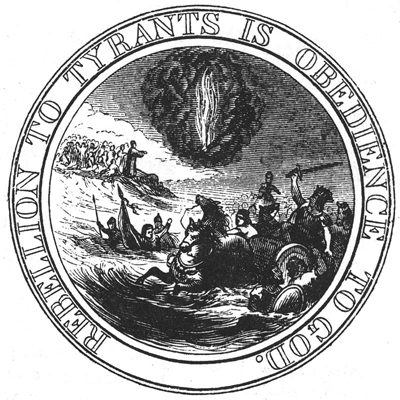
Benjamin Franklin’s proposal for the Great Seal of the United States of America
(Wikimedia Commons public domain image)
And liberation is a common thread that America, at its best, shares with the gospel of Jesus Christ, which liberates from sin and despair, and, ultimately, from death and from confinement in spirit prison.
Not for nothing did Benjamin Franklin propose an image of the exodus of the children of Israel from their bondage in Egypt, complete with Jehovah in a pillar of fire, as the Great Seal of the United States of America.
Independence Day isn’t only an occasion for hot dogs and sparklers, hamburgers and firecrackers, sloppy Joes and bands and parades. And, in a way, it’s not merely a day for celebration. It’s also an opportunity for reflection and resolution. Happy Fourth of July!
Previous Post

July 4, 2021
Through Star Valley and Beyond
Next Post
July 5, 2021 "Early Christian Temples and Baptism for the Dead"
Browse Our Archives
Select a Category Uncategorized
Select a Month October 2026 September 2026 August 2026 July 2026 June 2026 May 2026 April 2026 March 2026 February 2026 January 2026 December 2025 November 2025 October 2025 September 2025 August 2025 July 2025 June 2025 May 2025 April 2025 March 2025 February 2025 January 2025 December 2024 November 2024 October 2024 September 2024 August 2024 July 2024 June 2024 May 2024 April 2024 March 2024 February 2024 January 2024 December 2023 November 2023 October 2023 September 2023 August 2023 July 2023 June 2023 May 2023 April 2023 March 2023 February 2023 January 2023 December 2022 November 2022 October 2022 September 2022 August 2022 July 2022 June 2022 May 2022 April 2022 March 2022 February 2022 January 2022 December 2021 November 2021 October 2021 September 2021 August 2021 July 2021 June 2021 May 2021 April 2021 March 2021 February 2021 January 2021 December 2020 November 2020 October 2020 September 2020 August 2020 July 2020 June 2020 May 2020 April 2020 March 2020 February 2020 January 2020 December 2019 November 2019 October 2019 September 2019 August 2019 July 2019 June 2019 May 2019 April 2019 March 2019 February 2019 January 2019 December 2018 November 2018 October 2018 September 2018 August 2018 July 2018 June 2018 May 2018 April 2018 March 2018 February 2018 January 2018 December 2017 November 2017 October 2017 September 2017 August 2017 July 2017 June 2017 May 2017 April 2017 March 2017 February 2017 January 2017 December 2016 November 2016 October 2016 September 2016 August 2016 July 2016 June 2016 May 2016 April 2016 March 2016 February 2016 January 2016 December 2015 November 2015 October 2015 September 2015 August 2015 July 2015 June 2015 May 2015 April 2015 March 2015 February 2015 January 2015 December 2014 November 2014 March 2014 August 2013 February 2012
Follow Us!
TAKE THE
Religious Wisdom Quiz
I am a goat released into the wilderness, carrying away the sins of the people. What am I?
Select your answer to see how you score.
An atonement goat A sin offering The scapegoat A sacrifice
Related posts from Sic et Non

"The Book of Moses as a Temple Text"


Islam in America or Islam versus America?

TRENDING AT PATHEOS Latter-day Saint

Swimfan: Forgotten Aughts Pleasures
This is a recovery effort. In 2002, My Big Fat Greek Wedding...

Top Three Anti-Catholic Lies About Catholicism
This is my initial transcript for the video, "THE 3 WORST...

Pope Leo Celebrates Mass for Nurses & Docs...
I don't have any idea how he did it, but Pope Leo...

The Sermon on the Mount, Part I: Matthew...
The Sermon on the Mount, Part I (Matthew 4:12-5:12) St. Matthew moves...

What's up from Crossway: Reviewing some of their latest A few weeks...

Janie Learns the Way of the Cross: A...
Teaching children about Jesus' Passion can be challenging. Many parents and educators...
view all Latter-day Saint blogs
Ad-Free & Subscriber Log-In Subscription Support
- About Us
- 2026 Calendar
- Videos
- Podcasts
- Library of World Religions
- Faith In Media Tracker
- Advertise With Us
- Write for Us
- Privacy Policy
- Terms of Service
- Do Not Sell My Data
- Contact Us
- Radiant Digital
- Manage Newsletter Subscriptions
- Unsubscribe From Notifications
- Sitemap
Copyright 2008-2026, Patheos. All rights reserved.
Subscription Support Ad-Free & Subscriber Log-In
Follow Patheos