
BuddhistCatholicContemplativeEvangelicalGeneral ChristianHinduJewishLatter-day SaintMuslimNew VisionsProgressive Christian
Beliefs
- Buddhist
- Catholic
- Contemplative
- Evangelical
- General Christian
- Hindu
- Jewish
- Latter-day Saint
- More Voices
- Muslim
- New Visions
- Pagan
- Progressive Christian
Topics
- Religion News
- Food and Religion
- Sports and Religion
- Religious Art
- Religious Music and Entertainment
- Religious Events
- History and Religion
- Style and Religion
- Politics and Religion
- Women in Religion
- Recreation Outdoors and Religion
- Business Finance and Religion
- Careers Workplace and Religion
- Education and Religion
- Family Parenting and Religion
- Health Fitness and Religion
- Home and Religion
- Relationships and Religion
- Technology and Religion
- Travel and Religion
Columnists
- Buddhist Columnists
- Business Finance and Religion Columnists
- Careers Workplace and Religion Columnists
- Catholic Columnists
- Contemplative Columnists
- Education and Religion Columnists
- Evangelists Columnists
- Family Parenting and Religion Columnists
- General Christian Columnists
- Health Fitness and Religion Columnists
- Hindu Columnists
- History and Religion Columnists
- Home and Religion Columnists
- Jewish Columnists
- More Voices Columnists
- Latter Day Columnists
- Muslim Columnists
- New Visions Columnists
- Nonreligious Columnists
- Pagan Columnists
- Politics and Religion Columnists
- Progressive Columnists
- Recreation Outdoors and Religion Columnists
- Relationships and Religion Columnists
- Religion News Columnists
- Religious Art Columnists
- Religious Events Columnists
- Religious Music and Entertainment Columnists
- Sports and Religion Columnists
- Style and Religion Columnists
- Technology and Religion Columnists
- Travel and Religion Columnists
- Women in Religion Columnists
Resource Library
- 2026 Calendar
- Library of World Religions
- The 100 Most Holy Places on Earth
- Patheos Answers
- Podcasts
- Videos
- Faith Leaders Database
- Anglican Episcopalian
- Bahai
- Baptist
- Buddhism
- Christianity
- Confucianism
- Eastern Orthodoxy
- Hinduism
- Holiness and Pentecostal
- ISKCON
- Islam
- Judaism
- Lutheran
- Methodist
- The Church of Jesus Christ of Latter-day Saints
- New Age
- Paganism
- Presbytarian and Reformed
- Protestantism
- Religion Behind the Scenes
- Roman Catholic
- Scientology
- Shia Islam
- Sikhism
- Sufism
- Sunni Islam
- Taoism
- Zen
- See all religions
Research Tools
 Ad-Free & Subscriber Log-In Subscription Support
Ad-Free & Subscriber Log-In Subscription Support
Follow Patheos 

- Trending:
- Forgiveness
- |
- Marriage
- |
- Consciousness
- |
- Death Penalty
- |
- Election
- |
- Halloween

- Home
- Latter-day Saint
- On the Book of Mormon and the Goodness of God
On the Book of Mormon and the Goodness of God
Last updated on: September 17, 2021 at 8:06 pm by Dan Peterson
On the Book of Mormon and the Goodness of God 2021-09-17T20:06:41-06:00 Dan Peterson
Patheos Explore the world's faith through different perspectives on religion and spirituality! Patheos has the views of the prevalent religions and spiritualities of the world.
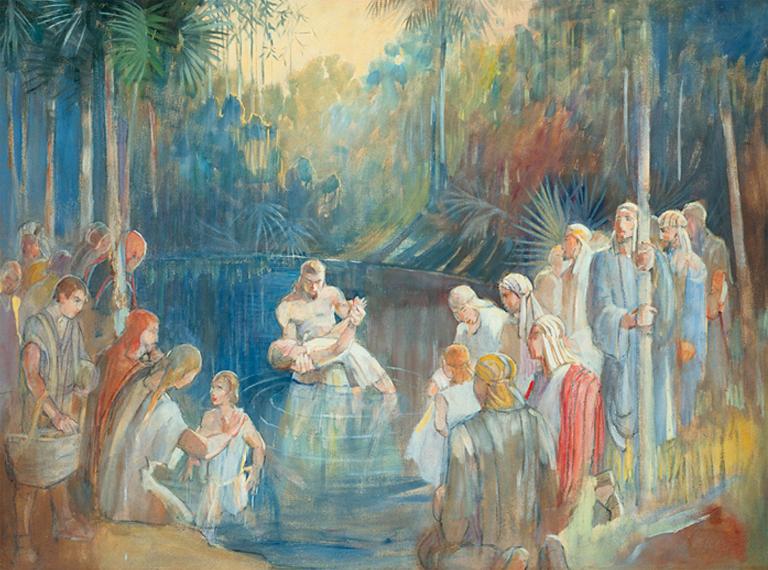
“Alma Baptizes in the Waters of Mormon” by Minerva Teichert (1888-1976)
Wikimedia Commons public domain image
***
The newest article in Interpreter: A Journal of Latter-day Saint Faith and Scholarship was written by Noel B. Reynolds and appeared today (Friday):
“The Goodness of God and His Children as a Fundamental Theological Concept in the Book of Mormon”
Abstract: The phrase goodness of God does occur occasionally in the Hebrew Bible but has not been considered by Old Testament scholars to be an independent principle in Israelite theology. Rather, it has been interpreted as just another way of talking about God’s acts of hesed, or loving kindness for his covenant people and is usually interpreted in the context of the covenants Israel received through Abraham and Moses. The Book of Mormon clearly echoes that Old Testament pattern but also presents two additional conceptual frameworks that are explained in terms of the goodness of God. It advances an explicit divine plan of redemption or salvation that existed before Abraham — even before the creation of the earth — which had as its purpose making eternal life possible for God’s human children universally — not just the descendants of Abraham. And it also teaches the gospel or doctrine of Christ that provides the path individuals must walk to take full advantage of that plan — as they become good like God and qualify to enter his presence and receive eternal life. Nephite usage radically expands the Old Testament concept by portraying this mortal probation as each person’s God-given opportunity to become good like God. The goodness of God is frequently invoked by the Nephite prophets as a basic theological concept which can explain why God advanced his plan of salvation for men before the world was and why he is completely reliable in blessing and protecting those who have entered the covenant path by embracing his gospel and striving to endure to the end. The Nephites also used the phrase in the Old Testament pattern to explain the acts of God in delivering, blessing, and preserving his covenant people. Furthermore, some usages seem to invoke all three of these contexts simultaneously, demonstrating the comfortable integration of each of these perspectives in Nephite theological understanding.
***
And after you’ve finished reading the new article by Professor Reynolds, you can perhaps read the essays below, drawn from an earlier number of Interpreter, when you’re not ferrying friends, neighbors, relatives, and perfect strangers to showings of Witnesses:
David L. Clark, “If I Pray Not Amiss”
Abstract: In 2nd Nephi, it is suggested that the Lord answers prayers but that requests made in prayer should not violate some kind of standard that would make them “amiss.” This undefined standard most likely excludes many prayers requesting immunity from those conditions of mortality which all mortals accepted and embraced with great enthusiasm in the great Council in Heaven. However, except for limited latter-day explanations of that great conference, our eager acceptance of all details of the conditions of mortality did not carry over into mortal memory. Consequently, when we request exemption from those conditions joyfully endorsed in premortal time, perhaps many qualify for the “prayers amiss” category. Exceptions from mortal conditions are granted only for divine and sometimes incomprehensible purposes.
Paul C. Peterson, “To Be Learned Is Good, If One Stays on the Rails”
Abstract: This review essay looks at certain problematical issues in the recently published collection of essays honoring Latter-day Saint historian Richard Lyman Bushman. Problems emerge from the title itself, “To Be Learned is Good,” as a result of the failure to note that the Book of Mormon passage “To be learned is good” is a conditional statement. In addition, since these essays are billed as “Essays on Faith and Scholarship,” it is odd most of them do not touch on this subject at all. I examine four essays in depth, including Adam Miller’s “Christo-Fiction, Mormon Philosophy, and the Virtual Body of Christ,” which is offered as a form of clarifying Mormon philosophy but provides more confusion than clarification. Jared Hickman’s essay, “The Perverse Core of Mormonism: The Book of Mormon, Genetic Secularity, and Messianic Decoloniality,” presents Mormonism as a religion that has much in common with Marxism, Frantz Fanon, and Sean Coulhard. While not as bold as Hickman, Patrick Mason looks at Mormonism as a modern religion and suggests that premodern thinkers are largely irrelevant to Mormonism and the modern world. Mason argues that “Mormonism is a religion that could meaningfully converse with modern philosophies and ideologies from transcendentalism, liberalism, and Marxism.” I discuss the weaknesses of this view. Attention is also given to the distinction between apologetics and “Mormon Studies” that arise from essays by Grant Wacker, Armand Mauss, Terryl Givens, and Brian D. Birch, who suggests “‘a methodological pluralism’” in approaching Mormon studies. I note that several of the essays in this volume are worthy of positive note, particularly those by Bushman himself, Mauss (who does address the presumed theme of the book), Givens, Mauro Properzi, and Melissa Wei-Tsing Inouye (who also addresses the titled theme of the book in a most engaging manner).
Review of J. Spencer Fluhman, Kathleen Flake, and Jed Woodworth, eds., To Be Learned is Good: Essays on Faith and Scholarship in Honor of Richard Lyman Bushman (Provo, Utah: Neal A. Maxwell Institute for Religious Scholarship, Brigham Young University, 2017). 368 pp. $24.56 (hardcover).
Matthew L. Bowen, “Moroni’s Wordplay on Joseph in Ether 13:1-13 and Moroni 10:31”
**Abstract: In two related prophecies, Moroni employs an apparent wordplay on the name Joseph in terms of the Hebrew idiom (lōʾ) yôsîp … ʿôd (+ verbal component), as preserved in the phrases “they shall no more be confounded” (Ether 13:8) and “that thou mayest no more be confounded” (Moroni 10:31). That phraseology enjoyed a long currency within Nephite prophecy (e.g., 1 Nephi 14:2, 15:20), ultimately having its source in Isaiah’s prophecies regarding Jerusalem/Zion (see, for example, Isaiah 51:22; 52:1– 2; 54:2–4). Ether and Moroni’s prophecy in Ether 13 that the Old Jerusalem and the New Jerusalem would “no more be confounded” further affirms the gathering of Israel in general and the gathering of the seed of Joseph in particular.
Brad Wilcox, Wendy Baker-Smemoe, Bruce L. Brown and Sharon Black, “Comparing Book of Mormon Names with Those Found in J.R.R. Tolkien’s Works: An Exploratory Study”
Abstract: The works of Tolkien and the Book of Mormon have been compared in a variety of ways by multiple authors and researchers, but none have looked specifically at the unusual names found within both. Wordprint studies are one tool used in author attribution research, but do authors use specific sounds more than others — consciously or subconsciously — when selecting or inventing names? Some research suggests they may and that their patterns could create a “sound print” or phonoprint. This constitutes a fresh and unusual path of research that deserves more attention. The purpose of this exploratory study was to see if phonoprints surfaced when examining Dwarf, Elf, Hobbit, Man, and other names created by Tolkien and Jaredite, Nephite, Mulekite, and Lamanite names found in the Book of Mormon. Results suggest that Tolkien had a phonoprint he was unable to entirely escape when creating character names, even when he claimed he based them on distinct languages. In contrast, in Book of Mormon names, a single author’s phonoprint did not emerge. Names varied by group in the way one would expect authentic names from different cultures to vary. Although much more research needs to be done to establish the validity and reliability of using phonoprints for author identification, this study opens a door for future research.
Stephen O. Smoot, “Et Incarnatus Est: The Imperative for Book of Mormon Historicity”
Abstract: Some have come to insist that the Book of Mormon should be read as inspired fiction, which is to say that readers, including Latter-day Saints, should abandon any belief in the Book of Mormon as an authentic ancient text and instead should see it as an inspired frontier novel written by Joseph Smith that may act as scripture for those who follow his teachings. This paper provides reasoning to reject this proposition as not only logically incoherent but also theologically impotent.1 It raises the objection that this position fundamentally undercuts the credibility of Joseph Smith. The Prophet’s direct claims concerning the coming forth of the Book of Mormon as well as how the Book of Mormon presents itself to the world do not easily permit any leeway for a “middle ground” on this matter.
Taylor Halverson, “Why Did Northern Israel Fall to the Assyrians? A Weberian Proposal”
Abstract: This article is centered on possible causes for the fall of Israel and, secondarily, Judah. The topic is not new. The very destruction of these ancient kingdoms may be the cause for the production of much of the Biblical literature that drives our interpretive enterprise. My proposal is that Max Weber’s socio-political theories of power and domination, sometimes called the tripartite classification of authority, may provide a fruitful lens by which to understand some of the reasons Judah persisted for more than a century after the fall of Israel. Specifically, I wish to investigate whether the lack of routinization of charismatic authority was a contributing factor in Israel’s fall.
Posted from Devils Lake, North Dakota
Previous Post

July 15, 2021
"Them boys was here alright!"
Next Post
July 16, 2021 Retracing my father's early footsteps
Browse Our Archives
Select a Category Uncategorized
Select a Month October 2026 September 2026 August 2026 July 2026 June 2026 May 2026 April 2026 March 2026 February 2026 January 2026 December 2025 November 2025 October 2025 September 2025 August 2025 July 2025 June 2025 May 2025 April 2025 March 2025 February 2025 January 2025 December 2024 November 2024 October 2024 September 2024 August 2024 July 2024 June 2024 May 2024 April 2024 March 2024 February 2024 January 2024 December 2023 November 2023 October 2023 September 2023 August 2023 July 2023 June 2023 May 2023 April 2023 March 2023 February 2023 January 2023 December 2022 November 2022 October 2022 September 2022 August 2022 July 2022 June 2022 May 2022 April 2022 March 2022 February 2022 January 2022 December 2021 November 2021 October 2021 September 2021 August 2021 July 2021 June 2021 May 2021 April 2021 March 2021 February 2021 January 2021 December 2020 November 2020 October 2020 September 2020 August 2020 July 2020 June 2020 May 2020 April 2020 March 2020 February 2020 January 2020 December 2019 November 2019 October 2019 September 2019 August 2019 July 2019 June 2019 May 2019 April 2019 March 2019 February 2019 January 2019 December 2018 November 2018 October 2018 September 2018 August 2018 July 2018 June 2018 May 2018 April 2018 March 2018 February 2018 January 2018 December 2017 November 2017 October 2017 September 2017 August 2017 July 2017 June 2017 May 2017 April 2017 March 2017 February 2017 January 2017 December 2016 November 2016 October 2016 September 2016 August 2016 July 2016 June 2016 May 2016 April 2016 March 2016 February 2016 January 2016 December 2015 November 2015 October 2015 September 2015 August 2015 July 2015 June 2015 May 2015 April 2015 March 2015 February 2015 January 2015 December 2014 November 2014 March 2014 August 2013 February 2012
Follow Us!
TAKE THE
Religious Wisdom Quiz
True or False: Paul instructs the Philippians to do everything without grumbling or arguing.
Select your answer to see how you score.
FALSE TRUE
Related posts from Sic et Non


Some notes on the archaeology of the Bible


TRENDING AT PATHEOS Latter-day Saint

Janie Learns the Way of the Cross: A...
Teaching children about Jesus' Passion can be challenging. Many parents and educators...

Looking For Good Catholic Writing - October 2026
He alone extends the heavens, and he walks upon the waves of...

In "Irreplaceable," our book on vocation and technology, Trevor Sutton and I...

I was strolling through the top floor of the brand new Parthenon...

What Does Gêvâh Mean For Kimberley Guifoyle &...
This week, a lot of the news is focused on Kimberly Guilfoyle....

INNER CIRCLE: Profound Mystery (Of Christ In All...
Ephesians 5:31-32 “For this reason, a man will leave his father and...
view all Latter-day Saint blogs
Ad-Free & Subscriber Log-In Subscription Support
- About Us
- 2026 Calendar
- Videos
- Podcasts
- Library of World Religions
- Faith In Media Tracker
- Advertise With Us
- Write for Us
- Privacy Policy
- Terms of Service
- Do Not Sell My Data
- Contact Us
- Radiant Digital
- Manage Newsletter Subscriptions
- Unsubscribe From Notifications
- Sitemap
Copyright 2008-2026, Patheos. All rights reserved.
Subscription Support Ad-Free & Subscriber Log-In
Follow Patheos