
BuddhistCatholicContemplativeEvangelicalGeneral ChristianHinduJewishLatter-day SaintMuslimNew VisionsProgressive Christian
Beliefs
- Buddhist
- Catholic
- Contemplative
- Evangelical
- General Christian
- Hindu
- Jewish
- Latter-day Saint
- More Voices
- Muslim
- New Visions
- Pagan
- Progressive Christian
Topics
- Religion News
- Food and Religion
- Sports and Religion
- Religious Art
- Religious Music and Entertainment
- Religious Events
- History and Religion
- Style and Religion
- Politics and Religion
- Women in Religion
- Recreation Outdoors and Religion
- Business Finance and Religion
- Careers Workplace and Religion
- Education and Religion
- Family Parenting and Religion
- Health Fitness and Religion
- Home and Religion
- Relationships and Religion
- Technology and Religion
- Travel and Religion
Columnists
- Buddhist Columnists
- Business Finance and Religion Columnists
- Careers Workplace and Religion Columnists
- Catholic Columnists
- Contemplative Columnists
- Education and Religion Columnists
- Evangelists Columnists
- Family Parenting and Religion Columnists
- General Christian Columnists
- Health Fitness and Religion Columnists
- Hindu Columnists
- History and Religion Columnists
- Home and Religion Columnists
- Jewish Columnists
- More Voices Columnists
- Latter Day Columnists
- Muslim Columnists
- New Visions Columnists
- Nonreligious Columnists
- Pagan Columnists
- Politics and Religion Columnists
- Progressive Columnists
- Recreation Outdoors and Religion Columnists
- Relationships and Religion Columnists
- Religion News Columnists
- Religious Art Columnists
- Religious Events Columnists
- Religious Music and Entertainment Columnists
- Sports and Religion Columnists
- Style and Religion Columnists
- Technology and Religion Columnists
- Travel and Religion Columnists
- Women in Religion Columnists
Resource Library
- 2026 Calendar
- Library of World Religions
- The 100 Most Holy Places on Earth
- Patheos Answers
- Podcasts
- Videos
- Faith Leaders Database
- Anglican Episcopalian
- Bahai
- Baptist
- Buddhism
- Christianity
- Confucianism
- Eastern Orthodoxy
- Hinduism
- Holiness and Pentecostal
- ISKCON
- Islam
- Judaism
- Lutheran
- Methodist
- The Church of Jesus Christ of Latter-day Saints
- New Age
- Paganism
- Presbytarian and Reformed
- Protestantism
- Religion Behind the Scenes
- Roman Catholic
- Scientology
- Shia Islam
- Sikhism
- Sufism
- Sunni Islam
- Taoism
- Zen
- See all religions
Research Tools
 Ad-Free & Subscriber Log-In Subscription Support
Ad-Free & Subscriber Log-In Subscription Support
Follow Patheos 

- Trending:
- Forgiveness
- |
- Marriage
- |
- Consciousness
- |
- Death Penalty
- |
- Election
- |
- Halloween

- Home
- Latter-day Saint
- “Early Christian Temples and Baptism for the Dead”
“Early Christian Temples and Baptism for the Dead”
Last updated on: July 5, 2021 at 2:51 pm by Dan Peterson
“Early Christian Temples and Baptism for the Dead” 2021-07-05T14:51:40-06:00 Dan Peterson
Patheos Explore the world's faith through different perspectives on religion and spirituality! Patheos has the views of the prevalent religions and spiritualities of the world.
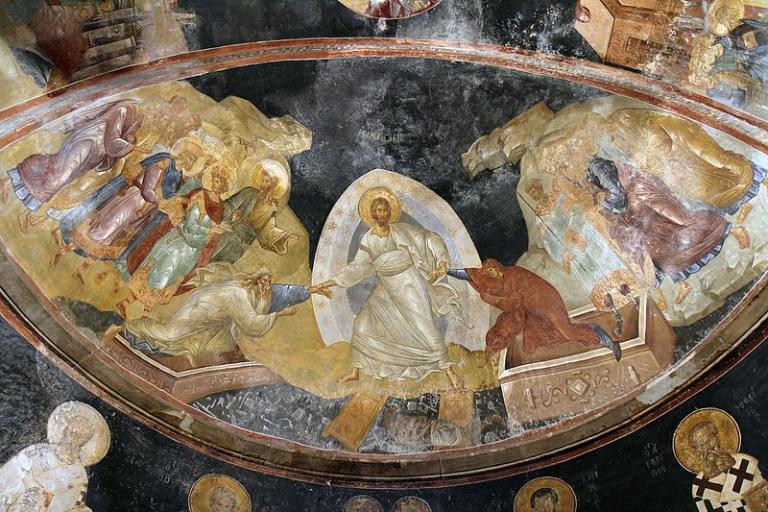
Between his crucifixion and his resurrection, Christ visits the world of spirits and, taking them by the hand, lifts Adam and Eve from their lost state. This fresco appears in Istanbul’s (Constantinople’s) marvelous “Chora Church.” It is also known as the Kariye Mosque (Turkish: Kariye Camii), or the Church of the Holy Savior in Chora, or “in the countryside” or “in the fields” (Greek: Ἐκκλησία τοῦ Ἁγίου Σωτῆρος ἐν τῇ Χώρᾳ), and is located in the Edirnekapı neighborhood of Istanbul, Turkey, outside the city’s great Byzantine walls. Hence the name. (Wikimedia Commons public domain image)
***
This “new” reprint article by David M. Calabro appeared just a few minutes ago in Interpreter: A Journal of Latter-day Saint Faith and Scholarship:
Abstract: This paper examines similarities between the account of the sacrifice and epiphany of the first parents in Moses 5:1–15 and analogous accounts found in apocryphal literature of the late antique and medieval periods. Apocryphal texts considered include primarily the Greek Life of Adam and Eve (also known as the Apocalypse of Moses*) and secondarily the* Conflict of Adam and Eve with Satan*, the* Cave of Treasures*, the medieval Jewish Sefer Raziel, and Islamic collections of Qisas al-Anbiya’ (“Stories of the Prophets”). The focus is not only on the content of the narratives, but also on structural elements such as voice and narrative flow. Based on this examination, David argues that some of these texts have a common type of origin, being both revelatory and oriented to a ritual context, while others belong to different types associated with different historical contexts. He shows how this typological approach could inform dialogue between scholars of Restoration scripture and those researching the origins of other traditions’ sacred texts.*
[Editor’s Note: Part of our book chapter reprint series, this article is reprinted here as a service to the Latter-day Saint community. Original pagination and page numbers have necessarily changed, otherwise the reprint has the same content as the original.
See David Calabro, “Early Christian Temples and Baptism for the Dead: Defining Sacred Space in the Late Antique Near East,” in The Temple: Symbols, Sermons, and Settings, Proceedings of the Fourth Interpreter Foundation Matthew B. Brown Memorial Conference, 10 November 2018, ed. Stephen D. Ricks and Jeffrey M. Bradshaw (Orem, UT: The Interpreter Foundation; Salt Lake City: Eborn Books, 2021), page numbers forthcoming. Further information at https://interpreterfoundation.org/books/the-temple-symbols-sermons-and-settings/.]
***
In this connection, you might also enjoy an article by Professor Hans A. Pohlsander, who passed away on 26 June 2021, slightly more than a week ago:
“A Rescue for the Dead: The Posthumous Salvation of Non-Christians in Early Christianity”
***
I think that I may have failed to call attention to this short piece, which went up on the Interpreter Foundation website on Saturday, while I was driving home from Jackson Hole, Wyoming:
***
And, just in case the three pieces listed above aren’t quite enough to keep you occupied and entertained while you’re waiting for grilling time this evening or while you sit there, bobbing up and down, hoping to get a chance to take your ski boat out of the lake, here are links to some articles from a previous volume of Interpreter:
Noel B. Reynolds, “The Gospel According to Mormon”
Abstract: Although scholarly investigation of the Book of Mormon has increased significantly over the last three decades, only a tiny portion of that effort has been focused on the theological or doctrinal content of this central volume of LDS scripture. This paper identifies three inclusios that promise definitions of the doctrine or gospel of Jesus Christ and proposes a cumulative methodology to explain how these definitions work. This approach reveals a consistently presented, six-part formula defining “the way” by which mankind can qualify for eternal life. In this way the paper provides a starting point for scholarly examinations of the theological content of this increasingly influential religious text. While the names of the six elements featured in Mormon’s gospel will sound familiar to students of the New Testament, the meanings he assigns to these may differ substantially from traditional Christian discourse in ways that make Mormon’s characterization of the gospel or doctrine of Christ unique. The overall pattern suggested is a dialog between man and God, who initially invites all people to trust in Christ and repent. Those who respond by repenting and seeking baptism will be visited by fire and by the Holy Ghost, which initiates a lifelong interaction, leading the convert day by day in preparation for the judgment, at which she may finally be invited to enter the kingdom of God.
Editor’s Note: This article was published originally in an international theological journal and is reprinted here as a service to the LDS community with minor revisions, updates, and edits included. See Noel B. Reynolds, “The Gospel according to Mormon,” Scottish Journal of Theology 68:2 (2015), 218-34. doi: 10.1017/S003693061500006X
Jeff Lindsay, “Joseph Smith’s Universe vs. Some Wonders of Chinese Science Fiction”
Abstract: Chinese science fiction works recently have received increasing attention and acclaim, most notably Liu Cixin’s The Three Body Problem*. Liu’s epic trilogy, available in Chinese and English, has received international honors and recognition for its vision, its daring application of advanced physics in a novel, and its highly original ideas about our life in the cosmos. Another Chinese physicist and science fiction author, Jiang Bo, also explores related issues but in a much more distant and wide-ranging trilogy,* The Heart of the Milky Way series. Both works have interesting treatments of concepts relevant to Gospel perspectives, particularly the cosmic implications and teachings in the revelations given through the Prophet Joseph Smith. In the end, the questions they raise and the possibilities they present raise cosmic questions worthy of consideration by seekers of truth and urge us to consider what this cosmos is and where it is going. There are two ultimate possibilities: “Darkness, everything darkness” from the tragic “dark forest” model of Liu Cixin or the model of a benign universe crafted by a loving Heavenly Father. The latter, the cosmos of light, eternal progress, and endless joy is the universe of Joseph Smith and is profound enough to be seriously pitted against the alternative offered by China’s brilliant physicists. Their writings treat the physics and metaphysics of the cosmos from a materialist perspective; if materialism rules, then it is tooth and claw, “everything darkness” in the end (though Jiang Bo offers hope of renewal and progress for some after his chaos and final grand calamity at the heart of the galaxy). Joseph Smith’s cosmology gives us compelling reasons to see it otherwise and rejoice in the miracle of the actual universe we are in. Along the way, he offers some profound insights that should at least raise eyebrows and stimulate thinking among the physicists and philosophers of our age. These insights, contrary to claims of some critics, are not simply plagiarism or [Page 106]crude reworkings of common ideas from his day, but represent profound and original breakthroughs in thought, solving significant problems in the world’s views on life and the cosmos.
[Editor’s Note: As stated in the formal mission statement of the Interpreter Foundation, we try to draw upon a “wide range of ancillary disciplines” (including literature and culture) to help illustrate the truths of the gospel and the reality of the Restoration. Even so, some may never have considered how one particular literary genre — science fiction — can fit into such an effort. Indeed, some may scoff at the genre entirely and presume it has no place in academic discourse. Owing to the fact that science fiction attempts to create future worlds and that those worlds necessarily reflect a “world view” consistent with the cultural views of the authors, it can be helpful to at least consider those views. When you further consider that Joseph Smith described and promoted a future world that he credited to revelation and interaction with the divine, we can learn new insights by comparing the man-made views of our potential future with the revealed views of our future. In this paper, author Jeff Lindsay does just that, comparing our place in the universe as viewed through the lens of cutting-edge science fiction with our place in the universe as viewed through the lens of the founding prophet of the Restoration. We found this effort both intriguing and interesting. My hope is that you will consider this somewhat “out of the box” approach both enjoyable and worthwhile.]
Kent P. Jackson, “Dehumanization and Peace”
Abstract: Those who follow world events are painfully aware that peace in the Middle East — and particularly in the Holy Land — seems eternally elusive. From a distance we watch events unfold which we are not able to fully comprehend because of that very distance. There are individuals who are burdened with the devastating reality of living with war and perpetual turmoil in the Holy Land. One of those is Sahar Qumsiyeh, a Palestinian Arab Latter-day Saint who grew up in the West Bank near Bethlehem. Her story of how she converted to Mormonism and learned how to find peace in a troubled world is recommended reading for every Latter-day Saint.
Review of Sahar Qumsiyeh, Peace for a Palestinian: One Woman’s Story of Faith Amidst War in the Holy Land (Salt Lake City: Deseret Book, 2018). 176 pp. $15.99.
Shirley S. Ricks, “Peace in the Holy Land”
Abstract: Living in the Holy Land as a Palestinian Latter-day Saint has created unique challenges and perspective for Sahar Qumsiyeh. In order to attend church meetings in Jerusalem from her home near Bethlehem, Sahar was required to travel under unsafe and stressful circumstances for hours through military checkpoints to cover the few miles’ distance (as the crow flies). Sahar’s story, Peace for a Palestinian*, varies dramatically from our own and reminds us that true discipleship requires sacrifice, which in turn brings blessings.*
Personal response to Sahar Qumsiyeh, Peace for a Palestinian: One Woman’s Story of Faith amidst War in the Holy Land (Salt Lake City: Deseret Book, 2018). 176 pp. $15.99.
Gregory L. Smith, “What is Mormon Transhumanism? And is it Mormon?”
Abstract: Some sources have described Mormonism as the faith most friendly to the intellectual movement known as Transhumanism. This paper reviews an introductory paper by the past President of the Mormon Transhumanist Association. A syllogism that purports to show that Mormonism is compatible with — or even requires — Transhumanism is analyzed. The syllogism’s premises are shown to misunderstand or misrepresent LDS scripture and doctrine. The proffered Transhumanist conception of “human nature” and the perspective offered by LDS scripture are compared and found to be incompatible. Additional discrepancies between the Transhumanist article’s representation of LDS doctrine and the actual teachings of LDS scripture and leaders on doctrinal matters (the Premortal Council in Heaven, the relationship between substance dualism and LDS thought, and the possibility of engineering or controlling spiritual experiences) are examined. The article does not accurately reflect LDS teachings, and thus has not demonstrated that Transhumanism is congenial to LDS scripture or doctrine.
Tarik D. LaCour, “Race: Always Complicated, Never Simple”
Abstract: The concept that race has evolved rather than remaining static is not well understood, both outside and within The Church of Jesus Christ of Latter-day Saints. In Religion of a Different Color*, W. Paul Reeve shows how the concept of race evolved from painting Mormons as nonwhite in the 19th century to “too white” by the beginning of the 21st century.*
Review of W. Paul Reeve, Religion of a Different Color: Race and the Mormon Struggle for Whiteness (New York: Oxford University Press, 2015). 352 pp. $36.95 (hardcover), $24.95 (paperback).
***
And, finally, some general religion news that you might find interesting:
“Scouting membership numbers collapse: AP totally ignores role of religion in this drama”
Church of Jesus Christ of Latter-day Saints
salvation for the unevangelized
salvation of the unevangelized
Previous Post

July 4, 2021
Thoughts on the Fourth of July
Next Post
July 6, 2021 My late friend John Tvedtnes and I
Browse Our Archives
Select a Category Uncategorized
Select a Month October 2026 September 2026 August 2026 July 2026 June 2026 May 2026 April 2026 March 2026 February 2026 January 2026 December 2025 November 2025 October 2025 September 2025 August 2025 July 2025 June 2025 May 2025 April 2025 March 2025 February 2025 January 2025 December 2024 November 2024 October 2024 September 2024 August 2024 July 2024 June 2024 May 2024 April 2024 March 2024 February 2024 January 2024 December 2023 November 2023 October 2023 September 2023 August 2023 July 2023 June 2023 May 2023 April 2023 March 2023 February 2023 January 2023 December 2022 November 2022 October 2022 September 2022 August 2022 July 2022 June 2022 May 2022 April 2022 March 2022 February 2022 January 2022 December 2021 November 2021 October 2021 September 2021 August 2021 July 2021 June 2021 May 2021 April 2021 March 2021 February 2021 January 2021 December 2020 November 2020 October 2020 September 2020 August 2020 July 2020 June 2020 May 2020 April 2020 March 2020 February 2020 January 2020 December 2019 November 2019 October 2019 September 2019 August 2019 July 2019 June 2019 May 2019 April 2019 March 2019 February 2019 January 2019 December 2018 November 2018 October 2018 September 2018 August 2018 July 2018 June 2018 May 2018 April 2018 March 2018 February 2018 January 2018 December 2017 November 2017 October 2017 September 2017 August 2017 July 2017 June 2017 May 2017 April 2017 March 2017 February 2017 January 2017 December 2016 November 2016 October 2016 September 2016 August 2016 July 2016 June 2016 May 2016 April 2016 March 2016 February 2016 January 2016 December 2015 November 2015 October 2015 September 2015 August 2015 July 2015 June 2015 May 2015 April 2015 March 2015 February 2015 January 2015 December 2014 November 2014 March 2014 August 2013 February 2012
Follow Us!
TAKE THE
Religious Wisdom Quiz
Which book of the Bible contains the phrase "Vanity of vanities"?
Select your answer to see how you score.
Proverbs Ecclesiastes Job Psalms
Related posts from Sic et Non


Notes on Women, Priesthood, and General Conference

"The Book of Moses as a Temple Text"

TRENDING AT PATHEOS Latter-day Saint

Swimfan: Forgotten Aughts Pleasures
This is a recovery effort. In 2002, My Big Fat Greek Wedding...

Top Three Anti-Catholic Lies About Catholicism
This is my initial transcript for the video, "THE 3 WORST...

Pope Leo Celebrates Mass for Nurses & Docs...
I don't have any idea how he did it, but Pope Leo...

The Sermon on the Mount, Part I: Matthew...
The Sermon on the Mount, Part I (Matthew 4:12-5:12) St. Matthew moves...

What's up from Crossway: Reviewing some of their latest A few weeks...

Janie Learns the Way of the Cross: A...
Teaching children about Jesus' Passion can be challenging. Many parents and educators...
view all Latter-day Saint blogs
Ad-Free & Subscriber Log-In Subscription Support
- About Us
- 2026 Calendar
- Videos
- Podcasts
- Library of World Religions
- Faith In Media Tracker
- Advertise With Us
- Write for Us
- Privacy Policy
- Terms of Service
- Do Not Sell My Data
- Contact Us
- Radiant Digital
- Manage Newsletter Subscriptions
- Unsubscribe From Notifications
- Sitemap
Copyright 2008-2026, Patheos. All rights reserved.
Subscription Support Ad-Free & Subscriber Log-In
Follow Patheos