
BuddhistCatholicContemplativeEvangelicalGeneral ChristianHinduJewishLatter-day SaintMuslimNew VisionsProgressive Christian
Beliefs
- Buddhist
- Catholic
- Contemplative
- Evangelical
- General Christian
- Hindu
- Jewish
- Latter-day Saint
- More Voices
- Muslim
- New Visions
- Pagan
- Progressive Christian
Topics
- Religion News
- Food and Religion
- Sports and Religion
- Religious Art
- Religious Music and Entertainment
- Religious Events
- History and Religion
- Style and Religion
- Politics and Religion
- Women in Religion
- Recreation Outdoors and Religion
- Business Finance and Religion
- Careers Workplace and Religion
- Education and Religion
- Family Parenting and Religion
- Health Fitness and Religion
- Home and Religion
- Relationships and Religion
- Technology and Religion
- Travel and Religion
Columnists
- Buddhist Columnists
- Business Finance and Religion Columnists
- Careers Workplace and Religion Columnists
- Catholic Columnists
- Contemplative Columnists
- Education and Religion Columnists
- Evangelists Columnists
- Family Parenting and Religion Columnists
- General Christian Columnists
- Health Fitness and Religion Columnists
- Hindu Columnists
- History and Religion Columnists
- Home and Religion Columnists
- Jewish Columnists
- More Voices Columnists
- Latter Day Columnists
- Muslim Columnists
- New Visions Columnists
- Nonreligious Columnists
- Pagan Columnists
- Politics and Religion Columnists
- Progressive Columnists
- Recreation Outdoors and Religion Columnists
- Relationships and Religion Columnists
- Religion News Columnists
- Religious Art Columnists
- Religious Events Columnists
- Religious Music and Entertainment Columnists
- Sports and Religion Columnists
- Style and Religion Columnists
- Technology and Religion Columnists
- Travel and Religion Columnists
- Women in Religion Columnists
Resource Library
- 2026 Calendar
- Library of World Religions
- The 100 Most Holy Places on Earth
- Patheos Answers
- Podcasts
- Videos
- Faith Leaders Database
- Anglican Episcopalian
- Bahai
- Baptist
- Buddhism
- Christianity
- Confucianism
- Eastern Orthodoxy
- Hinduism
- Holiness and Pentecostal
- ISKCON
- Islam
- Judaism
- Lutheran
- Methodist
- The Church of Jesus Christ of Latter-day Saints
- New Age
- Paganism
- Presbytarian and Reformed
- Protestantism
- Religion Behind the Scenes
- Roman Catholic
- Scientology
- Shia Islam
- Sikhism
- Sufism
- Sunni Islam
- Taoism
- Zen
- See all religions
Research Tools
 Ad-Free & Subscriber Log-In Subscription Support
Ad-Free & Subscriber Log-In Subscription Support
Follow Patheos 

- Trending:
- Forgiveness
- |
- Marriage
- |
- Consciousness
- |
- Death Penalty
- |
- Election
- |
- Halloween

- Home
- Latter-day Saint
- See it while you still can!
See it while you still can!
Last updated on: September 9, 2021 at 3:46 pm by Dan Peterson
See it while you still can! 2021-09-09T15:46:57-06:00 Dan Peterson
Patheos Explore the world's faith through different perspectives on religion and spirituality! Patheos has the views of the prevalent religions and spiritualities of the world.
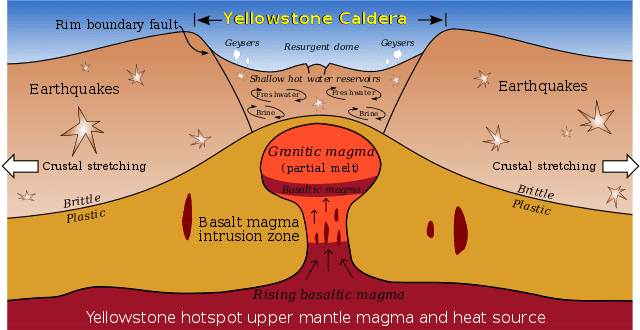
“At Yellowstone and some other volcanoes, some scientists theorize that the earth’s crust fractures and cracks in a concentric or ring-fracture pattern. At some point these cracks reach the magma “reservoir,” release the pressure, and the volcano explodes. The huge amount of material released causes the volcano to collapse into a huge crater—a caldera.” From nps.gov
I had a lot of work to do yesterday, so we got outside much later than I had hoped. Still, we did manage to see a multitude of elk, several bison (including a relatively newborn calf), and a black bear; to spend some very peaceful time looking over Flood Geyser (which kindly staged a small eruption for us at the end) and the Midway Geyser Basin; to explore Firehole River and Firehole Lake; to relax for a while along the Madison River; to take in an obligatory eruption of Old Faithful; and to admire an absolutely gorgeous sunset. Time very well spent.
I also did some relevant reading yesterday, and I thought that I would share these two passages with you:
America’s oldest and most famous national park sits atop one of the largest, most explosive volcanoes ever to exist.
We can only imagine the explosion at what we now call Yellowstone National Park. No one witnessed it. It happened 2.1 million years ago. We are left to estimate its power by mapping exposures of welded tuff and studying strata of ash beds in far-flung reaches of the West.
But scientists have concluded that the eruption was immense, the energy released unfathomable — 2,500 times greater than the explosion that ripped Mount St. Helens in 1980, blowing off 1,300 feet of mountain, killing fifty-seven, and destroying forests for miles around eastern Washington. The Yellowstone eruption ejected more than a hundred times as much magma and ash as did Krakatau in Indonesia in 1883, when more than 36,000 died as a result of one of the most famous volcanic eruptions ever. Yellowstone — and a few other known volcanic eruptions — are termed “super volcanoes.” That means they have expelled at least 1,000 cubic kilometers (about 240 cubic miles) of magma more or less all at once. No volcano in historic times, when literate humans were around to witness it, has even approached such magnitude.
But humans may get a chance to see Yellowstone blow firsthand. Because Yellowstone is not only the site of one of the largest volcanic eruptions ever known. It is also the largest, potentially most explosive, most violent, most deadly active volcano on the planet. Scientists say the chance of another catastrophic explosion someday is almost inevitable. . . .
When such an explosion occurs, it will be a catastrophe. Christiansen calls it a potential “major human disaster” — not just for the park but for the entire region. The park itself will be destroyed, the forest leveled, and every living thing within vaporized, incinerated, blown to bits, buried in welded ash and mud, or asphyxiated by carbon dioxide. People in the surrounding towns of West Yellowstone, Gardiner, and Cooke City will face the same fate. Towns and cities throughout the West will have to dig out from deep volcanic ash. Cars, buses, planes will all be grounded till the ash clears. Respiratory illness will soon take a toll. Domestic livestock and wildlife west of the Mississippi will be st[r]uck, and probably doomed. Great Plains wheat fields, the global breadbasket, will miss a season — or several — leading to widespread famine. The global volcanic winter will last years and influence the climate for decades or centuries. The worldwide death toll, says Michael Rampino, New York University associate professor of earth and environmental sciences, could reach a billion. “How do you get food, how do you get supplies, how do you get in and out, even after the eruption?” says Rampino, who has studied the climatic effects of huge volcanoes. “It depends on what you mean by killed — killed right away, starved to death?”
So we have something to look forward to — a probable disaster of global proportions. The question is when.
What is tantalizing — and a bit alarming — to consider is the timing of Yellowstone’s super eruptions: 2.1 million years, 1.3 million years, 640,000 years ago. The intervals are 800,000 and 660,000 years. That suggests another explosion is due — and, in geologic time, soon!
Meanwhile, the geysers vent, the hot springs bubble, and the fumaroles hiss, powered by the magma beneath the ground, by the same magma that has charged the largest active volcano on earth and one of the largest volcanic eruptions ever to rock the planet. They remind us that the monster still stirs.
Greg Breining, Super Volcano: The Ticking Time Bomb Beneath Yellowstone National Park (Beverley MA: Voyageur Press, 2007), 16-17, 20-21.
Just to make sure that words like something to look forward to and tantalizing, not to mention that final chirpy exclamation point (“soon!”), don’t get you to feeling too happy or positive, Breining’s epigraph is taken from George Gordon, Lord Byron’s, aptly named poem “Darkness”:
The bright sun was extinguish’d, and the stars
Did wander darkling in the eternal space,
Rayless, and pathless, and the icy earth
Swung blind and blackening in the moonless air;
Morn came and went — and came, and brought no day.
The moral of the story, I suppose, is that you should come and visit Yellowstone National Park while it’s still here and while you’re still able.
Posted from West Yellowstone, Montana
There’s an irony here: The overwhelming majority of Yellowstone National Park is located in Wyoming. But the money-machine tax-revenue-generating tourist town of West Yellowstone is just over the state border in Montana. Life isn’t fair.
Previous Post

June 29, 2021
"Ancient Temple Imagery in the Sermons of Jacob"
Next Post
July 1, 2021 It's Over
Browse Our Archives
Select a Category Uncategorized
Select a Month October 2026 September 2026 August 2026 July 2026 June 2026 May 2026 April 2026 March 2026 February 2026 January 2026 December 2025 November 2025 October 2025 September 2025 August 2025 July 2025 June 2025 May 2025 April 2025 March 2025 February 2025 January 2025 December 2024 November 2024 October 2024 September 2024 August 2024 July 2024 June 2024 May 2024 April 2024 March 2024 February 2024 January 2024 December 2023 November 2023 October 2023 September 2023 August 2023 July 2023 June 2023 May 2023 April 2023 March 2023 February 2023 January 2023 December 2022 November 2022 October 2022 September 2022 August 2022 July 2022 June 2022 May 2022 April 2022 March 2022 February 2022 January 2022 December 2021 November 2021 October 2021 September 2021 August 2021 July 2021 June 2021 May 2021 April 2021 March 2021 February 2021 January 2021 December 2020 November 2020 October 2020 September 2020 August 2020 July 2020 June 2020 May 2020 April 2020 March 2020 February 2020 January 2020 December 2019 November 2019 October 2019 September 2019 August 2019 July 2019 June 2019 May 2019 April 2019 March 2019 February 2019 January 2019 December 2018 November 2018 October 2018 September 2018 August 2018 July 2018 June 2018 May 2018 April 2018 March 2018 February 2018 January 2018 December 2017 November 2017 October 2017 September 2017 August 2017 July 2017 June 2017 May 2017 April 2017 March 2017 February 2017 January 2017 December 2016 November 2016 October 2016 September 2016 August 2016 July 2016 June 2016 May 2016 April 2016 March 2016 February 2016 January 2016 December 2015 November 2015 October 2015 September 2015 August 2015 July 2015 June 2015 May 2015 April 2015 March 2015 February 2015 January 2015 December 2014 November 2014 March 2014 August 2013 February 2012
Follow Us!
TAKE THE
Religious Wisdom Quiz
In the Parable of the Good Samaritan, who is the true neighbor?
Select your answer to see how you score.
The priest The robber The Samaritan The Levite
Related posts from Sic et Non

My first day without employment
Will all 150 of your relationships end if...
TRENDING AT PATHEOS Latter-day Saint

Letters on Living the Faith by C.S. Lewis
Most of us met C.S. Lewis as a public intellectual. Mere Christianity....

When Halloween Unmasks Married Hearts
Written by Dr. David K. Ewen from Eternal Truth Bible College Behind...

Aristotle. He’s been called the father of logic, the father of the...

Methodist Central Hall and Westminster Abbey
Situated on the same square is Methodist Central Hall and Westminster Abbey. ...

57th Dove Awards Honor Dolly Parton, Crown New...
On gospel music’s biggest night, the 57th annual GMA Dove Awards honored...

The First Eucharistic Controversy: Christ’s Real Presence
For Catholics, the Eucharist is the source and summit of the Christian...
view all Latter-day Saint blogs
Ad-Free & Subscriber Log-In Subscription Support
- About Us
- 2026 Calendar
- Videos
- Podcasts
- Library of World Religions
- Faith In Media Tracker
- Advertise With Us
- Write for Us
- Privacy Policy
- Terms of Service
- Do Not Sell My Data
- Contact Us
- Radiant Digital
- Manage Newsletter Subscriptions
- Unsubscribe From Notifications
- Sitemap
Copyright 2008-2026, Patheos. All rights reserved.
Subscription Support Ad-Free & Subscriber Log-In
Follow Patheos