
BuddhistCatholicContemplativeEvangelicalGeneral ChristianHinduJewishLatter-day SaintMuslimNew VisionsProgressive Christian
Beliefs
- Buddhist
- Catholic
- Contemplative
- Evangelical
- General Christian
- Hindu
- Jewish
- Latter-day Saint
- More Voices
- Muslim
- New Visions
- Pagan
- Progressive Christian
Topics
- Religion News
- Food and Religion
- Sports and Religion
- Religious Art
- Religious Music and Entertainment
- Religious Events
- History and Religion
- Style and Religion
- Politics and Religion
- Women in Religion
- Recreation Outdoors and Religion
- Business Finance and Religion
- Careers Workplace and Religion
- Education and Religion
- Family Parenting and Religion
- Health Fitness and Religion
- Home and Religion
- Relationships and Religion
- Technology and Religion
- Travel and Religion
Columnists
- Buddhist Columnists
- Business Finance and Religion Columnists
- Careers Workplace and Religion Columnists
- Catholic Columnists
- Contemplative Columnists
- Education and Religion Columnists
- Evangelists Columnists
- Family Parenting and Religion Columnists
- General Christian Columnists
- Health Fitness and Religion Columnists
- Hindu Columnists
- History and Religion Columnists
- Home and Religion Columnists
- Jewish Columnists
- More Voices Columnists
- Latter Day Columnists
- Muslim Columnists
- New Visions Columnists
- Nonreligious Columnists
- Pagan Columnists
- Politics and Religion Columnists
- Progressive Columnists
- Recreation Outdoors and Religion Columnists
- Relationships and Religion Columnists
- Religion News Columnists
- Religious Art Columnists
- Religious Events Columnists
- Religious Music and Entertainment Columnists
- Sports and Religion Columnists
- Style and Religion Columnists
- Technology and Religion Columnists
- Travel and Religion Columnists
- Women in Religion Columnists
Resource Library
- 2026 Calendar
- Library of World Religions
- The 100 Most Holy Places on Earth
- Patheos Answers
- Podcasts
- Videos
- Faith Leaders Database
- Anglican Episcopalian
- Bahai
- Baptist
- Buddhism
- Christianity
- Confucianism
- Eastern Orthodoxy
- Hinduism
- Holiness and Pentecostal
- ISKCON
- Islam
- Judaism
- Lutheran
- Methodist
- The Church of Jesus Christ of Latter-day Saints
- New Age
- Paganism
- Presbytarian and Reformed
- Protestantism
- Religion Behind the Scenes
- Roman Catholic
- Scientology
- Shia Islam
- Sikhism
- Sufism
- Sunni Islam
- Taoism
- Zen
- See all religions
Research Tools
 Ad-Free & Subscriber Log-In Subscription Support
Ad-Free & Subscriber Log-In Subscription Support
Follow Patheos 

- Trending:
- Forgiveness
- |
- Marriage
- |
- Consciousness
- |
- Death Penalty
- |
- Election
- |
- Halloween

- Home
- Latter-day Saint
- Nephi’s Gethsemane, the Existence of Jesus, Massachusetts, and Arizona
Nephi’s Gethsemane, the Existence of Jesus, Massachusetts, and Arizona
Last updated on: July 6, 2021 at 10:51 pm by Dan Peterson
Nephi’s Gethsemane, the Existence of Jesus, Massachusetts, and Arizona 2021-07-06T22:51:05-06:00 Dan Peterson
Patheos Explore the world's faith through different perspectives on religion and spirituality! Patheos has the views of the prevalent religions and spiritualities of the world.
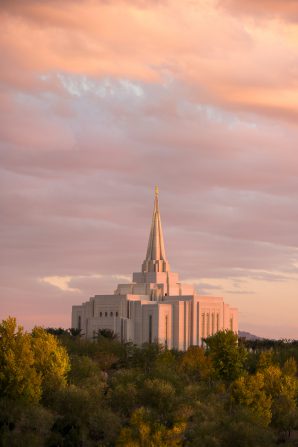
The Gilbert Arizona Temple
(LDS.org)
***
But, first: Especially for those of you in the Boston area and in the vicinity of Mesa and Gilbert, Arizona, don’t miss this weekend’s screenings of Witnesses!
MESA! GILBERT! Do NOT miss this! Witnesses Film actor Lincoln Hoppe will be in theaters this weekend and will do Q&A with audiences after each of the following shows. PLEASE share this! His understanding of, portrayal of, and feelings for Martin Harris are something you truly should not miss. Tickets at HARKINS theaters or at this link: https://witnessesfilm.com/
FRIDAY JUNE 25
2:00pm Santan Village
6:40pm Superstition Springs 25
SATURDAY JUNE 26
10:30am Queen Creek
1:20pm Superstition Springs 25
4:00pm Superstition Springs 25
6:40pm Superstition Springs 25
BOSTON! Meet WITNESSES actors Michael Zuccola, Samantha Valletta, and Paul Kandarian FRIDAY 7pm
Tickets
www.amctheatres.com/showtimes/all/2021-06-25/bostoncommon/all/93624695
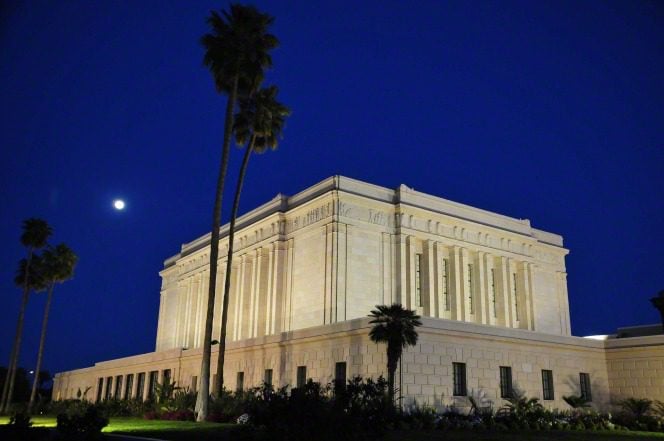
The Mesa Arizona Temple, Arizona’s first, is currently closed for renovation. (LDS Media Library)
Of course, when you’re not sitting transfixed in a darkened theater this weekend, you’ll want something to read. These two new articles just appeared in Interpreter: A Journal of Latter-day Saint Faith and Scholarship, the first by Taylor Halverson and the second by John Gee:
“Nephi’s Gethsemane: Seventeen Comparisons from the Literary Record”
Abstract: This note explores a literary comparison between Nephi’s confronting of Laban and shrinking from the act of shedding blood, to Jesus’s experience in the Garden of Gethsemane of shrinking from the act of shedding blood. Comparing these two stories suggests that we can profitably read Nephi’s experience with Laban as Nephi’s personal Gethsemane.
Review of Raphael Lataster, Questioning the Historicity of Jesus: Why a Philosophical Analysis Elucidates the Historical Discourse (Leiden, Netherlands: E. J. Brill, 2019). 508 pages. Hardback, $210.
Abstract: In a recent book, Raphael Lataster correctly argues that the acceptance of the general premises of New Testament scholarship, exemplified in the writings of Bart Ehrman, brings into question whether Jesus ever existed. Latter-day Saints who are serious about their witness of Jesus Christ need to be aware that acceptance of these presuppositions undermines their witness of the reality of Jesus Christ and his atonement and makes their faith vain.
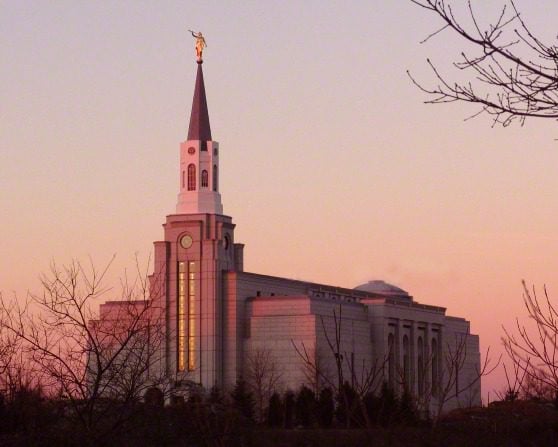
The Boston Massachusetts Temple
(LDS Media Library)
And here are some further reading suggestions from a past issue of Interpreter:
Matthew L. Bowen, ““Possess the Land in Peace”: Zeniff’s Ironic Wordplay on Shilom”
Abstract: The toponym Shilom likely derives from the Semitic/Hebrew root š-l-m*, whence also the similar-sounding word* šālôm*, “peace,” derives. The first mention of the toponym Shilom in Zeniff’s record — an older account than the surrounding material and an autobiography — occurs in Mosiah 9:6 in parallel with Zeniff’s mention of his intention to “possess the land in peace” (Mosiah 9:5). The language and text structure of Mosiah 9:5‒6 thus suggest a deliberate wordplay on Shilom in terms of* šālôm*. Zeniff uses the name Shilom as a point of irony throughout his brief royal record to emphasize a tenuous and often absent peace between his people and the Lamanites.*
Larry T. Wimmer, “Through a Glass Darkly: Examining Church Finances”
Abstract: The Mormon Hierarchy: Wealth & Corporate Power is Michael Quinn’s impressive response to a century of books and articles that have often distorted the finances of The Church of Jesus Christ of Latter-day Saints. This third volume in The Mormon Hierarchy series covers Church history from 1830 to 2010, and represents a staggering commitment. For 46 years Quinn has diligently gathered data on Church income, expenditures, taxation, and “living allowances” paid to Church leaders. The results are significant and engrossing, with but one possibly serious error. If you are interested in any aspect of the Church finances, the enormous effort required to bring us Wealth & Corporate Power may well be the final word. In Quinn’s own words, it tells an “American success story without parallel.”
Review of D. Michael Quinn, The Mormon Hierarchy: Wealth & Corporate Power (Salt Lake City: Signature Books, 2017), 597 pp., with appendices and index. $49.95.
Lynne Hilton Wilson, “Unveiling Women’s Veils of Authority”
ABSTRACT*: The Apostle Paul’s theological explanation for female veil wearing (1 Corinthians 11:2–13) highlights the woman’s head covering as an expression of female empowerment or “authority/exousia.” It appears that the Corinthian saints struggled with this tradition, as Paul preceded the discussion with, “but I would have you know/thelõ de” (1 Corinthians 11:3). Rather than merely restating the dress code for certain prayers, Paul laid out the doctrinal background underlying the imagery. He began with the order of creation from the Garden of Eden. God was the “kephale,” meaning source or origin of Christ, who was the source of man, who was the source of woman. Paul taught that God’s glory (referring to man) should pray unveiled, and by the same token, humanity’s glory (referring to woman) should address God with her head covered (1 Corinthians 11:7). The early church interpreted the relationship between Adam and Eve typologically. The Edenic couple typified Christ and his Church — the Bridegroom and Bride. In this typological scenario, Eve (or the Church) worked through the mediator Adam (or Christ). In either a symbolic or literal interpretation, Paul described this empowering veil as a sign of unique female authority to pray and prophesy (1 Corinthians 11:5). By covering her head, female saints received “power on her head” and could interact with angels (1 Corinthians 11:10). Paul concluded by emphasizing that men and women are completely interdependent — woman was created from man, while man is born of woman (1 Corinthians 11:11–12). In this regard we see an equal status between men and women in their relationship with the Lord. Their relationship focuses on their union with each other and God.*
Matthew L. Bowen, ““Swearing by Their Everlasting Maker”: Some Notes on Paanchi and Giddianhi”
Abstract: This brief article explores Paanchi and Giddianhi as names evidencing the Egyptian onomastic element –anchi/anhi/ʿnḫ(i) and the potential literary significance of these two names in the context of Mormon’s narrative detailing the formation of the oath-bound secret combinations sworn with oath-formulae upon one’s “life” (cf. Egyptian ʿnḫ*, “life”; “live”; “swear an oath [by one’s life]”). It also explores the implications for Mormon’s telling of Nephite history during his own time.*
Robert S. Boylan, “Two Notes on the Language Used in the Last Supper Accounts”
Abstract: The institution of the Lord’s Supper is recounted explicitly in four New Testament texts (Matthew 26:26–29; Mark 14:22–25; Luke 22:19–20; 1 Corinthians 11:23–26). Common to all these texts is the phrase “this is my body,” and in the Lukan and Pauline texts, the command to “do this in remembrance of me.” In this paper, I will examine both the grammatical and theological implications of “this is my body” and the concept of “remembrance” in the theology of the Last Supper — with how Latter-day Saints can appropriate such in their weekly observance of this sacred ordinance.
Stanford Carmack, “Is the Book of Mormon a Pseudo-Archaic Text?”
Abstract: In recent years the Book of Mormon has been compared to pseudo-biblical texts like Gilbert J. Hunt’s The Late War (1816). Some have found strong linguistic correspondence and declared that there is an authorial relationship. However, comparative linguistic studies performed to date have focused on data with low probative value vis-à-vis the question of authorship. What has been lacking is non-trivial descriptive linguistic analysis that focuses on less contextual and more complex types of data, such as syntax and morphosyntax (grammatical features such as verb agreement and inflection), as well as data less obviously biblical and/or less susceptible to conscious manipulation. Those are the kinds of linguistic studies that have greater probative value in relation to authorship, and that can determine whether Joseph Smith might have been able to produce Book of Mormon grammar. In order to determine whether it is a good match with the form and structure of pseudo-biblical writings, I investigate nearly 10 kinds of syntax and morphosyntax that occur in the Book of Mormon and the King James Bible, comparing their usage with each other and with that of four pseudo-biblical texts. Findings are summarized toward the end of the article, along with some observations on biblical hypercorrection and alternative LDS views on Book of Mormon language.
Wishing you a great weekend of viewing and reading, from the Interpreter Foundation!
Church of Jesus Christ of Latter-day Saints
Previous Post

June 24, 2021
"Do We Have Non-Biblical Evidence that Jesus Existed?"
Next Post
June 26, 2021 Water 1
Browse Our Archives
Select a Category Uncategorized
Select a Month October 2026 September 2026 August 2026 July 2026 June 2026 May 2026 April 2026 March 2026 February 2026 January 2026 December 2025 November 2025 October 2025 September 2025 August 2025 July 2025 June 2025 May 2025 April 2025 March 2025 February 2025 January 2025 December 2024 November 2024 October 2024 September 2024 August 2024 July 2024 June 2024 May 2024 April 2024 March 2024 February 2024 January 2024 December 2023 November 2023 October 2023 September 2023 August 2023 July 2023 June 2023 May 2023 April 2023 March 2023 February 2023 January 2023 December 2022 November 2022 October 2022 September 2022 August 2022 July 2022 June 2022 May 2022 April 2022 March 2022 February 2022 January 2022 December 2021 November 2021 October 2021 September 2021 August 2021 July 2021 June 2021 May 2021 April 2021 March 2021 February 2021 January 2021 December 2020 November 2020 October 2020 September 2020 August 2020 July 2020 June 2020 May 2020 April 2020 March 2020 February 2020 January 2020 December 2019 November 2019 October 2019 September 2019 August 2019 July 2019 June 2019 May 2019 April 2019 March 2019 February 2019 January 2019 December 2018 November 2018 October 2018 September 2018 August 2018 July 2018 June 2018 May 2018 April 2018 March 2018 February 2018 January 2018 December 2017 November 2017 October 2017 September 2017 August 2017 July 2017 June 2017 May 2017 April 2017 March 2017 February 2017 January 2017 December 2016 November 2016 October 2016 September 2016 August 2016 July 2016 June 2016 May 2016 April 2016 March 2016 February 2016 January 2016 December 2015 November 2015 October 2015 September 2015 August 2015 July 2015 June 2015 May 2015 April 2015 March 2015 February 2015 January 2015 December 2014 November 2014 March 2014 August 2013 February 2012
Follow Us!
TAKE THE
Religious Wisdom Quiz
Who was healed of leprosy after washing seven times in the Jordan River?
Select your answer to see how you score.
Ben-hadad Hezekiah Naaman Hazael
Related posts from Sic et Non


Notes on Women, Priesthood, and General Conference

"The Book of Moses as a Temple Text"

TRENDING AT PATHEOS Latter-day Saint

The Problem with False Prophets
Miller’s Station UMC| 10/18/26| Anchor Verse: Jeremiah 23: 1, 9-23 I...

Emotion in Early Christianity by Andrew Crislip
Andrew Crislip’s Emotion in Early Christianity examines an often overlooked dimension of...

16 Spiritual Touchstones for a More Grounded Life
After decades of spiritual study, here are 16 principles I try...

Catholic Evangelization: Sharing Your Faith Every Day
Welcome back to the Graceful Awakening mini-series called, “From Faith to Mission.” ...

The Pillar of the Boatmen: the Ancient Monument...
The Pillar of the Boatmen is a Romano-Gaulish sculpture that dates from...

In one sense walking into Westminster Abbey is like walking down the...
view all Latter-day Saint blogs
Ad-Free & Subscriber Log-In Subscription Support
- About Us
- 2026 Calendar
- Videos
- Podcasts
- Library of World Religions
- Faith In Media Tracker
- Advertise With Us
- Write for Us
- Privacy Policy
- Terms of Service
- Do Not Sell My Data
- Contact Us
- Radiant Digital
- Manage Newsletter Subscriptions
- Unsubscribe From Notifications
- Sitemap
Copyright 2008-2026, Patheos. All rights reserved.
Subscription Support Ad-Free & Subscriber Log-In
Follow Patheos