
BuddhistCatholicContemplativeEvangelicalGeneral ChristianHinduJewishLatter-day SaintMuslimNew VisionsProgressive Christian
Beliefs
- Buddhist
- Catholic
- Contemplative
- Evangelical
- General Christian
- Hindu
- Jewish
- Latter-day Saint
- More Voices
- Muslim
- New Visions
- Pagan
- Progressive Christian
Topics
- Religion News
- Food and Religion
- Sports and Religion
- Religious Art
- Religious Music and Entertainment
- Religious Events
- History and Religion
- Style and Religion
- Politics and Religion
- Women in Religion
- Recreation Outdoors and Religion
- Business Finance and Religion
- Careers Workplace and Religion
- Education and Religion
- Family Parenting and Religion
- Health Fitness and Religion
- Home and Religion
- Relationships and Religion
- Technology and Religion
- Travel and Religion
Columnists
- Buddhist Columnists
- Business Finance and Religion Columnists
- Careers Workplace and Religion Columnists
- Catholic Columnists
- Contemplative Columnists
- Education and Religion Columnists
- Evangelists Columnists
- Family Parenting and Religion Columnists
- General Christian Columnists
- Health Fitness and Religion Columnists
- Hindu Columnists
- History and Religion Columnists
- Home and Religion Columnists
- Jewish Columnists
- More Voices Columnists
- Latter Day Columnists
- Muslim Columnists
- New Visions Columnists
- Nonreligious Columnists
- Pagan Columnists
- Politics and Religion Columnists
- Progressive Columnists
- Recreation Outdoors and Religion Columnists
- Relationships and Religion Columnists
- Religion News Columnists
- Religious Art Columnists
- Religious Events Columnists
- Religious Music and Entertainment Columnists
- Sports and Religion Columnists
- Style and Religion Columnists
- Technology and Religion Columnists
- Travel and Religion Columnists
- Women in Religion Columnists
Resource Library
- 2026 Calendar
- Library of World Religions
- The 100 Most Holy Places on Earth
- Patheos Answers
- Podcasts
- Videos
- Faith Leaders Database
- Anglican Episcopalian
- Bahai
- Baptist
- Buddhism
- Christianity
- Confucianism
- Eastern Orthodoxy
- Hinduism
- Holiness and Pentecostal
- ISKCON
- Islam
- Judaism
- Lutheran
- Methodist
- The Church of Jesus Christ of Latter-day Saints
- New Age
- Paganism
- Presbytarian and Reformed
- Protestantism
- Religion Behind the Scenes
- Roman Catholic
- Scientology
- Shia Islam
- Sikhism
- Sufism
- Sunni Islam
- Taoism
- Zen
- See all religions
Research Tools
 Ad-Free & Subscriber Log-In Subscription Support
Ad-Free & Subscriber Log-In Subscription Support
Follow Patheos 

- Trending:
- Forgiveness
- |
- Marriage
- |
- Consciousness
- |
- Death Penalty
- |
- Election
- |
- Halloween

- Home
- Latter-day Saint
- “The most complex puzzle for humans and also the simplest, most self-evident fact”
“The most complex puzzle for humans and also the simplest, most self-evident fact”
Last updated on: May 24, 2021 at 12:27 am by Dan Peterson
“The most complex puzzle for humans and also the simplest, most self-evident fact” 2021-05-24T00:27:52-06:00 Dan Peterson
Patheos Explore the world's faith through different perspectives on religion and spirituality! Patheos has the views of the prevalent religions and spiritualities of the world.
***
But first:

This is an encouraging sign.
From the distributor who is overseeing the rollout of our film:
“Wow! Thank you! Due to incredible demand Megaplex Theatres has added a third showing of Witnesses Film on June 2nd! Walk the red carpet. See it first with cast and filmmakers. Hear behind-the-scenes stories involved with the making of Witnesses Film — the Movie Event of the Summer! Hurry to secure your tickets at https://www.megaplextheatres.com/film/HO00001567/true…
In this connection, Dallin Redd has kindly given me permission to share this image of a type-written page in his family’s history. It concerns Martin Harris, one of the Three Witnesses to the Book of Mormon, who is portrayed in the forthcoming Interpreter Foundation movie Witnesses by Lincoln Hoppe (shown in the background of the image above, looking sideways to the left):
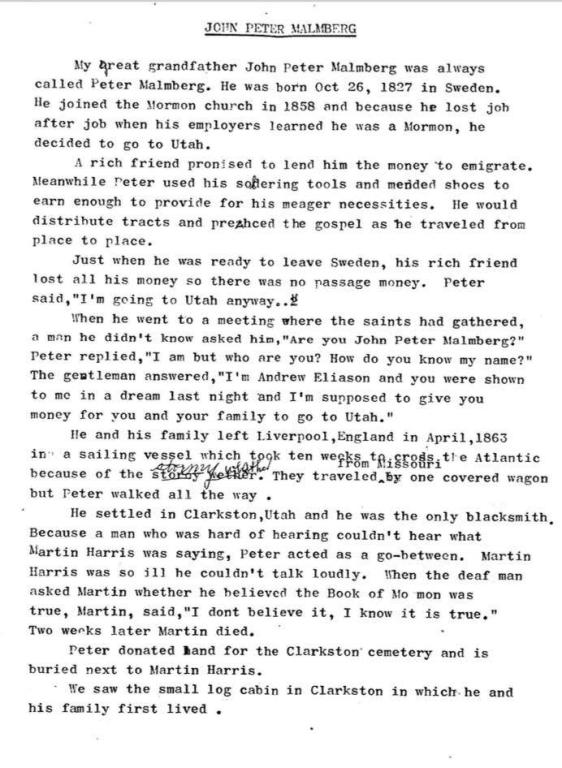
Image courtesy of Dallin Redd
***

A view of the skyline of Richmond, Virginia, from the James River, which, further along its course, gave its name to the early Virginia colony known as Jamestown
(Wikimedia Commons)
My wife and I spent the past eight days or so in Williamsburg and Richmond, Virginia.
(I’ve decided not to include the “posted from x” attributions anymore while I’m away from home in x; I have too many malevolent loons zealously scouring this blog every day for things that they can weaponize against me, and I wouldn’t put invading my house or damaging my property altogether beyond at least a few of them. They’re not overly scrupulous. For instance, one recently published a letter in a major Israeli newspaper under the name of a close friend of mine, in which my friend supposedly denounced me as a long-time anti-Semite and an enemy of Israel — thus positioning me, more or less, in the same league and moral class with Hamas and the Nazis. I consider that a very serious slander.)
I’m not an especially emotional or sentimental person, but saying goodbye to loved ones for what we know will be a fairly prolonged absence is always painful even to me, despite the fact that I have every reasonable confidence that I will see them again and before terribly long. This fact, I think, helps to make sense of the fact that even strong believers in a life beyond death and in heavenly reunions still cry at the passing of loved ones. Their mourning by no means proves them hypocritical or faithless.
More or less on that subject, I now share with you some passages that I marked during my recent reading of Bruce Greyson, After: A Doctor Explores What Near-Death Experiences Reveal about Life and Beyond (New York: St. Martin’s Essentials, 2021). You may perhaps recall that Dr. Greyson is Professor Emeritus of Psychiatry and Neurobehavioral Sciences at the University of Virginia School of Medicine, which is located in Charlottesville. (I was in Charlottesville just last Thursday.). Prior to joining the faculty at Virginia, he taught at the medical schools of the University of Michigan and the University of Connecticut, and he is a Distinguished Life Fellow of the American Psychiatric Association.
Your own consciousness is both the most complex puzzle for humans and also the simplest, most self-evident fact. (115)
Scientists and philosophers agree that, as philosophy professor Alva Noë put it, “After decades of concerted efforts on the part of neuroscientists, psychologists, and philosophers, only one proposition about how the brain makes us conscious — how it gives rise to sensation, feeling, subjectivity — has emerged unchallenged: we don’t have a clue.”
Physicist Nick Herbert put the problem this way: “Science’s biggest mystery is the nature of consciousness. It is not that we possess bad or imperfect theories of human awareness; we simply have no such theories at all. About all we know about consciousness is that it has something to do with the head, rather than the foot.” (117-118)
The dirty secret of neuroscience is that we have no idea how a physical event like electrical current or a chemical change in a nerve cell can produce consciousness.
Saying that “the mind is what the brain does” is like saying “making music is what a musical instrument does.” Musical instruments do produce musical sounds — but not by themselves. It takes something outside the instrument — a musician — to decide what sound to make and to make the instrument produce that sound. To quote Alva Noë again: “Instruments don’t make music or produce sounds. They enable people to make music or generate sounds. . . . The idea that consciousness is a phenomenon of the brain, the way digestion is a phenomenon of the stomach — is as fantastic as the idea of a self-playing orchestra.” (118)
The association between the mind and the brain is a fact. But the interpretation that the brain creates the mind is not a scientific fact. It’s only a theory developed to explain the association. And for everyday life, that is a workable model — it’s convenient to act as if our brains do create our minds. But there are additional scientific findings that suggest there’s more to the story. It turns out that the connection between mind and brain breaks down under exceptional circumstances, like near-death experiences. (118-119)
More than a decade ago, I participated in a symposium at the United Nations on alternative models for the mind and brain. Since then, a survey of two hundred fifty Scottish university students from eight different fields (86 percent of them various sciences) found that two-thirds believed that the mind and the brain are two separate things. A similar survey of almost two thousand Belgian medical professionals found that the majority believed the mind and brain are two separate things. And a recent survey of more than six hundred Brazilian psychiatrists found that the majority believed the mind was independent of the brain. An increasing number of scientists around the world are finding that the old model — the mind being totally dependent on the brain — is inadequate. (123-124)
That’s something to think about. If, that is, you’re the kind of person who is inclined to think.
Church of Jesus Christ of Latter-day Saints
Witnesses of the Book of Mormon
Next Post

May 24, 2021 "“Put Off Thy Shoes from Off Thy Feet”: Sandals and Sacred Space"
Browse Our Archives
Select a Category Uncategorized
Select a Month October 2026 September 2026 August 2026 July 2026 June 2026 May 2026 April 2026 March 2026 February 2026 January 2026 December 2025 November 2025 October 2025 September 2025 August 2025 July 2025 June 2025 May 2025 April 2025 March 2025 February 2025 January 2025 December 2024 November 2024 October 2024 September 2024 August 2024 July 2024 June 2024 May 2024 April 2024 March 2024 February 2024 January 2024 December 2023 November 2023 October 2023 September 2023 August 2023 July 2023 June 2023 May 2023 April 2023 March 2023 February 2023 January 2023 December 2022 November 2022 October 2022 September 2022 August 2022 July 2022 June 2022 May 2022 April 2022 March 2022 February 2022 January 2022 December 2021 November 2021 October 2021 September 2021 August 2021 July 2021 June 2021 May 2021 April 2021 March 2021 February 2021 January 2021 December 2020 November 2020 October 2020 September 2020 August 2020 July 2020 June 2020 May 2020 April 2020 March 2020 February 2020 January 2020 December 2019 November 2019 October 2019 September 2019 August 2019 July 2019 June 2019 May 2019 April 2019 March 2019 February 2019 January 2019 December 2018 November 2018 October 2018 September 2018 August 2018 July 2018 June 2018 May 2018 April 2018 March 2018 February 2018 January 2018 December 2017 November 2017 October 2017 September 2017 August 2017 July 2017 June 2017 May 2017 April 2017 March 2017 February 2017 January 2017 December 2016 November 2016 October 2016 September 2016 August 2016 July 2016 June 2016 May 2016 April 2016 March 2016 February 2016 January 2016 December 2015 November 2015 October 2015 September 2015 August 2015 July 2015 June 2015 May 2015 April 2015 March 2015 February 2015 January 2015 December 2014 November 2014 March 2014 August 2013 February 2012
Follow Us!
TAKE THE
Religious Wisdom Quiz
Who killed Goliath?
Select your answer to see how you score.
Samson Jonathan Saul David
Related posts from Sic et Non


Notes on Women, Priesthood, and General Conference

"America's Most Neighborly City"? It's not in Switzerland

"The Book of Moses as a Temple Text"
TRENDING AT PATHEOS Latter-day Saint

Janie Learns the Way of the Cross: A...
Teaching children about Jesus' Passion can be challenging. Many parents and educators...

Looking For Good Catholic Writing - October 2026
He alone extends the heavens, and he walks upon the waves of...

In "Irreplaceable," our book on vocation and technology, Trevor Sutton and I...

I was strolling through the top floor of the brand new Parthenon...

What Does Gêvâh Mean For Kimberley Guifoyle &...
This week, a lot of the news is focused on Kimberly Guilfoyle....

INNER CIRCLE: Profound Mystery (Of Christ In All...
Ephesians 5:31-32 “For this reason, a man will leave his father and...
view all Latter-day Saint blogs
Ad-Free & Subscriber Log-In Subscription Support
- About Us
- 2026 Calendar
- Videos
- Podcasts
- Library of World Religions
- Faith In Media Tracker
- Advertise With Us
- Write for Us
- Privacy Policy
- Terms of Service
- Do Not Sell My Data
- Contact Us
- Radiant Digital
- Manage Newsletter Subscriptions
- Unsubscribe From Notifications
- Sitemap
Copyright 2008-2026, Patheos. All rights reserved.
Subscription Support Ad-Free & Subscriber Log-In
Follow Patheos