
BuddhistCatholicContemplativeEvangelicalGeneral ChristianHinduJewishLatter-day SaintMuslimNew VisionsProgressive Christian
Beliefs
- Buddhist
- Catholic
- Contemplative
- Evangelical
- General Christian
- Hindu
- Jewish
- Latter-day Saint
- More Voices
- Muslim
- New Visions
- Pagan
- Progressive Christian
Topics
- Religion News
- Food and Religion
- Sports and Religion
- Religious Art
- Religious Music and Entertainment
- Religious Events
- History and Religion
- Style and Religion
- Politics and Religion
- Women in Religion
- Recreation Outdoors and Religion
- Business Finance and Religion
- Careers Workplace and Religion
- Education and Religion
- Family Parenting and Religion
- Health Fitness and Religion
- Home and Religion
- Relationships and Religion
- Technology and Religion
- Travel and Religion
Columnists
- Buddhist Columnists
- Business Finance and Religion Columnists
- Careers Workplace and Religion Columnists
- Catholic Columnists
- Contemplative Columnists
- Education and Religion Columnists
- Evangelists Columnists
- Family Parenting and Religion Columnists
- General Christian Columnists
- Health Fitness and Religion Columnists
- Hindu Columnists
- History and Religion Columnists
- Home and Religion Columnists
- Jewish Columnists
- More Voices Columnists
- Latter Day Columnists
- Muslim Columnists
- New Visions Columnists
- Nonreligious Columnists
- Pagan Columnists
- Politics and Religion Columnists
- Progressive Columnists
- Recreation Outdoors and Religion Columnists
- Relationships and Religion Columnists
- Religion News Columnists
- Religious Art Columnists
- Religious Events Columnists
- Religious Music and Entertainment Columnists
- Sports and Religion Columnists
- Style and Religion Columnists
- Technology and Religion Columnists
- Travel and Religion Columnists
- Women in Religion Columnists
Resource Library
- 2026 Calendar
- Library of World Religions
- The 100 Most Holy Places on Earth
- Patheos Answers
- Podcasts
- Videos
- Faith Leaders Database
- Anglican Episcopalian
- Bahai
- Baptist
- Buddhism
- Christianity
- Confucianism
- Eastern Orthodoxy
- Hinduism
- Holiness and Pentecostal
- ISKCON
- Islam
- Judaism
- Lutheran
- Methodist
- The Church of Jesus Christ of Latter-day Saints
- New Age
- Paganism
- Presbytarian and Reformed
- Protestantism
- Religion Behind the Scenes
- Roman Catholic
- Scientology
- Shia Islam
- Sikhism
- Sufism
- Sunni Islam
- Taoism
- Zen
- See all religions
Research Tools
 Ad-Free & Subscriber Log-In Subscription Support
Ad-Free & Subscriber Log-In Subscription Support
Follow Patheos 

- Trending:
- Forgiveness
- |
- Marriage
- |
- Consciousness
- |
- Death Penalty
- |
- Election
- |
- Halloween

- Home
- Latter-day Saint
- Simplicity, Harmony, and Brilliance
Simplicity, Harmony, and Brilliance
Last updated on: May 2, 2021 at 9:58 pm by Dan Peterson
Simplicity, Harmony, and Brilliance 2021-05-02T21:58:44-06:00 Dan Peterson
Patheos Explore the world's faith through different perspectives on religion and spirituality! Patheos has the views of the prevalent religions and spiritualities of the world.
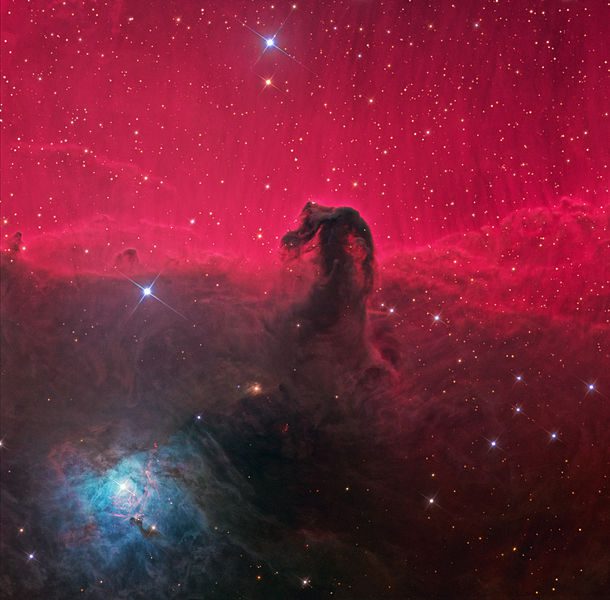
The Horsehead Nebula (Barnard 33), in the Constellation of Orion
(Wikimedia Commons public domain image, Author: Ken Crawford)
***
Here, I share some passages that I marked when reading Thomas Dubay, The Evidential Power of Beauty: Science and Theology Meet (San Francisco: Ignatius Press, 1999), a while back:
[F]or science, beauty is objective, “out there”. Among the mechanistic suppositions of previous generations was the idea that beauty is an inner attitude of the beholder rather than a property of the objective world. The awareness that the universe is stunningly beautiful wherever we turn our eye is now so much a conviction of our most productive scientists that objective grandeur is considered a warrant of truth. (38-39)
For contemporary science the first trait of beauty is an elegant simplicity. In this context simplicity refers to an essential purity, a freedom from superfluities, useless accretions, and needless complications. Einstein’s theory of gravitation possesses this grace and propriety, whereas competing theories do not, and thus “none of them are taken seriously.” Astrophysicist Roger Penrose commented that “no rival theory comes close to general relativity in elegance or simplicity of assumption.” For the scientist simplicity implies both completeness and economy: “It must take into account all the facts and must include only what is necessary. Nothing lacking, nothing superfluous.” Notable in the field of mathematical physics, Henri Poincaré commented that “it is because simplicity and vastness are both beautiful that we seek by preference simple facts and vast facts.” (39-40)
The second scientific element is harmony. Albert Einstein went so far as to assert that “without belief in the inner harmony of the world there could be no science.” . . . There will likewise be symmetry, as a solid scientific theory “will harmonize many previously unrelated facts.” Werner Heisenberg adds that “the symmetry properties always constitute the most essential features of a theory.” (40)
Brilliance is the third element in science’s view of the beautiful. Augros and Stanciu explain that “a theory with this quality has great clarity in itself and sheds light on many other things, suggesting new experiments. Newton, for example, astounded the world by explaining falling bodies, the tides and the motions of the planets and the comets with three simple laws.” George Thomason adds that “in physics, as in mathematics, it is a great beauty if a theory can bring together apparently different phenomena and show that they are closely connected; or even different aspects of the same thing.” (40-41)
If there were only one lily in the world, and if it could be exhibited in the great cities across the globe for one month at a time, we can be confident that thousands upon thousands of people would be willing to wait in long lines, perhaps for hours, for the privilege of drinking in the splendor of that singular bloom close up and appreciating its delicate fragrance. But because there are millions of lilies and uncounted other species of flowers with their own millions of individual blooms, we are blasé and unimpressed. (150-151)
On a different topic:
Our visible universe, with its fifty billion galaxies, each of which on average has perhaps two or three billion huge stars, is made up of a limited number (109) of natural elements, kinds of atoms. Even more impressive, planet Earth, with its myriads of minerals, rocks, stones, and metals and millions of plant and animal species, raises the question of how we can account for this bewildering array of complex varieties with so few building blocks. Things that we experience daily are composed of about a dozen elements, and living things consist chiefly of four elements: carbon, hydrogen, oxygen and nitrogen. Whence the vast and deep differences among them? And how account for the striking diversities among the elements themselves? (49)
And on yet another topic:
Art demands an artist. Random chance has never explained a waltz or a symphony, a physical equation or an epic poem. It cannot. (65)
Michelangelo’s Pietà is light in stone. Its radiance not only delights the observer but also simultaneously shouts that it came about not by a chance erosion caused by unknowing elements of water and wind. Its form, integrity, proportion, and radiance declare both its message and the design of the master who produced it. (116)
And, changing subjects yet again:
John Henry Newman . . . remarked that most people “go not by argument, but by their sympathies”. I have noticed that when a view or stated position adversely affects one’s chosen lifestyle either directly or indirectly, it is the rare person who will give it open-minded consideration. This is the case not only among the general population but among academics as well. Total intellectual honesty is not in oversupply. “Everybody has his filter which he takes about with him,” noted Henri de Lubac, “through which, from the indefinite mass of facts, he gathers in those suited to confirm his prejudices. . . . Rare, very rare are those who check their filter.” (71-72)
We’re almost done for the evening:
A word about scientism, known also as positivism. The name can be deceiving, for scientism is decidedly not science. Rather it is a philosophy, or, better, an ideology that views the physical sciences as the sole source of human knowledge. This fantastic assumption is supported by not the least shred of scientific evidenced, indeed, not by any evidence. Well-known scholar Huston Smith has termed scientism the “world’s littlest religion”, because it diminishes whatever it touches. In this religion “a) Science is our sacral mode of knowing. b) The crux of science is the controlled experiment. c) We can control only what is inferior to us. d) Conclusion: science discloses only our inferiors, from which God is excluded by definition.” (91)
And here we go, finally:
In his study of the origins of atheism, John Courtney Murray concluded that “atheism is never the conclusion of any theory, philosophical or scientific. It is a decision, a free act of choice that antedates all theories.” There are not many positions I share with Jean Paul Sartre, but I do commend his honesty in not even attempting to cover up the lack of proof for his atheism — which is why he called it postulatory. (94)
Previous Post

May 1, 2021
An old temple in Manti and, now, a new one in Ephraim, and other matters
Next Post
May 3, 2021 "The Divine Handclasp in the Hebrew Bible and in Near Eastern Iconography"
Browse Our Archives
Select a Category Uncategorized
Select a Month October 2026 September 2026 August 2026 July 2026 June 2026 May 2026 April 2026 March 2026 February 2026 January 2026 December 2025 November 2025 October 2025 September 2025 August 2025 July 2025 June 2025 May 2025 April 2025 March 2025 February 2025 January 2025 December 2024 November 2024 October 2024 September 2024 August 2024 July 2024 June 2024 May 2024 April 2024 March 2024 February 2024 January 2024 December 2023 November 2023 October 2023 September 2023 August 2023 July 2023 June 2023 May 2023 April 2023 March 2023 February 2023 January 2023 December 2022 November 2022 October 2022 September 2022 August 2022 July 2022 June 2022 May 2022 April 2022 March 2022 February 2022 January 2022 December 2021 November 2021 October 2021 September 2021 August 2021 July 2021 June 2021 May 2021 April 2021 March 2021 February 2021 January 2021 December 2020 November 2020 October 2020 September 2020 August 2020 July 2020 June 2020 May 2020 April 2020 March 2020 February 2020 January 2020 December 2019 November 2019 October 2019 September 2019 August 2019 July 2019 June 2019 May 2019 April 2019 March 2019 February 2019 January 2019 December 2018 November 2018 October 2018 September 2018 August 2018 July 2018 June 2018 May 2018 April 2018 March 2018 February 2018 January 2018 December 2017 November 2017 October 2017 September 2017 August 2017 July 2017 June 2017 May 2017 April 2017 March 2017 February 2017 January 2017 December 2016 November 2016 October 2016 September 2016 August 2016 July 2016 June 2016 May 2016 April 2016 March 2016 February 2016 January 2016 December 2015 November 2015 October 2015 September 2015 August 2015 July 2015 June 2015 May 2015 April 2015 March 2015 February 2015 January 2015 December 2014 November 2014 March 2014 August 2013 February 2012
Follow Us!
TAKE THE
Religious Wisdom Quiz
True or False: Jude quotes from the Book of Enoch in his epistle.
Select your answer to see how you score.
TRUE FALSE
Related posts from Sic et Non


Learning more about a region of which I've...

From Serbia's "White City," Belgrade

TRENDING AT PATHEOS Latter-day Saint

Letters on Living the Faith by C.S. Lewis
Most of us met C.S. Lewis as a public intellectual. Mere Christianity....

When Halloween Unmasks Married Hearts
Written by Dr. David K. Ewen from Eternal Truth Bible College Behind...

Aristotle. He’s been called the father of logic, the father of the...

Methodist Central Hall and Westminster Abbey
Situated on the same square is Methodist Central Hall and Westminster Abbey. ...

57th Dove Awards Honor Dolly Parton, Crown New...
On gospel music’s biggest night, the 57th annual GMA Dove Awards honored...

The First Eucharistic Controversy: Christ’s Real Presence
For Catholics, the Eucharist is the source and summit of the Christian...
view all Latter-day Saint blogs
Ad-Free & Subscriber Log-In Subscription Support
- About Us
- 2026 Calendar
- Videos
- Podcasts
- Library of World Religions
- Faith In Media Tracker
- Advertise With Us
- Write for Us
- Privacy Policy
- Terms of Service
- Do Not Sell My Data
- Contact Us
- Radiant Digital
- Manage Newsletter Subscriptions
- Unsubscribe From Notifications
- Sitemap
Copyright 2008-2026, Patheos. All rights reserved.
Subscription Support Ad-Free & Subscriber Log-In
Follow Patheos