
BuddhistCatholicContemplativeEvangelicalGeneral ChristianHinduJewishLatter-day SaintMuslimNew VisionsProgressive Christian
Beliefs
- Buddhist
- Catholic
- Contemplative
- Evangelical
- General Christian
- Hindu
- Jewish
- Latter-day Saint
- More Voices
- Muslim
- New Visions
- Pagan
- Progressive Christian
Topics
- Religion News
- Food and Religion
- Sports and Religion
- Religious Art
- Religious Music and Entertainment
- Religious Events
- History and Religion
- Style and Religion
- Politics and Religion
- Women in Religion
- Recreation Outdoors and Religion
- Business Finance and Religion
- Careers Workplace and Religion
- Education and Religion
- Family Parenting and Religion
- Health Fitness and Religion
- Home and Religion
- Relationships and Religion
- Technology and Religion
- Travel and Religion
Columnists
- Buddhist Columnists
- Business Finance and Religion Columnists
- Careers Workplace and Religion Columnists
- Catholic Columnists
- Contemplative Columnists
- Education and Religion Columnists
- Evangelists Columnists
- Family Parenting and Religion Columnists
- General Christian Columnists
- Health Fitness and Religion Columnists
- Hindu Columnists
- History and Religion Columnists
- Home and Religion Columnists
- Jewish Columnists
- More Voices Columnists
- Latter Day Columnists
- Muslim Columnists
- New Visions Columnists
- Nonreligious Columnists
- Pagan Columnists
- Politics and Religion Columnists
- Progressive Columnists
- Recreation Outdoors and Religion Columnists
- Relationships and Religion Columnists
- Religion News Columnists
- Religious Art Columnists
- Religious Events Columnists
- Religious Music and Entertainment Columnists
- Sports and Religion Columnists
- Style and Religion Columnists
- Technology and Religion Columnists
- Travel and Religion Columnists
- Women in Religion Columnists
Resource Library
- 2026 Calendar
- Library of World Religions
- The 100 Most Holy Places on Earth
- Patheos Answers
- Podcasts
- Videos
- Faith Leaders Database
- Anglican Episcopalian
- Bahai
- Baptist
- Buddhism
- Christianity
- Confucianism
- Eastern Orthodoxy
- Hinduism
- Holiness and Pentecostal
- ISKCON
- Islam
- Judaism
- Lutheran
- Methodist
- The Church of Jesus Christ of Latter-day Saints
- New Age
- Paganism
- Presbytarian and Reformed
- Protestantism
- Religion Behind the Scenes
- Roman Catholic
- Scientology
- Shia Islam
- Sikhism
- Sufism
- Sunni Islam
- Taoism
- Zen
- See all religions
Research Tools
 Ad-Free & Subscriber Log-In Subscription Support
Ad-Free & Subscriber Log-In Subscription Support
Follow Patheos 

- Trending:
- Forgiveness
- |
- Marriage
- |
- Consciousness
- |
- Death Penalty
- |
- Election
- |
- Halloween

- Home
- Latter-day Saint
- ““Put Off Thy Shoes from Off Thy Feet”: Sandals and Sacred Space”
““Put Off Thy Shoes from Off Thy Feet”: Sandals and Sacred Space”
Last updated on: May 24, 2021 at 10:02 pm by Dan Peterson
““Put Off Thy Shoes from Off Thy Feet”: Sandals and Sacred Space” 2021-05-24T22:02:36-06:00 Dan Peterson
Patheos Explore the world's faith through different perspectives on religion and spirituality! Patheos has the views of the prevalent religions and spiritualities of the world.
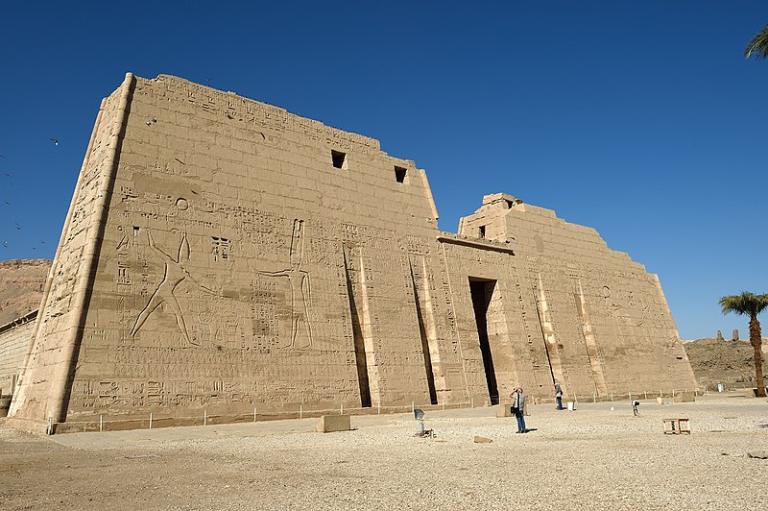
A pylon at Medinet Habu, on the west bank of the River Nile near Luxor, or ancient Thebes
(Wikimedia Commons public domain photograph)
***
Another article — this one by John Gee — has gone up today in Interpreter: A Journal of Latter-day Saint Faith and Scholarship:
““Put Off Thy Shoes from Off Thy Feet”: Sandals and Sacred Space”
Abstract: While many have written on ancient temples looking at the big picture, John Gee discusses one small detail on a single Egyptian temple from the New Kingdom. He focuses on depictions of Ramses III in and out of the temple of Medinet Habu. Outside the temple and when entering and leaving there are depictions of him wearing sandals. Inside the temple proper the king is always shown barefoot. Ramses III built Medinet Habu only slightly after the time of Moses and as Gee further notes, while not wearing footwear was a clear practice among the Egyptians it is far more explicit in Moses’ encounter with Deity when he is told to remove his “shoes from off they feet, for the place whereon thou standest is holy ground.” Gee observes that contemporary Egyptian temple practice “reflects the commands of God recorded in the Pentateuch,” as well as reflects Moses’ Egyptian background.
***
And, as I’ve been doing lately, I now offer links to some articles from a prior volume of Interpreter:
Daniel C. Peterson, “Looking Back, Almost Five Years On”
Abstract: As the axiom states, hindsight is 20/20. As Volume 24 of Interpreter: A Journal of Mormon Scripture nears the press, it seems relevant to look back to a tumultuous time nearly five years ago when the Interpreter Foundation was visualized and launched. If history has any value at all (particularly recent history), it provides a context for understanding the course on which we find ourselves. For the Interpreter Foundation, that course continues to be full of surprises and promise.
Taylor Halverson, “Deuteronomy 17:14–20 as Criteria for Book of Mormon Kingship”
Abstract: Deuteronomy 17:14–20 represents the most succinct summation in the Bible of criteria for kingship. Remarkably, the Book of Mormon narrative depicts examples of kingship that demonstrate close fidelity to the pattern set forth in Deuteronomy 17 (e.g., Nephi, Benjamin, or Mosiah II) or the inversion of the expected pattern of kingship (e.g., king Noah). Future research on Book of Mormon kingship through the lens of Deuteronomy 17:14–20 should prove fruitful.
Collin Charles Russell, “Meeting Zoram”
Abstract: Zoram, the servant of Laban, is a character from the Book of Mormon who is only mentioned a few times and on whom little information is given. This article analyzes what information is given in the Book of Mormon and contextualizes its historical background, all coupled with the observations of Latter-day Saint Church leaders and scholars. Insight is provided concerning Zoram’s Hebraic descent in the tribe of Manasseh and his working duties under Laban’s command, along with how all this affected his role in assisting Lehi’s family. The meaning of his name in Hebrew and possible correlations to the meaning of his life’s events are explained. The oath between Nephi and Zoram is discussed, and the debate regarding whether Zoram was a slave or servant is addressed, to show that he was likely a free servant.
Abstract: Joseph Smith used the term the Urim and Thummim to refer to the pair of seer stones, or “interpreters,” he obtained for translating the Book of Mormon as well as to other seer stones he used in a similar manner. According to witness accounts, he would put the stone(s) in a hat and pull the hat close around his face to exclude the light, and then he would see the translated text of the Book of Mormon. By what property or principle these stones enabled Joseph Smith to see the translated text has long been a matter of conjecture among Mormons, but the stones have commonly been understood as divinely powered devices analogous to the latest human communications technology. An alternative view, presented here, is that the stones had no technological function but simply served as aids to faith. In this view, the stones did not themselves translate or display text. They simply inspired the faith Joseph Smith needed to see imaginative visions, and in those visions, he saw the text of the Book of Mormon, just as Lehi and other ancient seers saw sacred texts in vision. Although Joseph Smith also saw visions without the use of stones, the logistics of dictating a book required the ability to see the translated text at will, and that was what the faith-eliciting stones would have made possible.
Abstract: This paper looks at the Book of Mormon through the lens of library science and the concept of archival provenance. The Nephites cared deeply about their records, and Mormon documented a thorough chain of custody for the plates he edited. However, ideas of archival science and provenance are recent developments in the western world, unknown to biblical authors or to anyone at Joseph Smith’s time. Understanding this aspect of Mormon’s authorship and Joseph Smith’s translation provides additional evidence to the historical validity of the Book of Mormon.
[Editor’s Note: This article is an updated and extended version of a presentation given at the Third Interpreter Matthew B. Brown Memorial Conference: The Temple on Mount Zion, November 5, 2016, at Brigham Young University in Provo, Utah. For a video version of the presentation, see https://interpreterfoundation.org/conferences/2016-temple-on-mount-zion-conference/2016-temple-on-mount-zion-conference-videos/]
Abstract: *In chapter 3 of the Gospel of John, Jesus described spiritual rebirth as consisting of two parts: being “born of water and of the spirit.”*1 *To this requirement of being “born again into the kingdom of heaven, of water, and of the Spirit,” Moses 6:59–60 adds that one must “be cleansed by blood, even the blood of mine Only Begotten; … For … by the blood ye are sanctified.”*2 *In this article, we will discuss the symbolism of water, spirit, and blood in scripture as they are actualized in the process of spiritual rebirth. We will highlight in particular the symbolic, salvific, interrelated, additive, retrospective, and anticipatory nature of these ordinances within the allusive and sometimes enigmatic descriptions of John 3 and Moses 6. Moses 6:51–68, with its dense infusion of temple themes, was revealed to the Prophet in December 1830, when the Church was in its infancy and more than a decade before the fulness of priesthood ordinances was made available to the Saints in Nauvoo. Our study of these chapters informs our closing perspective on the meaning of the sacrament, which is consistent with the recent re-emphasis of Church leaders that the “sacrament is a beautiful time to not just renew our baptismal covenants, but to commit to Him to renew all our covenants.”*3 We discuss the relationship of the sacrament to the shewbread of Israelite temples, and its anticipation of the heavenly feast that will be enjoyed by those who have been sanctified by the blood of Jesus Christ.
Church of Jesus Christ of Latter-day Saints
Foundation for Ancient Research and Mormon Studies
Interpreter Journal Latter-day Saint Faith Scholarship
Neal A. Maxwell institute for Religious Scholarship
Next Post

May 25, 2021 Remembering Heaven, Again
Browse Our Archives
Select a Category Uncategorized
Select a Month October 2026 September 2026 August 2026 July 2026 June 2026 May 2026 April 2026 March 2026 February 2026 January 2026 December 2025 November 2025 October 2025 September 2025 August 2025 July 2025 June 2025 May 2025 April 2025 March 2025 February 2025 January 2025 December 2024 November 2024 October 2024 September 2024 August 2024 July 2024 June 2024 May 2024 April 2024 March 2024 February 2024 January 2024 December 2023 November 2023 October 2023 September 2023 August 2023 July 2023 June 2023 May 2023 April 2023 March 2023 February 2023 January 2023 December 2022 November 2022 October 2022 September 2022 August 2022 July 2022 June 2022 May 2022 April 2022 March 2022 February 2022 January 2022 December 2021 November 2021 October 2021 September 2021 August 2021 July 2021 June 2021 May 2021 April 2021 March 2021 February 2021 January 2021 December 2020 November 2020 October 2020 September 2020 August 2020 July 2020 June 2020 May 2020 April 2020 March 2020 February 2020 January 2020 December 2019 November 2019 October 2019 September 2019 August 2019 July 2019 June 2019 May 2019 April 2019 March 2019 February 2019 January 2019 December 2018 November 2018 October 2018 September 2018 August 2018 July 2018 June 2018 May 2018 April 2018 March 2018 February 2018 January 2018 December 2017 November 2017 October 2017 September 2017 August 2017 July 2017 June 2017 May 2017 April 2017 March 2017 February 2017 January 2017 December 2016 November 2016 October 2016 September 2016 August 2016 July 2016 June 2016 May 2016 April 2016 March 2016 February 2016 January 2016 December 2015 November 2015 October 2015 September 2015 August 2015 July 2015 June 2015 May 2015 April 2015 March 2015 February 2015 January 2015 December 2014 November 2014 March 2014 August 2013 February 2012
Follow Us!
TAKE THE
Religious Wisdom Quiz
What is the main Christian group in Ethiopia called?
Select your answer to see how you score.
Ethiopian Orthodox Tewahedo Church Baptist Pentecostal Assemblies of God
Related posts from Sic et Non


Notes on Women, Priesthood, and General Conference

"The Book of Moses as a Temple Text"

TRENDING AT PATHEOS Latter-day Saint

Janie Learns the Way of the Cross: A...
Teaching children about Jesus' Passion can be challenging. Many parents and educators...

Looking For Good Catholic Writing - October 2026
He alone extends the heavens, and he walks upon the waves of...

In "Irreplaceable," our book on vocation and technology, Trevor Sutton and I...

I was strolling through the top floor of the brand new Parthenon...

What Does Gêvâh Mean For Kimberley Guifoyle &...
This week, a lot of the news is focused on Kimberly Guilfoyle....

INNER CIRCLE: Profound Mystery (Of Christ In All...
Ephesians 5:31-32 “For this reason, a man will leave his father and...
view all Latter-day Saint blogs
Ad-Free & Subscriber Log-In Subscription Support
- About Us
- 2026 Calendar
- Videos
- Podcasts
- Library of World Religions
- Faith In Media Tracker
- Advertise With Us
- Write for Us
- Privacy Policy
- Terms of Service
- Do Not Sell My Data
- Contact Us
- Radiant Digital
- Manage Newsletter Subscriptions
- Unsubscribe From Notifications
- Sitemap
Copyright 2008-2026, Patheos. All rights reserved.
Subscription Support Ad-Free & Subscriber Log-In
Follow Patheos