
BuddhistCatholicContemplativeEvangelicalGeneral ChristianHinduJewishLatter-day SaintMuslimNew VisionsProgressive Christian
Beliefs
- Buddhist
- Catholic
- Contemplative
- Evangelical
- General Christian
- Hindu
- Jewish
- Latter-day Saint
- More Voices
- Muslim
- New Visions
- Pagan
- Progressive Christian
Topics
- Religion News
- Food and Religion
- Sports and Religion
- Religious Art
- Religious Music and Entertainment
- Religious Events
- History and Religion
- Style and Religion
- Politics and Religion
- Women in Religion
- Recreation Outdoors and Religion
- Business Finance and Religion
- Careers Workplace and Religion
- Education and Religion
- Family Parenting and Religion
- Health Fitness and Religion
- Home and Religion
- Relationships and Religion
- Technology and Religion
- Travel and Religion
Columnists
- Buddhist Columnists
- Business Finance and Religion Columnists
- Careers Workplace and Religion Columnists
- Catholic Columnists
- Contemplative Columnists
- Education and Religion Columnists
- Evangelists Columnists
- Family Parenting and Religion Columnists
- General Christian Columnists
- Health Fitness and Religion Columnists
- Hindu Columnists
- History and Religion Columnists
- Home and Religion Columnists
- Jewish Columnists
- More Voices Columnists
- Latter Day Columnists
- Muslim Columnists
- New Visions Columnists
- Nonreligious Columnists
- Pagan Columnists
- Politics and Religion Columnists
- Progressive Columnists
- Recreation Outdoors and Religion Columnists
- Relationships and Religion Columnists
- Religion News Columnists
- Religious Art Columnists
- Religious Events Columnists
- Religious Music and Entertainment Columnists
- Sports and Religion Columnists
- Style and Religion Columnists
- Technology and Religion Columnists
- Travel and Religion Columnists
- Women in Religion Columnists
Resource Library
- 2026 Calendar
- Library of World Religions
- The 100 Most Holy Places on Earth
- Patheos Answers
- Podcasts
- Videos
- Faith Leaders Database
- Anglican Episcopalian
- Bahai
- Baptist
- Buddhism
- Christianity
- Confucianism
- Eastern Orthodoxy
- Hinduism
- Holiness and Pentecostal
- ISKCON
- Islam
- Judaism
- Lutheran
- Methodist
- The Church of Jesus Christ of Latter-day Saints
- New Age
- Paganism
- Presbytarian and Reformed
- Protestantism
- Religion Behind the Scenes
- Roman Catholic
- Scientology
- Shia Islam
- Sikhism
- Sufism
- Sunni Islam
- Taoism
- Zen
- See all religions
Research Tools
 Ad-Free & Subscriber Log-In Subscription Support
Ad-Free & Subscriber Log-In Subscription Support
Follow Patheos 

- Trending:
- Forgiveness
- |
- Marriage
- |
- Consciousness
- |
- Death Penalty
- |
- Election
- |
- Halloween

- Home
- Latter-day Saint
- “Matthew Black and Mircea Eliade Meet Hugh Nibley”
“Matthew Black and Mircea Eliade Meet Hugh Nibley”
Last updated on: May 10, 2021 at 1:46 pm by Dan Peterson
“Matthew Black and Mircea Eliade Meet Hugh Nibley” 2021-05-10T13:46:45-06:00 Dan Peterson
Patheos Explore the world's faith through different perspectives on religion and spirituality! Patheos has the views of the prevalent religions and spiritualities of the world.
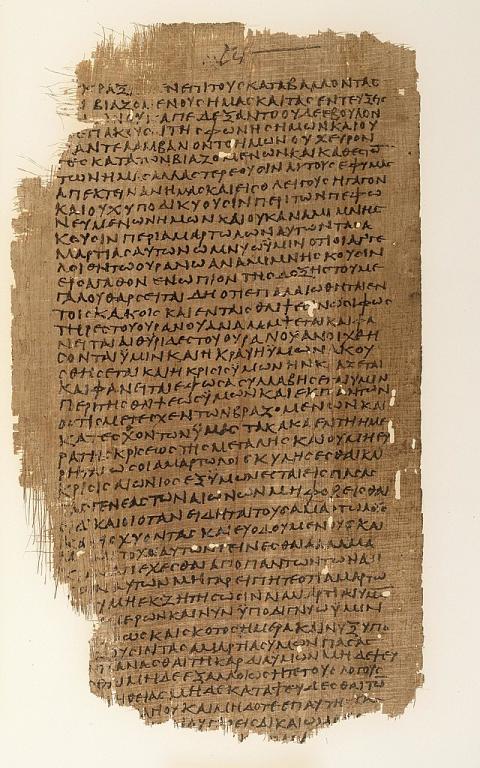
The back side of P.Mich.inv. 5552, showing portions of the Book of Enoch in Greek. This manuscript is part of the Chester Beatty Papyri, and is the 3rd leaf of the surviving manuscript, which also contained an unknown Christian homily attributed to Melito of Sardis. Most likely originated in Egypt.
(Wikimedia Commons public domain image)
***
This interesting reminiscence was just published in Interpreter: A Journal of Latter-day Saint Faith and Scholarship:
Gordon C. Thomasson, “Matthew Black and Mircea Eliade Meet Hugh Nibley”
Abstract: As a graduate student, Gordon Thomasson had the opportunity to introduce two internationally renowned scholars to the publications and scholarship of Hugh Nibley: Matthew Black, an eminent scholar of ancient Enoch writings; and Mircea Eliade, famed chair of the History of Religions program at the University of Chicago. Upon hearing of Nibley’s Enoch discoveries, Black made an immediate, impromptu visit to BYU to meet him. Upon reading one of Nibley’s studies, Eliade proposed hiring him on the spot, exclaiming, “He knows my field better than I do, and his translations are elegant!”
[Editor’s Note: Part of our book chapter reprint series, this article is reprinted here as a service to the Latter-day Saint community. Original pagination and page numbers have necessarily changed, otherwise the reprint has the same content as the original.
See Gordon C. Thomasson, “Matthew Black and Mircea Eliade Meet Hugh Nibley,” in Hugh Nibley Observed, ed. Jeffrey M. Bradshaw, Shirley S. Ricks, and Stephen T. Whitlock” (Orem, UT: The Interpreter Foundation; Salt Lake City: Eborn Books, 2021), 423–432. Further information at https://interpreterfoundation.org/books/hugh-nibley-observed/.]
***
And, as an added bonus, here are links to — reminders of — several articles that were published previously in Interpreter:
Daniel C. Peterson, “The Small Voice”
Abstract: Revelation comes in various forms, some of them spectacular and some of them extremely subtle. The scriptures and the history of the Restoration offer numerous examples across the entire spectrum. Whatever its form, however, divine revelation remains divine revelation, and it is the avowed mission of the Interpreter Foundation to thoughtfully ponder such revelation, to try to explicate its meaning, and to illustrate its richness. In turn, such examination can itself provide an opportunity for personal revelation—both for the examiners and, we hope, for those who read or hear the results of their work.
Ugo A. Perego, “The Changing Forms of the Latter-day Saint Sacrament”
Abstract: Partaking of bread and water each Sunday is a fundamental part of the theology of the Church of Jesus Christ of Latter-day Saints — a solemn moment in which the mortal Savior’s mission and ministry are remembered and pondered by those who partake individually and as a congregation. This paper explores instructions provided by the Savior himself as found in the Mormon canon of scriptures, together with a review of how this practice has changed over time as part of the LDS Church liturgy. Moreover, the meaning associated with this sacred ordinance is analyzed by way of the Savior’s teachings in ancient scripture through Mormon prophets in modern times, particularly in light of a more recent emphasis shared by the LDS Church leadership.
Abstract: The Book of Abraham has attracted a great deal of scholarly attention since some of the papyri once owned by Joseph Smith were rediscovered. A focus of this attention has been the source of the Book of Abraham, with some contending that the extant fragments are the source, while others have argued that the source is either other papyri or something else altogether. New investigations suggest that, while the relationship between papyri and text is not clear, it is clear that the fragments are not the source and that the method of translation was not the Kirtland Egyptian Papers. Additionally, further investigations into the source of the Book of Abraham as well as the interpretations of the facsimiles have made it clear that much of the controversy about the Book of Abraham has been based on untested assumptions. Book of Abraham studies have made significant strides forward in the last few decades, while some avenues of research are in need of further pursuit.
Matthew L. Bowen, ““Creator of the First Day”: The Glossing of Lord of Sabaoth in D&C 95:7”
Abstract: The calqued name-title “Lord of Sabaoth,” echoing James 5:4, occurs four times in the Doctrine and Covenants in revelations given to the prophet Joseph Smith from December 25, 1832 to August 6, 1833. Of these occurrences, only D&C 95:7 offers a gloss or interpretation for the name “the Lord of Sabaoth,” which is, by interpretation, “the creator of the first day, the beginning and the end.” Upon close inspection, this explanation makes excellent sense from an ancient Israelite etiological as well as (perhaps) an etymological standpoint. Past criticisms of the gloss in D&C 95:7 have focused on the wrongly assumed incongruity of “first day” and “Sabaoth” (“hosts”), and have neglected function of the divine name Yhwh in titles, most often represented in scripture by the term “Lord*,” as in the calqued name-title Lord of Hosts. Understanding the connection between* Yhwh (the form of which suggests the meaning “He creates,” “He brings into existence,” “he brings to pass”), the divine council (the “hosts”), creation (on “the first day” or “Day One”), and the underlying grammatical meaning of “Lord of Hosts” = Yhwh ṣĕbāʾôt (i.e., “He creates the [heavenly] hosts” or “He brings to pass the [heavenly] hosts”) is crucial to understanding the calque “Lord of Sabaoth” and the explanation given in D&C 95:7. When considered in its entirety, this revealed gloss is right on target. The creation/begetting of the heavenly hosts was associated with “the first day” or “Day One” in ancient Israelite thought. They are described as “finished” or fully prepared by the end of the six creative periods (“days” in Genesis 2:1). Additionally, “Lord of Sabaoth” or Yhwh ṣĕbāʾôt is to be understood in connection with the similarly constructed name-title Yhwh ʾĕlōhîm (“He creates gods,” “he causes gods to be,” or “he brings to pass gods”). The meristic appositive title “the beginning and the end” implies that Yhwh is not only the “author”/“creator” of Israel and its salvation but the “finisher” thereof. Far from evidence of Joseph Smith’s lack of knowledge of Hebrew, the interpretive gloss in D&C 95:7 constitutes evidence of Joseph’s ability to obtain correct translations and interpretations through revelation.
Dennis Newton, “Nephi’s Use of Inverted Parallels”
Abstract: Did Nephi intentionally use chiasmus in his writings? An analysis of fifteen multi-level chiasm candidates in Nephi’s writings demonstrates a high statistical probability (99%+) that the poetic form was used intentionally by Nephi but only during two specific writing periods. This finding is buttressed by further analysis, which reveals a clear and unexpected literary pattern for which Nephi seems to have reserved his usage of chiasmus. The nature of obedience is a major theme in Nephi’s writings, and he regularly employed chiasms to explore the topic early in his writings. After a period during which he discontinued use of the technique, he returned to the poetic device toward the end of his life to signal a significant shift in his thoughts on the topic of obedience.
Duane Boyce, “Reclaiming Jacob”
Abstract. A chapter of Adam Miller’s Future Mormon concerns Jacob’s encounter with Sherem in Jacob 7. While novel, Miller’s treatment of Jacob and Sherem appears inadequate. He overlooks features of the text that seem to subvert his unconventional conclusions about them. This essay identifies a number of such matters, falling in four major categories, and shares thoughts on the need for perspective when discussing Jacob’s conduct — or the conduct of any prophet, for that matter. It also highlights the jeopardy we face of being the second group to fall for Sherem’s lies.
Posted from Kihei, Maui, Hawaii
Church of Jesus Christ of Latter-day Saints
Interpreter Journal Latter-day Saint Faith Scholarship
Previous Post

May 10, 2021
The view from Haleakalā on Mother's Day 2021
Next Post
May 11, 2021 Creation
Browse Our Archives
Select a Category Uncategorized
Select a Month October 2026 September 2026 August 2026 July 2026 June 2026 May 2026 April 2026 March 2026 February 2026 January 2026 December 2025 November 2025 October 2025 September 2025 August 2025 July 2025 June 2025 May 2025 April 2025 March 2025 February 2025 January 2025 December 2024 November 2024 October 2024 September 2024 August 2024 July 2024 June 2024 May 2024 April 2024 March 2024 February 2024 January 2024 December 2023 November 2023 October 2023 September 2023 August 2023 July 2023 June 2023 May 2023 April 2023 March 2023 February 2023 January 2023 December 2022 November 2022 October 2022 September 2022 August 2022 July 2022 June 2022 May 2022 April 2022 March 2022 February 2022 January 2022 December 2021 November 2021 October 2021 September 2021 August 2021 July 2021 June 2021 May 2021 April 2021 March 2021 February 2021 January 2021 December 2020 November 2020 October 2020 September 2020 August 2020 July 2020 June 2020 May 2020 April 2020 March 2020 February 2020 January 2020 December 2019 November 2019 October 2019 September 2019 August 2019 July 2019 June 2019 May 2019 April 2019 March 2019 February 2019 January 2019 December 2018 November 2018 October 2018 September 2018 August 2018 July 2018 June 2018 May 2018 April 2018 March 2018 February 2018 January 2018 December 2017 November 2017 October 2017 September 2017 August 2017 July 2017 June 2017 May 2017 April 2017 March 2017 February 2017 January 2017 December 2016 November 2016 October 2016 September 2016 August 2016 July 2016 June 2016 May 2016 April 2016 March 2016 February 2016 January 2016 December 2015 November 2015 October 2015 September 2015 August 2015 July 2015 June 2015 May 2015 April 2015 March 2015 February 2015 January 2015 December 2014 November 2014 March 2014 August 2013 February 2012
Follow Us!
TAKE THE
Religious Wisdom Quiz
According to Hebrews, without what is it impossible to please God?
Select your answer to see how you score.
Faith Sacrifice Obedience Love
Related posts from Sic et Non


Notes on Women, Priesthood, and General Conference

"The Book of Moses as a Temple Text"

TRENDING AT PATHEOS Latter-day Saint

How to Make a Decision When You Can't...
Main point: It’s much more valuable to stay close to God so...

Archdiocese Hosts Military Marriage Retreat in Germany
RASTATT, Germany — The transient military lifestyle, with its frequent deployments and...

Nearly every morning, I make the drive to Detroit with my high-school-age...

The Real AI Story Is Adoption Without Trust
Artificial intelligence has crossed a political threshold. It is no longer a...

A new article, written by Jeff Lindsay and Gale L. Pooley,...

Swimfan: Forgotten Aughts Pleasures
This is a recovery effort. In 2002, My Big Fat Greek Wedding...
view all Latter-day Saint blogs
Ad-Free & Subscriber Log-In Subscription Support
- About Us
- 2026 Calendar
- Videos
- Podcasts
- Library of World Religions
- Faith In Media Tracker
- Advertise With Us
- Write for Us
- Privacy Policy
- Terms of Service
- Do Not Sell My Data
- Contact Us
- Radiant Digital
- Manage Newsletter Subscriptions
- Unsubscribe From Notifications
- Sitemap
Copyright 2008-2026, Patheos. All rights reserved.
Subscription Support Ad-Free & Subscriber Log-In
Follow Patheos