
BuddhistCatholicContemplativeEvangelicalGeneral ChristianHinduJewishLatter-day SaintMuslimNew VisionsProgressive Christian
Beliefs
- Buddhist
- Catholic
- Contemplative
- Evangelical
- General Christian
- Hindu
- Jewish
- Latter-day Saint
- More Voices
- Muslim
- New Visions
- Pagan
- Progressive Christian
Topics
- Religion News
- Food and Religion
- Sports and Religion
- Religious Art
- Religious Music and Entertainment
- Religious Events
- History and Religion
- Style and Religion
- Politics and Religion
- Women in Religion
- Recreation Outdoors and Religion
- Business Finance and Religion
- Careers Workplace and Religion
- Education and Religion
- Family Parenting and Religion
- Health Fitness and Religion
- Home and Religion
- Relationships and Religion
- Technology and Religion
- Travel and Religion
Columnists
- Buddhist Columnists
- Business Finance and Religion Columnists
- Careers Workplace and Religion Columnists
- Catholic Columnists
- Contemplative Columnists
- Education and Religion Columnists
- Evangelists Columnists
- Family Parenting and Religion Columnists
- General Christian Columnists
- Health Fitness and Religion Columnists
- Hindu Columnists
- History and Religion Columnists
- Home and Religion Columnists
- Jewish Columnists
- More Voices Columnists
- Latter Day Columnists
- Muslim Columnists
- New Visions Columnists
- Nonreligious Columnists
- Pagan Columnists
- Politics and Religion Columnists
- Progressive Columnists
- Recreation Outdoors and Religion Columnists
- Relationships and Religion Columnists
- Religion News Columnists
- Religious Art Columnists
- Religious Events Columnists
- Religious Music and Entertainment Columnists
- Sports and Religion Columnists
- Style and Religion Columnists
- Technology and Religion Columnists
- Travel and Religion Columnists
- Women in Religion Columnists
Resource Library
- 2026 Calendar
- Library of World Religions
- The 100 Most Holy Places on Earth
- Patheos Answers
- Podcasts
- Videos
- Faith Leaders Database
- Anglican Episcopalian
- Bahai
- Baptist
- Buddhism
- Christianity
- Confucianism
- Eastern Orthodoxy
- Hinduism
- Holiness and Pentecostal
- ISKCON
- Islam
- Judaism
- Lutheran
- Methodist
- The Church of Jesus Christ of Latter-day Saints
- New Age
- Paganism
- Presbytarian and Reformed
- Protestantism
- Religion Behind the Scenes
- Roman Catholic
- Scientology
- Shia Islam
- Sikhism
- Sufism
- Sunni Islam
- Taoism
- Zen
- See all religions
Research Tools
 Ad-Free & Subscriber Log-In Subscription Support
Ad-Free & Subscriber Log-In Subscription Support
Follow Patheos 

- Trending:
- Forgiveness
- |
- Marriage
- |
- Consciousness
- |
- Death Penalty
- |
- Election
- |
- Halloween

- Home
- Latter-day Saint
- Interreligious Dialogue, Effective and Ineffective
Interreligious Dialogue, Effective and Ineffective
Last updated on: May 13, 2021 at 3:18 pm by Dan Peterson
Interreligious Dialogue, Effective and Ineffective 2021-05-13T15:18:07-06:00 Dan Peterson
Patheos Explore the world's faith through different perspectives on religion and spirituality! Patheos has the views of the prevalent religions and spiritualities of the world.
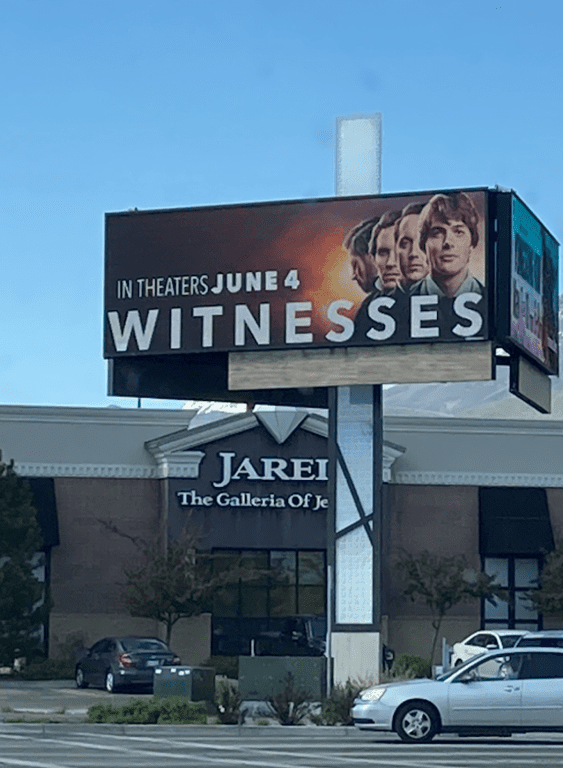
My wife took this photograph with her iPhone at the corner of State Street and University Parkway in Utah County earlier this afternoon. From the passenger seat, of course. The “Witnesses” ad migrates around the three sides of the display column.
Driving southbound on I-15 early this morning, I was pleased to see an advertisement for the Interpreter Foundation’s soon-to premiere theatrical film, Witnesses, on an electronic billboard. And just a few hours ago, I saw the same advertisement on an electronic billboard at the corner of University Parkway and State Street — in other words, at the southwest corner of University Mall — in Orem. Good grief. It looks as if this thing could really happen.
If you want it to happen in a theater in your community, please (if you haven’t already done so) go to the Witnesses film website and request it to come. Don’t assume that you live too far out of the “Mormon corridor” for that to be possible. The film is already slated to be shown on a few screens in five states beyond Utah and Idaho; there’s nothing written in stone that should, necessarily, prevent it from going still further.
***
Along with some reading on the nighttime flights, I watched several movies en route to and from Maui. (When I’m really tired but can’t sleep, movies help to pass the time; I get in some of my best viewing on long flights.) I’ll offer brief notes on three of the films that I watched: (1) I’m afraid that I heartily disliked The Personal History of David Copperfield. I’m sorry about that, since the cast is quite good and since it has received pretty positive reviews from critics and even from its (small) audience. But there you have it. The movie has some charm and some wit. And, of course, it’s connected (sort of) with Charles Dickens. There’s that. So I’m glad that I watched it, but I won’t watch it again. (2) I very much liked News of the World. As usual, Tom Hanks was very good. But I was surprised at how affecting young Helena Zengel was, especially given how few words she spoke (most of them not even in English). (3) I don’t know that it would be appropriate to “like” the 1951 film version (or any version) of Tennessee Williams’s 1947 Pulitzer Prize winning play, A Streetcar Named Desire. I hadn’t actually seen it for at least a couple of decades. But it’s still shatteringly powerful after all these years. Vivien Leigh is remarkable as Blanche; Marlon Brando is disturbingly thuggish and repugnant as Stanley Kowalski. And I’ve been a fan and an admirer of Elia Kazan since I first began to pay real attention to his work shortly after my mission, as the result of a brief undergraduate evening course that I took on classic American cinema. I suppose that the most famous line from the film is Blanche’s “Whoever you are, I have always depended on the kindness of strangers.” My favorite, though, also spoken by Blanche (but, this time, to Stanley), is this one: “Deliberate cruelty is unforgivable, and the one thing of which I have never, ever, been guilty.” (I don’t think that I ever have, either.) Stanley Kowalski, of course, is the absolute poster boy for deliberate cruelty.
***
I’m also very pleased to see these two items on the official website of the Church of Jesus Christ of Latter-day Saints:
“Latter-day Saints Express Respect for Muslim Devotion during Ramadan”
***
I’ve recently beccome aware of a new Utah-based organization called the Baskerville Institute, which has been cooperating with the Utah-based Foundation for Religious Diplomacy. The two organizations are led, respectively, by my friend Dr. Bahman Baktiari and my friend Dr. Charles Randall Paul.
I’ve been involved with the Foundation for Religious Diplomacy for a long time. Why? Because I like its approach very much. The goal is to create friendship and greater understanding between different religious viewpoints, including atheism, and referring to differences within religious traditions as well as between them. The aim is not ecumenical agreement, though (of course) we don’t object to such agreement. On the whole, the realistic objective is to further civil and even friendly disagreement. Resptful contestation. As Randy Paul rather cheekily puts it, we want religious adversaries to say to each other “You’re going to Hell, but I feel really bad about that.”
In order to further this objective, FRD seeks to involve people for interaction who are deeply committed to their respective religious faiths and who would very much like to see others embrace their religious faiths. In my experience, this is both quite distinct from the approach usually connected with ecumenism or ecumenicism and also quite a bit more useful. I’ve been involved in ecumenical gatherings on several continents over the course of my long and lamentable life, and I’ve too often seen dialogues between very liberal, even peripheral, members of religious communities — people who have no real constituency in their own traditions and who, therefore, neither represent their people nor carry people with them. (Within my own Latter-day Saint community, I recall very clearly a prominent (and, so far as I know, “active”) left-leaning academic who comfortably declared in my hearing that he felt that he had much more in common with fellow liberals in other religious traditions than with conservative members of his/our own. Frankly, I still find that statement rather shocking, and highly disappointing.) In particular, I remember a Muslim/Christian/Jewish “trialogue” in Jerusalem years back during which I felt obliged at several points to come to the defense –against ordained Catholic clergy — of the then-pontiff John Paul II. One of the Muslim members of the group later joked to me that, if we ever did such a “trialogue” again, it would be nice to involve some actual Christian believers. At the end, I proposed that, for a future gathering, we should invite some intelligent, committed Evangelicals. “There are no ‘intelligent Evangelicals,'” one of the priests responded with a dismissive snort.
During the previous year’s “trialogue,” which convened in Graz, Austria, one of the ostensible Christians in our small group (nine each representing Judaism, Christianity, and Islam) — a prominent theologian, now deceased, from Harvard Divinity School — had delivered a public evening lecture for a predominantly Muslim audience. His remarks were designed to build bridges with the Muslims, and the technique that he employed was basically to deny Christian belief. His remarks came across as atheistic — which I don’t think was terribly misleading. I was astonished that the naïve organizer of our trialogue group somehow imagined that those Muslims would enjoy the Harvard professor’s entirely characteristic and entirely predictable approach and that they would find it appealing. They didn’t. Quite the contrary, they were noticeably upset. To deny the truth of fundamental Christian beliefs is, effectively, to deny the truth of central Islamic doctrines, too.
It scarcely needs saying that FRD’s approach is fundamentally and dramatically different from that kind of “ecumenism.”
Church of Jesus Christ of Latter-day Saints
Foundation for Religious Diplomacy
The Personal History of David Copperfield
Witnesses of the Book of Mormon
Previous Post

May 11, 2021
Creation
Next Post
May 13, 2021 "For all find what they truly seek."
Browse Our Archives
Select a Category Uncategorized
Select a Month October 2026 September 2026 August 2026 July 2026 June 2026 May 2026 April 2026 March 2026 February 2026 January 2026 December 2025 November 2025 October 2025 September 2025 August 2025 July 2025 June 2025 May 2025 April 2025 March 2025 February 2025 January 2025 December 2024 November 2024 October 2024 September 2024 August 2024 July 2024 June 2024 May 2024 April 2024 March 2024 February 2024 January 2024 December 2023 November 2023 October 2023 September 2023 August 2023 July 2023 June 2023 May 2023 April 2023 March 2023 February 2023 January 2023 December 2022 November 2022 October 2022 September 2022 August 2022 July 2022 June 2022 May 2022 April 2022 March 2022 February 2022 January 2022 December 2021 November 2021 October 2021 September 2021 August 2021 July 2021 June 2021 May 2021 April 2021 March 2021 February 2021 January 2021 December 2020 November 2020 October 2020 September 2020 August 2020 July 2020 June 2020 May 2020 April 2020 March 2020 February 2020 January 2020 December 2019 November 2019 October 2019 September 2019 August 2019 July 2019 June 2019 May 2019 April 2019 March 2019 February 2019 January 2019 December 2018 November 2018 October 2018 September 2018 August 2018 July 2018 June 2018 May 2018 April 2018 March 2018 February 2018 January 2018 December 2017 November 2017 October 2017 September 2017 August 2017 July 2017 June 2017 May 2017 April 2017 March 2017 February 2017 January 2017 December 2016 November 2016 October 2016 September 2016 August 2016 July 2016 June 2016 May 2016 April 2016 March 2016 February 2016 January 2016 December 2015 November 2015 October 2015 September 2015 August 2015 July 2015 June 2015 May 2015 April 2015 March 2015 February 2015 January 2015 December 2014 November 2014 March 2014 August 2013 February 2012
Follow Us!
TAKE THE
Religious Wisdom Quiz
What did God use to guide the Israelites by night in the wilderness?
Select your answer to see how you score.
A cloud The moon A pillar of fire A torch
Related posts from Sic et Non


Notes on Women, Priesthood, and General Conference

"America's Most Neighborly City"? It's not in Switzerland

"The Book of Moses as a Temple Text"
TRENDING AT PATHEOS Latter-day Saint

Janie Learns the Way of the Cross: A...
Teaching children about Jesus' Passion can be challenging. Many parents and educators...

Looking For Good Catholic Writing - October 2026
He alone extends the heavens, and he walks upon the waves of...

In "Irreplaceable," our book on vocation and technology, Trevor Sutton and I...

I was strolling through the top floor of the brand new Parthenon...

What Does Gêvâh Mean For Kimberley Guifoyle &...
This week, a lot of the news is focused on Kimberly Guilfoyle....

INNER CIRCLE: Profound Mystery (Of Christ In All...
Ephesians 5:31-32 “For this reason, a man will leave his father and...
view all Latter-day Saint blogs
Ad-Free & Subscriber Log-In Subscription Support
- About Us
- 2026 Calendar
- Videos
- Podcasts
- Library of World Religions
- Faith In Media Tracker
- Advertise With Us
- Write for Us
- Privacy Policy
- Terms of Service
- Do Not Sell My Data
- Contact Us
- Radiant Digital
- Manage Newsletter Subscriptions
- Unsubscribe From Notifications
- Sitemap
Copyright 2008-2026, Patheos. All rights reserved.
Subscription Support Ad-Free & Subscriber Log-In
Follow Patheos