
BuddhistCatholicContemplativeEvangelicalGeneral ChristianHinduJewishLatter-day SaintMuslimNew VisionsProgressive Christian
Beliefs
- Buddhist
- Catholic
- Contemplative
- Evangelical
- General Christian
- Hindu
- Jewish
- Latter-day Saint
- More Voices
- Muslim
- New Visions
- Pagan
- Progressive Christian
Topics
- Religion News
- Food and Religion
- Sports and Religion
- Religious Art
- Religious Music and Entertainment
- Religious Events
- History and Religion
- Style and Religion
- Politics and Religion
- Women in Religion
- Recreation Outdoors and Religion
- Business Finance and Religion
- Careers Workplace and Religion
- Education and Religion
- Family Parenting and Religion
- Health Fitness and Religion
- Home and Religion
- Relationships and Religion
- Technology and Religion
- Travel and Religion
Columnists
- Buddhist Columnists
- Business Finance and Religion Columnists
- Careers Workplace and Religion Columnists
- Catholic Columnists
- Contemplative Columnists
- Education and Religion Columnists
- Evangelists Columnists
- Family Parenting and Religion Columnists
- General Christian Columnists
- Health Fitness and Religion Columnists
- Hindu Columnists
- History and Religion Columnists
- Home and Religion Columnists
- Jewish Columnists
- More Voices Columnists
- Latter Day Columnists
- Muslim Columnists
- New Visions Columnists
- Nonreligious Columnists
- Pagan Columnists
- Politics and Religion Columnists
- Progressive Columnists
- Recreation Outdoors and Religion Columnists
- Relationships and Religion Columnists
- Religion News Columnists
- Religious Art Columnists
- Religious Events Columnists
- Religious Music and Entertainment Columnists
- Sports and Religion Columnists
- Style and Religion Columnists
- Technology and Religion Columnists
- Travel and Religion Columnists
- Women in Religion Columnists
Resource Library
- 2026 Calendar
- Library of World Religions
- The 100 Most Holy Places on Earth
- Patheos Answers
- Podcasts
- Videos
- Faith Leaders Database
- Anglican Episcopalian
- Bahai
- Baptist
- Buddhism
- Christianity
- Confucianism
- Eastern Orthodoxy
- Hinduism
- Holiness and Pentecostal
- ISKCON
- Islam
- Judaism
- Lutheran
- Methodist
- The Church of Jesus Christ of Latter-day Saints
- New Age
- Paganism
- Presbytarian and Reformed
- Protestantism
- Religion Behind the Scenes
- Roman Catholic
- Scientology
- Shia Islam
- Sikhism
- Sufism
- Sunni Islam
- Taoism
- Zen
- See all religions
Research Tools
 Ad-Free & Subscriber Log-In Subscription Support
Ad-Free & Subscriber Log-In Subscription Support
Follow Patheos 

- Trending:
- Forgiveness
- |
- Marriage
- |
- Consciousness
- |
- Death Penalty
- |
- Election
- |
- Halloween

- Home
- Latter-day Saint
- Close Readings of the Book of Mormon and Other Scriptural Texts
Close Readings of the Book of Mormon and Other Scriptural Texts
Last updated on: May 18, 2021 at 6:13 pm by Dan Peterson
Close Readings of the Book of Mormon and Other Scriptural Texts 2021-05-18T18:13:23-06:00 Dan Peterson
Patheos Explore the world's faith through different perspectives on religion and spirituality! Patheos has the views of the prevalent religions and spiritualities of the world.
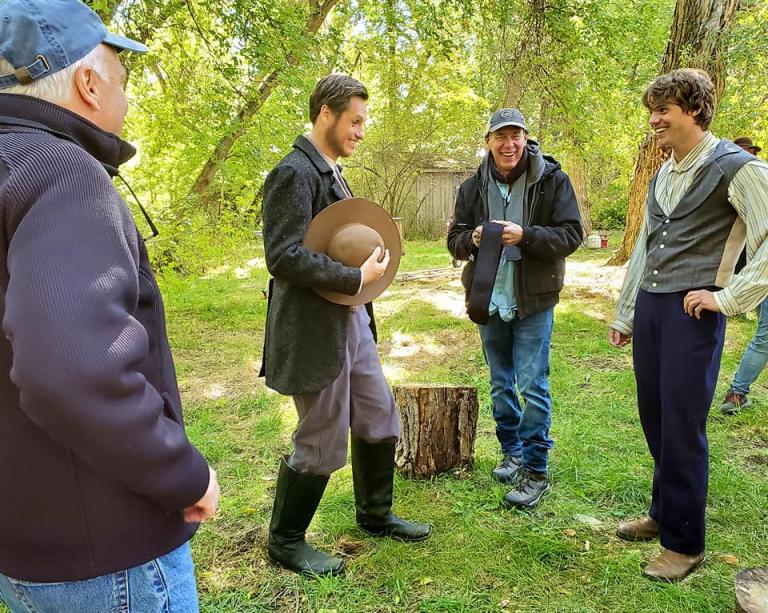
Mark Goodman (director), Lincoln Hoppe (“Martin Harris”), Joseph L Garrard, and Paul Reid Wuthrich (“Joseph Smith”) on the set of the Interpreter Foundation’s “Witnesses” film project in 2019. Still photograph by James Jordan.
Two new items went up today in Interpreter: A Journal of Latter-day Saint Faith and Scholarship. The first is by A. Keith Thompson, and the second is by Blake T. Ostler:
“The Brass Plates: Can Modern Scholarship Help Identify Their Contents?”
Abstract: The Book of Mormon contains little information about what the Brass Plates contain. Nephi said it was a larger record than the Hebrew Bible brought to America by the Gentiles. But it could not have contained the records of Old Testament prophets who wrote after Lehi’s party left Jerusalem or the New Testament. We know it contained some writings from Zenos, Zenock, Neum, and Ezias, but what else could it have contained? Though the “Documentary Hypothesis” idea that the Christian Bible is the product of redactors is distasteful to many Christians, this article suggests this scholarship should not trouble Latter-day Saints, who celebrate Mormon’s scriptural abridgement of ancient American scripture. This article also revisits the insights of some Latter-day Saint scholars who have suggested the Brass Plates are a record of the tribe of Joseph, and this may explain its scriptural content. The eight verses from Micah 5, which Christ quoted three times during His visit to the Nephites and which did not previously appear in Mormon’s abridgment, receive close analysis.
“An Ingenious and Inspiring Literary Analysis of Alma 30–42”
Review of Mark A. Wrathall, Alma 30–63: A Brief Theological Introduction (Provo, UT: The Neal A. Maxwell Institute for Religious Scholarship, 2020). 176 pages. $9.95 (paperback).
Abstract: Mark A. Wrathall’s analytic treatment of Alma 30–42 is a sheer gift that inspires insight into the theological depth of Alma’s thought. His reading of Alma teases out insights not previously recognized and not easily discovered regarding belief and knowledge and their relation to faith and committed action. This extremely rewarding introduction provides a glimpse at the best any writer in the Latter-day Saint tradition has written on Alma’s thoughts and goals.
***
And, just in case you missed them or have forgotten about them, here are links to some articles from a previous number of Interpreter:
Joseph M. Spencer, “On the Dating of Moroni 8-9”
Abstract: Students of the Book of Mormon who have attempted to establish a rough (internal) date for the composition of Mormon’s two letters in Moroni 8–9 have come to different and inconsistent conclusions. Nonetheless, there seems to be evidence enough from the text to arrive at reasonably certain conclusions as to when the letters are supposed to have originated. At the same time, the fact that the text never bothers to state the exact circumstances under which the letters were produced is theologically suggestive. What might be the interpretive and especially theological implications that follow from the establishment of rough dates for the letters? This essay argues from textual evidence that the reader should understand the two letters to have been written at rather different times: Moroni 8 in the years 345–50, and Moroni 9 in the years 375–80. It then draws interpretive and theological conclusions about the import of these dates: principally that Moroni’s inclusion of the letters forces readers to recognize that Mormon’s history is inventive and theologically motivated.
Matthew R. Linford, “The Parable of the Benevolent Father and Son”
Abstract: A discussion is presented on the Parable of the Prodigal Son, including the departure of the young man into a faraway land, his return, and the welcome he received from his father. To better understand the cultural significance of this story, a Middle Eastern scholar (Kenneth Bailey) is referenced. The prodigal son breaks his father’s heart when he leaves home, but at the same time his older brother fails in his duty to his family. The father in the parable represents Christ, who is seen to take upon himself the shame of his returning boy and later of his older brother. The reinstatement of the prodigal son is confirmed by the actions of the father, who embraces him, dresses him in a robe, puts shoes on his feet, has a ring placed on his finger, brings him into his house, and kills the fatted calf for him. These actions have deep gospel and cultural significance. The older son’s failure to come into the feast for his brother is a public insult to his father, and his words to his father in the courtyard are a second public insult. The Parable of the Prodigal Son is shown to be similar to other stories from the scriptures, including Jesus’s meal with Simon the Pharisee (Luke 7:36–43), the Parable of the Man and His Great Supper (Luke 14:16–24), the Parable of the King and His Son’s Wedding (Matthew 22:2–14), and Lehi’s dream in 1 Nephi 8. Consistent elements across these stories include a feast/meal, a male authority figure who initiates or invites others to the feast, well-to-do guests who refuse the invitation, their criticism of the host of the feast and their fellowman, an application of grace, and the presence of the less favored individuals at the feast at the end of the stories. It is shown that the prodigal son represents the publicans and sinners of Jesus’s day, while the older son represents the scribes and Pharisees. Emphasis is placed on the remarkable countercultural and benevolent role played by the father/patriarch in these stories.
Abstract: In light of Noel Reynolds’ hypothesis that some material in the Book of Moses may have been present on the brass plates that Nephi used, one may wonder if Nephi or other authors might also have drawn upon the use of chains in the Book of Moses, particularly Satan’s “great chain [that] veiled … the earth with darkness” (Moses 7:26) and the “chains of darkness” (Moses 7:57). Though the phrase “chains of darkness” is not used in the Book of Mormon, 2 Nephi 1:23, quoting Lehi, combines chains and obscurity*, where* obscurity can have the meaning of darkness. In fact, there may be a Hebraic wordplay behind Lehi’s words when he tells his wayward sons to “come forth out of obscurity and arise from the dust,” based on the similarity between the Hebrew words for “obscurity” and “dust.” The association between dust and chains and several other newly found linkages to Book of Moses material is enriched by a study of Walter Brueggemann on the covenant-related meanings of “rising from the dust” and “returning to the dust” in the Bible, a topic we explore in Part 2. Then, after showing how dust-related themes in the Book of Mormon can enhance our understanding of several important passages, we build on that knowledge in Part 3 to “dust off” the most famous chiasmus in the Book of Mormon, where we will show that some apparent gaps and wordy regions in the complex chiastic structure of Alma 36 are more compact and meaningful than we may have realized. Both dust-related themes and themes from the Book of Moses assist in better appreciating the richness of that masterpiece of Hebraic poetry. Overall, a small amount of exploration motivated by Reynolds’ work may have led to several interesting finds that strengthen the case for Book of Moses content on the brass plates and deepen our appreciation of the use of ancient Near Eastern dust themes in the Book of Mormon, that majestic “voice from the dust.”
Abstract: In light of Noel Reynolds’ hypothesis that some material in the Book of Moses may have been present on the brass plates that Nephi used, one may wonder if Nephi or other authors might also have drawn upon the use of chains in the Book of Moses. Further examination of this connection points to the significance of the theme of “dust” in Lehi’s words and the surrounding passages from Nephi and Jacob, where it can involve motifs of covenant keeping, resurrection, and enthronement. Recognizing the usage of dust-related themes in the Book of Mormon can enhance our understanding of the meaning and structure of several portions of the text. An appeal to the Book of Mormon’s use of dust may also help fill in some gaps in the complex chiastic structure of Alma 36 (to be treated in Part 3) and add meaning to other portions of that “voice from the dust,” the Book of Mormon.
Abstract: In light of Noel Reynolds’ hypothesis that some material in the Book of Moses may have been present on the brass plates that Nephi used, exploration of concepts related to chains in the Book of Moses led to several insights involving a group of related motifs in the Book of Mormon where shaking off Satan’s chains and rising from the dust are linked, as discussed in Parts 1 and 2. Here we argue that an appeal to the Book of Mormon’s use of dust may fill in some gaps in the complex chiastic structure of Alma 36 and strengthen the case that it is a carefully crafted example of ancient Semitic poetry.
Taylor Halverson, “Reading 1 Nephi With Wisdom”
Abstract*: Nephi is the prototypical wise son of the Wisdom tradition. As Proverbs advocates that a wise man cherishes the word of God, so Nephi cherishes the words of the wise. Nephi’s record begins with a declaration of his upbringing in the Wisdom tradition and his authenticity and reliability as a wise son and scribe (1 Nephi 1:1–3). His is a record of the learning of the Jews — a record of wisdom. If the Wisdom tradition is a foundation for Nephi’s scribal capabilities and outlook, perhaps the principles and literary skills represented by the scribal Wisdom tradition constitute the “learning of the Jews” that Nephi references so early in his account. Thus, if Nephi’s is a record of the learning of the Jews — a record of wisdom — we would be wise to read it with Wisdom — that is, through the lens of ancient Israelite and Middle Eastern Wisdom traditions.*
Posted from Richmond, Virginia
Previous Post

May 13, 2021
"For all find what they truly seek."
Next Post
May 15, 2021 Four Books That Can Fortify Faith
Browse Our Archives
Select a Category Uncategorized
Select a Month October 2026 September 2026 August 2026 July 2026 June 2026 May 2026 April 2026 March 2026 February 2026 January 2026 December 2025 November 2025 October 2025 September 2025 August 2025 July 2025 June 2025 May 2025 April 2025 March 2025 February 2025 January 2025 December 2024 November 2024 October 2024 September 2024 August 2024 July 2024 June 2024 May 2024 April 2024 March 2024 February 2024 January 2024 December 2023 November 2023 October 2023 September 2023 August 2023 July 2023 June 2023 May 2023 April 2023 March 2023 February 2023 January 2023 December 2022 November 2022 October 2022 September 2022 August 2022 July 2022 June 2022 May 2022 April 2022 March 2022 February 2022 January 2022 December 2021 November 2021 October 2021 September 2021 August 2021 July 2021 June 2021 May 2021 April 2021 March 2021 February 2021 January 2021 December 2020 November 2020 October 2020 September 2020 August 2020 July 2020 June 2020 May 2020 April 2020 March 2020 February 2020 January 2020 December 2019 November 2019 October 2019 September 2019 August 2019 July 2019 June 2019 May 2019 April 2019 March 2019 February 2019 January 2019 December 2018 November 2018 October 2018 September 2018 August 2018 July 2018 June 2018 May 2018 April 2018 March 2018 February 2018 January 2018 December 2017 November 2017 October 2017 September 2017 August 2017 July 2017 June 2017 May 2017 April 2017 March 2017 February 2017 January 2017 December 2016 November 2016 October 2016 September 2016 August 2016 July 2016 June 2016 May 2016 April 2016 March 2016 February 2016 January 2016 December 2015 November 2015 October 2015 September 2015 August 2015 July 2015 June 2015 May 2015 April 2015 March 2015 February 2015 January 2015 December 2014 November 2014 March 2014 August 2013 February 2012
Follow Us!
TAKE THE
Religious Wisdom Quiz
I found the Book of the Law in the temple during repairs and wept when it was read to me. Who am I?
Select your answer to see how you score.
Joash Hezekiah Josiah Asa
Related posts from Sic et Non


Some notes on the archaeology of the Bible


TRENDING AT PATHEOS Latter-day Saint

The Sermon on the Mount, Part I: Matthew...
The Sermon on the Mount, Part I (Matthew 4:12-5:12) St. Matthew moves...

What's up from Crossway: Reviewing some of their latest A few weeks...

Janie Learns the Way of the Cross: A...
Teaching children about Jesus' Passion can be challenging. Many parents and educators...

Looking For Good Catholic Writing - October 2026
He alone extends the heavens, and he walks upon the waves of...

In "Irreplaceable," our book on vocation and technology, Trevor Sutton and I...

I was strolling through the top floor of the brand new Parthenon...
view all Latter-day Saint blogs
Ad-Free & Subscriber Log-In Subscription Support
- About Us
- 2026 Calendar
- Videos
- Podcasts
- Library of World Religions
- Faith In Media Tracker
- Advertise With Us
- Write for Us
- Privacy Policy
- Terms of Service
- Do Not Sell My Data
- Contact Us
- Radiant Digital
- Manage Newsletter Subscriptions
- Unsubscribe From Notifications
- Sitemap
Copyright 2008-2026, Patheos. All rights reserved.
Subscription Support Ad-Free & Subscriber Log-In
Follow Patheos