
BuddhistCatholicContemplativeEvangelicalGeneral ChristianHinduJewishLatter-day SaintMuslimNew VisionsProgressive Christian
Beliefs
- Buddhist
- Catholic
- Contemplative
- Evangelical
- General Christian
- Hindu
- Jewish
- Latter-day Saint
- More Voices
- Muslim
- New Visions
- Pagan
- Progressive Christian
Topics
- Religion News
- Food and Religion
- Sports and Religion
- Religious Art
- Religious Music and Entertainment
- Religious Events
- History and Religion
- Style and Religion
- Politics and Religion
- Women in Religion
- Recreation Outdoors and Religion
- Business Finance and Religion
- Careers Workplace and Religion
- Education and Religion
- Family Parenting and Religion
- Health Fitness and Religion
- Home and Religion
- Relationships and Religion
- Technology and Religion
- Travel and Religion
Columnists
- Buddhist Columnists
- Business Finance and Religion Columnists
- Careers Workplace and Religion Columnists
- Catholic Columnists
- Contemplative Columnists
- Education and Religion Columnists
- Evangelists Columnists
- Family Parenting and Religion Columnists
- General Christian Columnists
- Health Fitness and Religion Columnists
- Hindu Columnists
- History and Religion Columnists
- Home and Religion Columnists
- Jewish Columnists
- More Voices Columnists
- Latter Day Columnists
- Muslim Columnists
- New Visions Columnists
- Nonreligious Columnists
- Pagan Columnists
- Politics and Religion Columnists
- Progressive Columnists
- Recreation Outdoors and Religion Columnists
- Relationships and Religion Columnists
- Religion News Columnists
- Religious Art Columnists
- Religious Events Columnists
- Religious Music and Entertainment Columnists
- Sports and Religion Columnists
- Style and Religion Columnists
- Technology and Religion Columnists
- Travel and Religion Columnists
- Women in Religion Columnists
Resource Library
- 2026 Calendar
- Library of World Religions
- The 100 Most Holy Places on Earth
- Patheos Answers
- Podcasts
- Videos
- Faith Leaders Database
- Anglican Episcopalian
- Bahai
- Baptist
- Buddhism
- Christianity
- Confucianism
- Eastern Orthodoxy
- Hinduism
- Holiness and Pentecostal
- ISKCON
- Islam
- Judaism
- Lutheran
- Methodist
- The Church of Jesus Christ of Latter-day Saints
- New Age
- Paganism
- Presbytarian and Reformed
- Protestantism
- Religion Behind the Scenes
- Roman Catholic
- Scientology
- Shia Islam
- Sikhism
- Sufism
- Sunni Islam
- Taoism
- Zen
- See all religions
Research Tools
 Ad-Free & Subscriber Log-In Subscription Support
Ad-Free & Subscriber Log-In Subscription Support
Follow Patheos 

- Trending:
- Forgiveness
- |
- Marriage
- |
- Consciousness
- |
- Death Penalty
- |
- Election
- |
- Halloween

- Home
- Latter-day Saint
- Change and Decay in the Mid-Pacific
Change and Decay in the Mid-Pacific
Last updated on: May 5, 2021 at 12:50 am by Dan Peterson
Change and Decay in the Mid-Pacific 2021-05-05T00:50:34-06:00 Dan Peterson
Patheos Explore the world's faith through different perspectives on religion and spirituality! Patheos has the views of the prevalent religions and spiritualities of the world.
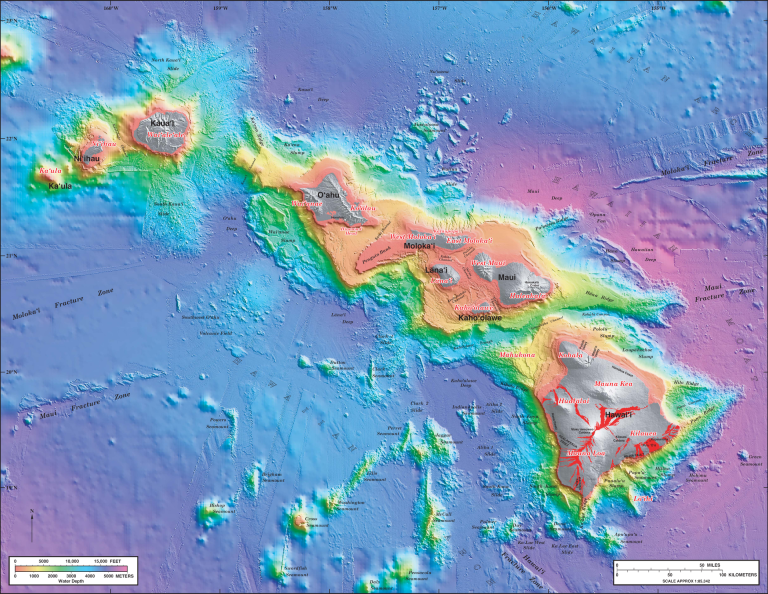
Public domain bathymetry image of the Hawaiian islands
***
Happily, we were able to attend the funeral of our friend and Orem neighbor yesterday. (See “Farewell, For Now, to a Friend,” but also one of the “other matters” here.) Doing so, however, has definitely put me into an elegiac mood.
Swift to its close ebbs out life’s little day.
Earth’s joys grow dim, its glories pass away.
Change and decay in all around I see.
O Thou who changest not, abide with me.
Those words, never before particularly important to me, came powerfully and continually to my mind in the days leading up to my father’s death, and, curiously, an instrumental version of that hymn was playing softly over the hospital sound system while we were sitting by my mother’s bedside as she drew her last breaths.
For as long as I can remember, I’ve been acutely aware of the transience of things. When I see beautiful flower gardens — as we saw just the other day in front of the administration building at BYU — I almost immediately remember that “This will not last.” Visiting ancient ruins, I inevitably think of the people who once walked there, who were as vividly alive in their brief day as we are in ours. I see older films and realize that the actors playing the handsome, beautiful, and witty characters in them are now all dead. No matter how hard even the best and most dedicated athletes exercise, they’ll eventually wind up physically incapacitated (if they haven’t already died by then.) Visiting the now-public homes of the extremely wealthy — from Versailles to San Simeon, from the Villa Vizcaya in Miami and Neuschwanstein in Bavaria to Doris Duke’s “Shangri La” in Honolulu — I’m forcefully struck by the fact that those who once lived in them have been gone far longer than the brief span of their occupancy. Sic transit gloria mundi. Thus passes the glory of the world. However many years we labor to build a spectacular home for ourselves, we simply won’t stay there very long.
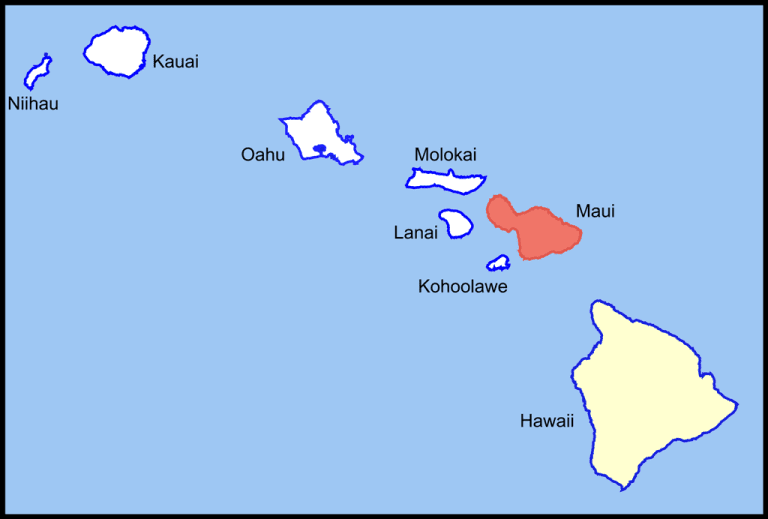
Maui among the principal Hawaiian Islands
(Wikimedia Commons public domain)
Curiously, no place on the earth makes me more aware of change and decay than does Hawaii. My parents first brought me here when I was five years old. I didn’t come again until I was a senior in high school, and then I was absent again for some time after that. Now, though, I’m genuinely not sure how many times I’ve been here — mostly for pleasure, but also for lectures and even for speaking to a devotional assembly at Brigham Young University’s campus at Laie, on the north shore of Oahu. Since my first visit to the islands as a very young child, they’ve moved approximately 14.5 feet to the northwest.
They’ve moved because the Pacific Plate, on which they sit, is moving. And it’s moving over a geological “hot spot.” A “hot spot” is an area under the earth’s rocky outer layer or crust where the magma is hotter than the surrounding magma. The magma plume that results causes the rocky crust to melt and to grow thin and, thus, to yield a place for the outbreak of volcanic activity. And that volcanic activity, in turn, is what has created the Hawaiian Islands. (And, of course, it’s what attracts me to visit the Hawaiian Islands, which represent one of the few places on the planet — Iceland, of course, would be another, and, naturally, it’s on my bucket list — that matches the perpetual seething rage that some of my anonymous critics claim to have detected in me.)
The movement of the Pacific Plate to the northwest makes volcanic action along the Hawaiian Ridge seem (to our vision, which experiences the crust as stable and unmoving) to move toward the southeast. Basically, therefore, the oldest islands in the Hawaiian Islands chain — Necker Island, for example, and Midway Atoll — are to the northwest. From Kure Atoll at the one end to the Big Island of Hawaii is an extent of roughly 1500 miles. Kaua’i is the oldest of the main Hawaiian islands. The Big Island is the newest, being the product of five distinct volcanos, and it is still volcanically active. Of its five originating volcanos, though, Kohala last erupted 60,000 years before the present and Mauna Kea last erupted 3,500 years ago; these two are generally considered dormant (which, by the way, does not mean extinct). Hualalai’s last eruption was in 1801, and that may be its final gasp. Or not. Only two of the Big Island’s volcanoes are active today — Mauna Loa and Kiluaea, both of which (surprise!) can be located roughly in the island’s southeast. Mauna Loa erupted in 1984; Kilauea is generally reckoned among the most active volcanoes on the planet. Moreover, about twenty-two miles off the southeastern coast of the Big Island is the Lōʻihi Seamount, an active volcano that is roughly 3200 feet beneath the surface of the Pacific Ocean but that, in approximately 10,000 years, at current rates, will debut as the newest island in the Hawaiian chain. (I’m currently selling beachfront property on Lōʻihi. Contact me soon. It’s going fast.)
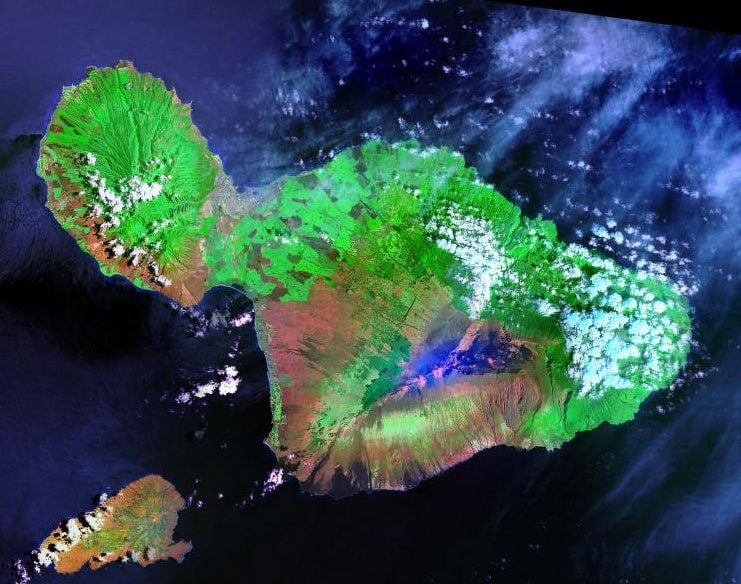
A 2006 public domain NASA Landsat satellite photo of Maui (false color)
The island upon which I’m writing, Maui, has been called a “volcanic doublet,” having been formed from two distinct shield volcanoes that formed a low isthmus between them. Unsurprisingly, that low and relatively flat isthmus is where Kahului and Maui’s airport are located, and where Wailuku, the county seat — Maui is a separate Hawaiian country — is also to be found. Maui is actually just a portion of a considerably larger unit, Maui Nui (“Greater Maui”), that also includes the islands of Lānaʻi, Kahoʻolawe, Molokaʻi, and the so-called Penguin Bank, which is now submerged beneath the ocean. During periods when the level of the sea has been lower, perhaps as recently as 20,000 years ago, these can all be joined together as a single island.
It should hardly be surprising now to learn that the western part of the island is the oldest part of it, and that the westernmost of the two principal volcanos has been pretty quiet and is much eroded. The famous volcano to the east, however, Haleakalā, is considerably higher (rising somewhat more than 10,000 feet above the surface of the sea), much larger, and, although dormant, is still capable of eruptng. (Its last eruption was in 1790.)
It appears now, however, that Maui’s period of growth is over. Gradually, the ocean that I can see right now and the waves that I can sometimes hear above the bird songs are wearing it down. Eventually, it will become a coral atoll, and then it will disappear beyond the waves. The Kaanapali resorts that were scarcely a developer’s dream when I spent an entire day walking the beach north of Lahaina back in 1970 will be renting out only their top floors, and at enormous discounts. And then you’ll all realize that my strong sense of the ephemeral character of everything around us wasn’t misplaced, after all. The famous and recurrent description of the weekly Tabernacle Choir broadcast as coming “from within the shadows of the everlasting hills” is, in the end, poetic but not literally true. The “everlasting hills” aren’t everlasting. Not really.
Swift to its close ebbs out life’s little day.
Earth’s joys grow dim, its glories pass away.
Change and decay in all around I see.
O Thou who changest not, abide with me.
Posted from Kāʻanapali, Maui, Hawaiʻi
Previous Post

May 3, 2021
"The Divine Handclasp in the Hebrew Bible and in Near Eastern Iconography"
Next Post
May 5, 2021 Tickets to "Witnesses" Are Available Now for 34 Theaters in Several States
Browse Our Archives
Select a Category Uncategorized
Select a Month October 2026 September 2026 August 2026 July 2026 June 2026 May 2026 April 2026 March 2026 February 2026 January 2026 December 2025 November 2025 October 2025 September 2025 August 2025 July 2025 June 2025 May 2025 April 2025 March 2025 February 2025 January 2025 December 2024 November 2024 October 2024 September 2024 August 2024 July 2024 June 2024 May 2024 April 2024 March 2024 February 2024 January 2024 December 2023 November 2023 October 2023 September 2023 August 2023 July 2023 June 2023 May 2023 April 2023 March 2023 February 2023 January 2023 December 2022 November 2022 October 2022 September 2022 August 2022 July 2022 June 2022 May 2022 April 2022 March 2022 February 2022 January 2022 December 2021 November 2021 October 2021 September 2021 August 2021 July 2021 June 2021 May 2021 April 2021 March 2021 February 2021 January 2021 December 2020 November 2020 October 2020 September 2020 August 2020 July 2020 June 2020 May 2020 April 2020 March 2020 February 2020 January 2020 December 2019 November 2019 October 2019 September 2019 August 2019 July 2019 June 2019 May 2019 April 2019 March 2019 February 2019 January 2019 December 2018 November 2018 October 2018 September 2018 August 2018 July 2018 June 2018 May 2018 April 2018 March 2018 February 2018 January 2018 December 2017 November 2017 October 2017 September 2017 August 2017 July 2017 June 2017 May 2017 April 2017 March 2017 February 2017 January 2017 December 2016 November 2016 October 2016 September 2016 August 2016 July 2016 June 2016 May 2016 April 2016 March 2016 February 2016 January 2016 December 2015 November 2015 October 2015 September 2015 August 2015 July 2015 June 2015 May 2015 April 2015 March 2015 February 2015 January 2015 December 2014 November 2014 March 2014 August 2013 February 2012
Follow Us!
TAKE THE
Religious Wisdom Quiz
What animal is mentioned in Proverbs as having little strength but great wisdom?
Select your answer to see how you score.
Ant Ox Bear Lion
Related posts from Sic et Non
TRENDING AT PATHEOS Latter-day Saint

Nearly every morning, I make the drive to Detroit with my high-school-age...

The Real AI Story Is Adoption Without Trust
Artificial intelligence has crossed a political threshold. It is no longer a...

A new article, written by Jeff Lindsay and Gale L. Pooley,...

Swimfan: Forgotten Aughts Pleasures
This is a recovery effort. In 2002, My Big Fat Greek Wedding...

Top Three Anti-Catholic Lies About Catholicism
This is my initial transcript for the video, "THE 3 WORST...

Pope Leo Celebrates Mass for Nurses & Docs...
I don't have any idea how he did it, but Pope Leo...
view all Latter-day Saint blogs
Ad-Free & Subscriber Log-In Subscription Support
- About Us
- 2026 Calendar
- Videos
- Podcasts
- Library of World Religions
- Faith In Media Tracker
- Advertise With Us
- Write for Us
- Privacy Policy
- Terms of Service
- Do Not Sell My Data
- Contact Us
- Radiant Digital
- Manage Newsletter Subscriptions
- Unsubscribe From Notifications
- Sitemap
Copyright 2008-2026, Patheos. All rights reserved.
Subscription Support Ad-Free & Subscriber Log-In
Follow Patheos