
BuddhistCatholicContemplativeEvangelicalGeneral ChristianHinduJewishLatter-day SaintMuslimNew VisionsProgressive Christian
Beliefs
- Buddhist
- Catholic
- Contemplative
- Evangelical
- General Christian
- Hindu
- Jewish
- Latter-day Saint
- More Voices
- Muslim
- New Visions
- Pagan
- Progressive Christian
Topics
- Religion News
- Food and Religion
- Sports and Religion
- Religious Art
- Religious Music and Entertainment
- Religious Events
- History and Religion
- Style and Religion
- Politics and Religion
- Women in Religion
- Recreation Outdoors and Religion
- Business Finance and Religion
- Careers Workplace and Religion
- Education and Religion
- Family Parenting and Religion
- Health Fitness and Religion
- Home and Religion
- Relationships and Religion
- Technology and Religion
- Travel and Religion
Columnists
- Buddhist Columnists
- Business Finance and Religion Columnists
- Careers Workplace and Religion Columnists
- Catholic Columnists
- Contemplative Columnists
- Education and Religion Columnists
- Evangelists Columnists
- Family Parenting and Religion Columnists
- General Christian Columnists
- Health Fitness and Religion Columnists
- Hindu Columnists
- History and Religion Columnists
- Home and Religion Columnists
- Jewish Columnists
- More Voices Columnists
- Latter Day Columnists
- Muslim Columnists
- New Visions Columnists
- Nonreligious Columnists
- Pagan Columnists
- Politics and Religion Columnists
- Progressive Columnists
- Recreation Outdoors and Religion Columnists
- Relationships and Religion Columnists
- Religion News Columnists
- Religious Art Columnists
- Religious Events Columnists
- Religious Music and Entertainment Columnists
- Sports and Religion Columnists
- Style and Religion Columnists
- Technology and Religion Columnists
- Travel and Religion Columnists
- Women in Religion Columnists
Resource Library
- 2026 Calendar
- Library of World Religions
- The 100 Most Holy Places on Earth
- Patheos Answers
- Podcasts
- Videos
- Faith Leaders Database
- Anglican Episcopalian
- Bahai
- Baptist
- Buddhism
- Christianity
- Confucianism
- Eastern Orthodoxy
- Hinduism
- Holiness and Pentecostal
- ISKCON
- Islam
- Judaism
- Lutheran
- Methodist
- The Church of Jesus Christ of Latter-day Saints
- New Age
- Paganism
- Presbytarian and Reformed
- Protestantism
- Religion Behind the Scenes
- Roman Catholic
- Scientology
- Shia Islam
- Sikhism
- Sufism
- Sunni Islam
- Taoism
- Zen
- See all religions
Research Tools
 Ad-Free & Subscriber Log-In Subscription Support
Ad-Free & Subscriber Log-In Subscription Support
Follow Patheos 

- Trending:
- Forgiveness
- |
- Marriage
- |
- Consciousness
- |
- Death Penalty
- |
- Election
- |
- Halloween

- Home
- Latter-day Saint
- Wordplay, “Intertextuality,” Archaisms, and Other Book of Mormon Subtleties
Wordplay, “Intertextuality,” Archaisms, and Other Book of Mormon Subtleties
Last updated on: April 17, 2021 at 12:53 pm by Dan Peterson
Wordplay, “Intertextuality,” Archaisms, and Other Book of Mormon Subtleties 2021-04-17T12:53:25-06:00 Dan Peterson
Patheos Explore the world's faith through different perspectives on religion and spirituality! Patheos has the views of the prevalent religions and spiritualities of the world.
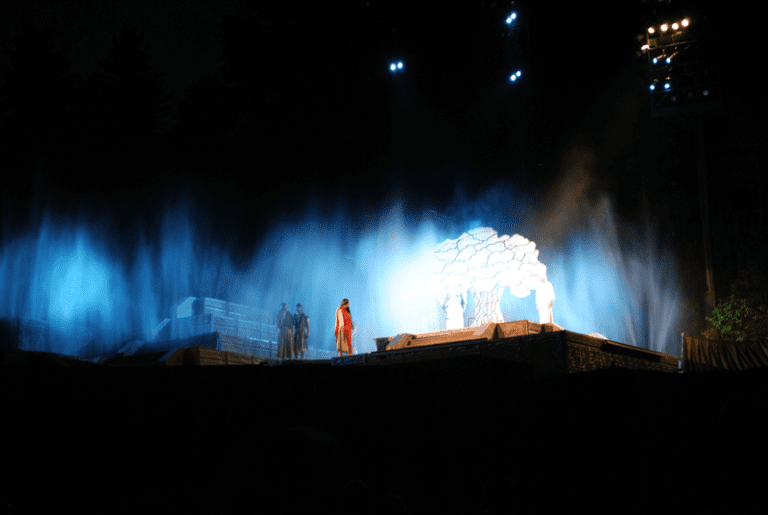
Nephi’s vision, as it was depicted at the 2011 Hill Cumorah Pageant near Palmyra, New York
(Wikimedia Commons public domain image)
***
Two new items appeared today in Interpreter: A Journal of Latter-day Saint Faith and Scholarship. The first is by Matthew L. Bowen, while the second is by Jeffrey Thayne:
““The Messiah Will Set Himself Again”: Jacob’s Use of Isaiah 11:11 in 2 Nephi 6:14 and Jacob 6:2”
Abstract: In sermons and writings, Jacob twice quotes the prophecy of Isaiah 11:11 (“the Lord [ʾădōnāy] shall set his hand again [yôsîp] the second time to gather the remnant of his people”). In 2 Nephi 6:14 and Jacob 6:2, Jacob uses Isaiah 11:11 as a lens through which he interprets much lengthier prophetic texts that detail the restoration, redemption, and gathering of Israel: namely, Isaiah 49:22–52:2 and Zenos’s Allegory of the Olive Trees (Jacob 5). In using Isaiah 11:11 in 2 Nephi 6:14, Jacob, consistent with the teaching of his father Lehi (2 Nephi 2:6), identifies ʾădōnāy (“the Lord”) in Isaiah 11:11 as “the Messiah” and the one who will “set himself again the second time to recover” his people (both Israel and the righteous Gentiles who “believe in him”) and “manifest himself unto them in great glory.” This recovery and restoration will be so thoroughgoing as to include the resurrection of the dead (see 2 Nephi 9:1–2, 12–13). In Jacob 6:2, Jacob equates the image of the Lord “set[ting] his hand again [yôsîp] the second time to recover his people” (Isaiah 11:11) to the Lord of the vineyard’s “labor[ing] in” and “nourish[ing] again” the vineyard to “bring forth again” (cf. Hebrew yôsîp*) the natural fruit (Jacob 5:29–33, 51–77) into the vineyard. All of this suggests that Jacob saw Isaiah 49:22–52:2 and Zenos’s allegory (Jacob 5) as telling essentially the same story. For Jacob, the prophetic declaration of Isaiah 11:11 concisely summed up this story, describing divine initiative and iterative action to “recover” or gather Israel in terms of the verb* yôsîp*. Jacob, foresaw this the divine action as being accomplished through the “servant” and “servants” in Isaiah 49–52, “servants” analogous to those described by Zenos in his allegory. For Jacob, the idiomatic use of* yôsîp in Isaiah 11:11 as he quotes it in 2 Nephi 6:14 and Jacob 6:2 and as repeated throughout Zenos’s allegory (Jacob 5) reinforces the patriarch Joseph’s statement preserved in 2 Nephi 3 that this figure would be a “Joseph” (yôsēp).
“Understanding Covenants Anew: Using Ancient Thought to Enrich Modern Faith”
Review of Jennifer C. Lane, Finding Christ in the Covenant Path: Ancient Insights for Modern Life (Provo, UT: Religious Studies Center at Brigham Young University / Salt Lake City: Deseret Book, 2020). 188 pages. Hardcover, $29.99.
Abstract: In the first half of her book, Lane takes us on a tour of ancient worlds by introducing us to ancient words, such as bĕrît (covenant), gā’al (redemption), pānîm (presence of the Lord), and so forth, while deftly weaving linguistic and historical insights with personal narratives that ground these insights in the practical affairs of day-to-day living. In the second half of the book, Lane takes us on a tour of medieval art and images, centering on how art has been used to portray the Savior and His mission. Throughout the entire book, Lane centers the attention of the reader on Christ, inviting us to take upon ourselves His image and likeness and to more fully appreciate the images crafted of Him by artists of prior centuries.
***
And here, in case you missed them or have forgotten about them or want to think about them again, are some links to articles from a previous issue of Interpreter:
Stanford Carmack, “The Case of the {-th} Plural in the Earliest Text”
Abstract: The earliest text of the Book of Mormon employs the {-th} plural — for example, “Nephi’s brethren rebelleth” — in a way that is substantially similar to what is found in many writings of the Early Modern period. The earliest text neither underuses nor overuses the construction, and it manifests inflectional variation and differential usage rates typical of Early Modern English. The totality of the evidence tells us that the Book of Mormon is most reasonably classified as a 16th- or 17th-century text, not as a 19th-century text full of biblical hypercorrections.
Editor’s note: Because of the complex typesetting of this article, the rest of it has not been reproduced on this webpage. The reader is referred to the PDF version to view the entire article.
Stanford Carmack, “The Case of Plural Was in the Earliest Text”
Abstract: Because it is primarily an Early Modern English text (in terms of its English language), the earliest text of the Book of Mormon understandably employs plural was — for example, “the words which was delivered” (Alma 5:11). It does so in a way that is substantially similar to what is found in many writings of the Early Modern period — that is, it manifests the syntactic usage, variation, and differential rates typical of that era.
Editor’s note: Because of the complex typesetting of this article, the rest of it has not been reproduced on this webpage. The reader is referred to the PDF version to view the entire article.
Kevin L. Tolley, “To “See and Hear””
Quinten Barney, “Samuel the Lamanite, Christ, and Zenos: A Study of Intertextuality”
Abstract: During Christ’s mortal ministry at Jerusalem, his teachings often drew upon the writings of Isaiah, Moses, and other prophets with whom his audience was familiar. On the other hand, Christ never seems to quote Nephi, Mosiah, or other Book of Mormon prophets to the Jews and their surrounding neighbors, despite being the ultimate source for their inspired writings. It is because of this apparent confinement to Old Testament sources that intertextual parallels between the words of Christ in Matthew 23–24 and the words of Samuel the Lamanite in Helaman 13–15 jump out as intriguing. This paper explores the intertextual relationship between these chapters in Helaman and Matthew and suggests that the parallels between these texts can be attributed to a common source available to both Samuel and Christ, the writings of the prophet Zenos.
Jeff Lindsay, “The Yoke of Christ: A Light Burden Heavy With Meaning”
Abstract: Christ’s famous call to take his yoke upon us in Matthew 11 may merit more analysis than it has commonly received. Taking up the yoke may have connections to other things that are taken upon us as well, including the name of Christ, temple covenants, priestly robes, and sacred anointing. These all reflect a relationship of obedience and service to the Master, who set the example by taking the heaviest yoke of all upon him, including the yoke-like beam of the cross that he carried to Golgotha and the full weight of human sin and misery as he suffered for us. Our yoke is easy, and the burden of the cross we are called to take up (Matthew 16:24; 3 Nephi 12:30) is light indeed relative to what he bore or to bearing the weight of our own sins. However, his call, while rooted in grace, implies actual effort and work, not belief alone. It is a call for faithful service, linked to him in sacred covenants most fully expressed in the sacred temple. A review of ancient scripture, early Christian writing, some Jewish perspectives, and modern revelation gives us insights into the richness of meaning that may be associated with taking upon us the yoke of Christ and entering into his rest.
Abstract: Doctrine and Covenants 9:7–9 is conventionally interpreted as the Lord’s description of the method by which the Book of Mormon was translated. A close reading of the entire revelation, however, suggests that the Lord was not telling Oliver Cowdery how to translate but rather how to know whether it was right for him to translate and how to obtain the faith necessary to do so. Faith would have enabled Oliver Cowdery to overcome his fear and translate, just as it would have enabled Peter (in Matthew 14) to overcome his fear and walk on water.
Abstract: As in Hebrew biblical narrative, wordplay on (or play on the meaning of) toponyms, or “place names,” is a discernable feature of Book of Mormon narrative. The text repeatedly juxtaposes the toponym Jershon (“place of inheritance” or “place of possession”) with terms inherit*,* inheritance, possess, possession*, etc. Similarly, the Mulekite personal name* Zarahemla (“seed of compassion,” “seed of pity”), which becomes the paramount Nephite toponym as their national capital after the time of Mosiah I, is juxtaposed with the term compassion*. Both wordplays occur and recur at crucial points in Nephite/Lamanite history. Moreover, both occur in connection with the migration of the first generation Lamanite converts. The Jershon wordplay recurs in the second generation, when the people of Ammon receive the Zoramite (re)converts into the land of Jershon, and wordplay on Zarahemla recurs subsequently, when the sons of these Lamanite converts come to the rescue of the Nephite nation. Rhetorical wordplay on* Zarahemla also surfaces in important speeches later in the Book of Mormon.
Matthew L. Bowen, “Onomastic Wordplay on Joseph and Benjamin and Gezera Shawa in the Book of Mormon”
Abstract: The Book of Mormon contains several quotations from the Hebrew Bible that have been juxtaposed on the basis of shared words or phrases, this for the purpose of interpreting the cited scriptural passages in light of one another. This exegetical technique — one that Jesus himself used — came to be known in later rabbinic times as Gezera Shawa (“equal statute”). In several additional instances, the use of Gezera Shawa converges with onomastic wordplay. Nephi uses a Gezera Shawa involving Isaiah 11:11 and Isaiah 29:14 twice on the basis of the yāsap verb forms yôsîp*/yôsīp (2 Nephi 25:17 and quoting the Lord in 2 Nephi 29:1) to create a stunning wordplay on the name “Joseph.” In another instance, King Benjamin uses Gezera Shawa involving Psalm 2:7, 2 Samuel 7:14, and Deuteronomy 14:1 (1–2) on the basis of the Hebrew noun bēn (“son”; plural bānîm, bānôt, “sons” and “daughters”) on which to build a rhetorical wordplay on his own name. This second wordplay, which further alludes to Psalm 110:1 on account of the noun* yāmin (“right hand”), was ready-made for his temple audience who, on the occasion of Mosiah’s coronation, were receiving their own “endowment” to become “sons” and “daughters” at God’s “right hand.” The use of Gezera Shawa was often christological — e.g., Jacob’s Gezera Shawa on (“stone”) in Jacob 4:15–17 and Alma’s Gezera Shawa on Zenos’s and Zenock’s phrase “because of thy Son” in Alma 33:11–16 (see Alma 33:4 17). Taken together, these examples suggest that we should pay more attention to scripture’s use of scripture and, in particular, the use of this exegetical practice. In doing so, we will better discern the messages intended by ancient prophets whose words the Book of Mormon preserves.
Posted from Park City, Utah
Church of Jesus Christ of Latter-day Saints
Interpreter Journal Latter-day Saint Faith Scholarship
Previous Post

April 15, 2021
A book coming. A conference coming. A movie coming. Oh my!
Next Post
April 16, 2021 Some reminiscences about how in the world I got onto the BYU faculty
Browse Our Archives
Select a Category Uncategorized
Select a Month October 2026 September 2026 August 2026 July 2026 June 2026 May 2026 April 2026 March 2026 February 2026 January 2026 December 2025 November 2025 October 2025 September 2025 August 2025 July 2025 June 2025 May 2025 April 2025 March 2025 February 2025 January 2025 December 2024 November 2024 October 2024 September 2024 August 2024 July 2024 June 2024 May 2024 April 2024 March 2024 February 2024 January 2024 December 2023 November 2023 October 2023 September 2023 August 2023 July 2023 June 2023 May 2023 April 2023 March 2023 February 2023 January 2023 December 2022 November 2022 October 2022 September 2022 August 2022 July 2022 June 2022 May 2022 April 2022 March 2022 February 2022 January 2022 December 2021 November 2021 October 2021 September 2021 August 2021 July 2021 June 2021 May 2021 April 2021 March 2021 February 2021 January 2021 December 2020 November 2020 October 2020 September 2020 August 2020 July 2020 June 2020 May 2020 April 2020 March 2020 February 2020 January 2020 December 2019 November 2019 October 2019 September 2019 August 2019 July 2019 June 2019 May 2019 April 2019 March 2019 February 2019 January 2019 December 2018 November 2018 October 2018 September 2018 August 2018 July 2018 June 2018 May 2018 April 2018 March 2018 February 2018 January 2018 December 2017 November 2017 October 2017 September 2017 August 2017 July 2017 June 2017 May 2017 April 2017 March 2017 February 2017 January 2017 December 2016 November 2016 October 2016 September 2016 August 2016 July 2016 June 2016 May 2016 April 2016 March 2016 February 2016 January 2016 December 2015 November 2015 October 2015 September 2015 August 2015 July 2015 June 2015 May 2015 April 2015 March 2015 February 2015 January 2015 December 2014 November 2014 March 2014 August 2013 February 2012
Follow Us!
TAKE THE
Religious Wisdom Quiz
Who killed Goliath?
Select your answer to see how you score.
Samson Jonathan Saul David
Related posts from Sic et Non


Notes on Women, Priesthood, and General Conference

"The Book of Moses as a Temple Text"

TRENDING AT PATHEOS Latter-day Saint

Janie Learns the Way of the Cross: A...
Teaching children about Jesus' Passion can be challenging. Many parents and educators...

Looking For Good Catholic Writing - October 2026
He alone extends the heavens, and he walks upon the waves of...

In "Irreplaceable," our book on vocation and technology, Trevor Sutton and I...

I was strolling through the top floor of the brand new Parthenon...

What Does Gêvâh Mean For Kimberley Guifoyle &...
This week, a lot of the news is focused on Kimberly Guilfoyle....

INNER CIRCLE: Profound Mystery (Of Christ In All...
Ephesians 5:31-32 “For this reason, a man will leave his father and...
view all Latter-day Saint blogs
Ad-Free & Subscriber Log-In Subscription Support
- About Us
- 2026 Calendar
- Videos
- Podcasts
- Library of World Religions
- Faith In Media Tracker
- Advertise With Us
- Write for Us
- Privacy Policy
- Terms of Service
- Do Not Sell My Data
- Contact Us
- Radiant Digital
- Manage Newsletter Subscriptions
- Unsubscribe From Notifications
- Sitemap
Copyright 2008-2026, Patheos. All rights reserved.
Subscription Support Ad-Free & Subscriber Log-In
Follow Patheos