
BuddhistCatholicContemplativeEvangelicalGeneral ChristianHinduJewishLatter-day SaintMuslimNew VisionsProgressive Christian
Beliefs
- Buddhist
- Catholic
- Contemplative
- Evangelical
- General Christian
- Hindu
- Jewish
- Latter-day Saint
- More Voices
- Muslim
- New Visions
- Pagan
- Progressive Christian
Topics
- Religion News
- Food and Religion
- Sports and Religion
- Religious Art
- Religious Music and Entertainment
- Religious Events
- History and Religion
- Style and Religion
- Politics and Religion
- Women in Religion
- Recreation Outdoors and Religion
- Business Finance and Religion
- Careers Workplace and Religion
- Education and Religion
- Family Parenting and Religion
- Health Fitness and Religion
- Home and Religion
- Relationships and Religion
- Technology and Religion
- Travel and Religion
Columnists
- Buddhist Columnists
- Business Finance and Religion Columnists
- Careers Workplace and Religion Columnists
- Catholic Columnists
- Contemplative Columnists
- Education and Religion Columnists
- Evangelists Columnists
- Family Parenting and Religion Columnists
- General Christian Columnists
- Health Fitness and Religion Columnists
- Hindu Columnists
- History and Religion Columnists
- Home and Religion Columnists
- Jewish Columnists
- More Voices Columnists
- Latter Day Columnists
- Muslim Columnists
- New Visions Columnists
- Nonreligious Columnists
- Pagan Columnists
- Politics and Religion Columnists
- Progressive Columnists
- Recreation Outdoors and Religion Columnists
- Relationships and Religion Columnists
- Religion News Columnists
- Religious Art Columnists
- Religious Events Columnists
- Religious Music and Entertainment Columnists
- Sports and Religion Columnists
- Style and Religion Columnists
- Technology and Religion Columnists
- Travel and Religion Columnists
- Women in Religion Columnists
Resource Library
- 2026 Calendar
- Library of World Religions
- The 100 Most Holy Places on Earth
- Patheos Answers
- Podcasts
- Videos
- Faith Leaders Database
- Anglican Episcopalian
- Bahai
- Baptist
- Buddhism
- Christianity
- Confucianism
- Eastern Orthodoxy
- Hinduism
- Holiness and Pentecostal
- ISKCON
- Islam
- Judaism
- Lutheran
- Methodist
- The Church of Jesus Christ of Latter-day Saints
- New Age
- Paganism
- Presbytarian and Reformed
- Protestantism
- Religion Behind the Scenes
- Roman Catholic
- Scientology
- Shia Islam
- Sikhism
- Sufism
- Sunni Islam
- Taoism
- Zen
- See all religions
Research Tools
 Ad-Free & Subscriber Log-In Subscription Support
Ad-Free & Subscriber Log-In Subscription Support
Follow Patheos 

- Trending:
- Forgiveness
- |
- Marriage
- |
- Consciousness
- |
- Death Penalty
- |
- Election
- |
- Halloween

- Home
- Latter-day Saint
- Varieties of Religious and Irreligious Experience
Varieties of Religious and Irreligious Experience
Last updated on: April 27, 2021 at 12:56 pm by Dan Peterson
Varieties of Religious and Irreligious Experience 2021-04-27T12:56:29-06:00 Dan Peterson
Patheos Explore the world's faith through different perspectives on religion and spirituality! Patheos has the views of the prevalent religions and spiritualities of the world.
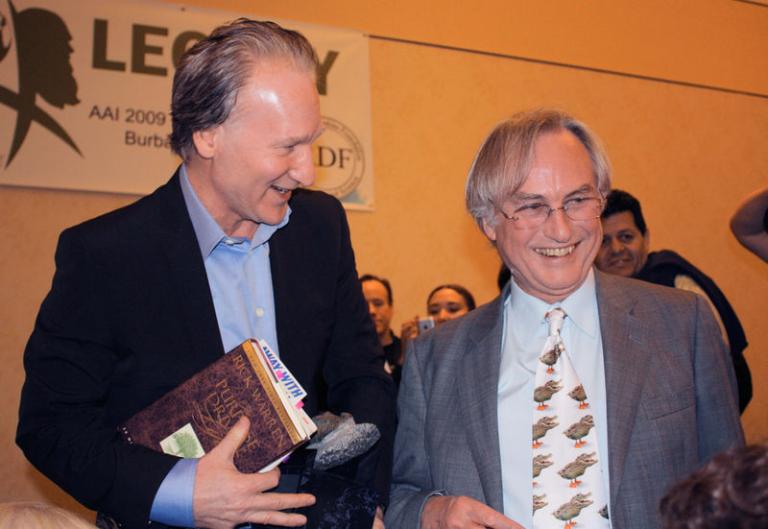
Bill Maher (on the left) and Richard Dawkins, shown here at the 2009 Atheist Alliance International meeting in Burbank, California (Wikimedia Commons public domain image)
***
Here’s some striking news involving two very vocal atheists. Unusually, I find myself siding with them:
***
I’ve had nothing to say about the recent case of the sex-therapist Natasha Helfer Parker, but I found these items valuable:
“What Natasha Helfer Parker and Her Defenders Get Wrong About Mental Health and Religion”
***
Does this next week seem to be stretching out ahead of you virtually forever, promising nothing of interest? Perhaps I can help. Here are links to some articles from a past issue of Interpreter:
Daniel C. Peterson, “Reflecting on the “Marks of Jesus””
Abstract: Loss, pain, and suffering are too often, it seems, co-sojourners through our lives. To one degree or another, we all become familiar with these elements of a life lived in an imperfect world. It is inevitable — and virtually universal — that such companions foster questions about the meaning of life and whether there is a God who is the author, director, and finisher of that meaning. For those who conclude that God is real and has part in our lives, suffering can have or acquire eternal significance, enhanced by the personal realization that God, too, suffers and has suffered. In the Christian paradigm, God shares our suffering and we, in turn, share in His. In the depths of our sorrow we have, literally, a “co-sufferer” sharing our journey. As Christians, we are called upon to take upon ourselves the name of Christ. This act not only gives us a new name, but may require us to bear loss, pain, and suffering as did Christ — to acquire the “marks of Jesus” in our own lives. Indeed, for some, such bearing may be a key part of becoming what God plans for us to become.
Brian C. Hales, “Dating Joseph Smith’s First Nauvoo Sealings”
Abstract: In the October 2015 issue of The Journal of Mormon History*, Gary Bergera presents a richly illustrated article, “Memory as Evidence: Dating Joseph Smith’s Plural Marriages to Louisa Beaman, Zina Jacobs, and Presendia Buell” (95–131). It focuses on a page from the “Historian’s Private Journal,” which Bergera dates to “specifically September or thereabouts” of 1866 (99). Wilford Woodruff’s handwriting on that page describes Joseph Smith’s plural marriage sealings and dates his marriage to Louisa Beaman to “May 1840,” to Zina Huntington on “October 27, 1840,” to Presendia Huntington on “December 11, 1840,” and also to Rhoda Richards on “June 12, 1843.” The first three dates on the historian’s document are important, as Bergera explains: “If accurate, Woodruff’s record not only pushes back the beginnings of Joseph Smith earliest Nauvoo plural marriage by a year but it also requires that we reevaluate what we think we know — and how we know it — about the beginnings of LDS polygamy” (95–96). The key question is whether the information on that page can be considered “accurate” in light of other available documents dealing with these plural sealings. During the remaining thirty-four pages of the article, Bergera presents an argument that 1840, not 1841, is the most reliable year for the Prophet’s earliest Nauvoo plural unions. This essay examines why his analysis of the records appears to be incomplete and his conclusions problematic.*
Jared Riddick, “A Pilgrim’s Faith”
Review of Russell Stevenson, Black Mormon: The Story of Elijah Ables. (self-published, 2014), 140 pp., 14.95.
Abstract: The history of the African-American community and The Church of Jesus Christ of Latter-day Saints has been a confused one since the Church’s early days. Few blacks joined the fledgling group, and those that united with the Saints met with a mixed reception. This short biography by historian Russell Stevenson is the story of one of these pioneering souls, Elijah Ables, who was also the first black priesthood holder.
Abstract: From the very beginning, Joseph’s story about the origins of the Book of Mormon seemed wild and unbelievable. Today, however, Joseph’s account enjoys a high degree of corroboration from (1) eyewitness accounts confirming Joseph’s possession of actual metal plates and other artifacts, with some even corroborating the involvement of an angel in providing access to the record; (2) eyewitness reports on the process of producing the text; and (3) evidence from the original manuscript. This evidence is reviewed here, and the implications it has for the Book of Mormon’s origin are considered.
Matthew L. Bowen, “The Scalp of Your Head: Polysemy in Alma 44:14–18”
Abstract: The fear that Moroni’s soldier’s speech (Alma 44:14) aroused in the Lamanite soldiers and the intensity of Zerahemnah’s subsequently redoubled anger are best explained by the polysemy (i.e., multiple meanings within a lexeme’s range of meaning) of a single word translated “chief” in Alma 44:14 and “heads” in Alma 44:18. As editor of a sacred history, Mormon was interested in showing the fulfilment of prophecy when such fulfilment occurred. Mormon’s description of the Lamanites “fall[ing] exceedingly fast” because of the exposure of the Lamanites’ “bare heads” to the Nephites’ swords and their being “smitten” in Alma 44:18 — just as “the scalp of their chief” was smitten and thus fell (Alma 44:12–14) — pointedly demonstrates the fulfilment of the soldier’s prophecy. In particular, the phrase “bare heads” constitutes a polysemic wordplay on “chief,” since words translated “head” can alternatively be translated “chief,” as in Alma 44:14. A similar wordplay on “top” and “leader” in 3 Nephi 4:28–29, probably again represented by a single word, also partly explains the force of the simile curse described there.
Abstract: In this article, I explore some of the opportunities and challenges that lie before us as we try to reach a better understanding of the prophetic corpus that has come to us from Joseph Smith. I turn my attention to a specific instance of these opportunities and challenges: the 21 May 1843 discourse on the doctrine of election, which Joseph Smith discussed in conjunction with the “more sure word of prophecy” mentioned in 2 Peter 1:19.
Taylor Halverson, “Reading 1 Peter Intertextually With Select Passages From the Old Testament”
Abstract: Literary studies, especially intertextual approaches, are relevant for exploring how scriptures are constructed and interpreted. Reading 1 Peter intertextually reveals the thoughtful way that Peter selected suitable, relevant, and applicable Old Testament scripture to encourage faithfulness for his audience. Peter draws from Isaiah 40 in 1 Peter 1:24-25 to preach comfort; Isaiah 40 is one of the hallmark Old Testament chapters focused on comfort. 1 Peter 2:2-3 quotes from Psalm 34 which is a hymn dedicated to the salvation that God’s servants experience when they faithfully turn to Him during times of distress and persecution. And when 1 Peter 1:16 invites people to be holy, that call is grounded in the meaning and significance of a portion of the ancient Israelite Holiness Code, Leviticus 19. In summary, Peter demonstrates his scriptural mastery by dipping his pen into some of the most appropriate Old Testament passages available to support his message of faith and encouragement to his audience.
Church of Jesus Christ of Latter-day Saints
Interpreter Journal Latter-day Saint Faith Scholarship
Previous Post

April 25, 2021
Approaching the Beatitudes (Beatitudes 1)
Next Post
April 27, 2021 Farewell, for Now, to a Friend
Browse Our Archives
Select a Category Uncategorized
Select a Month October 2026 September 2026 August 2026 July 2026 June 2026 May 2026 April 2026 March 2026 February 2026 January 2026 December 2025 November 2025 October 2025 September 2025 August 2025 July 2025 June 2025 May 2025 April 2025 March 2025 February 2025 January 2025 December 2024 November 2024 October 2024 September 2024 August 2024 July 2024 June 2024 May 2024 April 2024 March 2024 February 2024 January 2024 December 2023 November 2023 October 2023 September 2023 August 2023 July 2023 June 2023 May 2023 April 2023 March 2023 February 2023 January 2023 December 2022 November 2022 October 2022 September 2022 August 2022 July 2022 June 2022 May 2022 April 2022 March 2022 February 2022 January 2022 December 2021 November 2021 October 2021 September 2021 August 2021 July 2021 June 2021 May 2021 April 2021 March 2021 February 2021 January 2021 December 2020 November 2020 October 2020 September 2020 August 2020 July 2020 June 2020 May 2020 April 2020 March 2020 February 2020 January 2020 December 2019 November 2019 October 2019 September 2019 August 2019 July 2019 June 2019 May 2019 April 2019 March 2019 February 2019 January 2019 December 2018 November 2018 October 2018 September 2018 August 2018 July 2018 June 2018 May 2018 April 2018 March 2018 February 2018 January 2018 December 2017 November 2017 October 2017 September 2017 August 2017 July 2017 June 2017 May 2017 April 2017 March 2017 February 2017 January 2017 December 2016 November 2016 October 2016 September 2016 August 2016 July 2016 June 2016 May 2016 April 2016 March 2016 February 2016 January 2016 December 2015 November 2015 October 2015 September 2015 August 2015 July 2015 June 2015 May 2015 April 2015 March 2015 February 2015 January 2015 December 2014 November 2014 March 2014 August 2013 February 2012
Follow Us!
TAKE THE
Religious Wisdom Quiz
I am a goat released into the wilderness, carrying away the sins of the people. What am I?
Select your answer to see how you score.
An atonement goat A sin offering The scapegoat A sacrifice
Related posts from Sic et Non


Notes on Women, Priesthood, and General Conference

"The Book of Moses as a Temple Text"

TRENDING AT PATHEOS Latter-day Saint

Swimfan: Forgotten Aughts Pleasures
This is a recovery effort. In 2002, My Big Fat Greek Wedding...

Top Three Anti-Catholic Lies About Catholicism
This is my initial transcript for the video, "THE 3 WORST...

Pope Leo Celebrates Mass for Nurses & Docs...
I don't have any idea how he did it, but Pope Leo...

The Sermon on the Mount, Part I: Matthew...
The Sermon on the Mount, Part I (Matthew 4:12-5:12) St. Matthew moves...

What's up from Crossway: Reviewing some of their latest A few weeks...

Janie Learns the Way of the Cross: A...
Teaching children about Jesus' Passion can be challenging. Many parents and educators...
view all Latter-day Saint blogs
Ad-Free & Subscriber Log-In Subscription Support
- About Us
- 2026 Calendar
- Videos
- Podcasts
- Library of World Religions
- Faith In Media Tracker
- Advertise With Us
- Write for Us
- Privacy Policy
- Terms of Service
- Do Not Sell My Data
- Contact Us
- Radiant Digital
- Manage Newsletter Subscriptions
- Unsubscribe From Notifications
- Sitemap
Copyright 2008-2026, Patheos. All rights reserved.
Subscription Support Ad-Free & Subscriber Log-In
Follow Patheos