
BuddhistCatholicContemplativeEvangelicalGeneral ChristianHinduJewishLatter-day SaintMuslimNew VisionsProgressive Christian
Beliefs
- Buddhist
- Catholic
- Contemplative
- Evangelical
- General Christian
- Hindu
- Jewish
- Latter-day Saint
- More Voices
- Muslim
- New Visions
- Pagan
- Progressive Christian
Topics
- Religion News
- Food and Religion
- Sports and Religion
- Religious Art
- Religious Music and Entertainment
- Religious Events
- History and Religion
- Style and Religion
- Politics and Religion
- Women in Religion
- Recreation Outdoors and Religion
- Business Finance and Religion
- Careers Workplace and Religion
- Education and Religion
- Family Parenting and Religion
- Health Fitness and Religion
- Home and Religion
- Relationships and Religion
- Technology and Religion
- Travel and Religion
Columnists
- Buddhist Columnists
- Business Finance and Religion Columnists
- Careers Workplace and Religion Columnists
- Catholic Columnists
- Contemplative Columnists
- Education and Religion Columnists
- Evangelists Columnists
- Family Parenting and Religion Columnists
- General Christian Columnists
- Health Fitness and Religion Columnists
- Hindu Columnists
- History and Religion Columnists
- Home and Religion Columnists
- Jewish Columnists
- More Voices Columnists
- Latter Day Columnists
- Muslim Columnists
- New Visions Columnists
- Nonreligious Columnists
- Pagan Columnists
- Politics and Religion Columnists
- Progressive Columnists
- Recreation Outdoors and Religion Columnists
- Relationships and Religion Columnists
- Religion News Columnists
- Religious Art Columnists
- Religious Events Columnists
- Religious Music and Entertainment Columnists
- Sports and Religion Columnists
- Style and Religion Columnists
- Technology and Religion Columnists
- Travel and Religion Columnists
- Women in Religion Columnists
Resource Library
- 2026 Calendar
- Library of World Religions
- The 100 Most Holy Places on Earth
- Patheos Answers
- Podcasts
- Videos
- Faith Leaders Database
- Anglican Episcopalian
- Bahai
- Baptist
- Buddhism
- Christianity
- Confucianism
- Eastern Orthodoxy
- Hinduism
- Holiness and Pentecostal
- ISKCON
- Islam
- Judaism
- Lutheran
- Methodist
- The Church of Jesus Christ of Latter-day Saints
- New Age
- Paganism
- Presbytarian and Reformed
- Protestantism
- Religion Behind the Scenes
- Roman Catholic
- Scientology
- Shia Islam
- Sikhism
- Sufism
- Sunni Islam
- Taoism
- Zen
- See all religions
Research Tools
 Ad-Free & Subscriber Log-In Subscription Support
Ad-Free & Subscriber Log-In Subscription Support
Follow Patheos 

- Trending:
- Forgiveness
- |
- Marriage
- |
- Consciousness
- |
- Death Penalty
- |
- Election
- |
- Halloween

- Home
- Latter-day Saint
- “The Man Who Knew Infinity” (Part Two)
“The Man Who Knew Infinity” (Part Two)
Last updated on: April 17, 2021 at 9:57 pm by Dan Peterson
“The Man Who Knew Infinity” (Part Two) 2021-04-17T21:57:16-06:00 Dan Peterson
Patheos Explore the world's faith through different perspectives on religion and spirituality! Patheos has the views of the prevalent religions and spiritualities of the world.
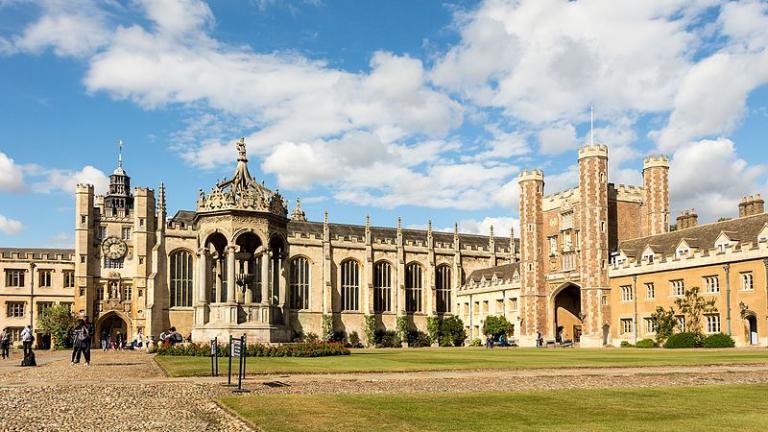
The “Great Court” of Trinity College, Cambridge, where G. H. Hardy spent his career and where Ramanujan was a Fellow
(Wikimedia Commons public domain image)
***
First of all, I’ve just become aware that Edward Idris Cardinal Cassidy passed away a week ago today, 10 April 2021, at the age of 96. I had the privilege of meeting with Cardinal Cassidy on two separate occasions, once in Rome (or, more precisely, in Vatican City) and once in Sydney, Australia, after he had retired from his service in the Vatican. He was — he is — a genial, kind, and open-minded man, and I respect him very much. I’ll have some more to say about him, and about my two experiences with him, in a day or two.
***
Continued from “The Man Who Knew Infinity (Part One)”:
I carry on now with notes taken from (and/or inspired by) Robert Kanigel, The Man Who Knew Infinity: A Life of the Genius Ramanujan (New York and London: Washington Square Press, 1991):
In the 1930s, E. T. Bell would remark that Ramanujan had broken the rules by which mathematicians evaluate their own. “When a truly great [algorist, or formalist] like the Hindu Ramanujan arrives unexpectedly out of nowhere, even expert analysts hail him as a gift from heaven,” he wrote, crediting him with “all but supernatural insight” into hidden connections between seemingly unrelated formulas.
Supernatural insight.
A gift from Heaven.
It is uncanny how often otherwise dogged rationalists have, over the years, turned to the language of the shaman and the priest to convey something of Ramanujan’s gifts. . . . And repeatedly they have been reduced to inchoate expressions of wonder and awe in the face of his powers, have stumbled about, groping for words, in trying to convey the mystery of Ramanujan.
“We have no idea how he did the marvelous things he did, what led him to them, or anything else,” says mathematician Richard Askey, a Ramanujan scholar at the University of Wisconsin in Madison. Says Bruce Berndt, after years of working through Ramanujan’s notebooks: “I still don’t understand it all. I may be able to prove it, but I don’t know where it comes from and where it fits into the rest of mathematics.” He adds at another point, “The enigma of Ramanujan’s creative process is still covered by a curtain that has scarcely been drawn.” (280)
J. E. Littlewood essentially surrenders in perplexity when trying to understand Ramanujan’s thought processes:
There is, indeed, a touch of real mystery [here]. If only we knew [the result in advance], we might be forced, by slow stages, to the correct form of [Psi sub q, symbols that I can’t reproduce on this blog]. But why was Ramanujan so certain there was one? Theoretical insight, to be the explanation, had to be of an order hardly to be credited. Yet it is hard to see what numerical instances could have been available to suggest so strong a result. And unless the form of [Psi sub q] was known already, no numerical evidence could suggest anything of the kind — there seems no escape, at least, from the conclusion that the discovery of the correct form was a single stroke of insight. (Cited at 280-281)
To borrow terminology suggested by the Polish emigré mathematician Mark Kac, Ramanujan was actually a “magician,” rather than an “ordinary genius”:
An ordinary genius is a fellow that you and I would be just as good as, if we were only many times better. There is no mystery as to how his mind works. Once we understand what he has done, we feel certain that we, too, could have done it. It is different with the magicians. They are, to use mathematical jargon, in the orthogonal complement of where we are and the working of their minds is for all intents and purposes incomprehensible. Even after we understand what they have done, the process by which they have done it is completely dark. (Cited at 281)
Kanigel reacts to such statements in a striking way:
Mystery, magic, and dark, hidden workings inaccessible to ordinary thought; it is these that Ramanujan’s work invariably conjures up, a sense of reason butting hard up against its limits.
But at reason’s limits does something else take over? Do we here flirt with spiritual or supernatural forces outside our understanding? (281)
Ramanujan himself plainly thought so. Kanigel cites reminiscences from fellow-Indians who knew him:
T. K. Rajagopolan, a former accountant general of Madras, would tell of Ramanujan’s insistence that after seeing in dreams the drops of blood that, according to tradition, heralded the presence of the god Narasimha, the male consort of the goddess Namagiri, “scrolls containing the most complicated mathematics used to unfold before his eyes.”
R. Radhakrishna Iyer, a classmate at Pachaiyappa’s College, recalled one day asking Ramanujan about his research only to have him reply, in Radhakrishna’s words, “that Lord Narasimha had appeared to him in a dream and told him that the time had not come for making public the fruits of his research.”
And it was on a day about a year before he left for England, in 1912 or early 1913, that Ramanujan, showing his work to mathematics professor R. Srinivasan, made the statement in which he pictured equations as products of the mind of God. (281-282)
Some, though — starting with Ramanujan’s zealously atheistic mathematical mentor, the great G. H. Hardy — have sought to downplay or even to dispute Ramanujan’s deep spirituality:
[M]ost Western observers, and some Indians, have wholly detached Ramanujan’s mystical streak from his mysterious ability to forge new mathematical linkages. Hailing the one, they’ve dismissed the other. (283)
Kanigel thinks that they are wrong to do so but, in the end, he too — a Western rationalist — wants to make Ramanujan’s creativity purely internal, psychological. He believes that the Indian’s credulity opened his mind in a unique way to intuition, to his own unconscious. Even G. H. Hardy was open, just a little tiny bit and rather reluctantly, to a role for the subconscious in mathematical thinking. But Kanigel isn’t quite sure of his own position:
But it was Hardy, the dedicated atheist, who represented the extreme position, and Ramanujan who was more in line with the large body of belief and conviction, within the Western tradition as well as that of the East, that perceived links between creativity and intuition on the one hand and spiritual forces on the other.
The Greeks, for example, invoked the muses — goddesses to whom poets looked for inspiration. Both the English and French languages speak of “divining” the truth. (286-287)
Just as India was not alone in attributing creative insights to divine influence, Ramanujan was not alone among mathematicians in holding strong religious beliefs. Newton was an unquestioning believer, felt humility in the face of the universe’s wonders, studied theology on his own. [The great eighteenth-century Swiss mathematician Leonhard] Euler, in E. T. Bell’s words, “never discarded a particle of his Calvinistic faith,” and grew more religious as he grew older. [The famous early-nineteenth-century French mathematician Augustin-Louis] Cauchy was forever trying to convert other mathematicians to Roman Catholicism. [The nineteenth-century French mathematician Charles] Hermite had a strong mystical bent. Even Descartes, that father of Enlightenment rationality, answered the call of the spirit: “His religious beliefs were unaffectedly simple in spite of his rational skepticism,” writes Bell. “He compared his religion, indeed, to the nurse from whom he had received it, and declared that he found it as comforting to lean upon one as on the other.” (287)
But, of course, the issue isn’t merely whether mathematicians can “hold strong religious beliefs.” Obviously they can do so, and sometimes they actually do. Ramanujan, however, wasn’t merely religious. He believed that his mathematical insights came to him by revelation. And he has company, in that regard:
Even among mathematicians not religiously minded, one finds evidence of at least respectful allusion to the dark terrain between faith and reason. [The preeminent nineteenth-century German mathematician Carl Friedrich] Gauss, for example, once proved a theorem, as he wrote, “not by dint of painful effort but so to speak by the grace of God.” James Hopwood Jeans, Hardy’s Cambridge classmate and a famous applied mathematician, wrote: “From the intrinsic evidence of his creation, the Great Architect of the Universe now begins to appear as a pure mathematician.” Even Littlewood, commenting on an incident in which “my pencil wrote down” the solution to a particularly bedeviling problem, could write, “If we may reject divine bounty, it happened exactly as if my subconsciousness knew the thing all the time.” Littlewood’s, of course, was the usual safe, ironic Cambridge skepticism, perhaps no more than a stylistic device — just as the other statements may be seen as no more than metaphor, Yet each contained the barest breath of ambivalence or humility in the face of the mysterious origins of human creativity. (287-288)
[Another excellent example that might have been included here is that of Blaise Pascal. I’ll write and post something about his case fairly soon. Perhaps also Henri Poincaré, if I’m not misremembering.]
There is much to think about here: A Latter-day Saint perspective would certainly allow, and perhaps insist on, the likelihood of genuinely prompting divine revelation in such cases.
And there is matter to think about not just on that particular subject: Robert Kanigel explicitly raises one question in this next paragraph, about the great loss suffered by mathematics because Ramanujan went so long without adequate mathematical education and because he died so very, very young, and indirectly suggests another: Isn’t it astonishing that purely theoretical mathematical ideas that have been worked out in isolation by a genius who knew nothing about chemistry, computers, or oncology can be found relevant to those fields (and others) decades after his death? This is precisely the issue raised by the famous 1960 essay “The Unreasonable Effectiveness of Mathematics in the Natural Sciences” by the Hungarian-American theoretical physicist Eugene Wigner, who would go on to win the 1963 Nobel Prize in Physics.
Writes Kanigel:
“Srinivasa Ramanujan,” an Englishman would later say of him, “was a mathematician so great that his name transcends jealousies, the one superlatively great mathematician whom India has produced in the last thousand years.” His leaps of intuition confound mathematicians even today, seven decades [now almost exactly 101 years] after his death. His papers are still plumbed for their secrets. His theorems are being applied in areas — polymer chemistry, computers, even (it has recently been suggested) cancer — scarcely imaginable during his lifetime. And always the nagging question: What might have been, had he been discovered a few years earlier, or lived a few years longer? (3)
Another question that Ramanujan’s story raises is, How many geniuses — with enormous gifts not only for mathematics but for business and literature and law and physics and statecraft and art and genetics and medicine and economics and scores of other fields — go utterly unrecognized, are lost in poverty, die too early, leaving their enormous potential untapped and even unknown? And what cures for cancer were lost at Bergen-Belsen and Dachau? What great novels and plays were snuffed out in the Gulag or the Cambodian “killing fields” before their authors ever put pen to paper or, perhaps, even conceived them? What contributions to science and art, literature and government, commerce and medicine have been lost in abortion clinics?
Thus Kanigel:
It is a story of one man and his stubborn faith in his own abilities. But it is not a story that concludes, Genius will out — though Ramanujan’s, in the main, did. Because so nearly did events turn out otherwise that we need no imagination to see how the least bit less persistence, or the least bit less luck, might have consigned him to obscurity. In a way, then, this is also a story about social and educational systems, and about how they matter, and how they can sometimes nurture talent and sometimes crush it. How many Ramanujans, his life begs us to ask, dwell in India today, unknown and unrecognized? And how many in America and Britain, locked away in racial or economic ghettos, scarcely aware of worlds outside their own? (3-4)
And, finally, on the question of whether mathematical facts or objects really objectively exist, of whether mathematicians “invent” them or “discover” them — Ramanujan plainly sided with those who believe them to be objectively real — G. H. Hardy offered a strikingly strong statement of what seems to be a realist position. In a 1928 Cambridge lecture, he said the following:
I have always thought of a mathematician as in the first instance an observer, a man who gazes at a distant range of mountains and notes down his observations. His object is simply to distinguish clearly and notify to others as many different peaks as he can. There are some peaks which he can distinguish easily, while others are less clear. He sees A sharply, while of B he can obtain only transitory glimpses. At last he makes out a ridge which leads from A, and following it to its end he discovers that it culminates in B. B is now fixed in his vision, and from this point he can proceed to further discoveries. In other cases perhaps he can distinguish a ridge which vanishes in the distances, and conjectures that it leads to a peak in the clouds or below the horizon. (cited at 285)
It seems, as was suggested in Part One of this entry, almost a religious vision. I’m happily inclined to believe that G. H. Hardy was religious, or spiritual, in his own way, as Srinivasa Ramanujan certainly was. May God bless them both.
Posted from Park City, Utah
Previous Post

April 16, 2021
Some reminiscences about how in the world I got onto the BYU faculty
Browse Our Archives
Select a Category Uncategorized
Select a Month October 2026 September 2026 August 2026 July 2026 June 2026 May 2026 April 2026 March 2026 February 2026 January 2026 December 2025 November 2025 October 2025 September 2025 August 2025 July 2025 June 2025 May 2025 April 2025 March 2025 February 2025 January 2025 December 2024 November 2024 October 2024 September 2024 August 2024 July 2024 June 2024 May 2024 April 2024 March 2024 February 2024 January 2024 December 2023 November 2023 October 2023 September 2023 August 2023 July 2023 June 2023 May 2023 April 2023 March 2023 February 2023 January 2023 December 2022 November 2022 October 2022 September 2022 August 2022 July 2022 June 2022 May 2022 April 2022 March 2022 February 2022 January 2022 December 2021 November 2021 October 2021 September 2021 August 2021 July 2021 June 2021 May 2021 April 2021 March 2021 February 2021 January 2021 December 2020 November 2020 October 2020 September 2020 August 2020 July 2020 June 2020 May 2020 April 2020 March 2020 February 2020 January 2020 December 2019 November 2019 October 2019 September 2019 August 2019 July 2019 June 2019 May 2019 April 2019 March 2019 February 2019 January 2019 December 2018 November 2018 October 2018 September 2018 August 2018 July 2018 June 2018 May 2018 April 2018 March 2018 February 2018 January 2018 December 2017 November 2017 October 2017 September 2017 August 2017 July 2017 June 2017 May 2017 April 2017 March 2017 February 2017 January 2017 December 2016 November 2016 October 2016 September 2016 August 2016 July 2016 June 2016 May 2016 April 2016 March 2016 February 2016 January 2016 December 2015 November 2015 October 2015 September 2015 August 2015 July 2015 June 2015 May 2015 April 2015 March 2015 February 2015 January 2015 December 2014 November 2014 March 2014 August 2013 February 2012
Follow Us!
TAKE THE
Religious Wisdom Quiz
What animal is mentioned in Proverbs as having little strength but great wisdom?
Select your answer to see how you score.
Ant Ox Bear Lion
Related posts from Sic et Non



“Once more unto the breach, dear friends, once...

Created or Discovered? (Part Two)
TRENDING AT PATHEOS Latter-day Saint

Nearly every morning, I make the drive to Detroit with my high-school-age...

The Real AI Story Is Adoption Without Trust
Artificial intelligence has crossed a political threshold. It is no longer a...

A new article, written by Jeff Lindsay and Gale L. Pooley,...

Swimfan: Forgotten Aughts Pleasures
This is a recovery effort. In 2002, My Big Fat Greek Wedding...

Top Three Anti-Catholic Lies About Catholicism
This is my initial transcript for the video, "THE 3 WORST...

Pope Leo Celebrates Mass for Nurses & Docs...
I don't have any idea how he did it, but Pope Leo...
view all Latter-day Saint blogs
Ad-Free & Subscriber Log-In Subscription Support
- About Us
- 2026 Calendar
- Videos
- Podcasts
- Library of World Religions
- Faith In Media Tracker
- Advertise With Us
- Write for Us
- Privacy Policy
- Terms of Service
- Do Not Sell My Data
- Contact Us
- Radiant Digital
- Manage Newsletter Subscriptions
- Unsubscribe From Notifications
- Sitemap
Copyright 2008-2026, Patheos. All rights reserved.
Subscription Support Ad-Free & Subscriber Log-In
Follow Patheos