
BuddhistCatholicContemplativeEvangelicalGeneral ChristianHinduJewishLatter-day SaintMuslimNew VisionsProgressive Christian
Beliefs
- Buddhist
- Catholic
- Contemplative
- Evangelical
- General Christian
- Hindu
- Jewish
- Latter-day Saint
- More Voices
- Muslim
- New Visions
- Pagan
- Progressive Christian
Topics
- Religion News
- Food and Religion
- Sports and Religion
- Religious Art
- Religious Music and Entertainment
- Religious Events
- History and Religion
- Style and Religion
- Politics and Religion
- Women in Religion
- Recreation Outdoors and Religion
- Business Finance and Religion
- Careers Workplace and Religion
- Education and Religion
- Family Parenting and Religion
- Health Fitness and Religion
- Home and Religion
- Relationships and Religion
- Technology and Religion
- Travel and Religion
Columnists
- Buddhist Columnists
- Business Finance and Religion Columnists
- Careers Workplace and Religion Columnists
- Catholic Columnists
- Contemplative Columnists
- Education and Religion Columnists
- Evangelists Columnists
- Family Parenting and Religion Columnists
- General Christian Columnists
- Health Fitness and Religion Columnists
- Hindu Columnists
- History and Religion Columnists
- Home and Religion Columnists
- Jewish Columnists
- More Voices Columnists
- Latter Day Columnists
- Muslim Columnists
- New Visions Columnists
- Nonreligious Columnists
- Pagan Columnists
- Politics and Religion Columnists
- Progressive Columnists
- Recreation Outdoors and Religion Columnists
- Relationships and Religion Columnists
- Religion News Columnists
- Religious Art Columnists
- Religious Events Columnists
- Religious Music and Entertainment Columnists
- Sports and Religion Columnists
- Style and Religion Columnists
- Technology and Religion Columnists
- Travel and Religion Columnists
- Women in Religion Columnists
Resource Library
- 2026 Calendar
- Library of World Religions
- The 100 Most Holy Places on Earth
- Patheos Answers
- Podcasts
- Videos
- Faith Leaders Database
- Anglican Episcopalian
- Bahai
- Baptist
- Buddhism
- Christianity
- Confucianism
- Eastern Orthodoxy
- Hinduism
- Holiness and Pentecostal
- ISKCON
- Islam
- Judaism
- Lutheran
- Methodist
- The Church of Jesus Christ of Latter-day Saints
- New Age
- Paganism
- Presbytarian and Reformed
- Protestantism
- Religion Behind the Scenes
- Roman Catholic
- Scientology
- Shia Islam
- Sikhism
- Sufism
- Sunni Islam
- Taoism
- Zen
- See all religions
Research Tools
 Ad-Free & Subscriber Log-In Subscription Support
Ad-Free & Subscriber Log-In Subscription Support
Follow Patheos 

- Trending:
- Forgiveness
- |
- Marriage
- |
- Consciousness
- |
- Death Penalty
- |
- Election
- |
- Halloween

- Home
- Latter-day Saint
- “Resurrection Month”
“Resurrection Month”
Last updated on: April 3, 2021 at 6:06 pm by Dan Peterson
“Resurrection Month” 2021-04-03T18:06:13-06:00 Dan Peterson
Patheos Explore the world's faith through different perspectives on religion and spirituality! Patheos has the views of the prevalent religions and spiritualities of the world.
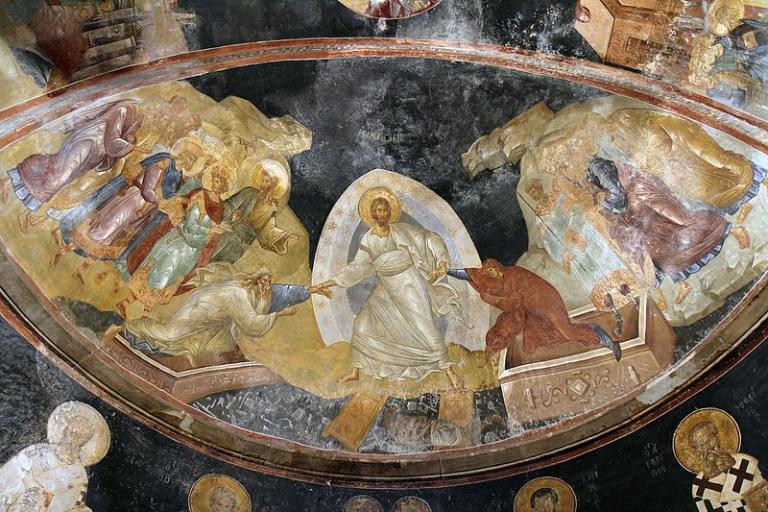
Between his crucifixion and his resurrection, Christ visits the world of spirits and, taking them by the end, lifts Adam and Eve from their lost state. This fresco appears in Istanbul’s (Constantinople’s) marvelous “Chora Church.”
(Wikimedia Commons public domain image)
***
The new article that went up today in Interpreter: A Journal of Latter-day Saint Faith and Scholarship is our annual Easter article — though, for reasons that I fully understand and with which I can sympathize, its author, Claudia Bushman, is not overly fond of that word, Easter:
Abstract: We tend to have big events and a full month celebrating Christmas, but here we are in a very Christian church that has come to almost ignore the events of the crucifixion and the resurrection. The Last Supper and the events that followed it are the important events of the season. With some planning and creativity, we can immerse ourselves in a Resurrection Month by thinking about the gift of life and promise for the future that we have been given, reading the old scriptures, and reliving the life and times of our elder brother and great teacher.
***
A reader of this blog named Nathan Whilk has kindly reminded me of the epitaph for Joy Davidman, C. S. Lewis’s American-born wife. It’s wonderfully appropriate for this season of the year:
Here the whole world (stars, water, air,
And field, and forest, as they were
Reflected in a single mind)
Like cast off clothes was left behind
In ashes, yet with hopes that she,
Re-born from holy poverty,
In lenten lands, hereafter may
Resume them on her Easter Day.
***
A. Keith Thompson, “The Doctrine of Resurrection in the Book of Mormon”
Abstract: The doctrine of resurrection was taught by Lehi and Jacob among the first Nephites but was not mentioned again in the record until the time of Abinadi, perhaps 350 years later. In the court of King Noah that doctrine and the idea of a suffering Messiah who would bear the sins of his people and redeem them, were heresies and Abinadi paid for them with his life. While Abinadi’s testimony converted Alma1 and the doctrine of the resurrection inspired Alma2 after his conversion, it was a source of schism in the church at Zarahemla along lines that remind us of the Sadducees at Jerusalem. The doctrine of the resurrection taught in the Book of Mormon is a precursor to the doctrine now understood by the Latter-day Saints in the light of modern revelation. One example is that the Nephite prophets used the term first resurrection differently than we do. But perhaps the most remarkable thing about the way that the doctrine of resurrection develops in the Book of Mormon, is that it develops consistently. That consistency bears further testimony to the prophetic mission of Joseph Smith. He could not have done that by himself.
Matthew L. Bowen, “Not Leaving and Going On to Perfection”
A Review of Samuel M. Brown’s First Principles and Ordinances: The Fourth Article of Faith in Light of the Temple*, Provo, UT: Neal A. Maxwell Institute, 2014. 167 pp., index. $16.95.*
Neal Rappleye, “Learning Nephi’s Language: Creating a Context for 1 Nephi 1:2”
Abstract: The claim that God revealed the details of Book of Mormon geography is not new, but the recent argument that there was a conspiracy while the Prophet was still alive to oppose a revealed geography is a novel innovation. A recent theory argues that the “Mesoamerican theory” or “limited Mesoamerican geography” originated in 1841 with Benjamin Winchester, an early Mormon missionary, writer, and dissident, who rejected the leadership of Brigham Young and the Twelve after 1844. This theory also claims that three unsigned editorials on Central America and the Book of Mormon published in the Times and Seasons on September 15 and October 1, 1842 were written by Benjamin Winchester, who successfully conspired with other dissidents to publish them against the will of the Prophet. Three articles address these claims. This first article addresses two questions: Did Joseph Smith, as some have claimed, know the details of and put forth a revealed Book of Mormon geography? Second, what is a Mesoamerican geography and does it constitute a believable motive for a proposed Winchester conspiracy?
Abstract: The claim that God revealed the details of Book of Mormon geography is not new, but the recent argument that there was a conspiracy while the Prophet was still alive to oppose a revealed geography is a novel innovation. A recent theory argues that the “Mesoamerican theory” or “limited Mesoamerican geography” originated in 1841 with Benjamin Winchester, an early Mormon missionary, writer, and dissident, who rejected the leadership of Brigham Young and the Twelve after 1844. This theory also claims that three unsigned editorials on Central America and the Book of Mormon published in the Times and Seasons on September 15 and October 1, 1842, were written by Benjamin Winchester, who successfully conspired with other dissidents to publish them against the will of the Prophet. Three articles address these claims. The first article addressed two questions: Did Joseph Smith, as some have claimed, know the details of and put forth a revealed Book of Mormon geography? Second, what is a Mesoamerican geography and does it constitute a believable motive for a proposed Winchester conspiracy? This second article provides additional historical background on the question of Joseph Smith’s thinking on the Book of Mormon by examining the influence of John L. Stephen’s 1841 work, Incidents of Travel in Central America*, upon early Latter-day Saints, including Joseph Smith.*
Steven T. Densley, Jr., “A Treasure Trove of Quotations”
A review of James E. Faulconer, The New Testament Made Harder: Scripture Study Questions. The Neal A. Maxwell Institute for Religious Scholarship, 2015, 518 pages with endnotes. $21.95 (paperback).
Abstract: The New Testament Made Harder is a book that collects study questions that follow the Gospel Doctrine reading schedule. The book contains very little commentary and does not provide answers to the questions posed. The main objective is not to provide information, but rather to encourage students of the New Testament to think more deeply about what they are reading. For those who are willing to put forth the effort, they will find this book to be a helpful tool in learning to analyze the scriptures more closely.
Abstract: The crux of the creation–evolution conflict is a futile desire to scientifically prove or disprove the existence of God. The conflict is manifest in the common belief that creation means a divine, supernatural process and that evolution denotes an atheistic, accidental event. Evolution involves a random change in an inherited trait followed by selection for or against the altered trait. If humans use this principle to design machines, solve complex mathematical problems, engineer proteins, and manipulate living organisms, then certainly a super-intelligent being could have used evolution to create life on earth. This reasoning indicates that evolution does not prove atheism and that evolution is a constructive process. The theory of evolution is a mechanistic description and therefore, like all other scientific principles, is neutral on the question of God’s existence. Evolution is compatible with the simple scriptural accounts of creation. Consequently, belief or unbelief in God is put back where it should be — on individual choice.
Previous Post

April 1, 2021
Serving the Cause by Getting the Shot, and Observing Hugh Nibley
Next Post
April 3, 2021 "But I tell you, I saw it!"
Browse Our Archives
Select a Category Uncategorized
Select a Month October 2026 September 2026 August 2026 July 2026 June 2026 May 2026 April 2026 March 2026 February 2026 January 2026 December 2025 November 2025 October 2025 September 2025 August 2025 July 2025 June 2025 May 2025 April 2025 March 2025 February 2025 January 2025 December 2024 November 2024 October 2024 September 2024 August 2024 July 2024 June 2024 May 2024 April 2024 March 2024 February 2024 January 2024 December 2023 November 2023 October 2023 September 2023 August 2023 July 2023 June 2023 May 2023 April 2023 March 2023 February 2023 January 2023 December 2022 November 2022 October 2022 September 2022 August 2022 July 2022 June 2022 May 2022 April 2022 March 2022 February 2022 January 2022 December 2021 November 2021 October 2021 September 2021 August 2021 July 2021 June 2021 May 2021 April 2021 March 2021 February 2021 January 2021 December 2020 November 2020 October 2020 September 2020 August 2020 July 2020 June 2020 May 2020 April 2020 March 2020 February 2020 January 2020 December 2019 November 2019 October 2019 September 2019 August 2019 July 2019 June 2019 May 2019 April 2019 March 2019 February 2019 January 2019 December 2018 November 2018 October 2018 September 2018 August 2018 July 2018 June 2018 May 2018 April 2018 March 2018 February 2018 January 2018 December 2017 November 2017 October 2017 September 2017 August 2017 July 2017 June 2017 May 2017 April 2017 March 2017 February 2017 January 2017 December 2016 November 2016 October 2016 September 2016 August 2016 July 2016 June 2016 May 2016 April 2016 March 2016 February 2016 January 2016 December 2015 November 2015 October 2015 September 2015 August 2015 July 2015 June 2015 May 2015 April 2015 March 2015 February 2015 January 2015 December 2014 November 2014 March 2014 August 2013 February 2012
Follow Us!
TAKE THE
Religious Wisdom Quiz
I was rejected by God as king for offering an unauthorized sacrifice instead of waiting. Who am I?
Select your answer to see how you score.
Saul Solomon Rehoboam David
Related posts from Sic et Non


Some notes on the archaeology of the Bible

An action movie and some vacuous theology

TRENDING AT PATHEOS Latter-day Saint

Pope Leo Celebrates Mass for Nurses & Docs...
I don't have any idea how he did it, but Pope Leo...

The Sermon on the Mount, Part I: Matthew...
The Sermon on the Mount, Part I (Matthew 4:12-5:12) St. Matthew moves...

What's up from Crossway: Reviewing some of their latest A few weeks...

Janie Learns the Way of the Cross: A...
Teaching children about Jesus' Passion can be challenging. Many parents and educators...

Looking For Good Catholic Writing - October 2026
He alone extends the heavens, and he walks upon the waves of...

In "Irreplaceable," our book on vocation and technology, Trevor Sutton and I...
view all Latter-day Saint blogs
Ad-Free & Subscriber Log-In Subscription Support
- About Us
- 2026 Calendar
- Videos
- Podcasts
- Library of World Religions
- Faith In Media Tracker
- Advertise With Us
- Write for Us
- Privacy Policy
- Terms of Service
- Do Not Sell My Data
- Contact Us
- Radiant Digital
- Manage Newsletter Subscriptions
- Unsubscribe From Notifications
- Sitemap
Copyright 2008-2026, Patheos. All rights reserved.
Subscription Support Ad-Free & Subscriber Log-In
Follow Patheos