
BuddhistCatholicContemplativeEvangelicalGeneral ChristianHinduJewishLatter-day SaintMuslimNew VisionsProgressive Christian
Beliefs
- Buddhist
- Catholic
- Contemplative
- Evangelical
- General Christian
- Hindu
- Jewish
- Latter-day Saint
- More Voices
- Muslim
- New Visions
- Pagan
- Progressive Christian
Topics
- Religion News
- Food and Religion
- Sports and Religion
- Religious Art
- Religious Music and Entertainment
- Religious Events
- History and Religion
- Style and Religion
- Politics and Religion
- Women in Religion
- Recreation Outdoors and Religion
- Business Finance and Religion
- Careers Workplace and Religion
- Education and Religion
- Family Parenting and Religion
- Health Fitness and Religion
- Home and Religion
- Relationships and Religion
- Technology and Religion
- Travel and Religion
Columnists
- Buddhist Columnists
- Business Finance and Religion Columnists
- Careers Workplace and Religion Columnists
- Catholic Columnists
- Contemplative Columnists
- Education and Religion Columnists
- Evangelists Columnists
- Family Parenting and Religion Columnists
- General Christian Columnists
- Health Fitness and Religion Columnists
- Hindu Columnists
- History and Religion Columnists
- Home and Religion Columnists
- Jewish Columnists
- More Voices Columnists
- Latter Day Columnists
- Muslim Columnists
- New Visions Columnists
- Nonreligious Columnists
- Pagan Columnists
- Politics and Religion Columnists
- Progressive Columnists
- Recreation Outdoors and Religion Columnists
- Relationships and Religion Columnists
- Religion News Columnists
- Religious Art Columnists
- Religious Events Columnists
- Religious Music and Entertainment Columnists
- Sports and Religion Columnists
- Style and Religion Columnists
- Technology and Religion Columnists
- Travel and Religion Columnists
- Women in Religion Columnists
Resource Library
- 2026 Calendar
- Library of World Religions
- The 100 Most Holy Places on Earth
- Patheos Answers
- Podcasts
- Videos
- Faith Leaders Database
- Anglican Episcopalian
- Bahai
- Baptist
- Buddhism
- Christianity
- Confucianism
- Eastern Orthodoxy
- Hinduism
- Holiness and Pentecostal
- ISKCON
- Islam
- Judaism
- Lutheran
- Methodist
- The Church of Jesus Christ of Latter-day Saints
- New Age
- Paganism
- Presbytarian and Reformed
- Protestantism
- Religion Behind the Scenes
- Roman Catholic
- Scientology
- Shia Islam
- Sikhism
- Sufism
- Sunni Islam
- Taoism
- Zen
- See all religions
Research Tools
 Ad-Free & Subscriber Log-In Subscription Support
Ad-Free & Subscriber Log-In Subscription Support
Follow Patheos 

- Trending:
- Forgiveness
- |
- Marriage
- |
- Consciousness
- |
- Death Penalty
- |
- Election
- |
- Halloween

- Home
- Latter-day Saint
- “And the One Pointed the Way: Issues of Interpretation and Translation Involving the Liahona”
“And the One Pointed the Way: Issues of Interpretation and Translation Involving the Liahona”
Last updated on: April 30, 2021 at 6:57 pm by Dan Peterson
“And the One Pointed the Way: Issues of Interpretation and Translation Involving the Liahona” 2021-04-30T18:57:16-06:00 Dan Peterson
Patheos Explore the world's faith through different perspectives on religion and spirituality! Patheos has the views of the prevalent religions and spiritualities of the world.
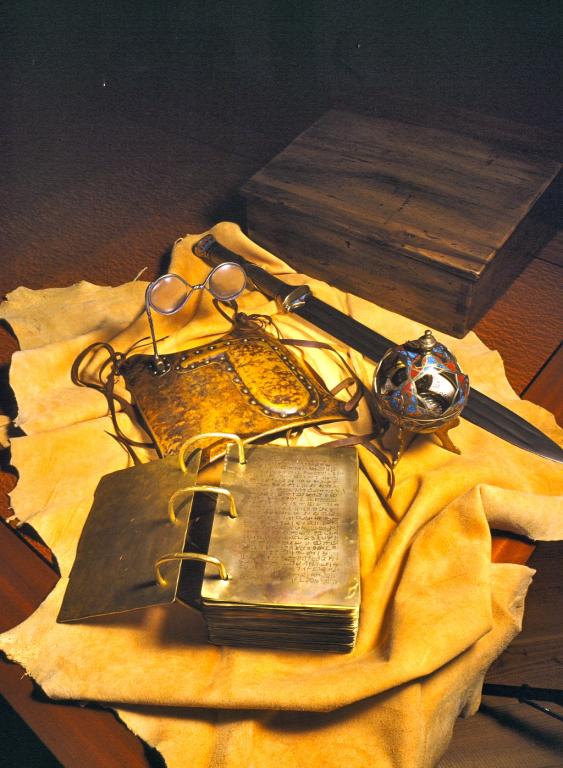
Twenty-first century re-creations of the golden plates, the Liahona, the Urim and Thummim, the sword of Laban, and the breastplate, made by David A. Baird. Brother Baird also created the plates used in the Interpreter Foundation’s forthcoming “Witnesses” film
***
This new article appeared earlier today in Interpreter: A Journal of Latter-day Saint Faith and Scholarship:
Loren Blake Spendlove, “And the One Pointed the Way: Issues of Interpretation and Translation Involving the Liahona”
Abstract: In describing the operation of the spindles in the Liahona, Nephi’s statement that “the one pointed the way” in 1 Nephi 16:10 is frequently taken to mean that one of the two spindles indicated the direction to travel. However, Nephi’s apparent use of the Hebrew word האחד (ha’echad)1 may imply a different mechanism in which the direction was being shown when both operated as one. If so, there may be added symbolism of unity and oneness inherent in Nephi’s and Alma’s descriptions of the Liahona. Additionally, I provide a detailed analysis of words and phrases used by Nephi and Alma to describe the Liahona which potentially reveal intriguing Hebrew wordplay in the text.
So did this announcement:
“Tickets for the Witnesses Film Now On Sale”
Including a link to yesterday’s televised announcement of the opening of ticket sales on ABC4’s “Daily Dish” Entertainment segment
***
And here are links to some previously-published articles in Interpreter:
Loren Blake Spendlove and Tina Spendlove, “Turning to the Lord With the Whole Heart: The Doctrine of Repentance in the Bible and the Book of Mormon”
Abstract: Repentance is considered one of the foundational principles of the gospel. As demonstrated in this article, there is a harmony in how repentance is portrayed in the Old Testament, New Testament, and Book of Mormon. In all three books the principle of repentance is shown to be a two-part process of turning away from sin and returning to the Lord through good works. Just as faith has been called “active belief,” repentance could be called “active remorse,” and must be accompanied by good works to be effective in our lives. The goal and end result of sincere repentance is a turning to the Lord with the whole heart, enabling us to return to the presence of God.
Daniel C. Peterson, “Many Witnesses to a Marvelous Work”
Review of Dennis Largey, Andrew Hedges, John Hilton III, and Kerry Hull, eds. The Coming Forth of the Book of Mormon: A Marvelous Work and a Wonder, Religious Studies Center, Brigham Young University, Provo, Utah, in cooperation with Deseret Book Company, Salt Lake City, 2015, pp 308.
Abstract: At the end of October each year, speakers from the Church Educational System, as well as other gospel scholars, gather at Brigham Young University to make presentations at the Sidney B. Sperry Symposium. The Coming Forth of the Book of Mormon: A Marvelous Work and a Wonder is a compilation of the addresses given at the forty-fourth symposium, in 2015. This volume does not so much delve into the doctrine of the Book of Mormon as it studies the history behind its coming into the world. Just as the doctrine itself is inspirational, the story behind the coming forth of the Book of Mormon serves as an inspiration and a testament to its truthfulness.
Dennis Newton, “Nephi’s Change of Heart”
Abstract: How long did it take Nephi to compose his portions of the “small account?” Careful text analysis and data mining suggest that “Nephi’s” texts may have been composed across periods as great as forty years apart. I propose a timeline with four distinct periods of composition. The merits of this timeline are weighed, and some thoughts are explored as to how this timeline alters the reader’s perceptions of Nephi. The net effect is that Nephi becomes more sympathetic, more personable, and more relatable as his record progresses and that the totality of Nephi’s writings are best understood and interpreted when the factor of time is considered.
Duane Boyce, “The Ammonites Were Not Pacifists”
Abstract: Although it is common to believe that the Ammonites were pacifists, the report of their story demonstrates that this is a mistake. Appreciating the Ammonites’ non-pacifism helps us think more clearly about them, and it also explains several features of the text. These are textual elements that surprise us if we assume that the Ammonites were pacifists, but that make perfect sense once we understand that they were not. Moreover, in addition to telling us that the Ammonites were not pacifists, the text also gives us the actual reason the Ammonites came to eschew all conflict — and we learn from this why significant prophetic leaders (from King Benjamin to Alma to Mormon) did not reject the sword in the same way. The text also reveals the intellectual flaw in supposing that the Ammonites’ early acts of self-sacrifice set the proper example for all disciples to follow.
Matthew L. Bowen, ““O Ye Fair Ones” — Revisited”
Abstract: The best explanation for the name “Nephi” is that it derives from the Egyptian word nfr*, “good,” “goodly,” “fine,” “fair,” “beautiful.” Nephi’s autobiographical wordplay on his own name in his self-introduction (and elsewhere throughout his writings) revolves around the evident meaning of his name. This has important implications for how the derived gentilic term “Nephites” was understood over time, especially among the Nephites themselves. Nephi’s early ethno-cultural descriptions of his people describe them as “fair” and “beautiful” (vis-à-vis the Lamanites). These early descriptions subsequently become the basis for Nephite ethno-cultural self-perceptions. The Nephites’ supposition that they were the “good” or “fair ones” was all too frequently at odds with reality, especially when Nephite “chosenness” was understood as inherent or innate. In the end the “good” or “fair ones” fell (Mormon 6:17‒20), because they came to “delight in everything save that which is good” (Moroni 9:19). The Book of Mormon thus constitutes a warning against our own contemporary cultural and religious tendency toward exceptionalism. Mormon and Moroni, like Nephi their ancestor through his writings on the small plates, endeavor through their own writing and editorial work to show how the “unbelieving” descendants of the Nephites and Lamanites can again become the “good” and the “fair ones” by choosing to come unto Christ, partaking of his “goodness,” and doing the “good” stipulated by the doctrine of Christ.*
Brant A. Gardner, “Beauty Way More Than Skin Deep”
Review of Royal Skousen, Robin Scott Jensen, eds., The Joseph Smith Papers: Revelations and Translations Volume 3, Part 1: Printer’s Manuscript of the Book of Mormon 1 Nephi–Alma 35 (Salt Lake City: The Church Historian’s Press, 2015). pp 575. $89.99.
Abstract: All of the volumes in the Joseph Smith Papers series are beautifully presented, with important photographic and excellent typographic versions of the texts. This volume continues by providing this treatment for the Printer’s Manuscript of the Book of Mormon.
Church of Jesus Christ of Latter-day Saints
Interpreter Journal Latter-day Saint Faith Scholarship
Witnesses of the Book of Mormon
Previous Post

April 29, 2021
Tickets for "Witnesses" Are Now on Sale
Next Post
May 1, 2021 An old temple in Manti and, now, a new one in Ephraim, and other matters
Browse Our Archives
Select a Category Uncategorized
Select a Month October 2026 September 2026 August 2026 July 2026 June 2026 May 2026 April 2026 March 2026 February 2026 January 2026 December 2025 November 2025 October 2025 September 2025 August 2025 July 2025 June 2025 May 2025 April 2025 March 2025 February 2025 January 2025 December 2024 November 2024 October 2024 September 2024 August 2024 July 2024 June 2024 May 2024 April 2024 March 2024 February 2024 January 2024 December 2023 November 2023 October 2023 September 2023 August 2023 July 2023 June 2023 May 2023 April 2023 March 2023 February 2023 January 2023 December 2022 November 2022 October 2022 September 2022 August 2022 July 2022 June 2022 May 2022 April 2022 March 2022 February 2022 January 2022 December 2021 November 2021 October 2021 September 2021 August 2021 July 2021 June 2021 May 2021 April 2021 March 2021 February 2021 January 2021 December 2020 November 2020 October 2020 September 2020 August 2020 July 2020 June 2020 May 2020 April 2020 March 2020 February 2020 January 2020 December 2019 November 2019 October 2019 September 2019 August 2019 July 2019 June 2019 May 2019 April 2019 March 2019 February 2019 January 2019 December 2018 November 2018 October 2018 September 2018 August 2018 July 2018 June 2018 May 2018 April 2018 March 2018 February 2018 January 2018 December 2017 November 2017 October 2017 September 2017 August 2017 July 2017 June 2017 May 2017 April 2017 March 2017 February 2017 January 2017 December 2016 November 2016 October 2016 September 2016 August 2016 July 2016 June 2016 May 2016 April 2016 March 2016 February 2016 January 2016 December 2015 November 2015 October 2015 September 2015 August 2015 July 2015 June 2015 May 2015 April 2015 March 2015 February 2015 January 2015 December 2014 November 2014 March 2014 August 2013 February 2012
Follow Us!
TAKE THE
Religious Wisdom Quiz
How many books are in the New Testament?
Select your answer to see how you score.
27 13 30 21
Related posts from Sic et Non


"The Book of Moses as a Temple Text"


TRENDING AT PATHEOS Latter-day Saint

In "Irreplaceable," our book on vocation and technology, Trevor Sutton and I...

I was strolling through the top floor of the brand new Parthenon...

What Does Gêvâh Mean For Kimberley Guifoyle &...
This week, a lot of the news is focused on Kimberly Guilfoyle....

INNER CIRCLE: Profound Mystery (Of Christ In All...
Ephesians 5:31-32 “For this reason, a man will leave his father and...

Do Not Rejoice When Your Enemy Falls: The...
Turning an execution into a public spectacle is a disturbing expression of...

'The Chosen' S6 Trailer: The Passion Gets Very...
Not many watching 'The Chosen' worry about spoilers, but just because they...
view all Latter-day Saint blogs
Ad-Free & Subscriber Log-In Subscription Support
- About Us
- 2026 Calendar
- Videos
- Podcasts
- Library of World Religions
- Faith In Media Tracker
- Advertise With Us
- Write for Us
- Privacy Policy
- Terms of Service
- Do Not Sell My Data
- Contact Us
- Radiant Digital
- Manage Newsletter Subscriptions
- Unsubscribe From Notifications
- Sitemap
Copyright 2008-2026, Patheos. All rights reserved.
Subscription Support Ad-Free & Subscriber Log-In
Follow Patheos