
BuddhistCatholicContemplativeEvangelicalGeneral ChristianHinduJewishLatter-day SaintMuslimNew VisionsProgressive Christian
Beliefs
- Buddhist
- Catholic
- Contemplative
- Evangelical
- General Christian
- Hindu
- Jewish
- Latter-day Saint
- More Voices
- Muslim
- New Visions
- Pagan
- Progressive Christian
Topics
- Religion News
- Food and Religion
- Sports and Religion
- Religious Art
- Religious Music and Entertainment
- Religious Events
- History and Religion
- Style and Religion
- Politics and Religion
- Women in Religion
- Recreation Outdoors and Religion
- Business Finance and Religion
- Careers Workplace and Religion
- Education and Religion
- Family Parenting and Religion
- Health Fitness and Religion
- Home and Religion
- Relationships and Religion
- Technology and Religion
- Travel and Religion
Columnists
- Buddhist Columnists
- Business Finance and Religion Columnists
- Careers Workplace and Religion Columnists
- Catholic Columnists
- Contemplative Columnists
- Education and Religion Columnists
- Evangelists Columnists
- Family Parenting and Religion Columnists
- General Christian Columnists
- Health Fitness and Religion Columnists
- Hindu Columnists
- History and Religion Columnists
- Home and Religion Columnists
- Jewish Columnists
- More Voices Columnists
- Latter Day Columnists
- Muslim Columnists
- New Visions Columnists
- Nonreligious Columnists
- Pagan Columnists
- Politics and Religion Columnists
- Progressive Columnists
- Recreation Outdoors and Religion Columnists
- Relationships and Religion Columnists
- Religion News Columnists
- Religious Art Columnists
- Religious Events Columnists
- Religious Music and Entertainment Columnists
- Sports and Religion Columnists
- Style and Religion Columnists
- Technology and Religion Columnists
- Travel and Religion Columnists
- Women in Religion Columnists
Resource Library
- 2026 Calendar
- Library of World Religions
- The 100 Most Holy Places on Earth
- Patheos Answers
- Podcasts
- Videos
- Faith Leaders Database
- Anglican Episcopalian
- Bahai
- Baptist
- Buddhism
- Christianity
- Confucianism
- Eastern Orthodoxy
- Hinduism
- Holiness and Pentecostal
- ISKCON
- Islam
- Judaism
- Lutheran
- Methodist
- The Church of Jesus Christ of Latter-day Saints
- New Age
- Paganism
- Presbytarian and Reformed
- Protestantism
- Religion Behind the Scenes
- Roman Catholic
- Scientology
- Shia Islam
- Sikhism
- Sufism
- Sunni Islam
- Taoism
- Zen
- See all religions
Research Tools
 Ad-Free & Subscriber Log-In Subscription Support
Ad-Free & Subscriber Log-In Subscription Support
Follow Patheos 

- Trending:
- Forgiveness
- |
- Marriage
- |
- Consciousness
- |
- Death Penalty
- |
- Election
- |
- Halloween

- Home
- Latter-day Saint
- “Variety and Complexity in the Witnesses to the Book of Mormon”
“Variety and Complexity in the Witnesses to the Book of Mormon”
Last updated on: March 19, 2021 at 11:24 pm by Dan Peterson
“Variety and Complexity in the Witnesses to the Book of Mormon” 2021-03-19T23:24:51-06:00 Dan Peterson
Patheos Explore the world's faith through different perspectives on religion and spirituality! Patheos has the views of the prevalent religions and spiritualities of the world.
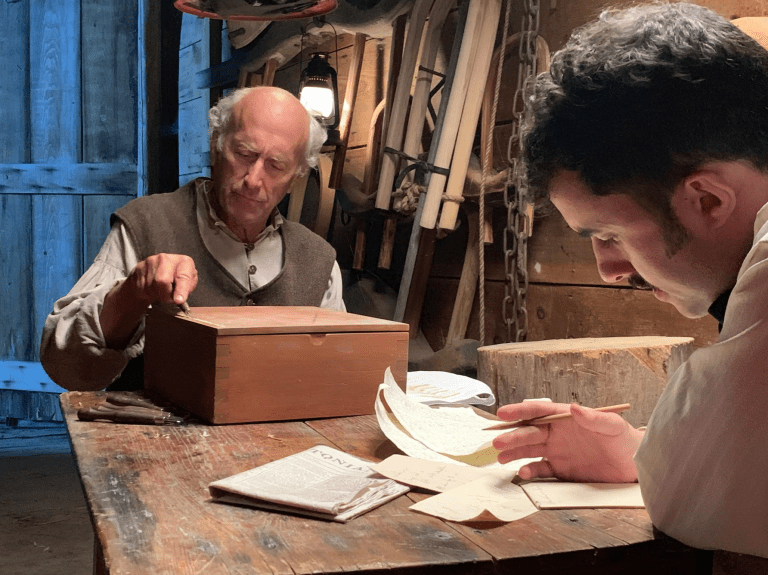
A rather reluctant David Whitmer being interviewed by reporter Edwin Kelly in Whitmer’s Richmond, Missouri, livery stable. (A 2019 still photo by James Jordan from the then set of the interpreter Foundation’s “Witnesses” film project in Old Sturbridge Village, in Massachusetts.)
***
Newly published as the latest article in Interpreter: A Journal of Latter-day Saint Faith and Scholarship:
Daniel C. Peterson, “Variety and Complexity in the Witnesses to the Book of Mormon”
Abstract: This paper examines the testimonies of the witnesses of the Book of Mormon— not only the Three Witnesses and the Eight Witnesses, but many others who experienced and testified of the reality of the Book of Mormon plates. Together, these testimonies offer impressive support for the claims of Joseph Smith regarding the Book of Mormon and, thus, the Restoration. The variety and complexity of their collective testimony makes finding a single, alternative, non-divine explanation for the witness experiences challenging, indeed.
[Editor’s Note: A very similar version of this essay was delivered as an address at the annual FairMormon Conference in August 2020.]
From a previous issue of Interpreter: A Journal of Latter-day Saint Faith and Scholarship:
Royal Skousen, “Restoring the Original Text of the Book of Mormon”
Abstract: The Book of Mormon Critical Text Project, under the editorship of Royal Skousen, began in 1988 and is now nearing completion. In 2001, facsimile transcripts of the two Book of Mormon manuscripts (volumes 1 and 2 of the critical text) were published by the Foundation for Ancient Research and Mormon Studies (FARMS). From 2004 to 2009 the six books of volume 4 of the critical text, Analysis of Textual Variants of the Book of Mormon, were published, also by FARMS. Parts 1 and 2 of volume 3 of the critical text, The History of the Text of the Book of Mormon*, will be published in early 2015. These two parts will describe all the grammatical editing that the Book of Mormon text has undergone, from 1829 up to the present. When all six parts of volume 3 of the critical text have been published, volume 5 of the critical text,* A Complete Electronic Collation of the Book of Mormon*, will be released. Within the next couple years, the Joseph Smith Papers will publish photographs of the two Book of Mormon manuscripts, along with transcriptions based on volumes 1 and 2 of the critical text. Nearly all of the work of the project has involved the knowledge and periodic involvement of the Scriptures Committee of the Church of Jesus Christ of Latter-day Saints. The project itself, however, remains independent of the Church, and none of its findings have involved any ecclesiastical approval or endorsement.*
Stanford Carmack, “The Implications of Past-Tense Syntax in the Book of Mormon”
Abstract: In the middle of the 16th century there was a short-lived surge in the use of the auxiliary did to express the affirmative past tense in English, as in Moroni «did arrive» with his army to the land of Bountiful (Alma 52:18). The 1829 Book of Mormon contains nearly 2,000 instances of this particular syntax, using it 27% of the time in past-tense contexts. The 1611 King James Bible — which borrowed heavily from Tyndale’s biblical translations of the 1520s and ’30s — employs this syntax less than 2% of the time. While the Book of Mormon’s rate is significantly higher than the Bible’s, it is close to what is found in other English-language texts written mainly in the mid- to late 1500s. And the usage died out in the 1700s. So the Book of Mormon is unique for its time — this is especially apparent when features of adjacency, inversion, and intervening adverbial use are considered. Textual evidence and syntactic analysis argue strongly against both 19th-century composition and an imitative effort based on King James English. Book of Mormon past-tense syntax could have been achieved only by following the use of largely inaccessible 16th-century writings. But mimicry of lost syntax is difficult if not impossible, and so later writers who consciously sought to imitate biblical style failed to match its did*-usage at a deep, systematic level. This includes Ethan Smith who in 1823 wrote* View of the Hebrews*, a text very different from both the Bible and the Book of Mormon in this respect. The same may be said about Hunt’s* The Late War and Snowden’s The American Revolution*.*
Editor’s note: Because of the complex typesetting of this article, it has not been reproduced on this webpage. The reader is referred to the PDF version to view the article.
Stan Spencer, “Reflections of Urim: Hebrew Poetry Sheds Light on the Directors-Interpreters Mystery”
Abstract: In the early editions of the Book of Mormon, Alma refers to the Nephite interpreters as directors*. Because* director(s) elsewhere refers to the brass ball that guided Lehi’s family through the wilderness, Alma’s use of the term was apparently considered a mistake, and directors was changed to interpreters for the 1920 edition of the Book of Mormon. There are reasons, however, to believe that Alma’s use of directors was intentional. I present contextual evidence that Alma was actually using the Hebrew word urim*, which was later translated into English as* directors (for the interpreters) and director (for the brass ball), and biblical evidence that those translations are appropriate. Alma may have called the instruments urim to emphasize their sacred importance. As English prose, Alma’s discussion of these sacred instruments is wordy and at times confusing. As Hebrew poetry built around the word urim*, it makes more sense. Alma’s apparent sophisticated use of this word suggests that he had a thorough understanding of the ancient connotations of* urim and remarkable talent as a classical Hebrew poet.
Neal Rappleye, “Lehi the Smelter: New Light on Lehi’s Profession”
Abstract: The name Heshlon*, attested once (in Ether 13:28), as a toponym in the Book of Mormon most plausibly denotes “place of crushing.” The meaning of* Heshlon thus becomes very significant in the context of Ether 13:25–31, which describes the crushing or enfeebling of Coriantumr’s armies and royal power. This meaning is also significant in the wider context of Moroni’s narrative of the Jaredites’ destruction. Fittingly, the name Heshlon itself serves as a literary turning point in a chiastic structure which describes the fateful reversal of Coriantumr’s individual fortunes and the worsening of the Jaredites’ collective fortunes. Perhaps Moroni, who witnessed the gradual crushing and destruction of the Nephites, mentioned this name in his abridgement of the Book of Ether on account of the high irony of its meaning in view of the Jaredite war of attrition which served as precursor to the destruction of the Nephites.
Church of Jesus Christ of Latter-day Saints
Witnesses of the Book of Mormon
Previous Post

March 18, 2021
A Contemporary Report on the Death of David Whitmer
Next Post
March 20, 2021 "Lamb of God"
Browse Our Archives
Select a Category Uncategorized
Select a Month October 2026 September 2026 August 2026 July 2026 June 2026 May 2026 April 2026 March 2026 February 2026 January 2026 December 2025 November 2025 October 2025 September 2025 August 2025 July 2025 June 2025 May 2025 April 2025 March 2025 February 2025 January 2025 December 2024 November 2024 October 2024 September 2024 August 2024 July 2024 June 2024 May 2024 April 2024 March 2024 February 2024 January 2024 December 2023 November 2023 October 2023 September 2023 August 2023 July 2023 June 2023 May 2023 April 2023 March 2023 February 2023 January 2023 December 2022 November 2022 October 2022 September 2022 August 2022 July 2022 June 2022 May 2022 April 2022 March 2022 February 2022 January 2022 December 2021 November 2021 October 2021 September 2021 August 2021 July 2021 June 2021 May 2021 April 2021 March 2021 February 2021 January 2021 December 2020 November 2020 October 2020 September 2020 August 2020 July 2020 June 2020 May 2020 April 2020 March 2020 February 2020 January 2020 December 2019 November 2019 October 2019 September 2019 August 2019 July 2019 June 2019 May 2019 April 2019 March 2019 February 2019 January 2019 December 2018 November 2018 October 2018 September 2018 August 2018 July 2018 June 2018 May 2018 April 2018 March 2018 February 2018 January 2018 December 2017 November 2017 October 2017 September 2017 August 2017 July 2017 June 2017 May 2017 April 2017 March 2017 February 2017 January 2017 December 2016 November 2016 October 2016 September 2016 August 2016 July 2016 June 2016 May 2016 April 2016 March 2016 February 2016 January 2016 December 2015 November 2015 October 2015 September 2015 August 2015 July 2015 June 2015 May 2015 April 2015 March 2015 February 2015 January 2015 December 2014 November 2014 March 2014 August 2013 February 2012
Follow Us!
TAKE THE
Religious Wisdom Quiz
True or False: In Revelation, there are ten elders seated around God's throne.
Select your answer to see how you score.
TRUE FALSE
Related posts from Sic et Non


Notes on Women, Priesthood, and General Conference

"The Book of Moses as a Temple Text"

TRENDING AT PATHEOS Latter-day Saint

How to Make a Decision When You Can't...
Main point: It’s much more valuable to stay close to God so...

Archdiocese Hosts Military Marriage Retreat in Germany
RASTATT, Germany — The transient military lifestyle, with its frequent deployments and...

Nearly every morning, I make the drive to Detroit with my high-school-age...

The Real AI Story Is Adoption Without Trust
Artificial intelligence has crossed a political threshold. It is no longer a...

A new article, written by Jeff Lindsay and Gale L. Pooley,...

Swimfan: Forgotten Aughts Pleasures
This is a recovery effort. In 2002, My Big Fat Greek Wedding...
view all Latter-day Saint blogs
Ad-Free & Subscriber Log-In Subscription Support
- About Us
- 2026 Calendar
- Videos
- Podcasts
- Library of World Religions
- Faith In Media Tracker
- Advertise With Us
- Write for Us
- Privacy Policy
- Terms of Service
- Do Not Sell My Data
- Contact Us
- Radiant Digital
- Manage Newsletter Subscriptions
- Unsubscribe From Notifications
- Sitemap
Copyright 2008-2026, Patheos. All rights reserved.
Subscription Support Ad-Free & Subscriber Log-In
Follow Patheos