
BuddhistCatholicContemplativeEvangelicalGeneral ChristianHinduJewishLatter-day SaintMuslimNew VisionsProgressive Christian
Beliefs
- Buddhist
- Catholic
- Contemplative
- Evangelical
- General Christian
- Hindu
- Jewish
- Latter-day Saint
- More Voices
- Muslim
- New Visions
- Pagan
- Progressive Christian
Topics
- Religion News
- Food and Religion
- Sports and Religion
- Religious Art
- Religious Music and Entertainment
- Religious Events
- History and Religion
- Style and Religion
- Politics and Religion
- Women in Religion
- Recreation Outdoors and Religion
- Business Finance and Religion
- Careers Workplace and Religion
- Education and Religion
- Family Parenting and Religion
- Health Fitness and Religion
- Home and Religion
- Relationships and Religion
- Technology and Religion
- Travel and Religion
Columnists
- Buddhist Columnists
- Business Finance and Religion Columnists
- Careers Workplace and Religion Columnists
- Catholic Columnists
- Contemplative Columnists
- Education and Religion Columnists
- Evangelists Columnists
- Family Parenting and Religion Columnists
- General Christian Columnists
- Health Fitness and Religion Columnists
- Hindu Columnists
- History and Religion Columnists
- Home and Religion Columnists
- Jewish Columnists
- More Voices Columnists
- Latter Day Columnists
- Muslim Columnists
- New Visions Columnists
- Nonreligious Columnists
- Pagan Columnists
- Politics and Religion Columnists
- Progressive Columnists
- Recreation Outdoors and Religion Columnists
- Relationships and Religion Columnists
- Religion News Columnists
- Religious Art Columnists
- Religious Events Columnists
- Religious Music and Entertainment Columnists
- Sports and Religion Columnists
- Style and Religion Columnists
- Technology and Religion Columnists
- Travel and Religion Columnists
- Women in Religion Columnists
Resource Library
- 2026 Calendar
- Library of World Religions
- The 100 Most Holy Places on Earth
- Patheos Answers
- Podcasts
- Videos
- Faith Leaders Database
- Anglican Episcopalian
- Bahai
- Baptist
- Buddhism
- Christianity
- Confucianism
- Eastern Orthodoxy
- Hinduism
- Holiness and Pentecostal
- ISKCON
- Islam
- Judaism
- Lutheran
- Methodist
- The Church of Jesus Christ of Latter-day Saints
- New Age
- Paganism
- Presbytarian and Reformed
- Protestantism
- Religion Behind the Scenes
- Roman Catholic
- Scientology
- Shia Islam
- Sikhism
- Sufism
- Sunni Islam
- Taoism
- Zen
- See all religions
Research Tools
 Ad-Free & Subscriber Log-In Subscription Support
Ad-Free & Subscriber Log-In Subscription Support
Follow Patheos 

- Trending:
- Forgiveness
- |
- Marriage
- |
- Consciousness
- |
- Death Penalty
- |
- Election
- |
- Halloween

- Home
- Latter-day Saint
- The Qur’an on the Fall of Lucifer
The Qur’an on the Fall of Lucifer
Last updated on: March 15, 2021 at 10:47 pm by Dan Peterson
The Qur’an on the Fall of Lucifer 2021-03-15T22:47:18-06:00 Dan Peterson
Patheos Explore the world's faith through different perspectives on religion and spirituality! Patheos has the views of the prevalent religions and spiritualities of the world.
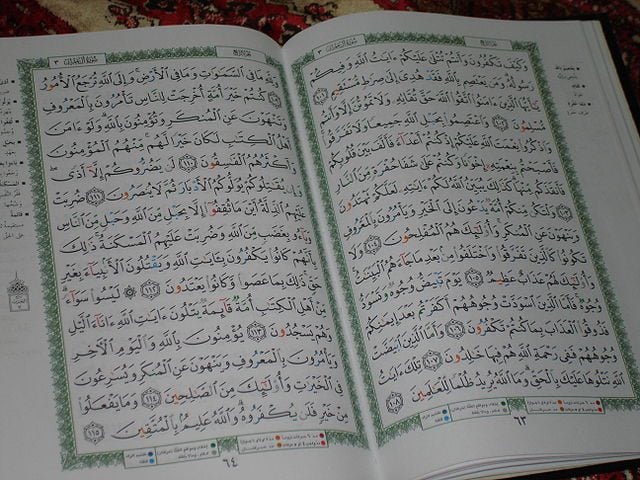
The Qur’an (Wikimedia Commons public domain image)
Below is my translation of Qur’an 2:30-38. It is not identical to the rendering of the same passage in M. A. S. Abdel Haleem’s 2005 translation of The Qur’an for the Oxford World’s Classics series, but I freely acknowledge that it’s very similar. That’s not coincidental. I like Abdel Haleem’s translation; it’s the one that I’ve used for roughly five years now in my classes on the Qur’an in English translation. I used it as the basis for my own version, below, but modified it as various points (as will be readily apparent to anybody who compares them). I’ll offer just a bit of commentary on the other side of the quoted passage:
- When your Lord told the angels, “I am putting a deputy on the earth,” they said, ‘Will you put someone there who will cause damage and bloodshed, while we celebrate Your praise and proclaim Your holiness?” But He said, “I know things you do not know.”
- He taught Adam all the names. Then He showed them to the angels and said, “Tell me the names of these if you truly [think you can].”
- They said, “May You be glorified! We only have knowledge of what You have taught us. You are the All Knowing and All Wise.”
- Then He said, “Adam, tell them their names.” And when he told them their names, [God] said, “Did I not tell you that I know what is hidden in the heavens and the earth, and that I know what you reveal and what you conceal?”
- When We told the angels, “Bow down before Adam,” they all bowed down. Except Iblis, who refused and was arrogant: he was among the disobedient.
- We said, “Adam, live with your wife in this garden. Both of you eat freely there, wherever you wish. But do not approach this tree, lest you both become wrongdoers.”
- But Satan caused them to fall and drove them out of the state that they had been in. We said, “Get out [all of you]! You shall be at enmity with each other. On earth you shall have a place to stay, and livelihood—for a while.”
- Then Adam received some words from his Lord and He accepted his repentance. (He is the Ever Relenting, the Most Merciful.)
- We said, ‘Go down from [the Garden], all of you! But when guidance comes from Me, as it certainly will, there will be no fear for those who follow My guidance, nor will they grieve.
This overall story should be familiar to most readers, though there are obvious differences. Similar passages occur at multiple places throughout the Qur’an (I haven’t counted them), but this is the first of them.
30. The Arabic word that I’ve translated as deputy is khalifa (خَلِيفَة, pronounced kha-LEEF-a), which is usually rendered in English as caliph. That term is best known to Westerners as the title of the central ruler of the Islamic world, especially from the seventh century through roughly the thirteenth century, but also as the title of the restored “caliphate” for which many Muslim fundamentalists (and Muslim extremists) yearn. The so-called “Islamic State” — Daesh or ISIS or ISIL — claimed in its heyday to be a “caliphate,” led by the late Abu Bakr al-Baghdadi, who claimed the title of khalifa or caliph. At its core, the Arabic word means something like “stand-in,” “deputy,” “vicegerent,” or “vicarious representative.” After the death of the Prophet Muhammad, the community was led by the khalifat rasul Allah, the khalifa of the Messenger of God. The use of the word here for Adam is, I think, quite interesting.
31-33. Although the Qur’an doesn’t mention animals here, it seems probable to me that the reference is to Adam’s naming of the animals, as mentioned in Genesis 2:19-20.
34. The name Iblis (pronounced eh-BLEES) derives ultimately from the same sources as the English words devil and diabolical, the Greek word διάβολος (diábolos, “slanderer,” from διαβάλλειν [diabállein, “to slander,” from διά (diá, “across, through”) and βάλλειν (bállein, “to hurl”)]. He is generally treated not as an angel but as one of the jinn, or “genies.”
34. The story of Satan’s fall told here — Iblis is also referred to as al-Shaytan, “Satan” — is obviously quite different from that familiar to Latter-day Saints. But there is a common element: pride or arrogance, and the disobedience to God that such arrogant pride fueled.
36. The Arabic plural imperative verb that, like Abdel Haleem, I’ve translated here as “Get out!” (اهۡبِطُوۡا, ihbitu) really means “Go down!” or “Descend!” That’s actually how I translated it in verse 38. For various reasons, I chose not to render it that way here in verse 36, but it’s important to understand that it is connected with the idea of descent. Verses 36 and 38 both suggest (as do other, related, passages, that the “fall” of Adam and Eve consisted, according to the Qur’an, in a literal descent from an elevated place — or, to look at the matter from a different angle, that the Garden of Eden was pictured, Qur’anically speaking, as being somehow “up,” above the terrestrial world in which Adam and Eve spent the rest of their lives and in which we now live.
37. The idea that Adam was given certain unspecified “words” (كَلِمٰتٍ) is both tantalizing and intriguing. What could they be?
38. It’s also striking to me that, at the very time of the Fall of Adam and Eve, they are also given a promise of eventual redemptive guidance.
***

The liberation of the Nazi concentration camp at Mauthausen, near Linz, Austria, on 6 May 1945, by elements of the Eleventh Armored Division of General George Patton’s Third Army. My father was there that day, though I don’t believe that he’s in this photograph. He raised me with the moral obligation that he himself felt, that the crimes committed at Mauthausen and other such camps must never be forgotten. And I HAVEN’T forgotten.
(Photo from Wikimedia Commons public domain)
Two weeks ago or thereabouts, I responded to somebody who had noted that Latter-day Saints, as a group, are not universally beloved. I called his attention to the work of Dr. Gary Lawrence, which points out that “Gentiles” who actually know one or more Latter-day Saints personally (and who are aware that they do) tend to think more positively about Church members as a group than do non-members who have no Latter-day Saint acquaintances (or, at least, are unaware of any). I compared this to the well-known fact that, even under the lethal anti-Semitism of Hitler’s Third Reich, Germans and Austrians who claimed to be ardent supporters of the Führer’s anti-Jewish policies would nonetheless write letters to the Nazi authorities begging for exceptions to be made for their long-time neighbor Frau Klein or their family physician, Dr. Goldberg, or their friend Herr Lübeck. (Such letters are still extant in archives.)
My point, of course, was that it’s far easier to demonize or stigmatize people in the abstract, at a distance, than to do so when they’re not merely far-off Others.
My point was absolutely not that the treatment of the Latter-day Saints has been even remotely on a par with the persecution and pogroms — and, of course, the Holocaust — that have been directed at the Jews. There were some episodes in the 1830s and 1840s that became quite bad for members of the Church, of course, but our situation has been far better since our emigration to the Great Basin West — and there is, mercifully, absolutely no parallel in the history of the Latter-day Saints to Auschwitz, Bergen-Belsen, Buchenwald, Dachau, or Mauthausen. Not even close.
As if any sentient and even minimally informed person could possibly imagine otherwise.
And I’m arguably both sentient and, regarding the Shoah, somewhat better than minimally informed.
A few folks who are perpetually determined to understand (or to misunderstand) everything I say and do in the worst possible fashion have recently decided to misrepresent me on this point. (For them, I’m an utterly bizarre combination of stupidity and moral depravity whose capacity for obtuse wickedness is functionally boundless.) I thought it advisable to correct their misrepresentation. Not, of course, that they’re likely to accept the correction.
Previous Post

March 13, 2021
"It is real in I am now no make believe"
Browse Our Archives
Select a Category Uncategorized
Select a Month October 2026 September 2026 August 2026 July 2026 June 2026 May 2026 April 2026 March 2026 February 2026 January 2026 December 2025 November 2025 October 2025 September 2025 August 2025 July 2025 June 2025 May 2025 April 2025 March 2025 February 2025 January 2025 December 2024 November 2024 October 2024 September 2024 August 2024 July 2024 June 2024 May 2024 April 2024 March 2024 February 2024 January 2024 December 2023 November 2023 October 2023 September 2023 August 2023 July 2023 June 2023 May 2023 April 2023 March 2023 February 2023 January 2023 December 2022 November 2022 October 2022 September 2022 August 2022 July 2022 June 2022 May 2022 April 2022 March 2022 February 2022 January 2022 December 2021 November 2021 October 2021 September 2021 August 2021 July 2021 June 2021 May 2021 April 2021 March 2021 February 2021 January 2021 December 2020 November 2020 October 2020 September 2020 August 2020 July 2020 June 2020 May 2020 April 2020 March 2020 February 2020 January 2020 December 2019 November 2019 October 2019 September 2019 August 2019 July 2019 June 2019 May 2019 April 2019 March 2019 February 2019 January 2019 December 2018 November 2018 October 2018 September 2018 August 2018 July 2018 June 2018 May 2018 April 2018 March 2018 February 2018 January 2018 December 2017 November 2017 October 2017 September 2017 August 2017 July 2017 June 2017 May 2017 April 2017 March 2017 February 2017 January 2017 December 2016 November 2016 October 2016 September 2016 August 2016 July 2016 June 2016 May 2016 April 2016 March 2016 February 2016 January 2016 December 2015 November 2015 October 2015 September 2015 August 2015 July 2015 June 2015 May 2015 April 2015 March 2015 February 2015 January 2015 December 2014 November 2014 March 2014 August 2013 February 2012
Follow Us!
TAKE THE
Religious Wisdom Quiz
What Christian group worships on Saturday instead of Sunday?
Select your answer to see how you score.
Pentecostals Presbyterians Seventh-day Adventists Baptists
Related posts from Sic et Non



Partially responding to a challenge

My ongoing (and, thus far, futile) war against...
TRENDING AT PATHEOS Latter-day Saint

Swimfan: Forgotten Aughts Pleasures
This is a recovery effort. In 2002, My Big Fat Greek Wedding...

Top Three Anti-Catholic Lies About Catholicism
This is my initial transcript for the video, "THE 3 WORST...

Pope Leo Celebrates Mass for Nurses & Docs...
I don't have any idea how he did it, but Pope Leo...

The Sermon on the Mount, Part I: Matthew...
The Sermon on the Mount, Part I (Matthew 4:12-5:12) St. Matthew moves...

What's up from Crossway: Reviewing some of their latest A few weeks...

Janie Learns the Way of the Cross: A...
Teaching children about Jesus' Passion can be challenging. Many parents and educators...
view all Latter-day Saint blogs
Ad-Free & Subscriber Log-In Subscription Support
- About Us
- 2026 Calendar
- Videos
- Podcasts
- Library of World Religions
- Faith In Media Tracker
- Advertise With Us
- Write for Us
- Privacy Policy
- Terms of Service
- Do Not Sell My Data
- Contact Us
- Radiant Digital
- Manage Newsletter Subscriptions
- Unsubscribe From Notifications
- Sitemap
Copyright 2008-2026, Patheos. All rights reserved.
Subscription Support Ad-Free & Subscriber Log-In
Follow Patheos