
BuddhistCatholicContemplativeEvangelicalGeneral ChristianHinduJewishLatter-day SaintMuslimNew VisionsProgressive Christian
Beliefs
- Buddhist
- Catholic
- Contemplative
- Evangelical
- General Christian
- Hindu
- Jewish
- Latter-day Saint
- More Voices
- Muslim
- New Visions
- Pagan
- Progressive Christian
Topics
- Religion News
- Food and Religion
- Sports and Religion
- Religious Art
- Religious Music and Entertainment
- Religious Events
- History and Religion
- Style and Religion
- Politics and Religion
- Women in Religion
- Recreation Outdoors and Religion
- Business Finance and Religion
- Careers Workplace and Religion
- Education and Religion
- Family Parenting and Religion
- Health Fitness and Religion
- Home and Religion
- Relationships and Religion
- Technology and Religion
- Travel and Religion
Columnists
- Buddhist Columnists
- Business Finance and Religion Columnists
- Careers Workplace and Religion Columnists
- Catholic Columnists
- Contemplative Columnists
- Education and Religion Columnists
- Evangelists Columnists
- Family Parenting and Religion Columnists
- General Christian Columnists
- Health Fitness and Religion Columnists
- Hindu Columnists
- History and Religion Columnists
- Home and Religion Columnists
- Jewish Columnists
- More Voices Columnists
- Latter Day Columnists
- Muslim Columnists
- New Visions Columnists
- Nonreligious Columnists
- Pagan Columnists
- Politics and Religion Columnists
- Progressive Columnists
- Recreation Outdoors and Religion Columnists
- Relationships and Religion Columnists
- Religion News Columnists
- Religious Art Columnists
- Religious Events Columnists
- Religious Music and Entertainment Columnists
- Sports and Religion Columnists
- Style and Religion Columnists
- Technology and Religion Columnists
- Travel and Religion Columnists
- Women in Religion Columnists
Resource Library
- 2026 Calendar
- Library of World Religions
- The 100 Most Holy Places on Earth
- Patheos Answers
- Podcasts
- Videos
- Faith Leaders Database
- Anglican Episcopalian
- Bahai
- Baptist
- Buddhism
- Christianity
- Confucianism
- Eastern Orthodoxy
- Hinduism
- Holiness and Pentecostal
- ISKCON
- Islam
- Judaism
- Lutheran
- Methodist
- The Church of Jesus Christ of Latter-day Saints
- New Age
- Paganism
- Presbytarian and Reformed
- Protestantism
- Religion Behind the Scenes
- Roman Catholic
- Scientology
- Shia Islam
- Sikhism
- Sufism
- Sunni Islam
- Taoism
- Zen
- See all religions
Research Tools
 Ad-Free & Subscriber Log-In Subscription Support
Ad-Free & Subscriber Log-In Subscription Support
Follow Patheos 

- Trending:
- Forgiveness
- |
- Marriage
- |
- Consciousness
- |
- Death Penalty
- |
- Election
- |
- Halloween

- Home
- Latter-day Saint
- Mark Hofmann, the “Salamander Letter,” and Me
Mark Hofmann, the “Salamander Letter,” and Me
Last updated on: March 23, 2021 at 9:03 pm by Dan Peterson
Mark Hofmann, the “Salamander Letter,” and Me 2021-03-23T21:03:16-06:00 Dan Peterson
Patheos Explore the world's faith through different perspectives on religion and spirituality! Patheos has the views of the prevalent religions and spiritualities of the world.
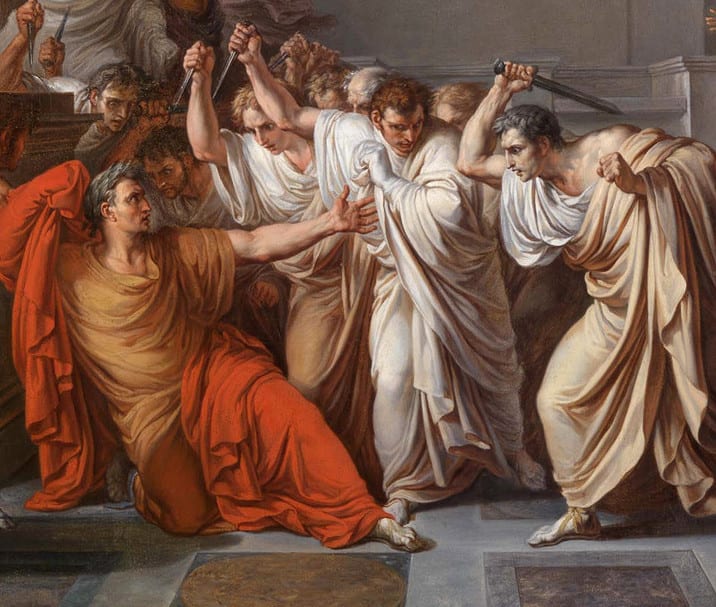
Vincenzo Camuccini, “The Death of Julius Caesar” (Wikimedia Commons public domain image)
For the record: I wasn’t involved in THIS episode, either.
For one reason or another, I still haven’t managed to watch the Netflix documentary series Murder Among the Mormons. Somehow, when I’ve begun to wind down late at night in recent weeks, I just haven’t been in the mood for it. I know that I need to watch the thing, but I always decide that I’ll watch it tomorrow night. Mañana. My wife and I like to relax before bedtime with BBC versions of classic novels or British detective shows, or with good books. Right now, for instance, I’m reading (and enjoying) Mark Twain’s relatively little-known 1896 novel — his last completed novel, and his own personal favorite — Personal Recollections of Joan of Arc.
I hadn’t seriously thought about Mark Hofmann, his forgeries, and his crimes for many years, but I’ve commented on them a few times in the past couple of weeks.
Yesterday, I think, I responded to a comment to one of these blog entries by noting of Mr. Hofmann’s so-called “Salamander Letter” that “I can’t prove it, but I doubted it from the start.”
Elsewhere, it’s been suggested by one of the usual suspects that I’m lying on that point. Surely, for example, I should be able to demonstrate that I really had such early doubts (via an article in some academic journal, for example). And surely I shared my insights with the leadership of the Church and/or with local Utah law enforcement and the FBI. So there should be solid proof of my “boast” on this score, right? Otherwise, as on every other occasion when my lips are moving or my fingers typing or my hand writing, I’m lying.
And here’s the really damning proof:
F.A.R.M.S. UPDATE
(c) June 1985
Moses, Moroni, and the Salamander
Martin Harris’ letter of 23 October 1830 to Wm. W. Phelps (published in Church News, 28 April 1985) has dismayed some people. Harris talks of a “white salamander” which was “transfigured” into “the spirit” otherwise known to us as the Angel Moroni. We may never know whether this description was an embellishment on the part of Harris, or an allegory employed by Joseph Smith, or whether Moroni somehow chose to appear to Joseph out of, or in the form of, a salamander. But since Phelps joined the Church after reading Harris’ letter, he must not have found the allusion to a salamander very disconcerting. In fact, as new research is showing, the salamander has been thought for millennia to have supernatural and extraordinary powers. Consider the following:
1. Well into the 19th century, it was commonly believed that salamanders “lived in or were able to endure, fire.” Numerous references to this wide-spread belief are listed in the Oxford English Dictionary under “salamander.” Long before, even Aristotle — of all people — reported: “The salamander shows that certain animals are naturally proof against fire, for it is said to extinguish a flame by passing through it.” Historia Animalium V.19, 552b.
2. Indeed, salamanders were thought to be “generated in fire.” The great Rabbi Akiba held to this view, in Hullin 127a. Other rabbis, including the noted Rashi, debated whether the fire had to be heated for seven days, seven years or seventy years to produce a salamander that would appear walking and flying in the midst of the fire. (Should we compare Dan. 3:19ff.?)
3. Accordingly, salamanders were often associated with spirits. In Germany, salamanders were thought to be “Wetter-propheten” (weather-prophets), and “Hausgeister” (house-protector spirits). German churchdoor locks and bolts, as well as ovens and fireplaces, had salamander insignia on them. Handwoerterbuch des deutschen Aberglaubens (Berlin, 1934), 6:458. In the Middle Ages, the salamander denoted “a being possessing the shape of a man whose element was the fire, or who at least could live in that element.” Chambers’s Encycl. (1875), 8:436. Earth, air, fire and water, each had a spirit — for fire, it was the salamander.
4. Moreover, salamanders were associated with the voice of God and with the Holy Ghost! From Midrash Ex. Rabbah XV.28 on Exodus 12, we find that the rabbis of the 9th Century A.D. and before believed that “God had to show Moses on Mt. Sinai was the salamander: “He stirred up the fire and showed him the salamander, for it [Ps. 29:7] says: The voice of the Lord heweth out flames of fire.” In 1841, the baptistry of Winchester Cathedral in England bore the figure of a salamander, alluding to the words, “He shall baptize you with the Holy Ghost, and with fire.” G. A. Poole, Churches: Their Struct. Arrang. & Decor. 9,2.
5. Since the salamander was said to endure fire, it was thought to protect others against burning, including hell-fire. The rabbis remarked that hell would not harm scribes, since they were “all fire, like the Torah; and if flames cannot hurt one who is anointed with salamander blood, still less can they injure the scribes.” Jewish Encycl. (1905) 10:646, citing the Talmud Hagiga 27a. A similar popular belief seems to stand behind Austrian lore relating the salamander to the atoning suffering of Christ. The Zohar (ii. 211b) mentions protective garments of salamander skin.
6. Not far removed from these ideas about salamanders are ideas depicted by the biblical phrase “fiery flying serpents” Were these “salamanders”? A brass model of this reptile symbolized Jesus himself, who commanded Moses to put it up on a pole, so the people who had been bitten could look to it and live (Num. 21:6-9; 1 Ne. 17:41; cf. Is. 14:29; 30:6; 2 Ne. 25:20). The Hebrew word here for “fiery” is saraf. This strongly suggests a further connection with the six-winged seraphim (Is. 6:2-6) and the nearly identical cherubin (Ezek. 1 & 10; Rev. 4:6-8). Cf. Egyptian srf (“griffon”). Were their six wings and abstraction from the six, red, wing-like, external gills of salamanders?
7. Eternal life and resurrection were also symbolized by the salamander. The Arabic word for both the salamander and the phoenix, which could die and rise again out of its own ashes, was samandal. See Al-Jahiz, Kitab al-Hayawan (9th c.) 5:309-10 (Harun edition); S. Nasser, Intro. to Islamic Cosmology, 2d ed., 273 n. 29.
8. People too were sometimes called salamanders. Shakespeare calls a fiery-red face a “salamander.” Henry IV, III, iii, 58. Likewise called were soldiers who courageously exposed themselves to fire in battle. Salamanders appear in medieval and renaissance coats of arms, including that of Francis I, King of France. Thomas Brooks in 1670 wrote, “God’s people are true salamanders, the live best in the fire of afflictions.” Works 6:441.
9. Not all salamanders were good, however. The poisonous ones are “spectacularly colored” with bright spots on a dark background. Encycl. Brit. (15th ed.), Macrop. 18:1087. They were linked with evil spirits. But the non-poisonous good ones were white or grey-brown.
Obviously, much has changed culturally since 1830. Some of us may wince at the suggestion that an angel of God should be associated with, or described as, a salamander. But to people then, no image or description would better fit the appearance of a brilliant white spiritual being, once a valiant soldier, now dwelling in a blazing pillar of light, shockingly pure and glorious, speaking with the voice of God while flying though the midst of Heaven, then the salamander! Moroni should be flattered. (JS-H 1:30-32; History of the Church 4:536).
Still, it was predictable that people would not understand this. The Lord apparently knew this would happen. In 1829, God commanded Harris not to try to describe things which he had not personally witnessed: “And I the Lord command him, my servant Martin Harris, that he shall say no more unto them concerning these things, except he shall say: I have seen them, and they have been shown unto me by the power of God; and these are the words which he shall say.” D&C 5:26. Harris seems to have overstepped his commission here when he wrote to Phelps in 1830.
Further research is still underway. Glenn Clark’s recent “Pillars of My Faith” presentation at the Sunstone Theological Symposium (May 18, 1985) covers several of these points and will soon appear in Sunstone. In the end, this research may lead to a less “modern” view of many symbolically meaningful religious events: a burning bush; a talking ass; a flaming sword; a tempting snake; the Lord with seven horns and seven eyes; a descending dove; and a salamander angel.
(FAIR USE COPYING NOTICE: These pages may be reproduced and used, without alteration, addition or deletion, for any nonpecuniary or non-publishing purpose, without permission.)
This 1985 document was issued, one critic observes, under my leadership of the Foundation for Ancient Research and Mormon Studies (FARMS), the forerunner of the Neal A. Maxwell Institute for Religious Scholarship. That proves beyond question that, when I boast today that I always doubted the authenticity of the “Salamander Letter,” I’m not telling the truth.
Well.
When Mark Hofmann burst upon the world of Latter-day Saint historiography with his forged “Anthon Transcript” in 1980, I was living with my wife in Cairo, Egypt. And we were still living in Egypt in 1981, when he “found” evidence of a blessing in which Joseph Smith supposedly promised the presidency of the Church to his son Joseph III.
It will be difficult for some to imagine such a thing, but this was a time without the internet. In Cairo, in fact, it was a time essentially without telephone connections (even across the city, to saying nothing of international calls). We occasionally heard something about Mr. Hofmann’s document “discoveries” — but very little, sketchily and after long delays.
My wife and I returned from Egypt in the summer of 1982. I was in residence for a doctorate at the University of California at Los Angeles from mid-1982 until roughly August 1985, when, really just beginning to work on my dissertation, I joined the faculty at Brigham Young University. When I wasn’t actually teaching, I was busy writing a long and very technical dissertation and inventing my new classes.
The “Salamander Letter” appeared in 1984. I was still a graduate student outside of Utah at the time. I was on the periphery of the Latter-day Saint academic community, and I was focused very much on Arabic and Islamic studies. More and more, in fact, on Isma‘ili Shi‘i Neoplatonism. I wasn’t exactly a close advisor to the Brethren. Why is there no evidence in any academic journal of my doubts about the “Salamander Letter”? I hadn’t yet published in my own field, let alone on Mark Hofmann’s document “finds.”
I chatted with Latter-day Saint friends about the case, but I doubt that our conversations were recorded and archived. I thought the FARMS material on salamanders intriguing and plausible. But I also had begun to worry about Hofmann’s string of spectacular document finds. It just seemed too much. And, for me, the salamander simply didn’t quite fit. Why had nobody else written like this?
When FARMS published its little response to the “Salamander Letter,” I was just finishing up my coursework at UCLA and preparing to move up to Utah to teach at BYU. I wasn’t at BYU yet. I wasn’t the chairman of FARMS. I wasn’t even affiliated with FARMS.
Hofmann committed his murders in October 1985. I had been in Utah for roughly two months by then, as a brand-new faculty member. Some of us had hallway conversations about the case. So far as I know, none of them were recorded. None have been archived.
Mark Hofmann was arrested in January 1986. He pled guilty to murder in January 1987.
Jack Welch asked me to create the Review of Books on the Book of Mormon, which eventually became the FARMS Review, in 1988. The first issue appeared in 1989. That was my first official involvement with the organization, and, at the time, that was the totality of my involvement.
I was invited to join the Board of Directors of FARMS in September of 1991, and I served as chairman of the Board from July 1997 through June 2001. Which should suggest to careful readers that I was not in charge of the organization in June 1985, when the document above appeared.
And, just to head some of my critics off at the pass: I was not on the grassy knoll in Dallas on 22 November 1963 and anyway, I was only ten years old at the time — which doesn’t make my involvement in the Kennedy assassination altogether impossible, but it does make it at least a bit less believable. Also, I neither knew nor had any contact with Jimmy Hoffa. Moreover, I have not the faintest idea where Elvis might be. And I sought sanctuary in neither Brazil nor Argentina at the end of the Second World War.
Incidentally. the argument made by the FARMS document above is actually not unreasonable. It was written at a time when various experts had “authenticated” the “Salamander Letter,” and, accordingly, responsible and faithful Latter-day Saint scholars tried to take it into account and to put it into a context that was consistent with Latter-day Saint faith. And what they found about the place of salamanders in hermetic lore was really quite interesting. They weren’t making it up — probably because Mark Hofmann had made a cunning choice in his fictional salamander. He didn’t choose it at random. The FARMS defense proved unnecessary, but it was not unsound. I just had absolutely nothing to do with it.
Foundation for Ancient Research and Mormon Studies
hurch of Jesus Christ of Latter-day Saints
Previous Post

March 20, 2021
"Lamb of God"
Next Post
March 22, 2021 Volcanos, Polygamy, the Gods, and Other Interesting Things
Browse Our Archives
Select a Category Uncategorized
Select a Month October 2026 September 2026 August 2026 July 2026 June 2026 May 2026 April 2026 March 2026 February 2026 January 2026 December 2025 November 2025 October 2025 September 2025 August 2025 July 2025 June 2025 May 2025 April 2025 March 2025 February 2025 January 2025 December 2024 November 2024 October 2024 September 2024 August 2024 July 2024 June 2024 May 2024 April 2024 March 2024 February 2024 January 2024 December 2023 November 2023 October 2023 September 2023 August 2023 July 2023 June 2023 May 2023 April 2023 March 2023 February 2023 January 2023 December 2022 November 2022 October 2022 September 2022 August 2022 July 2022 June 2022 May 2022 April 2022 March 2022 February 2022 January 2022 December 2021 November 2021 October 2021 September 2021 August 2021 July 2021 June 2021 May 2021 April 2021 March 2021 February 2021 January 2021 December 2020 November 2020 October 2020 September 2020 August 2020 July 2020 June 2020 May 2020 April 2020 March 2020 February 2020 January 2020 December 2019 November 2019 October 2019 September 2019 August 2019 July 2019 June 2019 May 2019 April 2019 March 2019 February 2019 January 2019 December 2018 November 2018 October 2018 September 2018 August 2018 July 2018 June 2018 May 2018 April 2018 March 2018 February 2018 January 2018 December 2017 November 2017 October 2017 September 2017 August 2017 July 2017 June 2017 May 2017 April 2017 March 2017 February 2017 January 2017 December 2016 November 2016 October 2016 September 2016 August 2016 July 2016 June 2016 May 2016 April 2016 March 2016 February 2016 January 2016 December 2015 November 2015 October 2015 September 2015 August 2015 July 2015 June 2015 May 2015 April 2015 March 2015 February 2015 January 2015 December 2014 November 2014 March 2014 August 2013 February 2012
Follow Us!
TAKE THE
Religious Wisdom Quiz
Above all else, guard your ____, for everything you do flows from it.
Select your answer to see how you score.
Heart Mind Words Actions
Related posts from Sic et Non


Notes on Women, Priesthood, and General Conference

"The Book of Moses as a Temple Text"

TRENDING AT PATHEOS Latter-day Saint

Catholic Evangelization: Sharing Your Faith Every Day
Welcome back to the Graceful Awakening mini-series called, “From Faith to Mission.” ...

The Pillar of the Boatmen: the Ancient Monument...
The Pillar of the Boatmen is a Romano-Gaulish sculpture that dates from...

In one sense walking into Westminster Abbey is like walking down the...

'Super Scam Me' Exposes AI Jon Bon Jovi...
Leslie Pickett believed she was in a relationship with Jon Bon Jovi....

The Brazilian Remake of Kendricks' 'Flywheel' Opens in...
“Flywheel,” the story that launched the Kendrick Brothers’ filmmaking career is getting...

The Dangers of Gradual Accommodation (Winking at Sin)
Recently, the “law of gradualness” resurfaced during the opening of a weeklong,...
view all Latter-day Saint blogs
Ad-Free & Subscriber Log-In Subscription Support
- About Us
- 2026 Calendar
- Videos
- Podcasts
- Library of World Religions
- Faith In Media Tracker
- Advertise With Us
- Write for Us
- Privacy Policy
- Terms of Service
- Do Not Sell My Data
- Contact Us
- Radiant Digital
- Manage Newsletter Subscriptions
- Unsubscribe From Notifications
- Sitemap
Copyright 2008-2026, Patheos. All rights reserved.
Subscription Support Ad-Free & Subscriber Log-In
Follow Patheos