
BuddhistCatholicContemplativeEvangelicalGeneral ChristianHinduJewishLatter-day SaintMuslimNew VisionsProgressive Christian
Beliefs
- Buddhist
- Catholic
- Contemplative
- Evangelical
- General Christian
- Hindu
- Jewish
- Latter-day Saint
- More Voices
- Muslim
- New Visions
- Pagan
- Progressive Christian
Topics
- Religion News
- Food and Religion
- Sports and Religion
- Religious Art
- Religious Music and Entertainment
- Religious Events
- History and Religion
- Style and Religion
- Politics and Religion
- Women in Religion
- Recreation Outdoors and Religion
- Business Finance and Religion
- Careers Workplace and Religion
- Education and Religion
- Family Parenting and Religion
- Health Fitness and Religion
- Home and Religion
- Relationships and Religion
- Technology and Religion
- Travel and Religion
Columnists
- Buddhist Columnists
- Business Finance and Religion Columnists
- Careers Workplace and Religion Columnists
- Catholic Columnists
- Contemplative Columnists
- Education and Religion Columnists
- Evangelists Columnists
- Family Parenting and Religion Columnists
- General Christian Columnists
- Health Fitness and Religion Columnists
- Hindu Columnists
- History and Religion Columnists
- Home and Religion Columnists
- Jewish Columnists
- More Voices Columnists
- Latter Day Columnists
- Muslim Columnists
- New Visions Columnists
- Nonreligious Columnists
- Pagan Columnists
- Politics and Religion Columnists
- Progressive Columnists
- Recreation Outdoors and Religion Columnists
- Relationships and Religion Columnists
- Religion News Columnists
- Religious Art Columnists
- Religious Events Columnists
- Religious Music and Entertainment Columnists
- Sports and Religion Columnists
- Style and Religion Columnists
- Technology and Religion Columnists
- Travel and Religion Columnists
- Women in Religion Columnists
Resource Library
- 2026 Calendar
- Library of World Religions
- The 100 Most Holy Places on Earth
- Patheos Answers
- Podcasts
- Videos
- Faith Leaders Database
- Anglican Episcopalian
- Bahai
- Baptist
- Buddhism
- Christianity
- Confucianism
- Eastern Orthodoxy
- Hinduism
- Holiness and Pentecostal
- ISKCON
- Islam
- Judaism
- Lutheran
- Methodist
- The Church of Jesus Christ of Latter-day Saints
- New Age
- Paganism
- Presbytarian and Reformed
- Protestantism
- Religion Behind the Scenes
- Roman Catholic
- Scientology
- Shia Islam
- Sikhism
- Sufism
- Sunni Islam
- Taoism
- Zen
- See all religions
Research Tools
 Ad-Free & Subscriber Log-In Subscription Support
Ad-Free & Subscriber Log-In Subscription Support
Follow Patheos 

- Trending:
- Forgiveness
- |
- Marriage
- |
- Consciousness
- |
- Death Penalty
- |
- Election
- |
- Halloween

- Home
- Latter-day Saint
- “Tree of Life, Tree of Healing”
“Tree of Life, Tree of Healing”
Last updated on: February 8, 2021 at 1:52 pm by Dan Peterson
“Tree of Life, Tree of Healing” 2021-02-08T13:52:09-07:00 Dan Peterson
Patheos Explore the world's faith through different perspectives on religion and spirituality! Patheos has the views of the prevalent religions and spiritualities of the world.
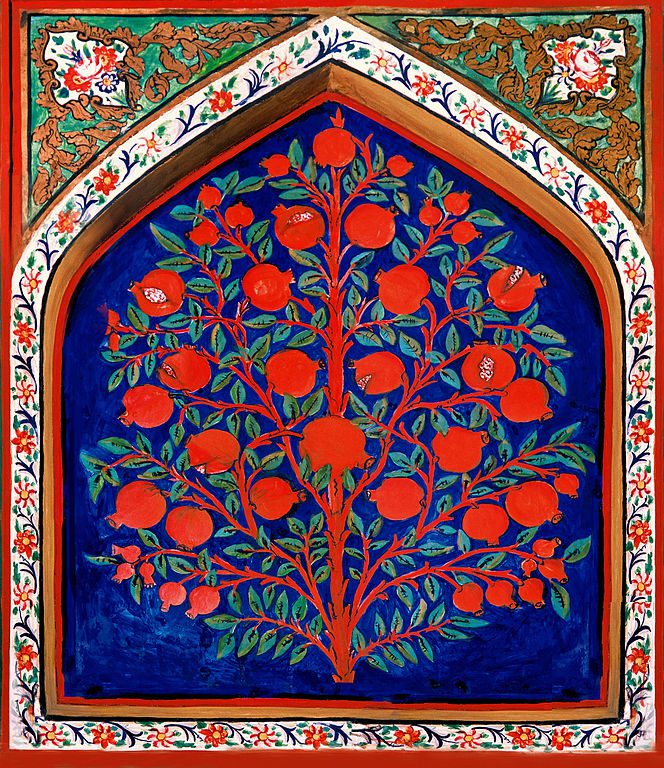
A seventeenth-century image of the Tree of Life from the Shaki Khan Palace in Azerbaijan
(Wikimedia Commons public domain)
Newly appearing in Interpreter: A Journal of Latter-day Saint Faith and Scholarship, an article by John A. Tvedtnes: “Tree of Life, Tree of Healing” Abstract: The late Hebrew scholar John Tvedtnes takes readers on a grand tour of Jewish and Christian stories and traditions that attest to the Tree of Life as not only a means to prolong life, but also to impart a healing power to individuals and to the earth itself. In a future day, it is said that the Saints will eat of its sweet fruit forever. [Editor’s Note: Part of our book chapter reprint series, this article is reprinted here as a service to the LDS community. Original pagination and page numbers have necessarily changed, otherwise the reprint has the same content as the original. See John Tvedtnes, “Tree of Life, Tree of Healing,” in “To Seek the Law of the Lord”: Essays in Honor of John W. Welch, ed. Paul Y. Hoskisson and Daniel C. Peterson (Orem, UT: The Interpreter Foundation, 2017), 495–520. Further information at https://interpreterfoundation.org/books/to-seek-the-law-of-the-lord-essays-in-honor-of-john-w-welch-2/.] *** I don’t know whether I’ve called attention to this item here before, but I just came across it (again, I think) while looking for something else, and I thought that it might be worth bringing to your notice today: “10 questions with John Gee” It appeared all the way back on 30 January 2018 — precisely three years ago this past Saturday — so a few things have changed since then. Most recently, John has taken notice of one of those things in a pair of articles for Interpreter: A Journal of Latter-day Saint Faith and Scholarship: “Prolegomena to a Study of the Egyptian Alphabet Documents in the Joseph Smith Papers” “Fantasy and Reality in the Translation of the Book of Abraham” Another notable change came for John personally in the first half of 2019: He was finally able to move from the Neal A. Maxwell Institute for Religious Scholarship (formerly the Foundation for Ancient Research and Mormon Studies, or FARMS) to the Department of Asian and Near Eastern Languages — my home department — in BYU’s College of Humanities. At the Maxwell Institute, he had long been the sole surviving remnant of the organization’s original founding vision. We’re delighted to have him in our department as the William (Bill) Gay Research Professor. *** And, once again, here are some “golden oldies” from a past volume of what was known then as Interpreter: A Journal of Mormon Scripture but is now titled Interpreter: A Journal of Latter-day Saint Faith and Scholarship: Daniel C. Peterson, “Introduction” Abstract: This introduction to Volume 5 considers the modern notion of a cessation of Bible-like divine manifestations and revelations, a belief which Joseph Smith encountered when he told others of the First Vision. This perception of an end to miracles and visions had become common by Joseph’s time, as evidenced by various writers, and continues to the present day. The Latter-day Saints, however, continue to believe in modern-day revelation, which we believe gives us a unique vantage point for the study of the Bible and other scripture, as illustrated in Interpreter: A Journal of Mormon Scripture*.* Benjamin L. McGuire, “Finding Parallels: Some Cautions and Criticisms, Part One” Benjamin L. McGuire, “Finding Parallels: Some Cautions and Criticisms, Part Two” Review of Rick Grunder. Mormon Parallels: A Bibliographic Source*. Layfayette, New York: Rick Grunder—Books, 2008. 2,088 pp. On CD-ROM. $200.00.* Abstract: Discovering parallels is inherently an act of comparison. Through comparison, parallels have been introduced frequently as proof (or evidence) of different issues within Mormon studies. Despite this frequency, very few investigations provide a theoretical or methodological framework by which the parallels themselves can be evaluated. This problem is not new to the field of Mormon studies but has in the past plagued literary studies more generally. In Part One, this review essay discusses present and past approaches dealing with the ways in which parallels have been used and valued in acts of literary comparison, uncovering the various difficulties associated with unsorted parallels as well as discussing the underlying motivations for these comparisons. In Part Two, a methodological framework is introduced and applied to examples from Grunder’s collection in Mormon Parallels. In using a consistent methodology to value these parallels, this essay suggests a way to address the historical concerns associated with using parallels to explain both texts and Mormonism as an historical religious movement. Brant A. Gardner, “When Hypotheses Collide: Responding to Lyon and Minson’s “When Pages Collide”” Abstract: At the end of 2012, Jack M. Lyon and Kent R. Minson published “When Pages Collide: Dissecting the Words of Mormon.” They suggest that there is textual evidence that supports the idea that Words of Mormon 12-18 is the translation of the end of the previous chapter of Mosiah. The rest of the chapter was lost with the 116 pages, but this text remained because it was physically on the next page, which Joseph had kept with him. In this paper, the textual information is examined to determine if it supports that hypothesis. The conclusion is that while the hypothesis is possible, the evidence is not conclusive. The question remains open and may ultimately depend upon one’s understanding of the translation process much more than the evidence from the manuscripts. Roger Nicholson, “The Spectacles, the Stone, the Hat, and the Book: A Twenty-first Century Believer’s View of the Book of Mormon Translation” Abstract: This essay seeks to examine the Book of Mormon translation method from the perspective of a regular, nonscholarly, believing member in the twenty-first century, by taking into account both what is learned in Church and what can be learned from historical records that are now easily available. What do we know? What should we know? How can a believing Latter-day Saint reconcile apparently conflicting accounts of the translation process? An examination of the historical sources is used to provide us with a fuller and more complete understanding of the complexity that exists in the early events of the Restoration. These accounts come from both believing and nonbelieving sources, and some skepticism ought to be employed in choosing to accept some of the interpretations offered by some of these sources as fact. However, an examination of these sources provides a larger picture, and the answers to these questions provide an enlightening look into Church history and the evolution of the translation story. This essay focuses primarily on the methods and instruments used in the translation process and how a faithful Latter-day Saint might view these as further evidence of truthfulness of the restored Gospel. Kevin Christensen, “Book Review: Temple Mysticism: An Introduction, by Margaret Barker” Review of Margaret Barker, Temple Mysticism: An Introduction (London: Society for Promoting Christian Knowledge, 2011), 181 pp. $18.94. Matthew L. Bowen, ““In the Mount of the Lord It Shall Be Seen” and “Provided”: Theophany and Sacrifice as the Etiological Foundation of the Temple in Israelite and Latter-day Saint Tradition” Abstract: For ancient Israelites, the temple was a place where sacrifice and theophany (i.e., seeing God or other heavenly beings) converged. The account of Abraham’s “arrested” sacrifice of Isaac (Genesis 22) and the account of the arrested slaughter of Jerusalem following David’s unauthorized census of Israel (2 Samuel 24; 1 Chronicles 21) served as etiological narratives—explanations of “cause” or “origin”—for the location of the Jerusalem temple and its sacrifices. Wordplay on the verb rāʾâ (to “see”) in these narratives creates an etiological link between the place-names “Jehovah-jireh,” “Moriah” and the threshing floor of Araunah/Ornan, pointing to the future location of the Jerusalem temple as the place of theophany and sacrifice par excellence. Isaac’s arrested sacrifice and the vicarious animal sacrifices of the temple anticipated Jesus’s later “un-arrested” sacrifice since, as Jesus himself stated, “Abraham rejoiced to see my day” (John 8:56). Sacrifice itself was a kind of theophany in which one’s own redemption could be “seen” and the scriptures of the Restoration confirm that Abraham and many others, even “a great many thousand years before” the coming of Christ, “saw” Jesus’s sacrifice and “rejoiced.” Additionally, theophany and sacrifice converge in the canonized revelations regarding the building of the latter-day temple. These temple revelations begin with a promise of theophany, and mandate sacrifice from the Latter-day Saints. In essence, the temple itself was, and is, Christ’s atonement having its intended effect on humanity.
Church of Jesus Christ of Latter-day Saints
Previous Post

January 31, 2021
"Revelation may come in the laboratory, out of the test tube"
Browse Our Archives
Select a Category Uncategorized
Select a Month October 2026 September 2026 August 2026 July 2026 June 2026 May 2026 April 2026 March 2026 February 2026 January 2026 December 2025 November 2025 October 2025 September 2025 August 2025 July 2025 June 2025 May 2025 April 2025 March 2025 February 2025 January 2025 December 2024 November 2024 October 2024 September 2024 August 2024 July 2024 June 2024 May 2024 April 2024 March 2024 February 2024 January 2024 December 2023 November 2023 October 2023 September 2023 August 2023 July 2023 June 2023 May 2023 April 2023 March 2023 February 2023 January 2023 December 2022 November 2022 October 2022 September 2022 August 2022 July 2022 June 2022 May 2022 April 2022 March 2022 February 2022 January 2022 December 2021 November 2021 October 2021 September 2021 August 2021 July 2021 June 2021 May 2021 April 2021 March 2021 February 2021 January 2021 December 2020 November 2020 October 2020 September 2020 August 2020 July 2020 June 2020 May 2020 April 2020 March 2020 February 2020 January 2020 December 2019 November 2019 October 2019 September 2019 August 2019 July 2019 June 2019 May 2019 April 2019 March 2019 February 2019 January 2019 December 2018 November 2018 October 2018 September 2018 August 2018 July 2018 June 2018 May 2018 April 2018 March 2018 February 2018 January 2018 December 2017 November 2017 October 2017 September 2017 August 2017 July 2017 June 2017 May 2017 April 2017 March 2017 February 2017 January 2017 December 2016 November 2016 October 2016 September 2016 August 2016 July 2016 June 2016 May 2016 April 2016 March 2016 February 2016 January 2016 December 2015 November 2015 October 2015 September 2015 August 2015 July 2015 June 2015 May 2015 April 2015 March 2015 February 2015 January 2015 December 2014 November 2014 March 2014 August 2013 February 2012
Follow Us!
TAKE THE
Religious Wisdom Quiz
True or False: Deborah was a prophetess and judge who led Israel to victory over the Canaanites.
Select your answer to see how you score.
TRUE FALSE
Related posts from Sic et Non


Notes on Women, Priesthood, and General Conference

"The Book of Moses as a Temple Text"

TRENDING AT PATHEOS Latter-day Saint

A new article, written by Jeff Lindsay and Gale L. Pooley,...

Swimfan: Forgotten Aughts Pleasures
This is a recovery effort. In 2002, My Big Fat Greek Wedding...

Top Three Anti-Catholic Lies About Catholicism
This is my initial transcript for the video, "THE 3 WORST...

Pope Leo Celebrates Mass for Nurses & Docs...
I don't have any idea how he did it, but Pope Leo...

The Sermon on the Mount, Part I: Matthew...
The Sermon on the Mount, Part I (Matthew 4:12-5:12) St. Matthew moves...

What's up from Crossway: Reviewing some of their latest A few weeks...
view all Latter-day Saint blogs
Ad-Free & Subscriber Log-In Subscription Support
- About Us
- 2026 Calendar
- Videos
- Podcasts
- Library of World Religions
- Faith In Media Tracker
- Advertise With Us
- Write for Us
- Privacy Policy
- Terms of Service
- Do Not Sell My Data
- Contact Us
- Radiant Digital
- Manage Newsletter Subscriptions
- Unsubscribe From Notifications
- Sitemap
Copyright 2008-2026, Patheos. All rights reserved.
Subscription Support Ad-Free & Subscriber Log-In
Follow Patheos