
BuddhistCatholicContemplativeEvangelicalGeneral ChristianHinduJewishLatter-day SaintMuslimNew VisionsProgressive Christian
Beliefs
- Buddhist
- Catholic
- Contemplative
- Evangelical
- General Christian
- Hindu
- Jewish
- Latter-day Saint
- More Voices
- Muslim
- New Visions
- Pagan
- Progressive Christian
Topics
- Religion News
- Food and Religion
- Sports and Religion
- Religious Art
- Religious Music and Entertainment
- Religious Events
- History and Religion
- Style and Religion
- Politics and Religion
- Women in Religion
- Recreation Outdoors and Religion
- Business Finance and Religion
- Careers Workplace and Religion
- Education and Religion
- Family Parenting and Religion
- Health Fitness and Religion
- Home and Religion
- Relationships and Religion
- Technology and Religion
- Travel and Religion
Columnists
- Buddhist Columnists
- Business Finance and Religion Columnists
- Careers Workplace and Religion Columnists
- Catholic Columnists
- Contemplative Columnists
- Education and Religion Columnists
- Evangelists Columnists
- Family Parenting and Religion Columnists
- General Christian Columnists
- Health Fitness and Religion Columnists
- Hindu Columnists
- History and Religion Columnists
- Home and Religion Columnists
- Jewish Columnists
- More Voices Columnists
- Latter Day Columnists
- Muslim Columnists
- New Visions Columnists
- Nonreligious Columnists
- Pagan Columnists
- Politics and Religion Columnists
- Progressive Columnists
- Recreation Outdoors and Religion Columnists
- Relationships and Religion Columnists
- Religion News Columnists
- Religious Art Columnists
- Religious Events Columnists
- Religious Music and Entertainment Columnists
- Sports and Religion Columnists
- Style and Religion Columnists
- Technology and Religion Columnists
- Travel and Religion Columnists
- Women in Religion Columnists
Resource Library
- 2026 Calendar
- Library of World Religions
- The 100 Most Holy Places on Earth
- Patheos Answers
- Podcasts
- Videos
- Faith Leaders Database
- Anglican Episcopalian
- Bahai
- Baptist
- Buddhism
- Christianity
- Confucianism
- Eastern Orthodoxy
- Hinduism
- Holiness and Pentecostal
- ISKCON
- Islam
- Judaism
- Lutheran
- Methodist
- The Church of Jesus Christ of Latter-day Saints
- New Age
- Paganism
- Presbytarian and Reformed
- Protestantism
- Religion Behind the Scenes
- Roman Catholic
- Scientology
- Shia Islam
- Sikhism
- Sufism
- Sunni Islam
- Taoism
- Zen
- See all religions
Research Tools
 Ad-Free & Subscriber Log-In Subscription Support
Ad-Free & Subscriber Log-In Subscription Support
Follow Patheos 

- Trending:
- Forgiveness
- |
- Marriage
- |
- Consciousness
- |
- Death Penalty
- |
- Election
- |
- Halloween

- Home
- Latter-day Saint
- “The Inclusive, Anti-Discrimination Message of the Book of Mormon”
“The Inclusive, Anti-Discrimination Message of the Book of Mormon”
Last updated on: February 8, 2021 at 1:43 pm by Dan Peterson
“The Inclusive, Anti-Discrimination Message of the Book of Mormon” 2021-02-08T13:43:23-07:00 Dan Peterson
Patheos Explore the world's faith through different perspectives on religion and spirituality! Patheos has the views of the prevalent religions and spiritualities of the world.
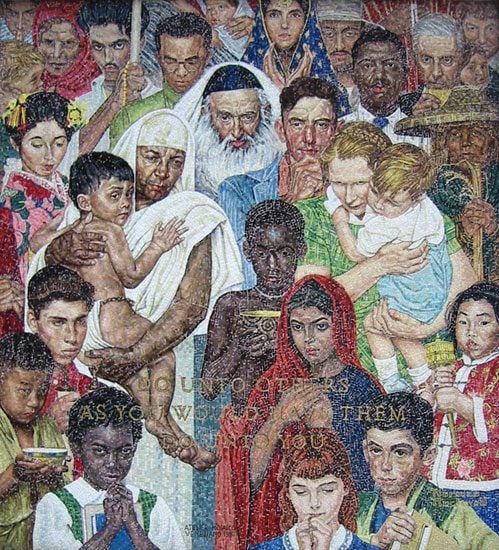
The Golden Rule Mosaic at Thanks-Giving Square in Dallas, Texas (based upon a painting by Norman Rockwell)
A (massive) new article, this one by David M. Belnap, has just been published in Interpreter: A Journal of Latter-day Saint Faith and Scholarship:
“The Inclusive, Anti-Discrimination Message of the Book of Mormon”
Abstract: Attitudes of superiority lead to societal conflict. The racial interpretation of a few Book of Mormon verses has contributed to these attitudes and conflicts, yet hundreds of inclusive messages are found in more than half of the book’s verses. God’s message, love, mercy, and justice are for all people. Righteous people did not think themselves above others, nor did they persecute others or start wars. War is tragic and is caused by wickedness. Conspiracies are a great evil. Righteous people were kind in their attitudes and actions, regardless of others’ social status or ethnicity. Some Book of Mormon people even gave their lives or put their lives at risk to act kindly, and some of these went from hating others to giving up their lives on behalf of others. The inclusive messages in the Book of Mormon are consistent with the position advocated by current Latter-day Saint leaders condemning all racism and disavowing racist hypotheses such as those derived from a few Book of Mormon verses (i.e., that skin color is related to righteousness). The inclusive messages also are consistent with the view that skin color in the Book of Mormon is not literal but is metaphorical. The Book of Mormon instructs us that the right way to interact is with love and respect, through examples of people respecting and reaching out to others, promises to all people, condemnation of unkindness and anti-Semitism, calls to all people to repent, and emphasizing the flaws of one’s own group and not those of others.
***
And, of course, Interpreter has published many past articles that continue to be worthy of attention. I’ve lately been calling renewed attention to them. Here are five more:
Abstract: Latter-day Saints have always been encouraged to seek the truth wherever it can be found. With the Book of Mormon being written especially to the Lamanites, we can assume that the more we know about Lamanite and Native American culture, the more we can understand, appreciate and gain insights as we read that inspired scripture. In this article the writer has compared examples from Native American culture and history to what we read in the Book of Mormon and experience as members of The Church of Jesus Christ of Latter-day Saints. Most importantly, as we read through the eyes of a Native American, we can appreciate the divinity and authenticity of the Book of Mormon, since Joseph Smith could not have known Native American culture and history in the way it is described herein.
John W. Welch, “Toward a Mormon Jurisprudence”
Preface: The following article was published in the Regent University Law Review in the first number of its 2008-2009 volume, pages 79-103. The article is reprinted here by permission without any substantive modifications. Because law reviews are not easily available on the Web or elsewhere to most readers, I am pleased to give wider exposure to this first foray into the idea of a Mormon jurisprudence. Regent University is an Evangelical Christian institution.
This article grew mainly out of a talk that was delivered on February 14, 2004, to the first national meeting of the student chapters of the J. Reuben Clark Law Society, held at Harvard Law School. Four years later, on February 13, 2008, Scott Adams, a third-year member of the law review at Regent University Law School contacted me and said that he was hoping to “put something together on Mormonism and the law,” to see if the law review might publish it. Scott rightly indicated that, according to his research, “no one has ever attempted to tackle the ambitious project of considering Mormonism, in general, and analyzing its potential implications on law (for example, how might an LDS judge see the law, as opposed to a Catholic).” Scott was thinking about writing a paper himself on natural law from an LDS perspective. I responded by suggesting that he contact Cole Durham, Francis Beckwith, and Nate Oman; and I offered to send him a copy of my Harvard speech, expressing interest in publishing that paper as a companion piece with his.
As it would soon turn out, the editor-in-chief and board of the Regent law review were very eager to publish my piece, especially if it could appear with another article presenting an [Page 50]“opposing viewpoint.” They suggested a member of their faculty, and after brief deliberations, all was agreed. In the end, however, no opposing or additional articles were forthcoming, and so this article was published on its own. I thank Scott and his fellow students for their help in checking and enriching the footnotes. They also had hopes that this publication would build good relationships between Evangelicals and future LDS students, which I too hope has occurred.
This essay tries to identify what a “Mormon” jurisprudence would, and would not, look like. Beyond its immediate relevance to legal thought, this article might have broader applications in helping LDS scholars in other disciplines to think about, for example, what a Mormon theory of literary criticism might look like, or what would be distinctive about a Mormon approach to political theory or to any other discipline. I believe that any such Mormon academic approach (1) would be solidly rooted in all LDS scripture, (2) would be inclusivistic, privileging fullness and openness over closure and completeness, and (3) would be fundamentally pluralistic and not reductionistic.
Obviously, this piece is just a beginning. There is much more to be done here. I have continued to work along these lines for the past decade and have published other things growing out of this paper, for example, a talk about rights and duties given at Stanford Law School, published in the Clark Memorandum (Fall, 2010), 26, http://www.jrcls.org/publications/clark_memo/issues/cmF10.pdf, and my Maeser lecture at Brigham Young University, available at http://byustudies.byu.edu/PDFLibrary/50.3WelchThy-08f4ba7e-d3a2-444f-bc8c-0ce842c12fc4.pdf.
I would hope next to articulate the specific implications of these ideas with respect to legal attitudes toward statutory construction, judicial activism, the spirit and letter of the law, justice and mercy, equality and freedom, pacifism and justifiable use of force, corrections and forms of punishment, degrees of fiduciary duties, types of contracts, the foundations of family [Page 51]law, the principles of constitutional law, and many other topics. This development would utilize historical, scriptural, logical, ethical, and other analyses.
Naturally, this article is neither complete nor comprehensive in scope. How could it truly exemplify my theory if it were otherwise? This was all I could cover in a brief presentation even to a group of bright law students gathered on a Valentine’s Day at Harvard. And I probably already had included enough here to bewilder most Baptist readers of the Regent University Law Review who were just then hearing for the first time about Mitt Romney and wondered how a Mormon might approach the law as the president of the United States.
That question, of course, is still up for grabs; and Latter-day Saints are more interested in political and legal issues than ever before. So I hope that readers may find this article still to be stimulating and, as reader Sid Unrau has commented, “well worth reading, contemplating, and building upon, … a valuable start for those who wish to further the subject.”
Craig L. Foster, “Misunderstanding Mormonism in The Mormonizing of America“
Abstract: The Mormonizing of America by Stephen Mansfield has been touted as a solid, impartial look at Mormon history and doctrine. Unfortunately, on closer examination, the book is seriously lacking both in substance and impartiality. This article discusses the book’s numerous problems.
Review of Stephen Mansfield. The Mormonizing of America: How the Mormon Religion Became a Dominant Force in Politics, Entertainment, and Pop Culture. Brentwood, TN: Worthy Publishing, 2012. 264 pp. $22.99.
Review of:
- Michael Dowd. Thank God for Evolution. New York: W. W. Norton, 2004. 336 pp., with index. $13.95.
- Karl W. Giberson. Saving Darwin: How to be a Christian and Believe in Evolution. New York: HarperCollins, 2008. 239 pp., with index. $9.98.
- Daniel J. Fairbanks. Relics of Eden: The Powerful Evidence of Evolution in Human DNA. Amherst, NY: Prometheus Books, 2007. 281 pp., with index. $15.86.
- Howard C. Stutz. “Let the Earth Bring Forth”, Evolution and Scripture. Draper, UT: Greg Kofford Books, 2010. 130 pp., with index. $15.95
- David C. Stove. Darwinian Fairytales: Selfish Genes, Errors of Heredity, and Other Fables of Evolution. New York: Encounter Books, 1995. 345 pp., with index. $18.95
- William A. Dembski. The End of Christianity: Finding a Good God in an Evil World. Nashville, TN: B&H Publishing Group, 2009. 229 pp., with index. $22.99
Abstract: At an author-meets-critic Sunstone Symposium on August 2, 2013, Gary Bergera devoted over 90% of his fifteen-minute review to criticize my 1500+ page, three-volume, Joseph Smith’s Polygamy: History and Theology. This article responds to several of the disagreements outlined by Bergera that on closer inspection appear as straw men. Also addressed are the tired arguments buoyed by carefully selected documentation he advanced supporting that (1) John C. Bennett learned of polygamy from Joseph Smith, (2) the Fanny Alger-Joseph Smith relationship was adultery, and (3) the Prophet practiced sexual polyandry. This article attempts to provide greater balance by including new evidences published for the first time in the three volumes but ignored by Bergera. These new documents and observations empower readers to expand their understanding beyond the timeworn reconstructions referenced in Bergera’s critical review.
***
Finally, some of you may find this interesting not only intrinsically but because of its connection to Utah and, perhaps not as indirect as some may think — the Economist article title may even have vaguely picked up on this — to the teachings of the Church of Jesus Christ of Latter-day Saints:
Deseret News: “Sen. Mitt Romney proposes to send monthly cash to families — permanently: Sen. Mike Lee proposes expanding child tax credit”
Church of Jesus Christ of Latter-day Saints
Previous Post

February 4, 2021
Football, Faith, and Freud
Browse Our Archives
Select a Category Uncategorized
Select a Month October 2026 September 2026 August 2026 July 2026 June 2026 May 2026 April 2026 March 2026 February 2026 January 2026 December 2025 November 2025 October 2025 September 2025 August 2025 July 2025 June 2025 May 2025 April 2025 March 2025 February 2025 January 2025 December 2024 November 2024 October 2024 September 2024 August 2024 July 2024 June 2024 May 2024 April 2024 March 2024 February 2024 January 2024 December 2023 November 2023 October 2023 September 2023 August 2023 July 2023 June 2023 May 2023 April 2023 March 2023 February 2023 January 2023 December 2022 November 2022 October 2022 September 2022 August 2022 July 2022 June 2022 May 2022 April 2022 March 2022 February 2022 January 2022 December 2021 November 2021 October 2021 September 2021 August 2021 July 2021 June 2021 May 2021 April 2021 March 2021 February 2021 January 2021 December 2020 November 2020 October 2020 September 2020 August 2020 July 2020 June 2020 May 2020 April 2020 March 2020 February 2020 January 2020 December 2019 November 2019 October 2019 September 2019 August 2019 July 2019 June 2019 May 2019 April 2019 March 2019 February 2019 January 2019 December 2018 November 2018 October 2018 September 2018 August 2018 July 2018 June 2018 May 2018 April 2018 March 2018 February 2018 January 2018 December 2017 November 2017 October 2017 September 2017 August 2017 July 2017 June 2017 May 2017 April 2017 March 2017 February 2017 January 2017 December 2016 November 2016 October 2016 September 2016 August 2016 July 2016 June 2016 May 2016 April 2016 March 2016 February 2016 January 2016 December 2015 November 2015 October 2015 September 2015 August 2015 July 2015 June 2015 May 2015 April 2015 March 2015 February 2015 January 2015 December 2014 November 2014 March 2014 August 2013 February 2012
Follow Us!
TAKE THE
Religious Wisdom Quiz
What meal did the Israelites eat before leaving Egypt?
Select your answer to see how you score.
Feast of Booths Firstfruits Passover Day of Atonement meal
Related posts from Sic et Non


Notes on Women, Priesthood, and General Conference

"The Book of Moses as a Temple Text"

TRENDING AT PATHEOS Latter-day Saint

Nearly every morning, I make the drive to Detroit with my high-school-age...

The Real AI Story Is Adoption Without Trust
Artificial intelligence has crossed a political threshold. It is no longer a...

A new article, written by Jeff Lindsay and Gale L. Pooley,...

Swimfan: Forgotten Aughts Pleasures
This is a recovery effort. In 2002, My Big Fat Greek Wedding...

Top Three Anti-Catholic Lies About Catholicism
This is my initial transcript for the video, "THE 3 WORST...

Pope Leo Celebrates Mass for Nurses & Docs...
I don't have any idea how he did it, but Pope Leo...
view all Latter-day Saint blogs
Ad-Free & Subscriber Log-In Subscription Support
- About Us
- 2026 Calendar
- Videos
- Podcasts
- Library of World Religions
- Faith In Media Tracker
- Advertise With Us
- Write for Us
- Privacy Policy
- Terms of Service
- Do Not Sell My Data
- Contact Us
- Radiant Digital
- Manage Newsletter Subscriptions
- Unsubscribe From Notifications
- Sitemap
Copyright 2008-2026, Patheos. All rights reserved.
Subscription Support Ad-Free & Subscriber Log-In
Follow Patheos