
BuddhistCatholicContemplativeEvangelicalGeneral ChristianHinduJewishLatter-day SaintMuslimNew VisionsProgressive Christian
Beliefs
- Buddhist
- Catholic
- Contemplative
- Evangelical
- General Christian
- Hindu
- Jewish
- Latter-day Saint
- More Voices
- Muslim
- New Visions
- Pagan
- Progressive Christian
Topics
- Religion News
- Food and Religion
- Sports and Religion
- Religious Art
- Religious Music and Entertainment
- Religious Events
- History and Religion
- Style and Religion
- Politics and Religion
- Women in Religion
- Recreation Outdoors and Religion
- Business Finance and Religion
- Careers Workplace and Religion
- Education and Religion
- Family Parenting and Religion
- Health Fitness and Religion
- Home and Religion
- Relationships and Religion
- Technology and Religion
- Travel and Religion
Columnists
- Buddhist Columnists
- Business Finance and Religion Columnists
- Careers Workplace and Religion Columnists
- Catholic Columnists
- Contemplative Columnists
- Education and Religion Columnists
- Evangelists Columnists
- Family Parenting and Religion Columnists
- General Christian Columnists
- Health Fitness and Religion Columnists
- Hindu Columnists
- History and Religion Columnists
- Home and Religion Columnists
- Jewish Columnists
- More Voices Columnists
- Latter Day Columnists
- Muslim Columnists
- New Visions Columnists
- Nonreligious Columnists
- Pagan Columnists
- Politics and Religion Columnists
- Progressive Columnists
- Recreation Outdoors and Religion Columnists
- Relationships and Religion Columnists
- Religion News Columnists
- Religious Art Columnists
- Religious Events Columnists
- Religious Music and Entertainment Columnists
- Sports and Religion Columnists
- Style and Religion Columnists
- Technology and Religion Columnists
- Travel and Religion Columnists
- Women in Religion Columnists
Resource Library
- 2026 Calendar
- Library of World Religions
- The 100 Most Holy Places on Earth
- Patheos Answers
- Podcasts
- Videos
- Faith Leaders Database
- Anglican Episcopalian
- Bahai
- Baptist
- Buddhism
- Christianity
- Confucianism
- Eastern Orthodoxy
- Hinduism
- Holiness and Pentecostal
- ISKCON
- Islam
- Judaism
- Lutheran
- Methodist
- The Church of Jesus Christ of Latter-day Saints
- New Age
- Paganism
- Presbytarian and Reformed
- Protestantism
- Religion Behind the Scenes
- Roman Catholic
- Scientology
- Shia Islam
- Sikhism
- Sufism
- Sunni Islam
- Taoism
- Zen
- See all religions
Research Tools
 Ad-Free & Subscriber Log-In Subscription Support
Ad-Free & Subscriber Log-In Subscription Support
Follow Patheos 

- Trending:
- Forgiveness
- |
- Marriage
- |
- Consciousness
- |
- Death Penalty
- |
- Election
- |
- Halloween

- Home
- Latter-day Saint
- The curious “assumption of intelligibility”
The curious “assumption of intelligibility”
Last updated on: February 13, 2021 at 10:53 pm by Dan Peterson
The curious “assumption of intelligibility” 2021-02-13T22:53:42-07:00 Dan Peterson
Patheos Explore the world's faith through different perspectives on religion and spirituality! Patheos has the views of the prevalent religions and spiritualities of the world.
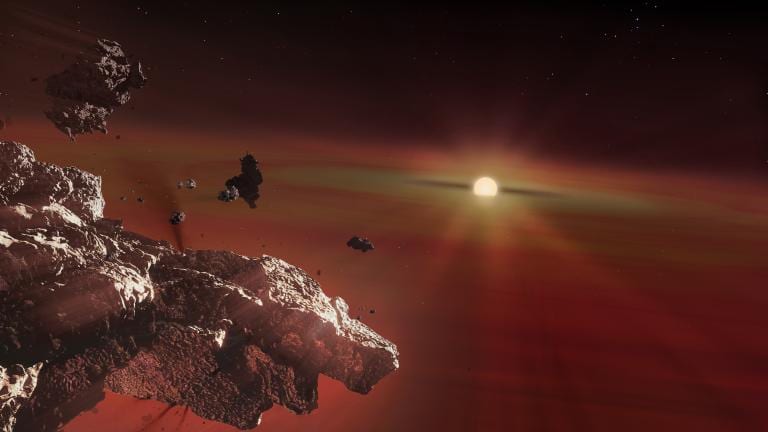
Remnants of planetary crust disintegrating under the tidal forces around a cool white dwarf. Material in the disc becomes vaporised close to the central star and flows onto the white dwarf atmosphere. Credit: University of Warwick/Mark Garlick
I eagerly await vaccination against COVID-19 — not only for my own safety and that of my family, but for all of those around me, for my community, for the society in which I live:
“If the vaccines do reduce the spread of the virus, “it means that even people [who] aren’t vaccinated will gain protection from the vaccinated people around them,” says Marm Kilpatrick, an infectious diseases researcher at the University of California, Santa Cruz. As more people get vaccinated, they won’t go on to infect as many other people as they might have before the shot, he says.”
***
Wondering whether to sacrifice in order to pay for music lessons for your children?
“Musical Training Gives the Brain a Crucial Advantage—Especially at an Early Age, Says New Study”
This is a really good innovation:
“Kenyan Woman’s Startup Recycles Plastic Waste into Bricks That Are 5x Stronger Than Concrete”
An interesting idea:
***
I love stories of archaeological finds by amateurs. This is a nice one:
““There are many more people using metal detectors than there are archeologists, so they find much more stuff, and it’s transforming our view of the past,” academic archeologist Professor Carenza Lewis told ITV.”
***
Astonishing:
“Birds can ‘read’ the Earth’s magnetic signature well enough to get back on course”
***
Out of Switzerland: “A new way of forming planets”
“TESS discovers new worlds in a river of young stars”
“Image: Hubble takes portrait of nebula”
And, from the other end of the planetary life cycle, an item out of England:
“Vaporised crusts of Earth-like planets found in dying stars”
***
Once again, out of England: “Women better at reading minds than men – new study: Bath psychologists have developed the first ever ‘mind-reading questionnaire’ to assess how well people understand what others are really thinking.”
I’m not even slightly surprised to learn that “women are much better than men at putting themselves in someone else’s shoes.”
***
This is important:
“Postmodernism: “The Ultimate Sour Grapes of Science Deniers””
Definitions are necessary but, quite often, surprisingly difficult. Here’s an example:
“How Big is the Solar System?”
***
Rev. Dr. David Wilkinson, a British Methodist theologian, holds a Ph.D. in systematic theology and teaches at the University of Durham. This is a passage that I marked a while back during a reading of his book God, Time and Stephen Hawking: An Exploration Into Origins (London: Monarch Books, 2001):
Although the popular view of Hawking’s work has often been to see it as an attack on God, it is far from that. There are a number of things about Hawking’s views on God which need to be clearly noted.
First, he takes as an assumption without justification that the universe is intelligible to us, that is we are free to observe it and describe it in mathematical terms. However, this is surely an aspect of the universe which needs explanation. John Polkinghorne was Professor of Mathematical Physics at Cambridge where he encountered first hand the intelligibility of the world in the area of particle physics. Now an ordained minister in the Church of England, he argues that it is a striking and non-trivial fact that the pattern of mathematics is realised in the physical structure of the world and that our minds are able to solve problems that the physical world presents. For this assumption of intelligibility used by science Polkinghorne sees the most reasonable explanation as the existence of a Creator who is the common ground of the rationality of our minds and the universe. We may add that a mathematical account of the creation of the universe implicitly assumes that the mathematical laws are transcendent, that is they are not contained by the physical universe. Yet where do these laws come from? Is the most reasonable explanation once again a rational creator?
Second, Hawking tends to identify God as exclusively a ‘deistic’ creator, making God vulnerable to being pushed out of the gaps. Deism viewed God as the initiator or originator of the universe, but that was all. It was as if God lit the blue touch paper and then went off for a cup of tea to have nothing more to do with the universe. Little consideration was given to historical revelation or religious experience that may point to God as sustainer and lawgiver of the universe. Hawking talks of God in much the same way and so his work is an attack on deism, rather than Christian theism. (129-130)
It should be pointed out, however, before any reader is reflexively inclined to dismiss him and his comments on the grounds that he’s merely a theologian, that Rev. Dr. Wilkinson also holds a doctorate in theoretical astrophysics and that he is a Fellow of the Royal Astronomical Society.
He goes on to offer a third note on Professor Hawking’s theoriziing and its relevance to the existence of God, but I think that I’ll save that point for a future blog entry. Instead, I’ll now quote another passage from Rev. Dr. Wilkinson that I marked. Referring to “the old distinction between how and why questions,” he remarks that
it is helpful to understand that science is primarily concerned about ‘how’ questions. How did the universe arise out of a Big Bang? How do gas clouds collapse under gravity to form stars? It [science] is a successful discipline because it limits itself to these kinds of questions. To note that it does not address ‘why’ questions is not to introduce a God of the gaps but simply to recognise that science is not about value and purpose. (131)
Previous Post

February 12, 2021
Jaredites, Polygamists, and Political Activists
Next Post
February 14, 2021 Addendum 1: A First Pass at Some Notes on Pre-Islamic Persia
Browse Our Archives
Select a Category Uncategorized
Select a Month October 2026 September 2026 August 2026 July 2026 June 2026 May 2026 April 2026 March 2026 February 2026 January 2026 December 2025 November 2025 October 2025 September 2025 August 2025 July 2025 June 2025 May 2025 April 2025 March 2025 February 2025 January 2025 December 2024 November 2024 October 2024 September 2024 August 2024 July 2024 June 2024 May 2024 April 2024 March 2024 February 2024 January 2024 December 2023 November 2023 October 2023 September 2023 August 2023 July 2023 June 2023 May 2023 April 2023 March 2023 February 2023 January 2023 December 2022 November 2022 October 2022 September 2022 August 2022 July 2022 June 2022 May 2022 April 2022 March 2022 February 2022 January 2022 December 2021 November 2021 October 2021 September 2021 August 2021 July 2021 June 2021 May 2021 April 2021 March 2021 February 2021 January 2021 December 2020 November 2020 October 2020 September 2020 August 2020 July 2020 June 2020 May 2020 April 2020 March 2020 February 2020 January 2020 December 2019 November 2019 October 2019 September 2019 August 2019 July 2019 June 2019 May 2019 April 2019 March 2019 February 2019 January 2019 December 2018 November 2018 October 2018 September 2018 August 2018 July 2018 June 2018 May 2018 April 2018 March 2018 February 2018 January 2018 December 2017 November 2017 October 2017 September 2017 August 2017 July 2017 June 2017 May 2017 April 2017 March 2017 February 2017 January 2017 December 2016 November 2016 October 2016 September 2016 August 2016 July 2016 June 2016 May 2016 April 2016 March 2016 February 2016 January 2016 December 2015 November 2015 October 2015 September 2015 August 2015 July 2015 June 2015 May 2015 April 2015 March 2015 February 2015 January 2015 December 2014 November 2014 March 2014 August 2013 February 2012
Follow Us!
TAKE THE
Religious Wisdom Quiz
Who said, "We ought to obey God rather than men"?
Select your answer to see how you score.
James John Peter Paul
Related posts from Sic et Non

A case of twin near-death experiences?

Toward a "Post-Materialist Science"?

This Wednesday, at 4 PM, Utah time

TRENDING AT PATHEOS Latter-day Saint

The Sermon on the Mount, Part I: Matthew...
The Sermon on the Mount, Part I (Matthew 4:12-5:12) St. Matthew moves...

What's up from Crossway: Reviewing some of their latest A few weeks...

Janie Learns the Way of the Cross: A...
Teaching children about Jesus' Passion can be challenging. Many parents and educators...

Looking For Good Catholic Writing - October 2026
He alone extends the heavens, and he walks upon the waves of...

In "Irreplaceable," our book on vocation and technology, Trevor Sutton and I...

I was strolling through the top floor of the brand new Parthenon...
view all Latter-day Saint blogs
Ad-Free & Subscriber Log-In Subscription Support
- About Us
- 2026 Calendar
- Videos
- Podcasts
- Library of World Religions
- Faith In Media Tracker
- Advertise With Us
- Write for Us
- Privacy Policy
- Terms of Service
- Do Not Sell My Data
- Contact Us
- Radiant Digital
- Manage Newsletter Subscriptions
- Unsubscribe From Notifications
- Sitemap
Copyright 2008-2026, Patheos. All rights reserved.
Subscription Support Ad-Free & Subscriber Log-In
Follow Patheos