
BuddhistCatholicContemplativeEvangelicalGeneral ChristianHinduJewishLatter-day SaintMuslimNew VisionsProgressive Christian
Beliefs
- Buddhist
- Catholic
- Contemplative
- Evangelical
- General Christian
- Hindu
- Jewish
- Latter-day Saint
- More Voices
- Muslim
- New Visions
- Pagan
- Progressive Christian
Topics
- Religion News
- Food and Religion
- Sports and Religion
- Religious Art
- Religious Music and Entertainment
- Religious Events
- History and Religion
- Style and Religion
- Politics and Religion
- Women in Religion
- Recreation Outdoors and Religion
- Business Finance and Religion
- Careers Workplace and Religion
- Education and Religion
- Family Parenting and Religion
- Health Fitness and Religion
- Home and Religion
- Relationships and Religion
- Technology and Religion
- Travel and Religion
Columnists
- Buddhist Columnists
- Business Finance and Religion Columnists
- Careers Workplace and Religion Columnists
- Catholic Columnists
- Contemplative Columnists
- Education and Religion Columnists
- Evangelists Columnists
- Family Parenting and Religion Columnists
- General Christian Columnists
- Health Fitness and Religion Columnists
- Hindu Columnists
- History and Religion Columnists
- Home and Religion Columnists
- Jewish Columnists
- More Voices Columnists
- Latter Day Columnists
- Muslim Columnists
- New Visions Columnists
- Nonreligious Columnists
- Pagan Columnists
- Politics and Religion Columnists
- Progressive Columnists
- Recreation Outdoors and Religion Columnists
- Relationships and Religion Columnists
- Religion News Columnists
- Religious Art Columnists
- Religious Events Columnists
- Religious Music and Entertainment Columnists
- Sports and Religion Columnists
- Style and Religion Columnists
- Technology and Religion Columnists
- Travel and Religion Columnists
- Women in Religion Columnists
Resource Library
- 2026 Calendar
- Library of World Religions
- The 100 Most Holy Places on Earth
- Patheos Answers
- Podcasts
- Videos
- Faith Leaders Database
- Anglican Episcopalian
- Bahai
- Baptist
- Buddhism
- Christianity
- Confucianism
- Eastern Orthodoxy
- Hinduism
- Holiness and Pentecostal
- ISKCON
- Islam
- Judaism
- Lutheran
- Methodist
- The Church of Jesus Christ of Latter-day Saints
- New Age
- Paganism
- Presbytarian and Reformed
- Protestantism
- Religion Behind the Scenes
- Roman Catholic
- Scientology
- Shia Islam
- Sikhism
- Sufism
- Sunni Islam
- Taoism
- Zen
- See all religions
Research Tools
 Ad-Free & Subscriber Log-In Subscription Support
Ad-Free & Subscriber Log-In Subscription Support
Follow Patheos 

- Trending:
- Forgiveness
- |
- Marriage
- |
- Consciousness
- |
- Death Penalty
- |
- Election
- |
- Halloween

- Home
- Latter-day Saint
- Jaredites, Polygamists, and Political Activists
Jaredites, Polygamists, and Political Activists
Last updated on: February 12, 2021 at 8:08 pm by Dan Peterson
Jaredites, Polygamists, and Political Activists 2021-02-12T20:08:32-07:00 Dan Peterson
Patheos Explore the world's faith through different perspectives on religion and spirituality! Patheos has the views of the prevalent religions and spiritualities of the world.
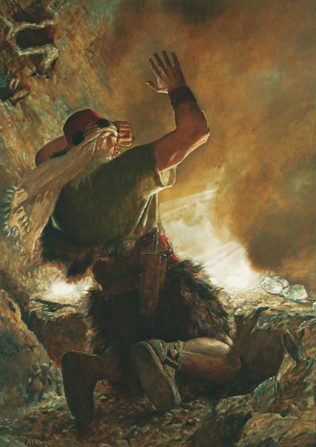
“The Brother of Jared Sees the Finger of the Lord,” by Arnold Friberg (Wikimedia Commons)
While we wait to see how long it will be before the long-promised hammer comes down upon Interpreter: A Journal of Latter-day Saint Faith and Scholarship, here are two new articles that appeared in it just a few minutes ago:
Abstract: Mormon uses pejorative wordplay on the name Jaredites based on the meaning of the Hebrew verb yārad*. The onomastic rhetoric involving the meaning of* yārad first surfaces in Helaman 6 where Mormon also employs wordplay on the name Cain in terms of qānâ or “getting gain.” The first wordplay occurs in the negative purpose clause “lest they should be a means of bringing down [cf. lĕhôrîd*] the people unto destruction” (Helaman 6:25) and the second in the prepositional phrase “until they had come down [cf.* yārĕdû/yordû*] to believe in their works” (Helaman 6:38). Mormon uses these pejorative wordplays as a means of emphasizing the genetic link that he sees between Jareditic secret combinations and the derivative Gadianton robbers. Moroni reflects upon his father’s earlier use of this type of pejorative wordplay on “Jaredites” and* yārad when he directly informs latter-day Gentiles regarding the “decrees of God” upon the land of promise “that ye may repent and not continue in your iniquities until the fullness be come, that ye may not bring down [cf. *tôrîdû/hôradtem*] the fullness of the wrath of God upon you as the inhabitants of the land hath hitherto done” (Ether 2:11). All three of these onomastic allusions constitute an urgent and timely warning to latter-day Gentiles living upon the land of promise. They warn the Gentiles against “coming down” to believe in and partake of the works and spoils of secret combinations like the Jaredites and the Nephites did, and thus “bringing down” their own people to destruction and “bringing down” the “fullness of the wrath of God” upon themselves, as the Jaredites and the Nephites both did.*
And
Hanna Seariac, “Polygamists and Political Activists: The Unlikely Marriage in Pioneering the Vote“
Review of Neylan McBaine, Pioneering the Vote: The Untold Story of Suffragists in Utah and the West (Salt Lake City: Shadow Mountain, 2020). 240 pages. $19.99 (hardback).
Abstract: Pioneering the Vote by Neylan McBaine provides a cogent and concise history of the role of Latter-day Saint women in the suffrage movement. McBaine interweaves a fictionalized narrative centered on Emmeline Wells with primary source excerpts and summaries of particular events. The book brings to life the women described and succeeds in explicating many of the important barriers that Latter-day Saint women faced while trying to participate in the suffrage movement — namely, polygamy. McBaine accurately portrays the aversion to polygamy, but she could have spent more time describing why and how Latter-day Saint women found polygamy empowering. While the book succeeds in recounting history and begins to analyze Latter-day Saint women’s role in this movement, more interaction with Latter-day Saint theology as a way of showing why women would feel passionately about obtaining suffrage while still maintaining polygamous relationships would create a more complete picture. Nevertheless, McBaine’s historic contribution to this field of study acts as a milestone from which we can advance to more nuanced discussions about the way polygamy empowered women.
***
And here is a sampling of some prior articles that appeared in Interpreter several years ago:
Louis C. Midgley, “A Plea for Narrative Theology: Living In and By Stories”
Abstract: The following are reflections on some of the complicated history, including the abuses, of what is commonly known as theology. The Saints do not “do theology.” Even when we are tempted, we do not reduce the contents or grounds of faith to something conforming to traditional theology. Instead, we tell stories of how and why we came to faith, which are then linked to a network of other stories found in our scriptures, and to a master narrative. We live in and by stories and not by either dogmatic or philosophically grounded systematic theology. Instead, we tend to engage in several strikingly different kinds of endeavors, especially including historical studies, which take the place of (and also clash with) what has traditionally been done under the name theology in its various varieties, confessional or otherwise.
Loren Blake Spendlove, “Limhi’s Discourse: Proximity and Distance in Teaching”
Abstract: The author introduces a syntactic technique known as “enallage”—an intentional substitution of one grammatical form for another. This technique can be used to create distance or proximity between the speaker, the audience, and the message. The author demonstrates how king Limhi skillfully used this technique to teach his people the consequences of sin and the power of deliverance through repentance.
John Gee, “Of Tolerance and Intolerance”
Review of D. A. Carson. The Intolerance of Tolerance. Grand Rapids, Michigan: William B. Eerdmans, 2012. 186 pp. with indices of names, subjects and scriptures. $24.00 (hardback), $16.00 (paperback).
James Stutz, “Can a Man See God? 1 Timothy 6:16 in Light of Ancient and Modern Revelation”
Abstract: Joseph Smith’s First Vision is a favorite target of critics of the LDS Church. Evangelical critics in particular, such as Matt Slick of the Christian Apologetics and Research Ministry, seek to discredit the First Vision on biblical grounds. This article explores biblical theophanies and argues that Joseph’s vision fits squarely with the experience of ancient prophets, especially those who are given the rare blessing of piercing the veil of light and glory, the Hebrew kabod, that God dwells within.
Abstract: In 1834, Oliver Cowdery began publishing a history of the Church in installments in the pages of the Latter Day Saints’ Messenger and Advocate*. The first installment talks of the religious excitement and events that ultimately led to Joseph Smith’s First Vision at age 14. However, in the subsequent installment published two months later, Oliver claims that he made a mistake, correcting Joseph’s age from 14 to 17 and failing to make any direct mention of the First Vision. Oliver instead tells the story of Moroni’s visit, thus making it appear that the religious excitement led to Moroni’s visit.*
This curious account has been misunderstood by some to be evidence that the “first” vision that Joseph claimed was actually that of the angel Moroni and that Joseph invented the story of the First Vision of the Father and Son at a later time. However, Joseph wrote an account of his First Vision in 1832 in which he stated that he saw the Lord, and there is substantial evidence that Oliver had this document in his possession at the time that he wrote his history of the Church. This essay demonstrates the correlations between Joseph Smith’s 1832 First Vision account, Oliver’s 1834/1835 account, and Joseph’s 1835 journal entry on the same subject. It is clear that not only did Oliver have Joseph’s history in his possession but that he used Joseph’s 1832 account as a basis for his own account. This essay also shows that Oliver knew of the First Vision and attempted to obliquely refer to the event several times in his second installment before continuing with his narrative of Moroni’s visit.
Louis C. Midgley, “Māori Latter-day Saint Faith: Some Preliminary Remarks”
Review of Marjorie Newton, Tiki and Temple: The Mormon Mission in New Zealand, 1854–1958 (Salt Lake City: Greg Kofford Books, 2012), xv + 328 pp. (including a glossary of Māori words, three appendices, bibliography, two maps, twenty-nine illustrations and a photography register, and index). $29.95 (paperback).
Abstract: Marjorie Newton’s widely acclaimed Tiki and Temple ((Marjorie Newton has received several awards for her book, and it has also been reviewed favorably.)) is a history of the first century of Latter-day Saint missionary endeavors in Aotearoa/New Zealand. She tells the remarkable story of what, beginning in 1881, rapidly became essentially a Māori version of the faith of Latter-day Saints. Her fine work sets the stage for a much closer look at the deeper reasons some Māori became faithful Latter-day Saints. It turns out that Māori seers (and hence their own prophetic tradition) was, for them, commensurate with the divine special revelations brought to them by LDS missionaries. Among other things, the arcane lore taught in special schools to an elite group among the Māori is now receiving close attention by Latter-day Saint scholars.
Hugh Nibley, “The Christmas Quest”
Introduction: The following article from Hugh Nibley, written more than half a century ago, is a timely reminder of the contrast between empty holiday exuberance and the prospect of authentic Christmas cheer that can be provided only by the good news of “a real Savior who has really spoken with men.”
This article originally appeared in Millennial Star 112/1 (January 1950), 4-5. It was reprinted in Eloquent Witness: Nibley on Himself, Others, and the Temple*, edited by Stephen D. Ricks.* The Collected Works of Hugh Nibley 17 (Salt Lake City, UT: Deseret Book, 2008), 121-124. Footnotes below have been added by Interpreter.
John S. Lewis, “The Scale of Creation in Space and Time”
Abstract: The accounts of creation in Genesis, Moses, and Abraham as well as in higher endowments of knowledge given to the faithful are based on visions in which the seer lacked the vocabulary to describe and the knowledge to interpret what he saw and hence was obliged to record his experiences in the imprecise language available to him. Modern attempts to explain accounts of these visions frequently make use of concepts and terminology that are completely at odds with the understanding of ancient peoples: they project anachronistic concepts that the original seer would not have recognized. This article reviews several aspects of the creation stories in scripture for the purpose of distinguishing anachronistic modern reinterpretations from the content of the original vision.
This essay derives from a presentation made at the 2013 Interpreter Symposium on Science and Religion: Cosmos, Earth, and Man on November 9, 2013. Details on the event, including links to videos, are available at journal.interpreterfoundation.org. An expanded version of the symposium proceedings will be published in hardcopy and digital formats.
Bryan S. Buchanan, “Enoch and Noah on Steroids”
Review of Jeffrey M. Bradshaw and David J. Larsen, In God’s Image and Likeness 2: Enoch, Noah, and the Tower of Babel (Salt Lake City, Utah: The Interpreter Foundation and Eborn Books, 2014), 590 pp. (full color interior includes footnotes; endnotes; three excursus sections; annotated bibliography on Enoch and the Flood; comprehensive reference list; thumbnail index of one hundred and eleven illustrations and photographs; and indexes of scriptures referenced, modern prophets quoted, and topics discussed). $49.99 (hardcover).
Reprinted with the kind permission of the Association for Mormon Letters.
Church of Jesus Christ of Latter-day Saints
Interpreter Journal Latter-day Saint Faith Scholarship
Next Post

February 13, 2021 The curious "assumption of intelligibility"
Browse Our Archives
Select a Category Uncategorized
Select a Month October 2026 September 2026 August 2026 July 2026 June 2026 May 2026 April 2026 March 2026 February 2026 January 2026 December 2025 November 2025 October 2025 September 2025 August 2025 July 2025 June 2025 May 2025 April 2025 March 2025 February 2025 January 2025 December 2024 November 2024 October 2024 September 2024 August 2024 July 2024 June 2024 May 2024 April 2024 March 2024 February 2024 January 2024 December 2023 November 2023 October 2023 September 2023 August 2023 July 2023 June 2023 May 2023 April 2023 March 2023 February 2023 January 2023 December 2022 November 2022 October 2022 September 2022 August 2022 July 2022 June 2022 May 2022 April 2022 March 2022 February 2022 January 2022 December 2021 November 2021 October 2021 September 2021 August 2021 July 2021 June 2021 May 2021 April 2021 March 2021 February 2021 January 2021 December 2020 November 2020 October 2020 September 2020 August 2020 July 2020 June 2020 May 2020 April 2020 March 2020 February 2020 January 2020 December 2019 November 2019 October 2019 September 2019 August 2019 July 2019 June 2019 May 2019 April 2019 March 2019 February 2019 January 2019 December 2018 November 2018 October 2018 September 2018 August 2018 July 2018 June 2018 May 2018 April 2018 March 2018 February 2018 January 2018 December 2017 November 2017 October 2017 September 2017 August 2017 July 2017 June 2017 May 2017 April 2017 March 2017 February 2017 January 2017 December 2016 November 2016 October 2016 September 2016 August 2016 July 2016 June 2016 May 2016 April 2016 March 2016 February 2016 January 2016 December 2015 November 2015 October 2015 September 2015 August 2015 July 2015 June 2015 May 2015 April 2015 March 2015 February 2015 January 2015 December 2014 November 2014 March 2014 August 2013 February 2012
Follow Us!
TAKE THE
Religious Wisdom Quiz
According to Jesus, what defiles a person?
Select your answer to see how you score.
Money What comes out of the heart Food eaten Clothing
Related posts from Sic et Non


Notes on Women, Priesthood, and General Conference

"America's Most Neighborly City"? It's not in Switzerland

"The Book of Moses as a Temple Text"
TRENDING AT PATHEOS Latter-day Saint

Nearly every morning, I make the drive to Detroit with my high-school-age...

The Real AI Story Is Adoption Without Trust
Artificial intelligence has crossed a political threshold. It is no longer a...

A new article, written by Jeff Lindsay and Gale L. Pooley,...

Swimfan: Forgotten Aughts Pleasures
This is a recovery effort. In 2002, My Big Fat Greek Wedding...

Top Three Anti-Catholic Lies About Catholicism
This is my initial transcript for the video, "THE 3 WORST...

Pope Leo Celebrates Mass for Nurses & Docs...
I don't have any idea how he did it, but Pope Leo...
view all Latter-day Saint blogs
Ad-Free & Subscriber Log-In Subscription Support
- About Us
- 2026 Calendar
- Videos
- Podcasts
- Library of World Religions
- Faith In Media Tracker
- Advertise With Us
- Write for Us
- Privacy Policy
- Terms of Service
- Do Not Sell My Data
- Contact Us
- Radiant Digital
- Manage Newsletter Subscriptions
- Unsubscribe From Notifications
- Sitemap
Copyright 2008-2026, Patheos. All rights reserved.
Subscription Support Ad-Free & Subscriber Log-In
Follow Patheos