
BuddhistCatholicContemplativeEvangelicalGeneral ChristianHinduJewishLatter-day SaintMuslimNew VisionsProgressive Christian
Beliefs
- Buddhist
- Catholic
- Contemplative
- Evangelical
- General Christian
- Hindu
- Jewish
- Latter-day Saint
- More Voices
- Muslim
- New Visions
- Pagan
- Progressive Christian
Topics
- Religion News
- Food and Religion
- Sports and Religion
- Religious Art
- Religious Music and Entertainment
- Religious Events
- History and Religion
- Style and Religion
- Politics and Religion
- Women in Religion
- Recreation Outdoors and Religion
- Business Finance and Religion
- Careers Workplace and Religion
- Education and Religion
- Family Parenting and Religion
- Health Fitness and Religion
- Home and Religion
- Relationships and Religion
- Technology and Religion
- Travel and Religion
Columnists
- Buddhist Columnists
- Business Finance and Religion Columnists
- Careers Workplace and Religion Columnists
- Catholic Columnists
- Contemplative Columnists
- Education and Religion Columnists
- Evangelists Columnists
- Family Parenting and Religion Columnists
- General Christian Columnists
- Health Fitness and Religion Columnists
- Hindu Columnists
- History and Religion Columnists
- Home and Religion Columnists
- Jewish Columnists
- More Voices Columnists
- Latter Day Columnists
- Muslim Columnists
- New Visions Columnists
- Nonreligious Columnists
- Pagan Columnists
- Politics and Religion Columnists
- Progressive Columnists
- Recreation Outdoors and Religion Columnists
- Relationships and Religion Columnists
- Religion News Columnists
- Religious Art Columnists
- Religious Events Columnists
- Religious Music and Entertainment Columnists
- Sports and Religion Columnists
- Style and Religion Columnists
- Technology and Religion Columnists
- Travel and Religion Columnists
- Women in Religion Columnists
Resource Library
- 2026 Calendar
- Library of World Religions
- The 100 Most Holy Places on Earth
- Patheos Answers
- Podcasts
- Videos
- Faith Leaders Database
- Anglican Episcopalian
- Bahai
- Baptist
- Buddhism
- Christianity
- Confucianism
- Eastern Orthodoxy
- Hinduism
- Holiness and Pentecostal
- ISKCON
- Islam
- Judaism
- Lutheran
- Methodist
- The Church of Jesus Christ of Latter-day Saints
- New Age
- Paganism
- Presbytarian and Reformed
- Protestantism
- Religion Behind the Scenes
- Roman Catholic
- Scientology
- Shia Islam
- Sikhism
- Sufism
- Sunni Islam
- Taoism
- Zen
- See all religions
Research Tools
 Ad-Free & Subscriber Log-In Subscription Support
Ad-Free & Subscriber Log-In Subscription Support
Follow Patheos 

- Trending:
- Forgiveness
- |
- Marriage
- |
- Consciousness
- |
- Death Penalty
- |
- Election
- |
- Halloween

- Home
- Latter-day Saint
- Addendum 1: A First Pass at Some Notes on Pre-Islamic Persia
Addendum 1: A First Pass at Some Notes on Pre-Islamic Persia
Last updated on: February 15, 2021 at 1:56 pm by Dan Peterson
Addendum 1: A First Pass at Some Notes on Pre-Islamic Persia 2021-02-15T13:56:45-07:00 Dan Peterson
Patheos Explore the world's faith through different perspectives on religion and spirituality! Patheos has the views of the prevalent religions and spiritualities of the world.
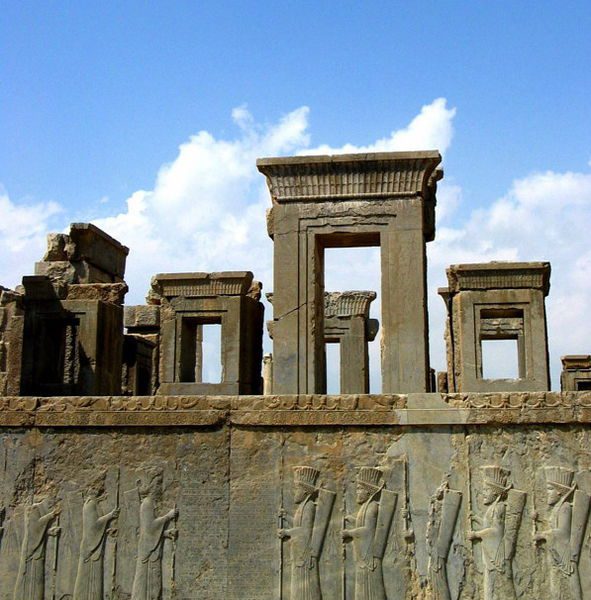
The ruins of ancient Persepolis, in Iran — the ceremonial capital of the Achaemenid Empire between about BC 550 and BC 330 — is one of the most impressive archaeological sites I’ve ever visited.
(Wikimedia Commons public domain photograph)
For the ongoing revision of my book on the Middle East for a popular, predominantly Latter-day Saint audience, I intend to expand its coverage beyond the Arabs. Here are some preliminary background notes for Iran before the coming of Islam:
The ancient Iranians had entered into what is now the modern nation of Iran from the steppes of Central Asia by approximately 2000 BC. Their most prominent factions were the Medes, the Persians, and the Parthians — the first two of which play fairly prominent roles in the Hebrew Bible.
Between the late tenth century BC and the late seventh century BC, the area was dominated by the Assyrian Empire, which had its principal seat of power in northern Mesopotamia. At the end of that period, however, the Medes and the Persians, in alliance with the Babylonians and some of their own fellow-Iranian tribes, rebelled against the Assyrian Empire, sacking its capital Nineveh (then probably the largest city in the world) and overthrowing the empire altogether.
By the late seventh century BC, the Median Empire ruled over not only the bulk of present-day Iran but also the eastern portion of the Anatolian Peninsula (essentially, the eastern part of modern Turkey).
In 550 BC, in what is generally known as the “Persian Revolt,” Cyrus the Great — a Persian — seized control of the Median Empire and a number of neighboring states and founded the Achaemenid Empire. In 547 BC, Cyrus took control of the Greek-speaking region of Ionia. In 539 BC, he conquered the Neo-Babylonian Empire.
Think of the story of Belshazzar’s Feast, as told in Daniel 5:
30 In that night was Belshazzar the king of the Chaldeans slain. 31 And Darius the Median took the kingdom, being about threescore and two years old.
The king who conquered Babylon was actually Cyrus the Persian, or Cyrus the Great. And the conquerors of Babylon weren’t the Medes but their kinsmen, the Persians. Moreover, it was Cyrus who released the Jewish exiles who had been carried off to Babylon, authorizing them to return to Judea (now under Persian rule), to rebuild their temple. He even helped to finance its construction:
22 Now in the first year of Cyrus king of Persia, that the word of the Lord spoken by the mouth of Jeremiah might be accomplished, the Lord stirred up the spirit of Cyrus king of Persia, that he made a proclamation throughout all his kingdom, and put it also in writing, saying, 23 Thus saith Cyrus king of Persia, All the kingdoms of the earth hath the Lord God of heaven given me; and he hath charged me to build him an house in Jerusalem, which is in Judah. Who is there among you of all his people? The Lord his God be with him, and let him go up. (2 Chronicles 36:22-23)
3 In the first year of Cyrus the king the same Cyrus the king made a decree concerning the house of God at Jerusalem, Let the house be builded, the place where they offered sacrifices, and let the foundations thereof be strongly laid; the height thereof threescore cubits, and the breadth thereof threescore cubits; 4 With three rows of great stones, and a row of new timber: and let the expenses be given out of the king’s house: 5 And also let the golden and silver vessels of the house of God, which Nebuchadnezzar took forth out of the temple which is at Jerusalem, and brought unto Babylon, be restored, and brought again unto the temple which is at Jerusalem, every one to his place, and place them in the house of God. (Ezra 6:3-5)
[The Lord] saith of Cyrus, He is my shepherd, and shall perform all my pleasure: even saying to Jerusalem, Thou shalt be built; and to the temple, Thy foundation shall be laid. (Isaiah 44:28)
At its greatest extent, the Achaemenid Empire ruled over approximately fifty million people–roughly 44% of the world’s total population in that day, which still stands as the highest proportion of humankind ever governed by a single state. To use modern political designations, its domains included the territories of Iran, Azerbaijan, Armenia, Georgia, Turkey or Anatolia, much of the coastal Black Sea, northern Greece, Macedonia, southern Bulgaria, Iraq, Syria, Lebanon, Jordan, Israel and the Palestinian territories, Egypt, Kuwait, northern Saudi Arabia, parts of the United Arab Emirates and Oman, Pakistan, Afghanistan, and much of Central Asia, reaching the banks of the Indus River and the Oxus River to the east.
Among the notable achievements of the Achaemenids was the creation of the Chapar Khaneh (چاپارخانه, or “courier house”), the imperial postal service. Created by Cyrus the Great and further developed by Darius the Great, it mainly followed the “Royal Road,” a 2500-kilometer-long or approximately 1555-mile-long ancient highway that connected most of the empire’s major cities. The ancient Greek historian Herodotus wrote that “There is nothing in the world that travels faster than these Persian couriers.” And his well-known praise of them is inscribed on the exterior of the James Farley Post Office Building in New York City:
Neither snow nor rain nor heat nor gloom of night stays these couriers from the swift completion of their appointed rounds.
Another important thing to note is that the Iranian peoples were Indo-European, both ethnically and linguistically, which means, among other things, that their language was related to Greek, Sanskrit, Latin, German, Italian, French, and English. Yet the Achaemenids adopted Imperial Aramaic — a Semitic tongue related to both Hebrew and Arabic that had been the lingua franca of the Babylonians — as the official language of their empire. Not coincidentally, some portions of the Old Testament (notably including Daniel 2:4 to Daniel 7:28) are in Aramaic, and, even centuries later, after the Babylonian captivity, Aramaic was the daily spoken language of Palestine — and likely that of Jesus and the first apostles.
Between 499 and 493 BC, the Greek cities of Asia Minor out on the western edges of the Empire rebelled against Achaemenid control in what is now known as the “Ionian Revolt.” When the Achaemenid ruler Darius the Great vowed to punish Athens and other mainland Greeks for their support of their ethnic kin in Asia Minor, the conflict broadened further into the Greco-Persian Wars that continued through the first half of the fifth-century BC. Persian forces seemed at first to have an overwhelming advantage, but they suffered a major defeat at the Battle of Marathon in 490 BC. (Modern day “marathons” commemorate the run of a messenger from the battlefield to convey the news of the great Greek victory to the people of Athens.)
Darius died in 486 BC, but his son and successor Xerxes opted to continue the war. With his victory over the vastly outnumbered Greeks at the famous Battle of Thermopylae (480 BC), he was able to torch Athens and raze its Acropolis. Still, the heroic rearguard defenders at Thermopylae, fighting to the death under the command of King Leonidas I of Sparta, left a legacy that inspired and unified the Greeks. The simple epitaph written for them by the poet Simonides and using an ancient name for the people of Sparta has lived on for centuries, but it rallied contemporaries in much the same way that the battle-cry “Remember the Alamo!” galvanized fighters for the independence of Texas from Santa Ana’s Mexico:
Ὦ ξεῖν’, ἀγγέλλειν Λακεδαιμονίοις ὅτι τῇδεκείμεθα, τοῖς κείνων ῥήμασι πειθόμενοι.
Oh stranger, tell the Lacedaemonians that we lie here, obedient to their orders.
Shortly after Thermopylae, Greek forces won decisive victories at the naval Battle of Salamis (480 BC), and then, on the land, at the Battle of Plataea (479 BC). Ultimately, the Achaemenids were obliged to withdraw from all of their territories in the Balkans and in eastern Europe.
In 334 BC, Alexander the Great invaded the Achaemenid Empire and defeated its last emperor, Darius III. Alexander was only 23. Manifestly, he was a military genius, and he had received a superb education from his private tutor, the philosopher Aristotle. Within a remarkably short time, he bore the titles of King of Macedon, Hegemon of the Hellenic League, King of Kings of Persia, Pharaoh of Egypt, and Lord of Asia. But he died suddenly in 323 BC, just 32 years old.
Among his successors were the Ptolemies of Egypt and, in the area of modern-day Iran, the Seleucids. By the middle of the second century BC, however, the Parthian Empire had become the main power in Iran, and it soon became — for centuries — the principal geopolitical rival of the Romans, culminating in the Roman–Parthian Wars, which lasted from 54 BC until 217 AD.
In 224 AD, the Parthians were succeeded by the Sassanid or Sasanian Empire. For the next four centuries or so, they replaced the Parthians as the archrivals of, first, the Roman Empire and then its successor, the Christianized Eastern Roman Empire or Byzantine Empire, which had its capital in Constantinople (today’s Istanbul). They were the world’s two great powers.
The wars continued, mostly along a line running through Syria and Palestine, Mesopotamia, the western region of the Caucasus, and Anatolia (modern Turkey). In the end, both were so exhausted by their perennial fighting that they fell relatively easy prey to the Arabs, newly energized by the revelation of Islam.
Previous Post

February 13, 2021
The curious "assumption of intelligibility"
Next Post
February 15, 2021 "The Handclasp, the Temple, and the King"
Browse Our Archives
Select a Category Uncategorized
Select a Month October 2026 September 2026 August 2026 July 2026 June 2026 May 2026 April 2026 March 2026 February 2026 January 2026 December 2025 November 2025 October 2025 September 2025 August 2025 July 2025 June 2025 May 2025 April 2025 March 2025 February 2025 January 2025 December 2024 November 2024 October 2024 September 2024 August 2024 July 2024 June 2024 May 2024 April 2024 March 2024 February 2024 January 2024 December 2023 November 2023 October 2023 September 2023 August 2023 July 2023 June 2023 May 2023 April 2023 March 2023 February 2023 January 2023 December 2022 November 2022 October 2022 September 2022 August 2022 July 2022 June 2022 May 2022 April 2022 March 2022 February 2022 January 2022 December 2021 November 2021 October 2021 September 2021 August 2021 July 2021 June 2021 May 2021 April 2021 March 2021 February 2021 January 2021 December 2020 November 2020 October 2020 September 2020 August 2020 July 2020 June 2020 May 2020 April 2020 March 2020 February 2020 January 2020 December 2019 November 2019 October 2019 September 2019 August 2019 July 2019 June 2019 May 2019 April 2019 March 2019 February 2019 January 2019 December 2018 November 2018 October 2018 September 2018 August 2018 July 2018 June 2018 May 2018 April 2018 March 2018 February 2018 January 2018 December 2017 November 2017 October 2017 September 2017 August 2017 July 2017 June 2017 May 2017 April 2017 March 2017 February 2017 January 2017 December 2016 November 2016 October 2016 September 2016 August 2016 July 2016 June 2016 May 2016 April 2016 March 2016 February 2016 January 2016 December 2015 November 2015 October 2015 September 2015 August 2015 July 2015 June 2015 May 2015 April 2015 March 2015 February 2015 January 2015 December 2014 November 2014 March 2014 August 2013 February 2012
Follow Us!
TAKE THE
Religious Wisdom Quiz
What Christian group believes in the doctrine of transubstantiation?
Select your answer to see how you score.
Catholics Pentecostals Baptists Protestants
Related posts from Sic et Non

Some notes on the archaeology of the Bible

Islam in America or Islam versus America?

A basic working chronology of Islamic-era Iran

Actual Data and Actual Crusades
TRENDING AT PATHEOS Latter-day Saint

Nearly every morning, I make the drive to Detroit with my high-school-age...

The Real AI Story Is Adoption Without Trust
Artificial intelligence has crossed a political threshold. It is no longer a...

A new article, written by Jeff Lindsay and Gale L. Pooley,...

Swimfan: Forgotten Aughts Pleasures
This is a recovery effort. In 2002, My Big Fat Greek Wedding...

Top Three Anti-Catholic Lies About Catholicism
This is my initial transcript for the video, "THE 3 WORST...

Pope Leo Celebrates Mass for Nurses & Docs...
I don't have any idea how he did it, but Pope Leo...
view all Latter-day Saint blogs
Ad-Free & Subscriber Log-In Subscription Support
- About Us
- 2026 Calendar
- Videos
- Podcasts
- Library of World Religions
- Faith In Media Tracker
- Advertise With Us
- Write for Us
- Privacy Policy
- Terms of Service
- Do Not Sell My Data
- Contact Us
- Radiant Digital
- Manage Newsletter Subscriptions
- Unsubscribe From Notifications
- Sitemap
Copyright 2008-2026, Patheos. All rights reserved.
Subscription Support Ad-Free & Subscriber Log-In
Follow Patheos