
BuddhistCatholicContemplativeEvangelicalGeneral ChristianHinduJewishLatter-day SaintMuslimNew VisionsProgressive Christian
Beliefs
- Buddhist
- Catholic
- Contemplative
- Evangelical
- General Christian
- Hindu
- Jewish
- Latter-day Saint
- More Voices
- Muslim
- New Visions
- Pagan
- Progressive Christian
Topics
- Religion News
- Food and Religion
- Sports and Religion
- Religious Art
- Religious Music and Entertainment
- Religious Events
- History and Religion
- Style and Religion
- Politics and Religion
- Women in Religion
- Recreation Outdoors and Religion
- Business Finance and Religion
- Careers Workplace and Religion
- Education and Religion
- Family Parenting and Religion
- Health Fitness and Religion
- Home and Religion
- Relationships and Religion
- Technology and Religion
- Travel and Religion
Columnists
- Buddhist Columnists
- Business Finance and Religion Columnists
- Careers Workplace and Religion Columnists
- Catholic Columnists
- Contemplative Columnists
- Education and Religion Columnists
- Evangelists Columnists
- Family Parenting and Religion Columnists
- General Christian Columnists
- Health Fitness and Religion Columnists
- Hindu Columnists
- History and Religion Columnists
- Home and Religion Columnists
- Jewish Columnists
- More Voices Columnists
- Latter Day Columnists
- Muslim Columnists
- New Visions Columnists
- Nonreligious Columnists
- Pagan Columnists
- Politics and Religion Columnists
- Progressive Columnists
- Recreation Outdoors and Religion Columnists
- Relationships and Religion Columnists
- Religion News Columnists
- Religious Art Columnists
- Religious Events Columnists
- Religious Music and Entertainment Columnists
- Sports and Religion Columnists
- Style and Religion Columnists
- Technology and Religion Columnists
- Travel and Religion Columnists
- Women in Religion Columnists
Resource Library
- 2026 Calendar
- Library of World Religions
- The 100 Most Holy Places on Earth
- Patheos Answers
- Podcasts
- Videos
- Faith Leaders Database
- Anglican Episcopalian
- Bahai
- Baptist
- Buddhism
- Christianity
- Confucianism
- Eastern Orthodoxy
- Hinduism
- Holiness and Pentecostal
- ISKCON
- Islam
- Judaism
- Lutheran
- Methodist
- The Church of Jesus Christ of Latter-day Saints
- New Age
- Paganism
- Presbytarian and Reformed
- Protestantism
- Religion Behind the Scenes
- Roman Catholic
- Scientology
- Shia Islam
- Sikhism
- Sufism
- Sunni Islam
- Taoism
- Zen
- See all religions
Research Tools
 Ad-Free & Subscriber Log-In Subscription Support
Ad-Free & Subscriber Log-In Subscription Support
Follow Patheos 

- Trending:
- Forgiveness
- |
- Marriage
- |
- Consciousness
- |
- Death Penalty
- |
- Election
- |
- Halloween

- Home
- Latter-day Saint
- Revision 8.10. “The BYU Jerusalem Center” (conclusion), plus diplomatic breakthroughs in the Middle East
Revision 8.10. “The BYU Jerusalem Center” (conclusion), plus diplomatic breakthroughs in the Middle East
Last updated on: January 3, 2021 at 12:57 pm by Dan Peterson
Revision 8.10. “The BYU Jerusalem Center” (conclusion), plus diplomatic breakthroughs in the Middle East 2021-01-03T12:57:33-07:00 Dan Peterson
Patheos Explore the world's faith through different perspectives on religion and spirituality! Patheos has the views of the prevalent religions and spiritualities of the world.
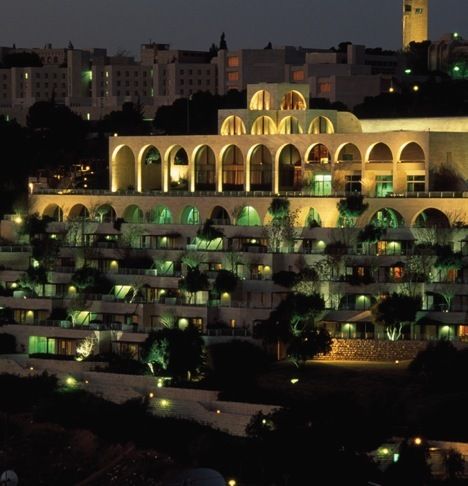
Brigham Young University’s Jerusalem Center for Near Eastern Studies by night, in a Wikimedia Commons photo apparently taken by Adam Farnes
For some time thereafter, no matter how careful we were, some new and usually rather ridiculous charge would still occasionally surface. One amusing instance of this was the accusation published by an Orthodox Jewish newspaper in both Jerusalem and New York during October 1987 that the nefarious Mormons were using their building’s highly visible location to impose a large illuminated cross on the nighttime horizon of Jerusalem. And it was true! (Sort of.) At night, when all the rooms on the sixth level had their lights burning, and when the lights were on in the stairway that runs down the center of the building, an imaginative person could make out a kind of electric cross. Denials that the appearance of a cross was intentional carried no weight with the critics, needless to say. Nor did it help to point out that, in contrast to other Christian groups, Latter-day Saints don’t use the cross in their architecture or liturgy—a fact for which we are routinely assailed and assaulted by Protestant anti-Mormons. Finally, officials of the center simply had to make sure that lights on the sixth level were either turned out or that the windows were covered when they were on.
But these little skirmishes mean little. The battle had been won. The building had been completed, despite intense opposition. What does it mean? Perhaps no one fully knows. Sitting on slightly more than four acres and with a total floor space of 103,420 square feet, Brigham Young University’s Jerusalem Center for Near Eastern Studies is among the most beautiful buildings in Jerusalem and is certainly one of the most visible. (Indeed, it has itself become a tourist attraction that draws thousands of Israelis and their guests each year.) Like a waterfall, it flows down the slope of Mount Scopus. Its many levels are adorned with Italian marble and Burmese teakwood. Its Danish- built organ–created by the venerable firm of Marcussen & Søn, founded in 1806–is one of the finest in the Middle East. From its upper auditorium, where sabbath services are now held for students enrolled in its academic programs and for other local members of the Church and visiting tourists, a breathtaking panoramic view of the Old City of Jerusalem can be seen through three walls of plate-glass windows. Through them, too, the sadness and strife of occupied East Jerusalem can also sometimes be seen, as, behind the pulpit, clouds of tear gas and smoke arise from the ongoing conflicts that occasionally rend the City of Peace.
A community of Latter-day Saints now exists in the Holy Land. It is not a community of agriculturalists and canal-builders, as our ancestors had pictured, but a community of scholars, teachers, and students. In a very real sense, I believe it fulfills the dreams and aspirations of the early missionaries who labored so faithfully in the Near East to build outposts of the kingdom of God in that historic but tortured land. What role the Jerusalem Center for Near Eastern Studies will play in the future of the Church and in the future of the Near East remains to be seen. Perhaps, if we prove worthy of the blessings we have received, it will someday serve the region as a city on a hill, a candle held high to give light to those around it.[1] Whatever benefit it may prove to others, however, it is certainly benefiting us. We can already confidently say that–notwithstanding some periods of reduced occupancy and even closure over the years, owing to both political instability and pandemic–it is building up a new generation of Latter-day Saints to whom the land of Palestine is familiar and for whom the stories of the Bible and the events of the area’s history live in a way they have never lived for our people in the past. If even a small proportion of those who administer and enjoy the programs and courses of the center come away from their experience at Jerusalem with something of the impact that others such as Lorenzo Snow have received, the spiritual life of the Church can only grow in depth and devotion. If even a few return from Palestine with a clearer understanding of our Muslim and Jewish brothers and sisters, our capacity to carry out the mission entrusted to us by the Lord can only increase.
[1] See Matthew 5:14-16.
***
Not everything about the now-mercifully-departed year 2020 was bad. Remarkably, several Arab countries — Bahrain, the United Arab Emirates, Sudan, and Morocco — have established diplomatic relations with Israel over the past several months, in addition to Egypt and Jordan, which have had such relations since, respectively, 1979 and 1994. There have also been some unprecedented contacts between the Israel and the Kingdom of Saudi Arabia, though they haven’t yet resulted in the establishment of formal ties. Here are some links that I’ve gathered on the subject (not at all an exhaustive sample):
National Review (15 September 2020): “How Trump Defied the Experts and Forged a Breakthrough in the Middle East: The UAE–Israel deal showed that the conventional wisdom was wrong.”
CNN (16 September 2020): “Two Gulf nations recognized Israel at the White House. Here’s what’s in it for all sides”
Religion Unplugged (16 September 2020): “Will Israel’s Peace Agreements Bring Religious Freedom In The Middle East?”
National Review (18 November 2020): “Iran ‘Ever More Isolated’ as Israel Forges New Ties: Israel and Bahrain take more steps toward the normalization of diplomatic ties”
The Economist (23 November 2020): “Israel and Saudi Arabia send a clear signal to Iran—and Joe Biden: The meaning of a surprising rendezvous”
The Wall Street Journal (27 November 2020)): “Secret Meeting in Desert Between Israeli, Saudi Leaders Failed to Reach Normalization Agreement: Saudi crown prince backed away from U.S.-brokered deal to solidify bulwark against Iran”
National Review (10 December 2020): “Trump Announces Israel and Morocco Agree to Normalize Relations”
Times of Israel (1 January 2021): “UAE, Bahrain delegations take part in Western Wall Hanukkah lighting ceremony: Social activists and opinion leaders from Gulf nations attend event in Jerusalem’s Old City described by Kotel chief rabbi as a ‘Hanukkah miracle’”
The crucial factor for Bahrain and the UAE, in my judgment, and possibly also for the Sudan, is pretty clearly the considerable Arab fear of Iran’s nuclear ambitions and of its naked quest for regional hegemony. Israel, a principal target of Iranian hostility, is a natural (and well-armed and militarily formidable) ally against the Islamic Republic. So Morocco’s entry into full relations with Israel is, in some ways, especially interesting. Morocco is very far away from Israel, which means that the Arab-Israeli conflict has always been, practically speaking, somewhat irrelevant. But Iran is even further away. So perhaps Morocco simply saw an opening and went through it. If so, we can hope that other Arab states will do the same.
Jerusalem Center for Near Eastern Studies
Previous Post

January 1, 2021
"Two Essays on Sustaining and Enlarging the Doctrine"
Next Post
January 3, 2021 An instructive disagreement at Oxford about the function of genes
Browse Our Archives
Select a Category Uncategorized
Select a Month October 2026 September 2026 August 2026 July 2026 June 2026 May 2026 April 2026 March 2026 February 2026 January 2026 December 2025 November 2025 October 2025 September 2025 August 2025 July 2025 June 2025 May 2025 April 2025 March 2025 February 2025 January 2025 December 2024 November 2024 October 2024 September 2024 August 2024 July 2024 June 2024 May 2024 April 2024 March 2024 February 2024 January 2024 December 2023 November 2023 October 2023 September 2023 August 2023 July 2023 June 2023 May 2023 April 2023 March 2023 February 2023 January 2023 December 2022 November 2022 October 2022 September 2022 August 2022 July 2022 June 2022 May 2022 April 2022 March 2022 February 2022 January 2022 December 2021 November 2021 October 2021 September 2021 August 2021 July 2021 June 2021 May 2021 April 2021 March 2021 February 2021 January 2021 December 2020 November 2020 October 2020 September 2020 August 2020 July 2020 June 2020 May 2020 April 2020 March 2020 February 2020 January 2020 December 2019 November 2019 October 2019 September 2019 August 2019 July 2019 June 2019 May 2019 April 2019 March 2019 February 2019 January 2019 December 2018 November 2018 October 2018 September 2018 August 2018 July 2018 June 2018 May 2018 April 2018 March 2018 February 2018 January 2018 December 2017 November 2017 October 2017 September 2017 August 2017 July 2017 June 2017 May 2017 April 2017 March 2017 February 2017 January 2017 December 2016 November 2016 October 2016 September 2016 August 2016 July 2016 June 2016 May 2016 April 2016 March 2016 February 2016 January 2016 December 2015 November 2015 October 2015 September 2015 August 2015 July 2015 June 2015 May 2015 April 2015 March 2015 February 2015 January 2015 December 2014 November 2014 March 2014 August 2013 February 2012
Follow Us!
TAKE THE
Religious Wisdom Quiz
What did Moses do after breaking the tablets?
Select your answer to see how you score.
Left the camp Fasted for 30 days Returned to Sinai for new tablets Destroyed the calf
Related posts from Sic et Non

Some notes on the archaeology of the Bible
Against Burgeoning Anti-Semitism

Mandatory Bible reading in Texas public schools?

A Follow-Up on How I Met President Jeffrey...
TRENDING AT PATHEOS Latter-day Saint

How to Make a Decision When You Can't...
Main point: It’s much more valuable to stay close to God so...

Archdiocese Hosts Military Marriage Retreat in Germany
RASTATT, Germany — The transient military lifestyle, with its frequent deployments and...

Nearly every morning, I make the drive to Detroit with my high-school-age...

The Real AI Story Is Adoption Without Trust
Artificial intelligence has crossed a political threshold. It is no longer a...

A new article, written by Jeff Lindsay and Gale L. Pooley,...

Swimfan: Forgotten Aughts Pleasures
This is a recovery effort. In 2002, My Big Fat Greek Wedding...
view all Latter-day Saint blogs
Ad-Free & Subscriber Log-In Subscription Support
- About Us
- 2026 Calendar
- Videos
- Podcasts
- Library of World Religions
- Faith In Media Tracker
- Advertise With Us
- Write for Us
- Privacy Policy
- Terms of Service
- Do Not Sell My Data
- Contact Us
- Radiant Digital
- Manage Newsletter Subscriptions
- Unsubscribe From Notifications
- Sitemap
Copyright 2008-2026, Patheos. All rights reserved.
Subscription Support Ad-Free & Subscriber Log-In
Follow Patheos