
BuddhistCatholicContemplativeEvangelicalGeneral ChristianHinduJewishLatter-day SaintMuslimNew VisionsProgressive Christian
Beliefs
- Buddhist
- Catholic
- Contemplative
- Evangelical
- General Christian
- Hindu
- Jewish
- Latter-day Saint
- More Voices
- Muslim
- New Visions
- Pagan
- Progressive Christian
Topics
- Religion News
- Food and Religion
- Sports and Religion
- Religious Art
- Religious Music and Entertainment
- Religious Events
- History and Religion
- Style and Religion
- Politics and Religion
- Women in Religion
- Recreation Outdoors and Religion
- Business Finance and Religion
- Careers Workplace and Religion
- Education and Religion
- Family Parenting and Religion
- Health Fitness and Religion
- Home and Religion
- Relationships and Religion
- Technology and Religion
- Travel and Religion
Columnists
- Buddhist Columnists
- Business Finance and Religion Columnists
- Careers Workplace and Religion Columnists
- Catholic Columnists
- Contemplative Columnists
- Education and Religion Columnists
- Evangelists Columnists
- Family Parenting and Religion Columnists
- General Christian Columnists
- Health Fitness and Religion Columnists
- Hindu Columnists
- History and Religion Columnists
- Home and Religion Columnists
- Jewish Columnists
- More Voices Columnists
- Latter Day Columnists
- Muslim Columnists
- New Visions Columnists
- Nonreligious Columnists
- Pagan Columnists
- Politics and Religion Columnists
- Progressive Columnists
- Recreation Outdoors and Religion Columnists
- Relationships and Religion Columnists
- Religion News Columnists
- Religious Art Columnists
- Religious Events Columnists
- Religious Music and Entertainment Columnists
- Sports and Religion Columnists
- Style and Religion Columnists
- Technology and Religion Columnists
- Travel and Religion Columnists
- Women in Religion Columnists
Resource Library
- 2026 Calendar
- Library of World Religions
- The 100 Most Holy Places on Earth
- Patheos Answers
- Podcasts
- Videos
- Faith Leaders Database
- Anglican Episcopalian
- Bahai
- Baptist
- Buddhism
- Christianity
- Confucianism
- Eastern Orthodoxy
- Hinduism
- Holiness and Pentecostal
- ISKCON
- Islam
- Judaism
- Lutheran
- Methodist
- The Church of Jesus Christ of Latter-day Saints
- New Age
- Paganism
- Presbytarian and Reformed
- Protestantism
- Religion Behind the Scenes
- Roman Catholic
- Scientology
- Shia Islam
- Sikhism
- Sufism
- Sunni Islam
- Taoism
- Zen
- See all religions
Research Tools
 Ad-Free & Subscriber Log-In Subscription Support
Ad-Free & Subscriber Log-In Subscription Support
Follow Patheos 

- Trending:
- Forgiveness
- |
- Marriage
- |
- Consciousness
- |
- Death Penalty
- |
- Election
- |
- Halloween

- Home
- Latter-day Saint
- “Cosmic Conundrum”
“Cosmic Conundrum”
Last updated on: January 24, 2021 at 5:19 pm by Dan Peterson
“Cosmic Conundrum” 2021-01-24T17:19:45-07:00 Dan Peterson
Patheos Explore the world's faith through different perspectives on religion and spirituality! Patheos has the views of the prevalent religions and spiritualities of the world.
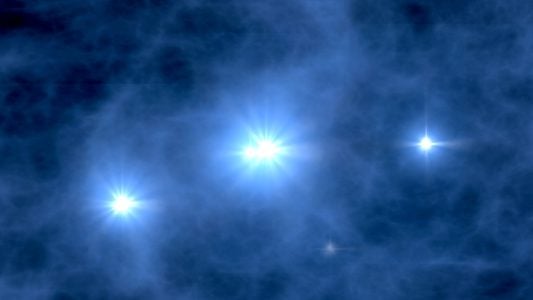
A NASA simulation of the first stars, about 400 million years after the Big Bang
(Wikimedia Commons public domain image)
Okay. If I havn’t been clear enough yet, let me make it unmistakably plain now: I believe that, consonant with advice from their physicians (in some marginal cases), as many people as possible should seek out and receive one of the vaccines that have been or will yet be approved for use against the novel coronavirus. And I intend to beat the drum to that end.
I want to get the COVID-19 pandemic behind us, so that our economy can revive, theaters and restaurants can return to normal, religious congregations can meet, and — very importantly — the temples can fully reopen.
So don’t be surprised if I use this space fairly frequently over the next few weeks and months to exhort people to continue maintaining “social distance,” scrubbing their hands, and wearing masks, and to encourage them to be vaccinated against COVID-19. Anc please don’t become angry.
Here are a few relevant links for now, the first five of them from roughly ten to fifteen days ago:
“Moderna thinks its vaccine will protect against the coronavirus for at least a year”
“People are 52% immune after first COVID-19 vaccine dose, doctor says”
“More than 90,000 Americans could die of Covid-19 in next three weeks, CDC forecast shows”
For those who can access the Wall Street Journal:
“The face mask that could end the pandemic”
From Scientific American:
From the The Economist (and I hope that you can access it), a very helpful brief history of vaccination:
“The smallpox vaccine took decades to bear fruit”
Also from The Economist (and I hope that Utah and other health officials will read it):
But maybe we’ll just allow the pandemic to continue, destroying our economy and preventing the temples from opening up and giving it more time and more opportunities to mutate so that it can kill more people:
“Poll finds more Utahns willing to get COVID-19 vaccine, but is it enough?”
***
But let’s change the subject and the mood:
CNN: “A stream of nearly 500 stars in the Milky Way is actually a family”
Scientific American: “Why Do We Assume Extraterrestrials Might Want to Visit Us? The idea presumes we’re inherently fascinating, but that’s not necessarily the case”
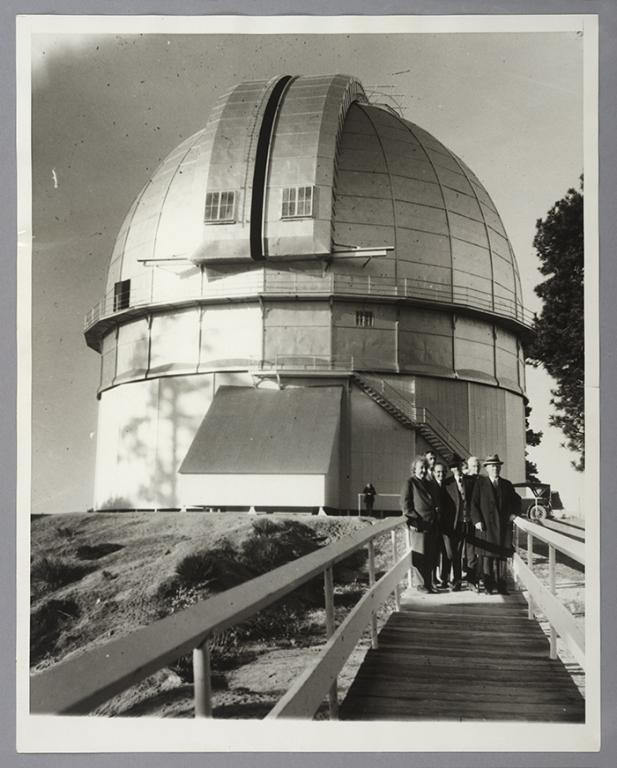
Left to right: Albert Einstein, Edwin Hubble, Walther Mayer, Walter S. Adams, Arthur S. King, and William W. Campbell pose in front of the 100-inch telescope dome at Mount Wilson Observatory on 29 January 1931 (The Huntington Library, Art Collections, and Botanical Gardens). I looked up at Mount Wilson and its broadcast facilities and observatories every day while growing up in San Gabriel, California
From the current issue: Clara Moskowitz, “Cosmic Conundrum: The strangely small value of the cosmological constant is one of the biggest unsolved mysteries in physics,” Scientific American 324/2 (February 2021): 24-29:
Quantum theory and experiments with particle accelerators both suggest that the universe is filled with “vacuum energy” — which is most likely connected with the mysterious “dark energy” — that pushes outward on space itself. It’s the reason that the universe is expanding, and not only expanding but doing so at a faster and faster rate.
But quantum theory predicts an enormous amount of vacuum energy, enough to have ensured that no stars or galaxies ever formed. Clearly, then, the value of vacuum energy is much lower — roughly 120 orders of magnitude lower — than what was predicted. Accordingly, some scientists have labeled vacuum energy “the worst theoretical prediction in the history of physics.” Or, as Antonio Padilla, a physicist at the University of Nottingham has said, “It’s generally regarded as one of the most awkward, embarrassing, difficult problems in theoretical physics today.”
And it has ramifications. For example, vacuum energy is thought to be the main ingredient in the “cosmological constant,” a mathematical term that looms large in the equations of general relativity.
But the cosmological constant itself has a complex history. “It was what you could call a nonsolution to a nonproblem,” says Rafael Sorkin, of the Perimeter Institute for Theoretical Physics in Ontario, Canada.
Albert Einstein invented in 1917 as a mathematical “kludge” in order to ensure that the field equations of his theory of general relativity didn’t entail an expanding universe. But then, in 1929, Edwin Hubble discovered astronomical evidence that, in fact, the universe is expanding. According to the late physicist George Gamow, Einstein eventually described the cosmological constant as “my biggest blunder” and removed it from his equations.
But then, in the late 1990s, two teams of astronomers were able to show that the expansion of the universe was speeding up, and they suggested that this acceleration was caused by “dark energy,” which, in turn, might have its source in the cosmological constant or “vacuum energy.”
But the value of the constant seemed to be wrong. And the question arose of exactly why it is precisely what it is. “Its value is very weird,” says Katherine Freese, a theoretical physicist at the University of Texas at Austin. “Even weirder than zero.”
The Nobel laureate Wolfgang Pauli noticed the problem already in the 1920s. By his calculations, vacuum energy should be so strong that the cosmos would have long since expanded to the point where light could not traverse the distances between of the objects within it. An observer on Earth, he calculated, should not be able to see even the Moon.
Of course, some physicists — notably the theoretical physicist Sabine Hosenfelder of Germany’s Frankfurt Institute for Advanced Studies — say that there’s no problem. It just is what it is, and that’s all.
But many scientists remain quite unsatisfied by such responses to the issue.
One of the most prominent — and, by some, most hated — solutions to the cosmological problem is called the anthropic principle. This line of thinking agrees that the cosmological constant in our universe has an unlikely value but explains it by saying we live in a multiverse. If ours is just one bubble in a cosmic sea, with different physical laws and constants in each, then there was bound to be one with this value. Most of the others would not lead to a universe with galaxies, stars, planets or life, so the fact that we find ourselves in one of the outliers is only to be expected. Because string theory requires a multiverse, string theorists tend to regard the cosmological constant problem as essentially solved by this reasoning. Other physicists, though, consider this philosophy a cop-out. “It’s giving up on the problem,” Sorkin says. (28)
I found it amusing to see Sorkin’s response, considering that philosophers and scientists who hypothesize that the life-permitting values of the various cosmic constants reflect some sort of “fine-tuning” are themselves often accused of “copping out” and of having “abandoned science.”
“We’ll keep trying,” [New York University’s Gregory] Gabadadze says of attempts to test cosmological constant hypotheses with experiments. . . . Despite the difficulty of the puzzle, he and other physicists still hope for a solution soon. Perhaps these efforts to understand the cosmological constant problem will reveal deeper truths about quantum physics and general relativity. Or maybe scientists will discover a simpler fix. And even while they’re seeking a solution that may never materialize, many physicists revel in the quest. (29)
Previous Post

January 23, 2021
"Remembering Heaven"
Browse Our Archives
Select a Category Uncategorized
Select a Month October 2026 September 2026 August 2026 July 2026 June 2026 May 2026 April 2026 March 2026 February 2026 January 2026 December 2025 November 2025 October 2025 September 2025 August 2025 July 2025 June 2025 May 2025 April 2025 March 2025 February 2025 January 2025 December 2024 November 2024 October 2024 September 2024 August 2024 July 2024 June 2024 May 2024 April 2024 March 2024 February 2024 January 2024 December 2023 November 2023 October 2023 September 2023 August 2023 July 2023 June 2023 May 2023 April 2023 March 2023 February 2023 January 2023 December 2022 November 2022 October 2022 September 2022 August 2022 July 2022 June 2022 May 2022 April 2022 March 2022 February 2022 January 2022 December 2021 November 2021 October 2021 September 2021 August 2021 July 2021 June 2021 May 2021 April 2021 March 2021 February 2021 January 2021 December 2020 November 2020 October 2020 September 2020 August 2020 July 2020 June 2020 May 2020 April 2020 March 2020 February 2020 January 2020 December 2019 November 2019 October 2019 September 2019 August 2019 July 2019 June 2019 May 2019 April 2019 March 2019 February 2019 January 2019 December 2018 November 2018 October 2018 September 2018 August 2018 July 2018 June 2018 May 2018 April 2018 March 2018 February 2018 January 2018 December 2017 November 2017 October 2017 September 2017 August 2017 July 2017 June 2017 May 2017 April 2017 March 2017 February 2017 January 2017 December 2016 November 2016 October 2016 September 2016 August 2016 July 2016 June 2016 May 2016 April 2016 March 2016 February 2016 January 2016 December 2015 November 2015 October 2015 September 2015 August 2015 July 2015 June 2015 May 2015 April 2015 March 2015 February 2015 January 2015 December 2014 November 2014 March 2014 August 2013 February 2012
Follow Us!
TAKE THE
Religious Wisdom Quiz
Which Christian principle is highlighted in the parable of the Good Samaritan?
Select your answer to see how you score.
Ignore strangers Compassion for all Only help friends Seek praise
Related posts from Sic et Non

“Once more unto the breach, dear friends, once...

A case of twin near-death experiences?


"Look on my Works, ye Mighty, and despair!"
TRENDING AT PATHEOS Latter-day Saint

In "Irreplaceable," our book on vocation and technology, Trevor Sutton and I...

I was strolling through the top floor of the brand new Parthenon...

What Does Gêvâh Mean For Kimberley Guifoyle &...
This week, a lot of the news is focused on Kimberly Guilfoyle....

INNER CIRCLE: Profound Mystery (Of Christ In All...
Ephesians 5:31-32 “For this reason, a man will leave his father and...

Do Not Rejoice When Your Enemy Falls: The...
Turning an execution into a public spectacle is a disturbing expression of...

'The Chosen' S6 Trailer: The Passion Gets Very...
Not many watching 'The Chosen' worry about spoilers, but just because they...
view all Latter-day Saint blogs
Ad-Free & Subscriber Log-In Subscription Support
- About Us
- 2026 Calendar
- Videos
- Podcasts
- Library of World Religions
- Faith In Media Tracker
- Advertise With Us
- Write for Us
- Privacy Policy
- Terms of Service
- Do Not Sell My Data
- Contact Us
- Radiant Digital
- Manage Newsletter Subscriptions
- Unsubscribe From Notifications
- Sitemap
Copyright 2008-2026, Patheos. All rights reserved.
Subscription Support Ad-Free & Subscriber Log-In
Follow Patheos