
BuddhistCatholicContemplativeEvangelicalGeneral ChristianHinduJewishLatter-day SaintMuslimNew VisionsProgressive Christian
Beliefs
- Buddhist
- Catholic
- Contemplative
- Evangelical
- General Christian
- Hindu
- Jewish
- Latter-day Saint
- More Voices
- Muslim
- New Visions
- Pagan
- Progressive Christian
Topics
- Religion News
- Food and Religion
- Sports and Religion
- Religious Art
- Religious Music and Entertainment
- Religious Events
- History and Religion
- Style and Religion
- Politics and Religion
- Women in Religion
- Recreation Outdoors and Religion
- Business Finance and Religion
- Careers Workplace and Religion
- Education and Religion
- Family Parenting and Religion
- Health Fitness and Religion
- Home and Religion
- Relationships and Religion
- Technology and Religion
- Travel and Religion
Columnists
- Buddhist Columnists
- Business Finance and Religion Columnists
- Careers Workplace and Religion Columnists
- Catholic Columnists
- Contemplative Columnists
- Education and Religion Columnists
- Evangelists Columnists
- Family Parenting and Religion Columnists
- General Christian Columnists
- Health Fitness and Religion Columnists
- Hindu Columnists
- History and Religion Columnists
- Home and Religion Columnists
- Jewish Columnists
- More Voices Columnists
- Latter Day Columnists
- Muslim Columnists
- New Visions Columnists
- Nonreligious Columnists
- Pagan Columnists
- Politics and Religion Columnists
- Progressive Columnists
- Recreation Outdoors and Religion Columnists
- Relationships and Religion Columnists
- Religion News Columnists
- Religious Art Columnists
- Religious Events Columnists
- Religious Music and Entertainment Columnists
- Sports and Religion Columnists
- Style and Religion Columnists
- Technology and Religion Columnists
- Travel and Religion Columnists
- Women in Religion Columnists
Resource Library
- 2026 Calendar
- Library of World Religions
- The 100 Most Holy Places on Earth
- Patheos Answers
- Podcasts
- Videos
- Faith Leaders Database
- Anglican Episcopalian
- Bahai
- Baptist
- Buddhism
- Christianity
- Confucianism
- Eastern Orthodoxy
- Hinduism
- Holiness and Pentecostal
- ISKCON
- Islam
- Judaism
- Lutheran
- Methodist
- The Church of Jesus Christ of Latter-day Saints
- New Age
- Paganism
- Presbytarian and Reformed
- Protestantism
- Religion Behind the Scenes
- Roman Catholic
- Scientology
- Shia Islam
- Sikhism
- Sufism
- Sunni Islam
- Taoism
- Zen
- See all religions
Research Tools
 Ad-Free & Subscriber Log-In Subscription Support
Ad-Free & Subscriber Log-In Subscription Support
Follow Patheos 

- Trending:
- Forgiveness
- |
- Marriage
- |
- Consciousness
- |
- Death Penalty
- |
- Election
- |
- Halloween

- Home
- Latter-day Saint
- Two memorable nineteenth-century stories from Santaquin and Nephi
Two memorable nineteenth-century stories from Santaquin and Nephi
Last updated on: December 17, 2020 at 12:53 am by Dan Peterson
Two memorable nineteenth-century stories from Santaquin and Nephi 2020-12-17T00:53:53-07:00 Dan Peterson
Patheos Explore the world's faith through different perspectives on religion and spirituality! Patheos has the views of the prevalent religions and spiritualities of the world.
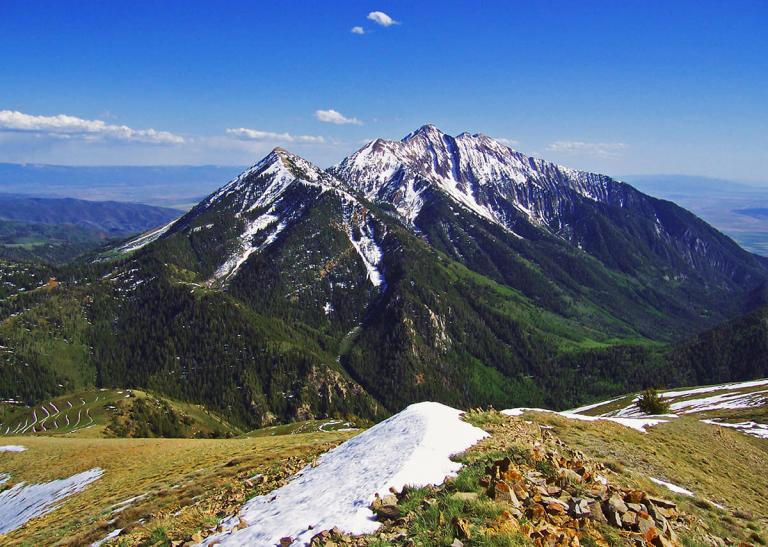
At nearly 12,000 feet, Mount Nebo — named after the biblical mountain that is located within today’s Hashemite Kingdom of Jordan, from which Moses was permitted to look over the Promised Land — dominates the area that includes Santaquin and Nephi. (Wikimedia Commons public domain image)
Permanently stashed in the glove compartment of our car — you do know the term glove compartment, I hope; my wife’s family tend to call it a cowl pocket, a phrase that I had never heard before but which, for much of my marriage, I mistakenly heard as the even weirder and more mysterious cow pocket — my wife and I keep a copy of Halka Chronic’s Roadside Geology of Utah. (When we spend significant time in adjacent states or in Hawaii, we bring along — or, if necessary, buy — the equivalent books for those areas.) Consulting the Roadside Geology has made otherwise rather routine drives both interesting and informative.
Relatively recently, though, we’ve added Cynthia Larsen Bennett, Roadside History of Utah (Missoula, MT: Mountain Press Publishing Company, 1999) to our cowl pocket (or glove compartment) library.
Driving down from Orem to St. George the other day, we read about the towns through which and by which I-15 passes.
One of them was Santaquin, the last town in Utah County as you go southwards, which sits atop the crest or the ridge of a number of hills — and which, for that reason, was originally known at its founding in 1851 as “Summit City.” It was abandoned already in 1853 owing to troubles with the the local Indians. When the settlers returned three years later, in 1856, it had been taken over by the Indians, who fired from the houses at the white men who entered the town. There was no love lost between them.
In 1857, when the news reached Utah that the federal troops of “Johnson’s Army” were coming to put down the mythical “Mormon rebellion” and destroy the Latter-day Saints, the northern settlements of the territory evacuated southward the following spring. More than a few of those who abandoned their homes and fled went to Summit City.
Among these refugees was a young man named Josiah Gibbs, who had been born in Nauvoo, Illinois, in 1845, just prior to the forced exodus of the Latter-day Saints from the city that they had founded there. He had spent the entire winter of 1857 seriously ill with inflammatory rheumatism. As Josiah began to improve, his father moved him outside to recuperate in the sunlight. However, although he felt considerably better, his legs were still very weak and he spent a great deal of time simply sitting outside, under the cover of a quilt. Many years thereafter, though, he published an article through the Utah State Historical Society entitled “Boyhood Memories of Josiah F. Gibbs.” Included in that article is what Gibbs called “one of the most cherished memories” of his life:
Presently there came to my super-sensitive ear drums the faint pit-pat of human feet. With easy, swinging strides a slender Indian boy was approaching from the south. He paused at the foot of my cot and keenly looked at the rheumatic invalid. (141)
The two boys somehow managed to communicate with one another by means of a combination of speech and gestures. Josiah was able to indicate that he felt reasonably well, but that his legs didn’t work.
After setting a target at a distance of about 25 feet, he returned to the side of my cot and gave me my first lesson in . . . bow and arrow shooting. During an hour or two the Indian boy chased arrows for his pupil, manifesting as keen delight when, by accident, I made a close or center shot, as if made by himself.
At about the same hour next morning, my Indian friend was at my cot-side. Again he chased arrows for me, and shared my boyish pleasure at evidences of rapid improvement.
A few days of penetrating sun-rays, exercise of my arms and body, and mild perspiration — thanks to the ingenious method of the Indian boy, figuratively, “put me on my feet.” With his aid I was soon able to walk, and then began our hunting trips for rabbits and other small game. One morning my companion surprised me with a gift of a beautiful bow, made from mountain sheep horn, backed by sinew, and a dozen or so cane arrows, tipped with greasewood spikes. It was a priceless token of friendship that in memory has never dimmed. (141)
To me, that story is a marvelous illustration of human care and kindness across a chasm of cultural and even linguistic difference. If it can happen in such a case, it can happen in cases where the differences are nowhere nearly so significant.
Josiah F. Gibbs went on to serve in the British Mission from 1867 to 1869, and he lived to the age of 86, dying in 1932. Summit City changed its name to Santaquin in roughly 1875 — to honor a peaceful Indian chief.
We also read about Nephi, which was originally established in 1851 under the name of Salt Creek.
Joseph L. Heywood, the LDS Church leader who led the settlement of the town, had a vision during the first night he camped on Salt Creek. He saw a railroad coming from the east to Salt Lake City, extending south to Salt Creek, and branching through Salt Creek Canyon into Sanpete County. This was the exact path the railroad finally took.
The first train arrived in Nephi in May 1879, and the line connecting Nephi with Sanpete County was constructed in 1880. The junction of the railroads brought prosperity to the town. (142)
The road to that prosperity wasn’t entirely straight and without obstacles, however. For instance, because of danger during the so-called Walker War with local Indians, the residents of Salt Creek built a fort for self-protection. At one point, while the fort was still under construction, Chief Walker paid them a visit. “I cannot shake hands over a wall,” he told them, asking that they stop building. They didn’t. They finished it. However, as it happened, they were able to live in peace and the settlement lost no lives during the conflict.
Posted from St. George, Utah
Church of Jesus Christ of Latter-day Saints
Previous Post

December 15, 2020
Nephite Secret Combinations and Shining Jaredite Stones
Next Post
December 17, 2020 "The Most American Religion"?
Browse Our Archives
Select a Category Uncategorized
Select a Month October 2026 September 2026 August 2026 July 2026 June 2026 May 2026 April 2026 March 2026 February 2026 January 2026 December 2025 November 2025 October 2025 September 2025 August 2025 July 2025 June 2025 May 2025 April 2025 March 2025 February 2025 January 2025 December 2024 November 2024 October 2024 September 2024 August 2024 July 2024 June 2024 May 2024 April 2024 March 2024 February 2024 January 2024 December 2023 November 2023 October 2023 September 2023 August 2023 July 2023 June 2023 May 2023 April 2023 March 2023 February 2023 January 2023 December 2022 November 2022 October 2022 September 2022 August 2022 July 2022 June 2022 May 2022 April 2022 March 2022 February 2022 January 2022 December 2021 November 2021 October 2021 September 2021 August 2021 July 2021 June 2021 May 2021 April 2021 March 2021 February 2021 January 2021 December 2020 November 2020 October 2020 September 2020 August 2020 July 2020 June 2020 May 2020 April 2020 March 2020 February 2020 January 2020 December 2019 November 2019 October 2019 September 2019 August 2019 July 2019 June 2019 May 2019 April 2019 March 2019 February 2019 January 2019 December 2018 November 2018 October 2018 September 2018 August 2018 July 2018 June 2018 May 2018 April 2018 March 2018 February 2018 January 2018 December 2017 November 2017 October 2017 September 2017 August 2017 July 2017 June 2017 May 2017 April 2017 March 2017 February 2017 January 2017 December 2016 November 2016 October 2016 September 2016 August 2016 July 2016 June 2016 May 2016 April 2016 March 2016 February 2016 January 2016 December 2015 November 2015 October 2015 September 2015 August 2015 July 2015 June 2015 May 2015 April 2015 March 2015 February 2015 January 2015 December 2014 November 2014 March 2014 August 2013 February 2012
Follow Us!
TAKE THE
Religious Wisdom Quiz
Who killed Goliath?
Select your answer to see how you score.
Samson Jonathan Saul David
Related posts from Sic et Non


Notes on Women, Priesthood, and General Conference

"America's Most Neighborly City"? It's not in Switzerland

"The Book of Moses as a Temple Text"
TRENDING AT PATHEOS Latter-day Saint

Janie Learns the Way of the Cross: A...
Teaching children about Jesus' Passion can be challenging. Many parents and educators...

Looking For Good Catholic Writing - October 2026
He alone extends the heavens, and he walks upon the waves of...

In "Irreplaceable," our book on vocation and technology, Trevor Sutton and I...

I was strolling through the top floor of the brand new Parthenon...

What Does Gêvâh Mean For Kimberley Guifoyle &...
This week, a lot of the news is focused on Kimberly Guilfoyle....

INNER CIRCLE: Profound Mystery (Of Christ In All...
Ephesians 5:31-32 “For this reason, a man will leave his father and...
view all Latter-day Saint blogs
Ad-Free & Subscriber Log-In Subscription Support
- About Us
- 2026 Calendar
- Videos
- Podcasts
- Library of World Religions
- Faith In Media Tracker
- Advertise With Us
- Write for Us
- Privacy Policy
- Terms of Service
- Do Not Sell My Data
- Contact Us
- Radiant Digital
- Manage Newsletter Subscriptions
- Unsubscribe From Notifications
- Sitemap
Copyright 2008-2026, Patheos. All rights reserved.
Subscription Support Ad-Free & Subscriber Log-In
Follow Patheos