
BuddhistCatholicContemplativeEvangelicalGeneral ChristianHinduJewishLatter-day SaintMuslimNew VisionsProgressive Christian
Beliefs
- Buddhist
- Catholic
- Contemplative
- Evangelical
- General Christian
- Hindu
- Jewish
- Latter-day Saint
- More Voices
- Muslim
- New Visions
- Pagan
- Progressive Christian
Topics
- Religion News
- Food and Religion
- Sports and Religion
- Religious Art
- Religious Music and Entertainment
- Religious Events
- History and Religion
- Style and Religion
- Politics and Religion
- Women in Religion
- Recreation Outdoors and Religion
- Business Finance and Religion
- Careers Workplace and Religion
- Education and Religion
- Family Parenting and Religion
- Health Fitness and Religion
- Home and Religion
- Relationships and Religion
- Technology and Religion
- Travel and Religion
Columnists
- Buddhist Columnists
- Business Finance and Religion Columnists
- Careers Workplace and Religion Columnists
- Catholic Columnists
- Contemplative Columnists
- Education and Religion Columnists
- Evangelists Columnists
- Family Parenting and Religion Columnists
- General Christian Columnists
- Health Fitness and Religion Columnists
- Hindu Columnists
- History and Religion Columnists
- Home and Religion Columnists
- Jewish Columnists
- More Voices Columnists
- Latter Day Columnists
- Muslim Columnists
- New Visions Columnists
- Nonreligious Columnists
- Pagan Columnists
- Politics and Religion Columnists
- Progressive Columnists
- Recreation Outdoors and Religion Columnists
- Relationships and Religion Columnists
- Religion News Columnists
- Religious Art Columnists
- Religious Events Columnists
- Religious Music and Entertainment Columnists
- Sports and Religion Columnists
- Style and Religion Columnists
- Technology and Religion Columnists
- Travel and Religion Columnists
- Women in Religion Columnists
Resource Library
- 2026 Calendar
- Library of World Religions
- The 100 Most Holy Places on Earth
- Patheos Answers
- Podcasts
- Videos
- Faith Leaders Database
- Anglican Episcopalian
- Bahai
- Baptist
- Buddhism
- Christianity
- Confucianism
- Eastern Orthodoxy
- Hinduism
- Holiness and Pentecostal
- ISKCON
- Islam
- Judaism
- Lutheran
- Methodist
- The Church of Jesus Christ of Latter-day Saints
- New Age
- Paganism
- Presbytarian and Reformed
- Protestantism
- Religion Behind the Scenes
- Roman Catholic
- Scientology
- Shia Islam
- Sikhism
- Sufism
- Sunni Islam
- Taoism
- Zen
- See all religions
Research Tools
 Ad-Free & Subscriber Log-In Subscription Support
Ad-Free & Subscriber Log-In Subscription Support
Follow Patheos 

- Trending:
- Forgiveness
- |
- Marriage
- |
- Consciousness
- |
- Death Penalty
- |
- Election
- |
- Halloween

- Home
- Latter-day Saint
- Revision 8.8 More opposition to the BYU Jerusalem Center
Revision 8.8 More opposition to the BYU Jerusalem Center
Last updated on: December 20, 2020 at 12:23 am by Dan Peterson
Revision 8.8 More opposition to the BYU Jerusalem Center 2020-12-20T00:23:01-07:00 Dan Peterson
Patheos Explore the world's faith through different perspectives on religion and spirituality! Patheos has the views of the prevalent religions and spiritualities of the world.
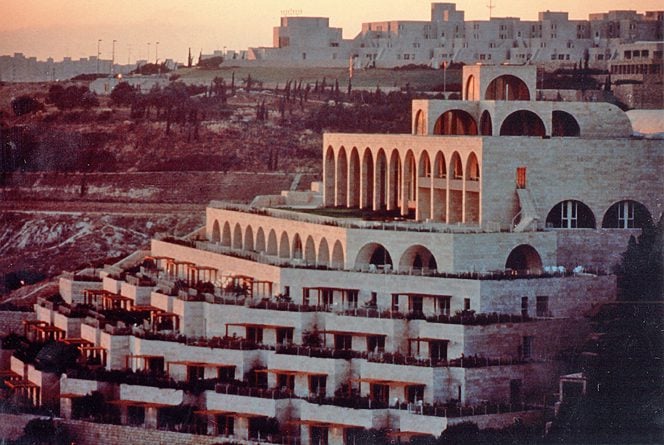
Posting a photograph of BYU’s completed Jerusalem Center for Near Eastern Studies serves, I suppose, to ruin the suspense: It WAS eventually built, despite the opposition. (LDS Media Library)
Don’t miss this important (and relevant) monument from the history of Israeli popular music:
As the Center came under attack it was clearly the Church itself that was being assaulted. The Latter-day Saint claim that this was a university building, an academic facility, rather than a mission home or a church, was almost universally brushed aside as a smoke screen. Still, many people in and out of Israel rose to the defense. Mayor Kollek did not back down from his support of the Center, but defended its construction now as a matter of religious freedom, pluralism, and human rights. Furthermore, he solicited from David Galbraith a carefully-crafted statement on behalf of the Church promising that students and staff of the Center would engage in neither overt nor covert proselyting. The statement was published in the Jerusalem Post. Leading newspapers throughout Israel pointed to the Latter-day Saints’ excellent record of abstaining from missionary activities during the more than fifteen years that they had been operating programs in Israel. The rabbi of Salt Lake City wrote a letter in support of the Center. New York’s Jewish Anti-Defamation League endorsed the Center’s continued construction, as did the Arizona Regional Board of the National Conference of Christians and Jews and the Jewish Genealogical Society of New York. Former American president Gerald Ford sent a personal letter of support to Prime Minister Shimon Peres. One hundred and fifty-four members of the United States Congress signed a letter of endorsement that was distributed to all members of the Knesset, the Israeli parliament.
Still the attacks on the Church continued. In November 1985, the announcement was made that Brigham Young University had retained a prominent Israeli public relations firm in order to help in presenting a more positive image of the University, the Center, and the Church to the Israeli public. The truth had to be heard above the clamor of voices denouncing the Saints. The firm immediately took out advertisements in a number of leading Israeli newspapers in order to explain the Latter-day Saints and their faith to an audience that knew very little about them and to clarify the purpose and projected function of the Jerusalem Center for Near Eastern Studies. Perhaps even more effective was a program, broadcast just after Christmas on Israeli television, that featured the Galbraith family. At one point in the program, Professor Galbraith played portions of a cassette tape on which he had recorded some of the threatening telephone calls he and his family had received. When the audience heard things like “This is your last warning; we’re bloodthirsty. If you don’t leave Israel we’re going to kill all of you, one by one,” there was an immediate response of outrage and of sympathy for the Galbraiths. More to the point, there was a surge of support for the center itself, and it would probably be fair to describe this television broadcast as a turning point in the story.
Many moderate Israeli and American Jews realized that, in fundamental ways, the dispute was not really about the Latter-day Saints at all. It was primarily a battle about the nature of Israeli society and the Israeli state. In a sense, they themselves were the targets of this ultra-Orthodox agitation. Was Israel really to be a Jewish state? What, then, would be the status of non-Jews within it? And what would be the status of nonreligious Jews, or of Jews who did not live according to the strict rules favored by the ultra-Orthodox? Should Judaism be enforced by law? The issues involved are much the same as those faced by many contemporary Muslims.
Judaism, like Islam, finds a major source of its religious authority and practice in the past. But modern values like democracy, equal rights, and religious toleration have come into general acceptance only since the time in which the fundamental documents of the two religions were composed or revealed. Consequently, they do not directly figure in the sacred texts upon which the two faiths are based. How, then, are they to be incorporated into modern Jewish and Islamic practice? Or should they be incorporated at all? Two easy solutions present themselves to the question of how to harmonize an ancient heritage with modern insights, values, and ways of thought: Either the ancient heritage can be abandoned and all modern ideas embraced without exception (the secularist solution), or the modern age can be altogether ignored (the fundamentalist solution). The difficult thing is to find a middle ground that preserves the best features of both. Not only is it difficult to find such a middle ground, but even if someone does manage to position himself in the middle, he thereby opens himself to attacks from both extremes. To the fundamentalists, he is an apostate; to the secularists, he is either a fundamentalist himself or a coward, caving in to pressure from reactionaries and fanatics. This was an unmistakable aspect of the struggle over the building of BYU’s Jerusalem Center for Near Eastern Studies.
Gradually, however, it dawned on even the most die-hard enemies of the Center that the building was going to be completed and that the government would not stop its construction. And, gradually, the campaign of harassment, distortion, and vilification against the Latter-day Saints began to wind down. There were still occasional flare-ups. Late in the construction process, for instance, local and general officers of the Church were requested to sign documents promising that neither the Center, nor the University, nor the Church itself would engage in any proselyting of Jews in Israel—ever. This was to be in addition to promises already made by BYU officials and leaders of the Church that the center would not be used for missionary purposes and that Latter-day Saints would not proselyte in Israel so long as such activity was not allowed by the government.
Church leaders refused to sign. As Elder James E. Faust, then of the Council of the Twelve, put it during a visit to Israel in January 1987, “We will never say never.” This most recent demand touched on a matter of fundamental importance, a matter beside which even the expensive and long-dreamed-of building on Mount Scopus was relatively unimportant. Latter-day Saints obey the law. That is a matter of principle and religious belief, enshrined in their Articles of Faith. They are willing to limit their missionary efforts when the law demands it. But they make no secret of another principle of their faith, namely that it is their ultimate goal and duty to take the gospel to all nations of the earth, including the Jews. They cannot renounce this principle and certainly will not do so merely to satisfy the excessive demands of any human government. The Church stood firm, and those making the demand backed down.
Church of Jesus Christ of Latter-day Saints
Jerusalem Center for Near Eastern Studies
Previous Post

December 18, 2020
"Joseph Smith's Translation Projects under a Microscope"
Next Post
December 20, 2020 A Revelation in the Operating Room
Browse Our Archives
Select a Category Uncategorized
Select a Month October 2026 September 2026 August 2026 July 2026 June 2026 May 2026 April 2026 March 2026 February 2026 January 2026 December 2025 November 2025 October 2025 September 2025 August 2025 July 2025 June 2025 May 2025 April 2025 March 2025 February 2025 January 2025 December 2024 November 2024 October 2024 September 2024 August 2024 July 2024 June 2024 May 2024 April 2024 March 2024 February 2024 January 2024 December 2023 November 2023 October 2023 September 2023 August 2023 July 2023 June 2023 May 2023 April 2023 March 2023 February 2023 January 2023 December 2022 November 2022 October 2022 September 2022 August 2022 July 2022 June 2022 May 2022 April 2022 March 2022 February 2022 January 2022 December 2021 November 2021 October 2021 September 2021 August 2021 July 2021 June 2021 May 2021 April 2021 March 2021 February 2021 January 2021 December 2020 November 2020 October 2020 September 2020 August 2020 July 2020 June 2020 May 2020 April 2020 March 2020 February 2020 January 2020 December 2019 November 2019 October 2019 September 2019 August 2019 July 2019 June 2019 May 2019 April 2019 March 2019 February 2019 January 2019 December 2018 November 2018 October 2018 September 2018 August 2018 July 2018 June 2018 May 2018 April 2018 March 2018 February 2018 January 2018 December 2017 November 2017 October 2017 September 2017 August 2017 July 2017 June 2017 May 2017 April 2017 March 2017 February 2017 January 2017 December 2016 November 2016 October 2016 September 2016 August 2016 July 2016 June 2016 May 2016 April 2016 March 2016 February 2016 January 2016 December 2015 November 2015 October 2015 September 2015 August 2015 July 2015 June 2015 May 2015 April 2015 March 2015 February 2015 January 2015 December 2014 November 2014 March 2014 August 2013 February 2012
Follow Us!
TAKE THE
Religious Wisdom Quiz
I told my daughter-in-law to uncover a man's feet and lie down at the threshing floor. Who am I?
Select your answer to see how you score.
Rebekah Naomi Ruth Bathsheba
Related posts from Sic et Non


Notes on Women, Priesthood, and General Conference

"The Book of Moses as a Temple Text"

TRENDING AT PATHEOS Latter-day Saint

Pope Leo Celebrates Mass for Nurses & Docs...
I don't have any idea how he did it, but Pope Leo...

The Sermon on the Mount, Part I: Matthew...
The Sermon on the Mount, Part I (Matthew 4:12-5:12) St. Matthew moves...

What's up from Crossway: Reviewing some of their latest A few weeks...

Janie Learns the Way of the Cross: A...
Teaching children about Jesus' Passion can be challenging. Many parents and educators...

Looking For Good Catholic Writing - October 2026
He alone extends the heavens, and he walks upon the waves of...

In "Irreplaceable," our book on vocation and technology, Trevor Sutton and I...
view all Latter-day Saint blogs
Ad-Free & Subscriber Log-In Subscription Support
- About Us
- 2026 Calendar
- Videos
- Podcasts
- Library of World Religions
- Faith In Media Tracker
- Advertise With Us
- Write for Us
- Privacy Policy
- Terms of Service
- Do Not Sell My Data
- Contact Us
- Radiant Digital
- Manage Newsletter Subscriptions
- Unsubscribe From Notifications
- Sitemap
Copyright 2008-2026, Patheos. All rights reserved.
Subscription Support Ad-Free & Subscriber Log-In
Follow Patheos