
BuddhistCatholicContemplativeEvangelicalGeneral ChristianHinduJewishLatter-day SaintMuslimNew VisionsProgressive Christian
Beliefs
- Buddhist
- Catholic
- Contemplative
- Evangelical
- General Christian
- Hindu
- Jewish
- Latter-day Saint
- More Voices
- Muslim
- New Visions
- Pagan
- Progressive Christian
Topics
- Religion News
- Food and Religion
- Sports and Religion
- Religious Art
- Religious Music and Entertainment
- Religious Events
- History and Religion
- Style and Religion
- Politics and Religion
- Women in Religion
- Recreation Outdoors and Religion
- Business Finance and Religion
- Careers Workplace and Religion
- Education and Religion
- Family Parenting and Religion
- Health Fitness and Religion
- Home and Religion
- Relationships and Religion
- Technology and Religion
- Travel and Religion
Columnists
- Buddhist Columnists
- Business Finance and Religion Columnists
- Careers Workplace and Religion Columnists
- Catholic Columnists
- Contemplative Columnists
- Education and Religion Columnists
- Evangelists Columnists
- Family Parenting and Religion Columnists
- General Christian Columnists
- Health Fitness and Religion Columnists
- Hindu Columnists
- History and Religion Columnists
- Home and Religion Columnists
- Jewish Columnists
- More Voices Columnists
- Latter Day Columnists
- Muslim Columnists
- New Visions Columnists
- Nonreligious Columnists
- Pagan Columnists
- Politics and Religion Columnists
- Progressive Columnists
- Recreation Outdoors and Religion Columnists
- Relationships and Religion Columnists
- Religion News Columnists
- Religious Art Columnists
- Religious Events Columnists
- Religious Music and Entertainment Columnists
- Sports and Religion Columnists
- Style and Religion Columnists
- Technology and Religion Columnists
- Travel and Religion Columnists
- Women in Religion Columnists
Resource Library
- 2026 Calendar
- Library of World Religions
- The 100 Most Holy Places on Earth
- Patheos Answers
- Podcasts
- Videos
- Faith Leaders Database
- Anglican Episcopalian
- Bahai
- Baptist
- Buddhism
- Christianity
- Confucianism
- Eastern Orthodoxy
- Hinduism
- Holiness and Pentecostal
- ISKCON
- Islam
- Judaism
- Lutheran
- Methodist
- The Church of Jesus Christ of Latter-day Saints
- New Age
- Paganism
- Presbytarian and Reformed
- Protestantism
- Religion Behind the Scenes
- Roman Catholic
- Scientology
- Shia Islam
- Sikhism
- Sufism
- Sunni Islam
- Taoism
- Zen
- See all religions
Research Tools
 Ad-Free & Subscriber Log-In Subscription Support
Ad-Free & Subscriber Log-In Subscription Support
Follow Patheos 

- Trending:
- Forgiveness
- |
- Marriage
- |
- Consciousness
- |
- Death Penalty
- |
- Election
- |
- Halloween

- Home
- Latter-day Saint
- Revision 8.7 “The Orson Hyde Memorial Garden and BYU’s Jerusalem Center”
Revision 8.7 “The Orson Hyde Memorial Garden and BYU’s Jerusalem Center”
Last updated on: December 13, 2020 at 11:58 pm by Dan Peterson
Revision 8.7 “The Orson Hyde Memorial Garden and BYU’s Jerusalem Center” 2020-12-13T23:58:18-07:00 Dan Peterson
Patheos Explore the world's faith through different perspectives on religion and spirituality! Patheos has the views of the prevalent religions and spiritualities of the world.
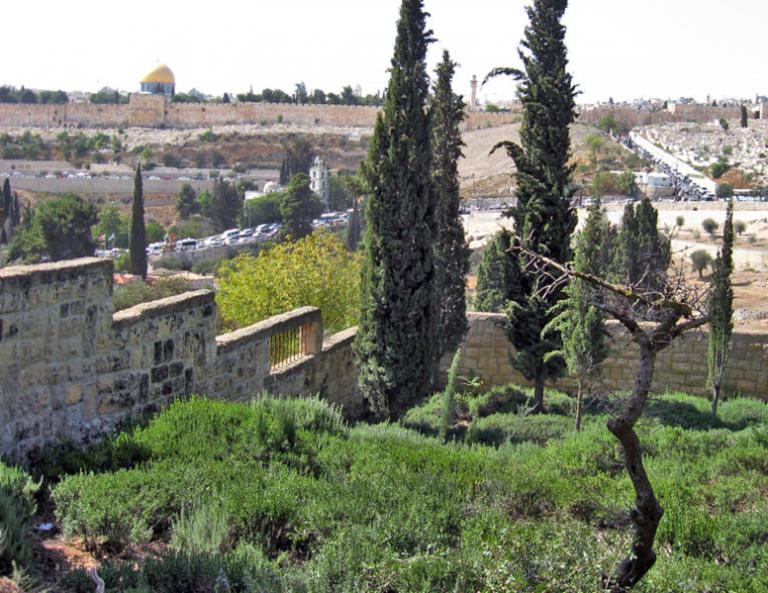
A view from the southwestern corner of the Orson Hyde Memorial Garden toward Jerusalem’s Old City (specifically, the Temple Mount and the Dome of the Rock).
Wikimedia Commons public domain
The idea of an Orson Hyde monument continued to be discussed as time went on, although some—notably Elder Howard W. Hunter of the Quorum of the Twelve Apostles—worried that such a monument might compromise Church efforts and harm the Church’s image among the Arabs.[1] Finally, on 24 October 1979, the anniversary of Elder Hyde’s momentous prayer, an Orson Hyde Memorial Garden, more than five landscaped acres on the slope of the Mount of Olives, was dedicated by President Spencer W. Kimball. The Prophet was accompanied by his first counselor, N. Eldon Tanner, as well as by Elder Howard W. Hunter. President Ezra Taft Benson of the Quorum of the Twelve came separately, as did Elders LeGrand Richards and Marvin J. Ashton, also of the Twelve. This was beyond doubt the densest concentration of apostles in Jerusalem since ancient times. Today, although it has been overshadowed by more recent developments involving the Church in Israel, the Orson Hyde Memorial Garden remains a symbol of Latter-day Saint interest in, and concern for, the remarkable past, present, and future of the land of Jerusalem. When political conditions permit, the garden serves as an occasional meeting place for the Saints, especially for sunrise services on Easter and for the annual commemoration of Elder Hyde’s prayer on 24 October.
Meanwhile, the Church continued to grow within Israel. Branches or groups began to appear in Tel Aviv, Haifa, and the Galilee. Most of the growth came from immigration, but there were also new members converted either within Israel or abroad. (Still, it must be stressed, there was no proselyting among the Jews.) One of these new members allowed the Jerusalem Branch to mark a major milestone: Suheil Abu Hadid, a Palestinian convert, became the first Arab from Jerusalem to be called on a mission in this dispensation when he accepted an assignment to serve in the Utah Salt Lake City South Mission. Later, an Israeli Arab named Ehab Abu Nuwara, who had investigated the Church in Israel but had been baptized while a student at BYU, was called to serve in the England London Mission.
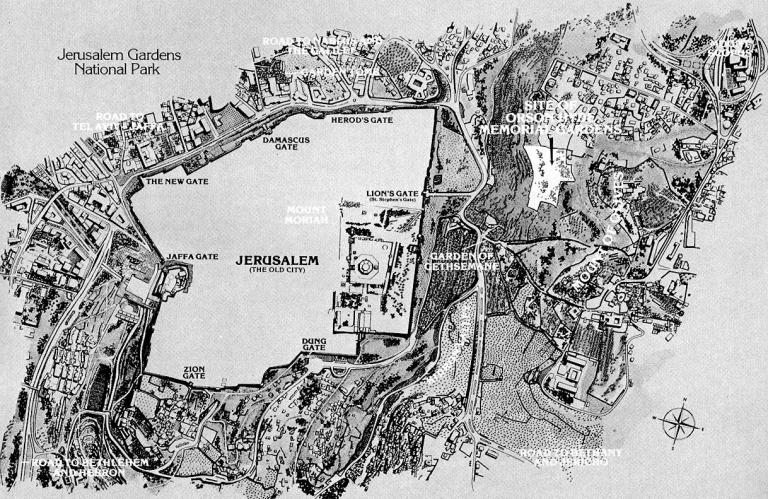
Map of the “Old City” of Jerusalem, showing the site of the Orson Hyde Memorial Gardens on the slope of the Mount of Olives facing the Old City to the west.The detailed portion of the Old City shows the Temple Mount, including the Dome of the Rock. The map comes from the January 1978 issue of the “Ensign”; I was living in Jerusalem at the time.
The dedication of the Orson Hyde Memorial Garden represented the fulfillment of a long-standing dream for many members of the Church. But another dream remained. That was the construction of a visitors’ center in Israel, probably to be combined with facilities for the growing number of students who came year after year to participate in BYU’s study programs in Jerusalem. Although it was fully realized that proselyting, as such, was not a viable option under current Israeli conditions, many still thought that, as long as there were no actual missionaries going from door to door, and as long as the Latter-day Saints were not actually seeking people out, some more low-key method of making the gospel known within Israel might nonetheless be acceptable.
However, it soon became clear that any plan to teach the gospel to the Jews, however inoffensive it might seem to the aggressively missionary-minded Latter-day Saints, would have to be given up.
Israeli sensitivities were simply too acute. Many Israeli Jews were willing to say that the loss of any Jew to another religion was equivalent, in its threat to the survival of Judaism as a whole, to the loss of a Jew in Hitler’s Holocaust. (The clear implication of this popular formula was, of course, that those who sought to proselyte the Jews were like Nazis in at least one respect: Both aimed at the “destruction” of Judaism.) Thus, when in March 1981 plans were submitted to the Israeli government for the building of a BYU “Jerusalem Center for Near Eastern Studies,” they included neither a formal visitors’ center nor, despite the fact that Latter-day Saint services were intended to be held there, a baptismal font.
The proposed building was approved by the government in early 1984. A small ground-breaking ceremony was held on 21 August of that year, and construction was soon underway. Also underway since late May, however, was a campaign to stop the building of the center. A Jewish anti-missionary organization known as Yad L’Achim protested the construction of the center as soon as it found out about it, citing the Latter-day Saints’ indisputable missionary zeal as a threat to Judaism. Several steps were taken by the Church to counter public fears. The special representative couples who were serving at the time in various areas of Israel were reassigned to other fields of labor. Newspaper advertisements offering LDS literature to anybody interested were cancelled. English and Hebrew-language pamphlets about the Church were destroyed. Sales of the Hebrew edition of the Book of Mormon were stopped, and no reprinting was authorized. It was, for the present, the end of any hope of teaching the gospel to Israeli Jews.
Such attempts at conciliation did not, however, pacify the most militant opponents of the center. Throughout its three years of construction, hysterical articles appeared in local newspapers and in the American Jewish press about the Latter-day Saint “threat” to Judaism and to the holy city of Jerusalem. (During one period lasting somewhat less than three weeks, 345 articles appeared in the Israeli press about the Latter-day Saints and their building.) The center, it was alleged, was merely a front for proselytizing missionaries. The students enrolled in its programs would not be real students, but undercover agents of the Church. Some of the allegations were actually flattering, in a twisted sort of way. For example, the Latter-day Saints were said to be dispatching “beautiful blonde women”— apparently BYU coeds—to Israel in order to lure Jewish boys away from their religious upbringing. They were also conspiring, with their Saudi Arabian allies, to create a vast and dangerous international financial empire. Other charges were harder to read in a positive light. It was argued by some that the Saints were “desecrating” Mount Scopus, the hill upon which the center was to stand. For a while, a number of agitators claimed that the site was actually an ancient Jewish cemetery; repeated denials of that claim by the Israeli archaeologist assigned to the site excavations were only gradually able to allay the concerns it had aroused.
Jerusalem’s legendary, long-time mayor Teddy Kollek was personally vilified for his support of the project and was even accused of accepting bribes from them as the price for his alleged betrayal of the Jewish people. Orthodox Jews demonstrated and prayed in front of the homes of David Galbraith and other Church and university leaders. Anonymous callers threatened prominent Latter-day Saints over the telephone and even tapped their phones, hoping perhaps to discover the sordid truth that lurked behind the Saints’ seemingly innocent faces. Thousands of Orthodox Jews demonstrated at the so-called Wailing Wall. Drives were organized to raise funds and to gather signatures on petitions designed to “fight the Mormons.” Anti-Mormon bumper stickers appeared on autos and trucks throughout Israel. Handwritten anti-Mormon slogans appeared on Israeli currency. Vandals damaged the place where the Jerusalem Branch held its sabbath meetings. Demonstrations near the center on Mount Scopus included the singing of such heart-warming lyrics, addressed to the Latter-day Saints, as “You better run for your life/Back to Utah overnight.” Sensing an opportunity, even Ed Decker, the notorious charlatan and professional apostate who had founded Ex-Mormons for Jesus and created the notorious pseudo-documentary film The God Makers, brought his traveling show to the city.
[1] On Elder Hunter’s view, see Baldridge, Grafting In, 26.
Posted from St. George, Utah
Church of Jesus Christ of Latter-day Saints
Jerusalem Center for Near Eastern Studies
Previous Post

December 12, 2020
Some things that need to be accounted for
Browse Our Archives
Select a Category Uncategorized
Select a Month October 2026 September 2026 August 2026 July 2026 June 2026 May 2026 April 2026 March 2026 February 2026 January 2026 December 2025 November 2025 October 2025 September 2025 August 2025 July 2025 June 2025 May 2025 April 2025 March 2025 February 2025 January 2025 December 2024 November 2024 October 2024 September 2024 August 2024 July 2024 June 2024 May 2024 April 2024 March 2024 February 2024 January 2024 December 2023 November 2023 October 2023 September 2023 August 2023 July 2023 June 2023 May 2023 April 2023 March 2023 February 2023 January 2023 December 2022 November 2022 October 2022 September 2022 August 2022 July 2022 June 2022 May 2022 April 2022 March 2022 February 2022 January 2022 December 2021 November 2021 October 2021 September 2021 August 2021 July 2021 June 2021 May 2021 April 2021 March 2021 February 2021 January 2021 December 2020 November 2020 October 2020 September 2020 August 2020 July 2020 June 2020 May 2020 April 2020 March 2020 February 2020 January 2020 December 2019 November 2019 October 2019 September 2019 August 2019 July 2019 June 2019 May 2019 April 2019 March 2019 February 2019 January 2019 December 2018 November 2018 October 2018 September 2018 August 2018 July 2018 June 2018 May 2018 April 2018 March 2018 February 2018 January 2018 December 2017 November 2017 October 2017 September 2017 August 2017 July 2017 June 2017 May 2017 April 2017 March 2017 February 2017 January 2017 December 2016 November 2016 October 2016 September 2016 August 2016 July 2016 June 2016 May 2016 April 2016 March 2016 February 2016 January 2016 December 2015 November 2015 October 2015 September 2015 August 2015 July 2015 June 2015 May 2015 April 2015 March 2015 February 2015 January 2015 December 2014 November 2014 March 2014 August 2013 February 2012
Follow Us!
TAKE THE
Religious Wisdom Quiz
What does the name "Moses" mean?
Select your answer to see how you score.
Delivered Saved Drawn out (of water) Judge
Related posts from Sic et Non


Notes on Women, Priesthood, and General Conference

"The Book of Moses as a Temple Text"

TRENDING AT PATHEOS Latter-day Saint

Pope Leo Celebrates Mass for Nurses & Docs...
I don't have any idea how he did it, but Pope Leo...

The Sermon on the Mount, Part I: Matthew...
The Sermon on the Mount, Part I (Matthew 4:12-5:12) St. Matthew moves...

What's up from Crossway: Reviewing some of their latest A few weeks...

Janie Learns the Way of the Cross: A...
Teaching children about Jesus' Passion can be challenging. Many parents and educators...

Looking For Good Catholic Writing - October 2026
He alone extends the heavens, and he walks upon the waves of...

In "Irreplaceable," our book on vocation and technology, Trevor Sutton and I...
view all Latter-day Saint blogs
Ad-Free & Subscriber Log-In Subscription Support
- About Us
- 2026 Calendar
- Videos
- Podcasts
- Library of World Religions
- Faith In Media Tracker
- Advertise With Us
- Write for Us
- Privacy Policy
- Terms of Service
- Do Not Sell My Data
- Contact Us
- Radiant Digital
- Manage Newsletter Subscriptions
- Unsubscribe From Notifications
- Sitemap
Copyright 2008-2026, Patheos. All rights reserved.
Subscription Support Ad-Free & Subscriber Log-In
Follow Patheos