
BuddhistCatholicContemplativeEvangelicalGeneral ChristianHinduJewishLatter-day SaintMuslimNew VisionsProgressive Christian
Beliefs
- Buddhist
- Catholic
- Contemplative
- Evangelical
- General Christian
- Hindu
- Jewish
- Latter-day Saint
- More Voices
- Muslim
- New Visions
- Pagan
- Progressive Christian
Topics
- Religion News
- Food and Religion
- Sports and Religion
- Religious Art
- Religious Music and Entertainment
- Religious Events
- History and Religion
- Style and Religion
- Politics and Religion
- Women in Religion
- Recreation Outdoors and Religion
- Business Finance and Religion
- Careers Workplace and Religion
- Education and Religion
- Family Parenting and Religion
- Health Fitness and Religion
- Home and Religion
- Relationships and Religion
- Technology and Religion
- Travel and Religion
Columnists
- Buddhist Columnists
- Business Finance and Religion Columnists
- Careers Workplace and Religion Columnists
- Catholic Columnists
- Contemplative Columnists
- Education and Religion Columnists
- Evangelists Columnists
- Family Parenting and Religion Columnists
- General Christian Columnists
- Health Fitness and Religion Columnists
- Hindu Columnists
- History and Religion Columnists
- Home and Religion Columnists
- Jewish Columnists
- More Voices Columnists
- Latter Day Columnists
- Muslim Columnists
- New Visions Columnists
- Nonreligious Columnists
- Pagan Columnists
- Politics and Religion Columnists
- Progressive Columnists
- Recreation Outdoors and Religion Columnists
- Relationships and Religion Columnists
- Religion News Columnists
- Religious Art Columnists
- Religious Events Columnists
- Religious Music and Entertainment Columnists
- Sports and Religion Columnists
- Style and Religion Columnists
- Technology and Religion Columnists
- Travel and Religion Columnists
- Women in Religion Columnists
Resource Library
- 2026 Calendar
- Library of World Religions
- The 100 Most Holy Places on Earth
- Patheos Answers
- Podcasts
- Videos
- Faith Leaders Database
- Anglican Episcopalian
- Bahai
- Baptist
- Buddhism
- Christianity
- Confucianism
- Eastern Orthodoxy
- Hinduism
- Holiness and Pentecostal
- ISKCON
- Islam
- Judaism
- Lutheran
- Methodist
- The Church of Jesus Christ of Latter-day Saints
- New Age
- Paganism
- Presbytarian and Reformed
- Protestantism
- Religion Behind the Scenes
- Roman Catholic
- Scientology
- Shia Islam
- Sikhism
- Sufism
- Sunni Islam
- Taoism
- Zen
- See all religions
Research Tools
 Ad-Free & Subscriber Log-In Subscription Support
Ad-Free & Subscriber Log-In Subscription Support
Follow Patheos 

- Trending:
- Forgiveness
- |
- Marriage
- |
- Consciousness
- |
- Death Penalty
- |
- Election
- |
- Halloween

- Home
- Latter-day Saint
- Does the Existence of the Universe Point to a Creator?
Does the Existence of the Universe Point to a Creator?
Last updated on: December 28, 2020 at 4:50 pm by Dan Peterson
Does the Existence of the Universe Point to a Creator? 2020-12-28T16:50:00-07:00 Dan Peterson
Patheos Explore the world's faith through different perspectives on religion and spirituality! Patheos has the views of the prevalent religions and spiritualities of the world.
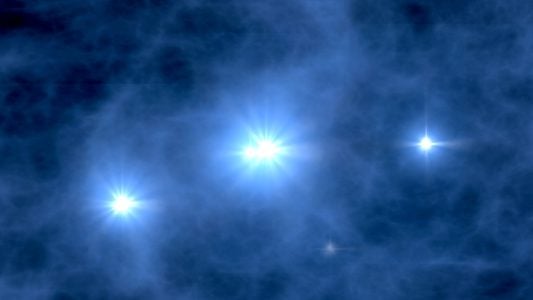
A NASA simulation of the first stars, about 400 million years after the Big Bang
(Wikimedia Commons public domain image)
Why is there anything at all?
Either the universe — by which, in this instance, I intend the ensemble, the totality, of all that exists — has always existed in some form or another, a simple brute fact that requires and admits of no explanation, or it came into existence. The cosmological theory of the “Big Bang,” overwhelmingly dominant in recent decades, suggests that the universe that we know began to exist approximately 13.8 billion years ago.
There seem to be two options here: Either nothing caused the known universe to exist or something cause the known universe to exist.
With that in mind, the so-called Kalaam Cosmological Argument — which draws its name from its origin among medieval Arab Muslim philosophers — comes into play. One of its foremost contemporary advocates, the evangelical Protestant philosopher William Lane Craig, typically lays it out in a simple syllogism that runs along the following lines.
- Everything that begins to exist must have a cause.
- The universe began to exist.
- Therefore, the universe must have a cause.
Judaeo-Christian scripture has never hesitated to identify that cause:
“All things were made by him; and without him was not any thing made that was made.” (John 1:3)
“For by him were all things created, that are in heaven, and that are in earth, visible and invisible, whether they be thrones, or dominions, or principalities, or powers: all things were created by him, and for him: And he is before all things, and by him all things consist.” (Colossians 1:16)
(See also such passages as Genesis 1:1; Psalm 8:1-3; 19:1; 95:3-6; 115:15; Romans 11:36; 1 Corinthians 8:6; and Hebrews 1:2.)
But, scientifically speaking, the question is unresolved. Writing in Scientific American in 1994, the noted Stanford University physicist and cosmologist Andrei Linde wrote:
The first, and main, problem is the very existence of the big bang. One may wonder, What came before? If space-time did not exist then, how could everything appear from nothing? What arose first: the universe or the laws determining its evolution? Explaining the initial singularity — where and when it all began — still remains the most intractable problem of modern cosmology. (Andrei Linde, “The Self-Reproducing Inflationary Universe,” Scientific American 271 [November 1994], 48)
It was perhaps for that reason that Sir John Maddox (1925-2009), a British theoretical chemist turned physicist who served for a total of twenty-two years as the editor of Nature, one of the world’s most prestigious scientific journals, called the Big Bang theory “a view of the origin of the Universe [that] is thoroughly unsatisfactory” (John Maddox, “Down with the Big Bang,” Nature 340 [10 August 1989], 425).
Many, however, see the Big Bang and the fertile orderliness of the cosmos that has resulted from it as an indicator of the existence of God. For example, Richard Swinburne (b. 1934), a distinguished philosopher long associated with Oxford University, asks an important question and responds to it in the light of traditional mainstream philosophical theism:
Why believe that there is a God at all? My answer is that to suppose that there is a God explains why there is a world at all . . . and so much else. In fact, the hypothesis of the existence of God makes sense of the whole of our experience, and it does better than any other explanation which can be put forward, and that is the grounds for believing it to be true. (Richard Swinburne, in “Evidence for God,” 229-238, in Terry Miethe and and Richard Flew, ed., Does God Exist? [San Francisco: Harper, 1991], 229)
Arno Penzias, co-winner of the 1978 Nobel Prize for Physics and co-discoverer, with Robert Wilson, of the cosmic background radiation that confirmed the Big Bang theory, commented that
Astronomy leads us to a unique event, a universe which was created out of nothing, one with the very delicate balance needed to provide exactly the conditions required to permit life, and one which has an underlying (one might say ‘supernatural’) plan. (Arno Penzias, cited in Henry Margenau and Roy Abraham Varghese, eds., Cosmos, Bios, Theos: Scientists Reflect on Science, God, and the Origin of the Universe: Life and Homo Sapiens [LaSalle, IL: Open Court, 1992], 83.)
The late NASA scientist Robert Jastrow (1925-2008), who described himself as a religious agnostic over much of his life, remarked that
The essential elements in the astronomical and biblical accounts of Genesis are the same: the chain of events leading to man commenced suddenly and sharply at a definite moment in time, in a flash of light and energy. . . . For the scientist who has lived by his faith in the power of reason, the story ends like a bad dream. He has scaled the mountain of ignorance; he is about to conquer the highest peak; as he pulls himself over the final rock, he is greeted by a band of theologians who have been sitting there for centuries. (Robert Jastrow, God and the Astronomers, 1978)
However, as Jastrow also observed, there has been resistance to theistic readings of the Big Bang, and he didn’t hesitate to describe that resistance as being, in some cases, of a quasi-religious character:
There is a kind of religion in science. . . . The religious faith of the scientist is violated by the discovery that the world had a beginning under conditions in which the known laws of physics are not valid, and as a product of forces or circumstances we cannot discover. (Robert Jastrow, God and the Astronomers [New York: Norton, 1978], 113-114)
The geneticist and evolutionary biologist Richard Lewontin, now emeritus Alexander Agassiz Research Professor at Harvard, will serve to illustrate Jastrow’s point. He expressed himself in very striking terms in early 1997:
We take the side of science in spite of the patent absurdity of some of its constructs . . . because we have a prior commitment, a commitment to materialism. It is not that the methods and institutions of science somehow compel us to accept a material explanation of the phenomenal world, but, on the contrary, that we are forced by our a priori adherence to material causes . . . no matter how counter-intuitive, no matter how mystifying to the uninitiated. Moreover, that materialism is an absolute, for we cannot allow a Divine foot in the door. (Richard Lewontin, “Billions and Billions of Demons,” The New York Review [9 January 1997], 31.)
Scott Todd, an immunologist at Kansas State University at the time, put that position even more concisely in a 1999 letter to Nature:
Even if all the data point to an intelligent designer, such a hypothesis is excluded from science because it is not materialistic. (Nature 410 [6752]: 423 [30 September 1999])
Theists, however, have not surrendered. Responding to the admittedly dominant naturalistic worldview, the British theoretical physicist Sir John Polkinghorne, formerly president of Queen’s College, Cambridge, observes that there exists “a possible explanation of equal intellectual respectability — and to my mind, greater elegance.” It is “that this one world is the way it is because it is the creation of the will of a Creator who purposes that it should be so.” (John Polkinghorne, One World [SPCK, 1986], 79-80.)
***
Some miscellaneous science stuff:
“Could COVID-19 have wiped out the Neandertals?”
“Here’s how Vikings celebrated Christmas: They drank, and they ate horse meat.”
***
Finally, a friend has kindly called my attention to a website that he’s created and that I think could be very helpful to many:

Browse Our Archives
Select a Category Uncategorized
Select a Month October 2026 September 2026 August 2026 July 2026 June 2026 May 2026 April 2026 March 2026 February 2026 January 2026 December 2025 November 2025 October 2025 September 2025 August 2025 July 2025 June 2025 May 2025 April 2025 March 2025 February 2025 January 2025 December 2024 November 2024 October 2024 September 2024 August 2024 July 2024 June 2024 May 2024 April 2024 March 2024 February 2024 January 2024 December 2023 November 2023 October 2023 September 2023 August 2023 July 2023 June 2023 May 2023 April 2023 March 2023 February 2023 January 2023 December 2022 November 2022 October 2022 September 2022 August 2022 July 2022 June 2022 May 2022 April 2022 March 2022 February 2022 January 2022 December 2021 November 2021 October 2021 September 2021 August 2021 July 2021 June 2021 May 2021 April 2021 March 2021 February 2021 January 2021 December 2020 November 2020 October 2020 September 2020 August 2020 July 2020 June 2020 May 2020 April 2020 March 2020 February 2020 January 2020 December 2019 November 2019 October 2019 September 2019 August 2019 July 2019 June 2019 May 2019 April 2019 March 2019 February 2019 January 2019 December 2018 November 2018 October 2018 September 2018 August 2018 July 2018 June 2018 May 2018 April 2018 March 2018 February 2018 January 2018 December 2017 November 2017 October 2017 September 2017 August 2017 July 2017 June 2017 May 2017 April 2017 March 2017 February 2017 January 2017 December 2016 November 2016 October 2016 September 2016 August 2016 July 2016 June 2016 May 2016 April 2016 March 2016 February 2016 January 2016 December 2015 November 2015 October 2015 September 2015 August 2015 July 2015 June 2015 May 2015 April 2015 March 2015 February 2015 January 2015 December 2014 November 2014 March 2014 August 2013 February 2012
Follow Us!
TAKE THE
Religious Wisdom Quiz
In 1 Timothy, what does Paul say is the root of all kinds of evil?
Select your answer to see how you score.
Pride Greed Money itself The love of money
Related posts from Sic et Non

A case of twin near-death experiences?

Toward a "Post-Materialist Science"?

Without Moroni statues, is the Church rejecting its...

Some thoughts on mind and brain
TRENDING AT PATHEOS Latter-day Saint

A new article, written by Jeff Lindsay and Gale L. Pooley,...

Swimfan: Forgotten Aughts Pleasures
This is a recovery effort. In 2002, My Big Fat Greek Wedding...

Top Three Anti-Catholic Lies About Catholicism
This is my initial transcript for the video, "THE 3 WORST...

Pope Leo Celebrates Mass for Nurses & Docs...
I don't have any idea how he did it, but Pope Leo...

The Sermon on the Mount, Part I: Matthew...
The Sermon on the Mount, Part I (Matthew 4:12-5:12) St. Matthew moves...

What's up from Crossway: Reviewing some of their latest A few weeks...
view all Latter-day Saint blogs
Ad-Free & Subscriber Log-In Subscription Support
- About Us
- 2026 Calendar
- Videos
- Podcasts
- Library of World Religions
- Faith In Media Tracker
- Advertise With Us
- Write for Us
- Privacy Policy
- Terms of Service
- Do Not Sell My Data
- Contact Us
- Radiant Digital
- Manage Newsletter Subscriptions
- Unsubscribe From Notifications
- Sitemap
Copyright 2008-2026, Patheos. All rights reserved.
Subscription Support Ad-Free & Subscriber Log-In
Follow Patheos