
BuddhistCatholicContemplativeEvangelicalGeneral ChristianHinduJewishLatter-day SaintMuslimNew VisionsProgressive Christian
Beliefs
- Buddhist
- Catholic
- Contemplative
- Evangelical
- General Christian
- Hindu
- Jewish
- Latter-day Saint
- More Voices
- Muslim
- New Visions
- Pagan
- Progressive Christian
Topics
- Religion News
- Food and Religion
- Sports and Religion
- Religious Art
- Religious Music and Entertainment
- Religious Events
- History and Religion
- Style and Religion
- Politics and Religion
- Women in Religion
- Recreation Outdoors and Religion
- Business Finance and Religion
- Careers Workplace and Religion
- Education and Religion
- Family Parenting and Religion
- Health Fitness and Religion
- Home and Religion
- Relationships and Religion
- Technology and Religion
- Travel and Religion
Columnists
- Buddhist Columnists
- Business Finance and Religion Columnists
- Careers Workplace and Religion Columnists
- Catholic Columnists
- Contemplative Columnists
- Education and Religion Columnists
- Evangelists Columnists
- Family Parenting and Religion Columnists
- General Christian Columnists
- Health Fitness and Religion Columnists
- Hindu Columnists
- History and Religion Columnists
- Home and Religion Columnists
- Jewish Columnists
- More Voices Columnists
- Latter Day Columnists
- Muslim Columnists
- New Visions Columnists
- Nonreligious Columnists
- Pagan Columnists
- Politics and Religion Columnists
- Progressive Columnists
- Recreation Outdoors and Religion Columnists
- Relationships and Religion Columnists
- Religion News Columnists
- Religious Art Columnists
- Religious Events Columnists
- Religious Music and Entertainment Columnists
- Sports and Religion Columnists
- Style and Religion Columnists
- Technology and Religion Columnists
- Travel and Religion Columnists
- Women in Religion Columnists
Resource Library
- 2026 Calendar
- Library of World Religions
- The 100 Most Holy Places on Earth
- Patheos Answers
- Podcasts
- Videos
- Faith Leaders Database
- Anglican Episcopalian
- Bahai
- Baptist
- Buddhism
- Christianity
- Confucianism
- Eastern Orthodoxy
- Hinduism
- Holiness and Pentecostal
- ISKCON
- Islam
- Judaism
- Lutheran
- Methodist
- The Church of Jesus Christ of Latter-day Saints
- New Age
- Paganism
- Presbytarian and Reformed
- Protestantism
- Religion Behind the Scenes
- Roman Catholic
- Scientology
- Shia Islam
- Sikhism
- Sufism
- Sunni Islam
- Taoism
- Zen
- See all religions
Research Tools
 Ad-Free & Subscriber Log-In Subscription Support
Ad-Free & Subscriber Log-In Subscription Support
Follow Patheos 

- Trending:
- Forgiveness
- |
- Marriage
- |
- Consciousness
- |
- Death Penalty
- |
- Election
- |
- Halloween

- Home
- Latter-day Saint
- Revision 8.5.”David O. McKay, Hugh J. Cannon, and Joseph Wilford Booth”
Revision 8.5.”David O. McKay, Hugh J. Cannon, and Joseph Wilford Booth”
Last updated on: November 29, 2020 at 5:35 pm by Dan Peterson
Revision 8.5.”David O. McKay, Hugh J. Cannon, and Joseph Wilford Booth” 2020-11-29T17:35:25-07:00 Dan Peterson
Patheos Explore the world's faith through different perspectives on religion and spirituality! Patheos has the views of the prevalent religions and spiritualities of the world.
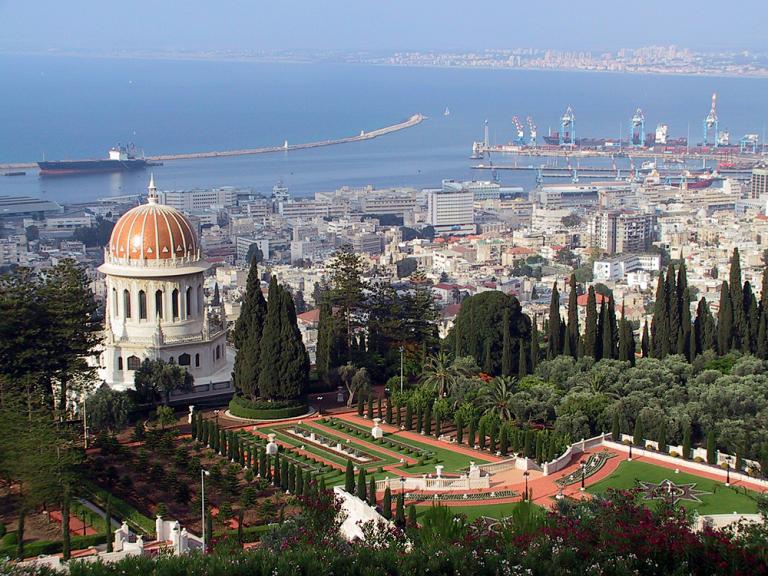
A view of today’s downtown Haifa and the Baha’i Gardens. (Wikimedia Commons public domain image)
Carrying on from my last installment, Revision 8.4 A Latter-day Saint Presence in Palestine and the Near East? I continue the story where I left off:
The other mission entrusted by the First Presidency to Elders McKay and Cannon was to get in contact, somehow, with President Joseph W. Booth. They needed to reorganize the surviving members of the Church in the region, and without his language skills and his knowledge of the areas and the members, it would be virtually impossible for them to do so. They absolutely had to find him. Yet this was a very difficult proposition. President Booth was always in motion, and they had no idea whatsoever of how to get in touch with him. They contacted the U.S. consul at Aleppo, Syria, but this did not seem to help much. A cable from European Mission headquarters told them that President Booth was somewhere en route to Aleppo, but this meant that he could still be anywhere. Nonetheless, after a series of inspired changes in plan, the two representatives from Salt Lake City literally ran into President Booth on a train bound for Haifa. Their mission had been a success.
Among the steps upon which the Church leaders agreed was the removal of the entire branch at Aintab to the safer city of Aleppo during the last two months of 1922. For the next five years, President Booth would devote himself to caring for the needs of these members, with little or no time left over for proselyting. He still dreamed of a Latter-day Saint colony in the Near East, and perhaps he consoled himself that his work with the Saints at Aleppo was at least a step in that direction. Even that dream, however, was soon to die. In early 1927, Dr. Franklin S. Harris arrived in the Near East on assignment from the First Presidency, with specific instructions to evaluate the feasibility of establishing a Church colony in the Holy Land. His report was not encouraging. He found that only twenty of nearly two hundred members of the Church in Palestine were able to support themselves. Furthermore, those who were productively employed had industrial skills, rather than the agricultural skills that would be necessary to create the kind of settlement that had long been envisioned. Dr. Harris could not in good conscience recommend that the project be pursued any further. The dream of an agricultural colony for Latter-day Saints in Palestine was dead.

In the souk or bazaar — the old marketplace — of Aleppo, Syria
(Wikimedia Commons public domain photograph)
In October 1927, Elder James E. Talmage of the Council of the Twelve, who was serving as president of the European Mission at the time, arrived at Aleppo to work for a season with President Booth. Together, they purchased a mission home in Haifa, on the corner of Carmel and Allenby Streets. President Booth was directed that American missionaries should establish themselves in respectable quarters in Haifa rather than living, as they had been, like refugees in the relatively backward city of Aleppo. A new focus for the work was in order. Syria and Turkey had simply failed to produce the number and quality of self-supporting converts that had been expected, and it was felt that a transfer of the missionaries to Haifa would allow for greater emphasis on work within Palestine and among the better-educated European population there.
A brief return trip to Aleppo to check on the condition of the Saints in the branch there was a great disappointment to President Booth. He found them to be, in his view, disobedient, selfish, and unworthy of the blessings they were receiving from the Lord through their knowledge of the restored gospel. In November, he went back again to Aleppo. Along the way, he stopped off in Beirut and Damascus, as well, to see how the few Saints in those cities were doing. One of his tasks while there was to arrange for the shipment of rugs to Utah. The Church, interested in bettering the material situation of its Armenian members, had begun to invest in their oriental carpet manufacturing and to sell the carpets through ZCMI, its department store in Salt Lake City. Though the idea of a Church agricultural settlement had come to nothing, the traditional Latter-day Saint mix of temporal and spiritual things was still very evident in the Near East.
Nonetheless, it could not truly be said that the cause of the Restoration was flourishing in the region. Just prior to his departure from Haifa, President Booth summarized the status of the Church in the Near East in a message that was later published in the Church magazine, the Improvement Era:
Our past and present status may be briefly told by counting up to ten; thus: One lady missionary, two workers in the field today, three cities have served as our headquarters, four elders have died in the field, five nationalities have been baptized, six languages are needed to teach them, seven apostles have been here, eight cities now claim one or more of our members, and nine out of ten are in poverty.[1]
It was not, as it must have seemed to him, much to show for the years of care and labor he had devoted to his stewardship. “Your humble servant,” he wrote to the brethren, “has had the pleasure and honor of seventeen years total in the mission field. The task at times has been a difficult one—almost like trying to tear away old Timpanogos with a tooth brush while a man with a team and scraper endeavors to pile it up again.”[2] After nearly eighteen years of missionary service among the peoples of the Near East, he continued to see members who were not living up to the standards they knew to be right, who were still dependent in far too many cases upon foreign missionaries, not only for their spiritual development but for their financial welfare as well.
President Booth managed to express both his deep sense of isolation and his desire for fellow laborers to help him fulfill the monumental task that he well knew stretched out before him. “Besides Sister Booth and Elder Snell, the writer, since he left London, October 2, 1921, has seen on an average only one face from Zion in 202 days, so you may be sure of a warm welcome if you come to do missionary work.” Elder Talmage had promised him that three pairs of missionaries would be sent from the European Mission to work with him and his wife. By the time he left for his trip to Aleppo, however, they had still not arrived. But a note from Elder Talmage had come, containing the reassuring words, “You may think we have forgotten you, but we have not.” Upon receiving these words of comfort, Joseph W. Booth, still working alone with only his wife as a companion in a faraway land of many languages and exotic customs, exclaimed, “In heaven’s name who would not proselyte for such [a] cause, where the harvest is so great and the laborers are so few?” [3]
President Booth’s mission, however, was finished. He was worn out, exhausted. He died of a heart attack on 5 December 1928, unaware that his release, signed by the First Presidency, was in the mail. The Church, grateful for the services he had rendered, erected a large headstone over his burial place in the sandy and desolate foreigners’ cemetery on the outskirts of Aleppo. Nearly five years later, Elder John A. Widtsoe dedicated his grave.
Joseph Wilford Booth was certainly the greatest missionary of the Church of Jesus Christ of Latter-day Saints yet to serve in the Near East. Yet he has been virtually forgotten. That is why I have chosen to dedicate this book to his memory and to his example of devoted and competent service among the peoples of the eastern Mediterranean.
[1] See Joseph W. Booth, “The Armenian Mission,” in Improvement Era 31 (October 1928), 1048-52. The quotation occurs on pp. 1048-49.
[2] Booth, “The Armenian Mission,” 1050.
[3] Both quotations occur at Booth, “The Armenian Mission,” 1052.
***

Interpreter Foundation volunteers gather in our state of the art studio for a scripture roundtable discussion on the weekly Interpreter Radio Show. (Wikimedia Commons public domain image)
Barring unforeseen developments, I expect to be on the Interpreter Radio Show with Martin Tanner tomorrow night (Sunday night, 29 November 2020) at 7 PM Utah time for a discussion of the First Vision of the Prophet Joseph Smith. The Interpreter Radio Show can be heard every Sunday evening from 7 to 9 PM (MDT), on K-TALK, AM 1640, or you can listen live on the Internet at ktalkmedia.com.
***
Salt Lake Tribune: “Bob Rees & Clifton Jolley: Live free and die. Our suicide pact with COVID-19.”
***
Three new items appeared today on the website of the Interpreter Foundation:
“Placement of the Witnesses Poster and Trailer”
Posted from Park City, Utah
Church of Jesus Christ of Latter-day Saints

Browse Our Archives
Select a Category Uncategorized
Select a Month October 2026 September 2026 August 2026 July 2026 June 2026 May 2026 April 2026 March 2026 February 2026 January 2026 December 2025 November 2025 October 2025 September 2025 August 2025 July 2025 June 2025 May 2025 April 2025 March 2025 February 2025 January 2025 December 2024 November 2024 October 2024 September 2024 August 2024 July 2024 June 2024 May 2024 April 2024 March 2024 February 2024 January 2024 December 2023 November 2023 October 2023 September 2023 August 2023 July 2023 June 2023 May 2023 April 2023 March 2023 February 2023 January 2023 December 2022 November 2022 October 2022 September 2022 August 2022 July 2022 June 2022 May 2022 April 2022 March 2022 February 2022 January 2022 December 2021 November 2021 October 2021 September 2021 August 2021 July 2021 June 2021 May 2021 April 2021 March 2021 February 2021 January 2021 December 2020 November 2020 October 2020 September 2020 August 2020 July 2020 June 2020 May 2020 April 2020 March 2020 February 2020 January 2020 December 2019 November 2019 October 2019 September 2019 August 2019 July 2019 June 2019 May 2019 April 2019 March 2019 February 2019 January 2019 December 2018 November 2018 October 2018 September 2018 August 2018 July 2018 June 2018 May 2018 April 2018 March 2018 February 2018 January 2018 December 2017 November 2017 October 2017 September 2017 August 2017 July 2017 June 2017 May 2017 April 2017 March 2017 February 2017 January 2017 December 2016 November 2016 October 2016 September 2016 August 2016 July 2016 June 2016 May 2016 April 2016 March 2016 February 2016 January 2016 December 2015 November 2015 October 2015 September 2015 August 2015 July 2015 June 2015 May 2015 April 2015 March 2015 February 2015 January 2015 December 2014 November 2014 March 2014 August 2013 February 2012
Follow Us!
TAKE THE
Religious Wisdom Quiz
What does "Capernaum" mean?
Select your answer to see how you score.
City of trade Village of comfort Port of peace Place of water
Related posts from Sic et Non


Notes on Women, Priesthood, and General Conference

"The Book of Moses as a Temple Text"

TRENDING AT PATHEOS Latter-day Saint

'Super Scam Me' Exposes AI Jon Bon Jovi...
Leslie Pickett believed she was in a relationship with Jon Bon Jovi....

The Brazilian Remake of Kendricks' 'Flywheel' Opens in...
“Flywheel,” the story that launched the Kendrick Brothers’ filmmaking career is getting...

The Dangers of Gradual Accommodation (Winking at Sin)
Recently, the “law of gradualness” resurfaced during the opening of a weeklong,...

The Iron Gates and the Lion of the...
Yesterday, I didn't finish my report about, well, yesterday. So I'll...

The Image: On the Horror of Capitalism and...
The Image Then went the Pharisees, and took counsel how they might...

We are approaching the date of our new American national holiday: October...
view all Latter-day Saint blogs
Ad-Free & Subscriber Log-In Subscription Support
- About Us
- 2026 Calendar
- Videos
- Podcasts
- Library of World Religions
- Faith In Media Tracker
- Advertise With Us
- Write for Us
- Privacy Policy
- Terms of Service
- Do Not Sell My Data
- Contact Us
- Radiant Digital
- Manage Newsletter Subscriptions
- Unsubscribe From Notifications
- Sitemap
Copyright 2008-2026, Patheos. All rights reserved.
Subscription Support Ad-Free & Subscriber Log-In
Follow Patheos