
BuddhistCatholicContemplativeEvangelicalGeneral ChristianHinduJewishLatter-day SaintMuslimNew VisionsProgressive Christian
Beliefs
- Buddhist
- Catholic
- Contemplative
- Evangelical
- General Christian
- Hindu
- Jewish
- Latter-day Saint
- More Voices
- Muslim
- New Visions
- Pagan
- Progressive Christian
Topics
- Religion News
- Food and Religion
- Sports and Religion
- Religious Art
- Religious Music and Entertainment
- Religious Events
- History and Religion
- Style and Religion
- Politics and Religion
- Women in Religion
- Recreation Outdoors and Religion
- Business Finance and Religion
- Careers Workplace and Religion
- Education and Religion
- Family Parenting and Religion
- Health Fitness and Religion
- Home and Religion
- Relationships and Religion
- Technology and Religion
- Travel and Religion
Columnists
- Buddhist Columnists
- Business Finance and Religion Columnists
- Careers Workplace and Religion Columnists
- Catholic Columnists
- Contemplative Columnists
- Education and Religion Columnists
- Evangelists Columnists
- Family Parenting and Religion Columnists
- General Christian Columnists
- Health Fitness and Religion Columnists
- Hindu Columnists
- History and Religion Columnists
- Home and Religion Columnists
- Jewish Columnists
- More Voices Columnists
- Latter Day Columnists
- Muslim Columnists
- New Visions Columnists
- Nonreligious Columnists
- Pagan Columnists
- Politics and Religion Columnists
- Progressive Columnists
- Recreation Outdoors and Religion Columnists
- Relationships and Religion Columnists
- Religion News Columnists
- Religious Art Columnists
- Religious Events Columnists
- Religious Music and Entertainment Columnists
- Sports and Religion Columnists
- Style and Religion Columnists
- Technology and Religion Columnists
- Travel and Religion Columnists
- Women in Religion Columnists
Resource Library
- 2026 Calendar
- Library of World Religions
- The 100 Most Holy Places on Earth
- Patheos Answers
- Podcasts
- Videos
- Faith Leaders Database
- Anglican Episcopalian
- Bahai
- Baptist
- Buddhism
- Christianity
- Confucianism
- Eastern Orthodoxy
- Hinduism
- Holiness and Pentecostal
- ISKCON
- Islam
- Judaism
- Lutheran
- Methodist
- The Church of Jesus Christ of Latter-day Saints
- New Age
- Paganism
- Presbytarian and Reformed
- Protestantism
- Religion Behind the Scenes
- Roman Catholic
- Scientology
- Shia Islam
- Sikhism
- Sufism
- Sunni Islam
- Taoism
- Zen
- See all religions
Research Tools
 Ad-Free & Subscriber Log-In Subscription Support
Ad-Free & Subscriber Log-In Subscription Support
Follow Patheos 

- Trending:
- Forgiveness
- |
- Marriage
- |
- Consciousness
- |
- Death Penalty
- |
- Election
- |
- Halloween

- Home
- Latter-day Saint
- Revision 8.4 A Latter-day Saint Presence in Palestine and the Near East?
Revision 8.4 A Latter-day Saint Presence in Palestine and the Near East?
Last updated on: November 15, 2020 at 5:42 pm by Dan Peterson
Revision 8.4 A Latter-day Saint Presence in Palestine and the Near East? 2020-11-15T17:42:47-07:00 Dan Peterson
Patheos Explore the world's faith through different perspectives on religion and spirituality! Patheos has the views of the prevalent religions and spiritualities of the world.
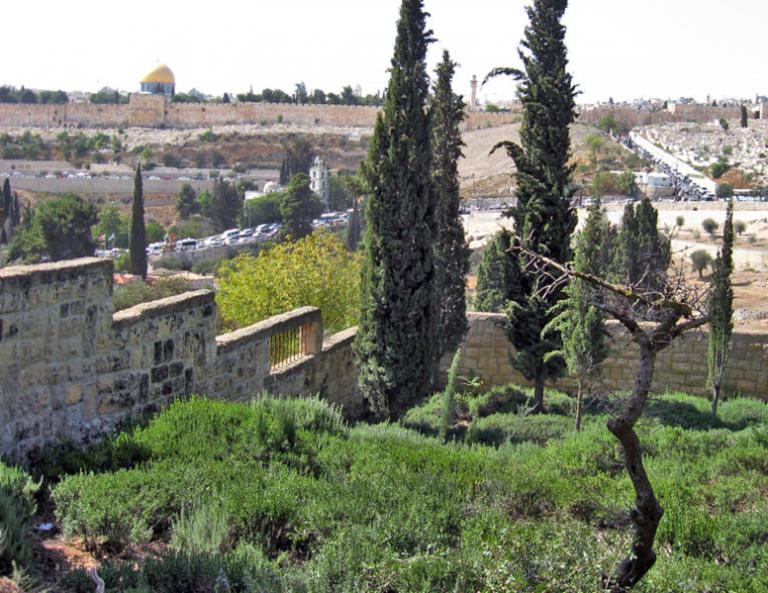
A view from the southwestern corner of the Orson Hyde Memorial Garden toward Jerusalem’s Old City (specifically, the Temple Mount and the Dome of the Rock).
Wikimedia Commons public domain photograph
The earliest Latter-day Saint missionaries to the Near East dreamed of a Church presence in the Holy Land, something more than a few scattered elders and something larger than the graves of a few faithful Saints. They envisioned a Latter-day Saint colony in Palestine. Ferdinand F. Hintze, the first president of the Turkish Mission, wrote to his wife as early as 1889 that he was trying to get a colony started somewhere near Jerusalem. Such a colony, he felt, would serve as a base from which the message of the gospel could go forth. Living together, the Saints would find strength in numbers and would be less prone to fall away through sheer isolation not only from the center of the Church but from one another. Furthermore, it would allow the Saints to become temporally independent as they gained greater understanding of the practical arts and sciences, much as the Saints in Utah were building their own commonwealth in the semi-arid lands of the American West. Near Eastern missionaries had seen what the industry and discipline of the German colonists had been able to accomplish in Haifa. Could the Saints not do even better, blessed as they were by the companionship of the Holy Ghost?
In 1873, President George A. Smith had reported much the same feeling after his visit to Palestine. “I was often asked,” he recalled to an audience of Saints assembled in the new Tabernacle at Salt Lake City, “if we were going to settle in Palestine. I replied that we were not, but I could take a thousand `Mormons,’ go up the Jordan, put in a dam to take out the water, and irrigate several thousand acres.”[1] Although President Smith died in 1875, it appears that his confidence about the abilities of the Latter-day Saints to deal with the difficult terrain of Palestine was shared by his brethren. At any rate, when the idea of a colony of Saints in the Holy Land was presented to the leaders of the Church, they were positively inclined toward it. They even saw the possibility of sending colonists from the American Zion to Jerusalem to put their colonizing skills to work in that land. Late in 1897, the First Presidency called Elder Anthon H. Lund of the Council of the Twelve to accompany Brother Hintze on a tour of the region to see if land for a Latter-day Saint colony could be secured. Suitable land was indeed found in the Jezreel Valley along the banks of the Kishon River. Unfortunately, the Church was in precarious financial health in 1898 and simply had no money with which to pursue the project. The dream had to be deferred. (This was the financial crisis that led to President Lorenzo Snow’s famous revelation on tithing, received in the tabernacle at St. George.)
A resident of Alpine, Utah, by the name of Joseph Wilford Booth was called to serve as the eleventh president of the Turkish Mission in August 1903. Elder Booth had previously served as a missionary in the same mission for almost four years, having only been released from his labors in April of the previous year. Already, he was headed back. This time, however, he was accompanied by his wife, Mary Reba, who would become the first “mission mother” in the history of the modern Near East. Her presence was important because, in the conservative and gender-segregated culture of the region, she could gain access to women in a way that was utterly impossible for the elders. The Booths worked side by side in Turkey and throughout the Near East until, because of political unrest, the Turkish Mission was shut down in 1909 and they and their missionaries were withdrawn.
For more than ten years, Church headquarters in Utah sent no representatives to the Middle East. When Joseph W. Booth returned in 1921, much was changed, including the name of the mission. In recognition of the group among whom most of the Church’s limited proselyting success had occurred, it was now to be called the “Armenian Mission.” Some changes, though, were clearly for the worse. The Haifa Branch had long since disappeared—the victim of emigration to Utah. But other units of the Church were in trouble as well. Where there had been more than a hundred members in the branch at Aintab in 1909, there were now only thirty-five. The First World War, the Turkish massacres of the Armenians, and the revolutionary unrest that accompanied the end of the Ottoman Empire had taken their terrible toll. “Aintab, the beautiful city of so many years of my missionary experiences, is now in ruins,” President Booth lamented, “and perhaps two thirds of the Christian population and a big percent of the Moslems have been slain in this awful struggle the past few years.”[2]
Late in 1921, Elder David O. McKay of the Quorum of the Twelve arrived at Jerusalem, along with his traveling companion Hugh J. Cannon. They were delighted to be there. Jerusalem, Elder McKay exclaimed, was “the most historic place in the world!” One of his assignments from the First Presidency was to leave an apostolic blessing on the land. He soon saw how desperately such a blessing was needed. Looking at the silver and gold decorations in the Grotto of the Nativity, the purported place of the birth of Jesus, Elder McKay felt them to be “desecrations.” Worse, with his own eyes he saw examples of the fatal violence that had begun to boil between Jews and Arabs in the so-called City of Peace. His own Arab Christian guide was vehement that the Jews would never be allowed to rule over Palestine. Elder McKay could not allow this to pass without contradiction.
“Michael,” he declared, “standing here on the street of David, this 2nd of November, 1921, I want to tell you something to remember. No matter how much the Mohammedans and the Greek Christians oppose the Jews’ coming back to Palestine, the Jews are coming and will possess this land.”
“Never,” Michael cried out, bitterly. “The streets will flow with blood first!”
“The streets may and undoubtedly will flow with blood,” replied the apostle, “but that will not prevent the Jews possessing their land. Don’t you believe your Bible?”
Elder McKay’s guide admitted that the Bible did foretell the rebuilding of Jerusalem. “But,” he insisted, “the time hasn’t come yet.””
“Yes,” Elder McKay corrected him, “the time has come.”[3]
[1] Journal of Discourses 16:100.
[2] Cited by Barrett, The Story of the Mormons in the Holy Land, 57.
[3] See Clare Middlemiss, ed., Cherished Experiences from the Writings of President David O. McKay (Salt Lake City: Deseret Book, 1976), 95.
Church of Jesus Christ of Latter-day Saints
Previous Post

November 14, 2020
The reliability of eyewitness testimony and the Book of Mormon
Next Post
November 16, 2020 Forgiveness, grace, and cosmic justice
Browse Our Archives
Select a Category Uncategorized
Select a Month October 2026 September 2026 August 2026 July 2026 June 2026 May 2026 April 2026 March 2026 February 2026 January 2026 December 2025 November 2025 October 2025 September 2025 August 2025 July 2025 June 2025 May 2025 April 2025 March 2025 February 2025 January 2025 December 2024 November 2024 October 2024 September 2024 August 2024 July 2024 June 2024 May 2024 April 2024 March 2024 February 2024 January 2024 December 2023 November 2023 October 2023 September 2023 August 2023 July 2023 June 2023 May 2023 April 2023 March 2023 February 2023 January 2023 December 2022 November 2022 October 2022 September 2022 August 2022 July 2022 June 2022 May 2022 April 2022 March 2022 February 2022 January 2022 December 2021 November 2021 October 2021 September 2021 August 2021 July 2021 June 2021 May 2021 April 2021 March 2021 February 2021 January 2021 December 2020 November 2020 October 2020 September 2020 August 2020 July 2020 June 2020 May 2020 April 2020 March 2020 February 2020 January 2020 December 2019 November 2019 October 2019 September 2019 August 2019 July 2019 June 2019 May 2019 April 2019 March 2019 February 2019 January 2019 December 2018 November 2018 October 2018 September 2018 August 2018 July 2018 June 2018 May 2018 April 2018 March 2018 February 2018 January 2018 December 2017 November 2017 October 2017 September 2017 August 2017 July 2017 June 2017 May 2017 April 2017 March 2017 February 2017 January 2017 December 2016 November 2016 October 2016 September 2016 August 2016 July 2016 June 2016 May 2016 April 2016 March 2016 February 2016 January 2016 December 2015 November 2015 October 2015 September 2015 August 2015 July 2015 June 2015 May 2015 April 2015 March 2015 February 2015 January 2015 December 2014 November 2014 March 2014 August 2013 February 2012
Follow Us!
TAKE THE
Religious Wisdom Quiz
What did God place on Jeremiah’s mouth as a sign of his calling?
Select your answer to see how you score.
A scroll Burning coal A staff His words
Related posts from Sic et Non


Notes on Women, Priesthood, and General Conference
"America's Most Neighborly City"? It's not in Switzerland

"The Book of Moses as a Temple Text"
TRENDING AT PATHEOS Latter-day Saint

The Sermon on the Mount, Part I: Matthew...
The Sermon on the Mount, Part I (Matthew 4:12-5:12) St. Matthew moves...

What's up from Crossway: Reviewing some of their latest A few weeks...

Janie Learns the Way of the Cross: A...
Teaching children about Jesus' Passion can be challenging. Many parents and educators...

Looking For Good Catholic Writing - October 2026
He alone extends the heavens, and he walks upon the waves of...

In "Irreplaceable," our book on vocation and technology, Trevor Sutton and I...

I was strolling through the top floor of the brand new Parthenon...
view all Latter-day Saint blogs
Ad-Free & Subscriber Log-In Subscription Support
- About Us
- 2026 Calendar
- Videos
- Podcasts
- Library of World Religions
- Faith In Media Tracker
- Advertise With Us
- Write for Us
- Privacy Policy
- Terms of Service
- Do Not Sell My Data
- Contact Us
- Radiant Digital
- Manage Newsletter Subscriptions
- Unsubscribe From Notifications
- Sitemap
Copyright 2008-2026, Patheos. All rights reserved.
Subscription Support Ad-Free & Subscriber Log-In
Follow Patheos