
BuddhistCatholicContemplativeEvangelicalGeneral ChristianHinduJewishLatter-day SaintMuslimNew VisionsProgressive Christian
Beliefs
- Buddhist
- Catholic
- Contemplative
- Evangelical
- General Christian
- Hindu
- Jewish
- Latter-day Saint
- More Voices
- Muslim
- New Visions
- Pagan
- Progressive Christian
Topics
- Religion News
- Food and Religion
- Sports and Religion
- Religious Art
- Religious Music and Entertainment
- Religious Events
- History and Religion
- Style and Religion
- Politics and Religion
- Women in Religion
- Recreation Outdoors and Religion
- Business Finance and Religion
- Careers Workplace and Religion
- Education and Religion
- Family Parenting and Religion
- Health Fitness and Religion
- Home and Religion
- Relationships and Religion
- Technology and Religion
- Travel and Religion
Columnists
- Buddhist Columnists
- Business Finance and Religion Columnists
- Careers Workplace and Religion Columnists
- Catholic Columnists
- Contemplative Columnists
- Education and Religion Columnists
- Evangelists Columnists
- Family Parenting and Religion Columnists
- General Christian Columnists
- Health Fitness and Religion Columnists
- Hindu Columnists
- History and Religion Columnists
- Home and Religion Columnists
- Jewish Columnists
- More Voices Columnists
- Latter Day Columnists
- Muslim Columnists
- New Visions Columnists
- Nonreligious Columnists
- Pagan Columnists
- Politics and Religion Columnists
- Progressive Columnists
- Recreation Outdoors and Religion Columnists
- Relationships and Religion Columnists
- Religion News Columnists
- Religious Art Columnists
- Religious Events Columnists
- Religious Music and Entertainment Columnists
- Sports and Religion Columnists
- Style and Religion Columnists
- Technology and Religion Columnists
- Travel and Religion Columnists
- Women in Religion Columnists
Resource Library
- 2026 Calendar
- Library of World Religions
- The 100 Most Holy Places on Earth
- Patheos Answers
- Podcasts
- Videos
- Faith Leaders Database
- Anglican Episcopalian
- Bahai
- Baptist
- Buddhism
- Christianity
- Confucianism
- Eastern Orthodoxy
- Hinduism
- Holiness and Pentecostal
- ISKCON
- Islam
- Judaism
- Lutheran
- Methodist
- The Church of Jesus Christ of Latter-day Saints
- New Age
- Paganism
- Presbytarian and Reformed
- Protestantism
- Religion Behind the Scenes
- Roman Catholic
- Scientology
- Shia Islam
- Sikhism
- Sufism
- Sunni Islam
- Taoism
- Zen
- See all religions
Research Tools
 Ad-Free & Subscriber Log-In Subscription Support
Ad-Free & Subscriber Log-In Subscription Support
Follow Patheos 

- Trending:
- Forgiveness
- |
- Marriage
- |
- Consciousness
- |
- Death Penalty
- |
- Election
- |
- Halloween

- Home
- Latter-day Saint
- Revision 8.3 “On Early Apostles and Missionaries in the Holy Land and the Near East”
Revision 8.3 “On Early Apostles and Missionaries in the Holy Land and the Near East”
Last updated on: November 15, 2020 at 5:44 pm by Dan Peterson
Revision 8.3 “On Early Apostles and Missionaries in the Holy Land and the Near East” 2020-11-15T17:44:47-07:00 Dan Peterson
Patheos Explore the world's faith through different perspectives on religion and spirituality! Patheos has the views of the prevalent religions and spiritualities of the world.
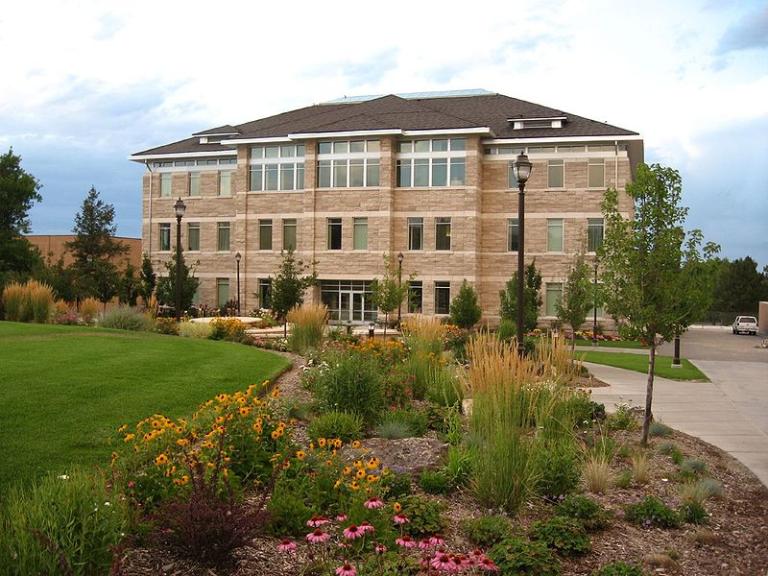
The Jacob Spori Building, on the Rexburg campus of Brigham Young University – Idaho
(Wikimedia Commons public domain image)
This was, however, not the last time that apostles of the Lord would visit Palestine in this dispensation to dedicate the land for the return of the Jews. Altogether, there seem to have been at least ten separate dedications of the Holy Land under apostolic authority. (No clearer illustration than this could possibly be provided of the urgent interest with which the prophets and apostles of this dispensation have watched events in the Holy Land.) Elder Anthon H. Lund of the Quorum of the Twelve, in company with Ferdinand F. Hintze of the Turkish Mission, rededicated the land from the Mount of Olives on 8 May 1898. Francis M. Lyman, then president of the Twelve, dedicated the land on three separate occasions and at three different sites during March of 1902. Elder David O. McKay, passing through Palestine on his world tour of missions, climbed with his companion Hugh J. Cannon to the top of the Mount of Olives and offered a prayer of thanksgiving and praise to God on 3 November 1921. Elder James E. Talmage rode with President Joseph W. Booth to the top of Mount Carmel, near Haifa, and rededicated the land for the redemption of Judah on 18 October 1927. Finally, in May of 1933, Elder John A. Widtsoe, accompanied by his wife and by President Badwagon Piranian of the Palestine Syria Mission, climbed the Mount of Olives to dedicate the land one more time. (He had offered an earlier prayer of dedication from high on Mount Carmel, overlooking the blue of the Mediterranean Sea.)
The actual preaching of the gospel to the inhabitants of Palestine and the Near East—although notably not to the Jews— began in 1884. During that year, an Armenian living in Istanbul, who had somehow heard of the Mormons, wrote to the president of the European Mission and asked him to send a representative of the Church to introduce the gospel into Turkey. The choice fell upon a Swiss convert to Mormonism by the name of Jacob Spori. When he arrived at Istanbul— where he was able to baptize the Armenian and his family—he became the first Latter-day Saint missionary ever to serve in the Near East.
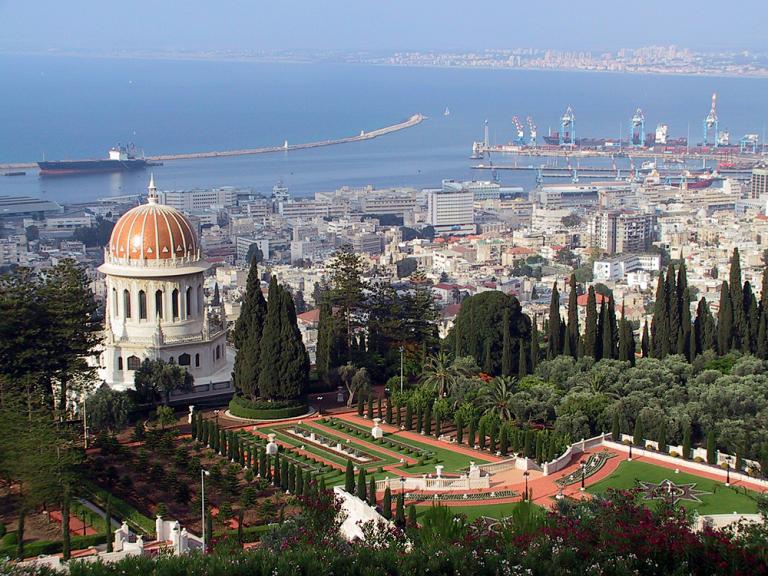
A view of today’s downtown Haifa and the Baha’i Gardens (Wikimedia Commons public domain image)
A second missionary, Joseph Tanner, arrived during the last month of 1885. In the spring of 1886, Francis M. Lyman, Jr., came to Istanbul and then accompanied Elder Tanner on a journey through the Middle East and Palestine. In the city of Haifa, they ran across a colony of devout German Christians who had settled in the Holy Land to await the second coming of Jesus. Impressed by the cleanliness and order of this colony, and remembering past contact with another member of the group who had joined the Church in Berlin, Elder Tanner persuaded his priesthood superiors that permanent missionaries should be sent to work with the Germans in Haifa. It was hoped that such missionary labor, besides being valuable in and of itself, would one day serve as a stepping stone to proselyting among the Palestinian Arabs.
As things turned out, only one available missionary had both the funds and the language capacity to go to Haifa and work among the German colonists there. That was Jacob Spori. Fortunately, he was granted a vision before his departure in which he saw a black-bearded man in Haifa, a blacksmith, who, he was told, would be prepared to receive him and his message when he arrived. This vision was precisely fulfilled. Upon reaching Haifa in late July of 1886, Elder Spori made his way to the street that he had seen in his vision and found the blacksmith’s shop just as he had expected it to be. The blacksmith, in turn, seeing Jacob Spori outside, dropped his tools and ran out into the street, crying after the missionary. He had, he said, seen Elder Spori in a dream the night before and knew that he had a divine message for him.
Not surprisingly, the blacksmith, a man named Johan Georg Grau, was converted along with his family. They became the nucleus of the Haifa Branch, the first organized unit of the Church in Palestine since ancient times. Even when Elder Spori returned to Istanbul, and then to Switzerland and, thereafter, on to Utah, the Grau family and subsequent converts kept the flame of the gospel alive in Palestine. Joseph Tanner replaced Elder Spori, working for five months in Haifa and down the coast in Jaffa. He baptized thirteen converts of Russian and German descent, as well as an Arab who was the first of his lineage to join the Church in this dispensation. Other missionaries came, too. Among them was Janne M. Sjodahl, a Danish convert who would later become a prominent writer on Latter-day Saint subjects in Utah. A former Baptist minister, he labored for nine months in Palestine, spending most of his time in and around Jaffa. He sensed deeply the magnitude of the task before him. In a letter to Wilford Woodruff, he wrote:
When I came here to Palestine, I was soon made aware of the fact, that I was placed face to face with millions of human beings, to whom the latter-day message has never sounded. I mean the Arabian speaking nations, who are scattered all over Syria, Arabia, Egypt, and a large part of Africa. And my prayer to God was that He would lead me and make an opening by which the light of His gospel might shine through.[1]
At first it appeared that Elder Sjodahl’s prayer would be abundantly answered. He did have some success among the Arabs. However, sickness cut short his mission in the Near East, and he was obliged to return to Switzerland. There were other setbacks, too. In 1888, Magdalena Grau, the blacksmith’s wife, died and was buried in the old German cemetery in Haifa at the foot of Mount Carmel, where her grave can still be seen. Her husband emigrated to Utah for a few years, but returned to Haifa in the late nineties as a missionary to his old German friends in the colony there. For some years, he served the branch in Haifa as its president. Meanwhile, in 1890, Elder Edgar D. Simmons became the first Latter-day Saint missionary to die in the Near East when he succumbed to smallpox and was buried at Aintab, Turkey (modern-day Gaziantep). Another, Elder Adolph Haag of Payson, Utah, died of typhus fever at Haifa on 3 October 1892 and was buried not far from Magdalena Grau in the city’s little German cemetery.
This was sad, but the work went on. Elder Haag’s companion, President Musser of the Turkish Mission, kept himself busy preaching the gospel in both English and German, as well as studying Arabic in order to expand the scope of his missionary service yet further. He visited Jerusalem on several occasions, working among the Arabs. He was astonished by their customs, which to him were completely exotic. He was also deeply impressed by the Dome of the Rock, the Muslim shrine on the Temple Mount. By the time he left, there were three small branches of the Church in the Near East: at Aleppo in Syria, at Aintab, Turkey, and at Haifa. In 1895, however, yet another missionary, serving the Lord in a far off and very foreign land, died of smallpox. Elder John A. Clark was buried near the grave of Adolph Haag, again in the German cemetery at Haifa— a place that, for more than one Latter-day Saint visitor to the Near East, has now taken on something of the character of holy ground. Yet the graveyard is not entirely a melancholy spot, and not only because we know of the glorious promises made to those who give their lives in the faithful service of the Lord. It demonstrates, as eloquently as anything can, the interest that the Church of Jesus Christ of Latter-day Saints has long had in the land of Palestine and the high price that members of the Church have been willing to pay for that interest and that faith.[2]
[1] Cited by Barrett, The Story of the Mormons in the Holy Land, 41.
[2] It has been claimed that, many years later when the question arose of official recognition for the Church in the nation of Israel (previously Palestine), the graves of Elders Haag and Clark in Haifa served to demonstrate that the Church had been actively established in the land prior to the partition of Palestine and the organization of the State of Israel, which was a condition required for recognition. See Baldridge, Grafting In, 7. Unfortunately, recent research has cast doubt on that claim, and it cannot be substantiated at the present time.
***
I was amused during the break in today’s Interpreter Foundation “Temple on Mount Zion” conference — a break that I mostly employed to read through a lengthy new blog entry from Drs. Royal Skousen and Stanford Carmack for imminent posting on the Interpreter website — to see a characteristically dismissive comment from one particularly dedicated critic of mine. In it, he responds to the publication, yesterday, of my most recent Interpreter volume introduction (“It Came from Beyond”). He claims to discern a recent decline of energy at the Interpreter Foundation, a slowing and a sluggishness that, I assume, is to be viewed as an indicator that we’re beginning to fail. I’m not sure whence he derives this supposed impression. Perhaps it stems from a striking recent reduction in our pace of publication: Whereas we’ve occasionally published two or even three articles per week and have never failed, since August 2012, to publish at least one, our productivity has plummeted in recent weeks to the fairly consistent publication of at least two weekly journal articles. On the other hand, his perception may come from the supposed fact that, as he himself has also claimed to perceive, one of our mainstays, John Gee — who spoke in the first of today’s two conference sessions and chaired the second — is moving away from his long-time defense of the Book of Abraham. (If Dr. Gee is giving up on defending the Book of Moses, I’ve entirely missed it.)
Our slow fading is also perhaps suggested by today’s Interpreter Foundation conference, as well as by these two new items that were posted earlier today on the Interpreter Foundation’s website:
“Book of Moses Essays #28: Enoch’s Grand Vision: The Weeping of Enoch (Moses 7:28–43)”
Sigh.
“Men must endure
Their going hence, even as their coming hither.
Ripeness is all.”
(William Shakespeare, King Lear 5.2)
Church of Jesus Christ of Latter-day Saints
Previous Post

November 6, 2020
Saturday's Temple Conference
Browse Our Archives
Select a Category Uncategorized
Select a Month October 2026 September 2026 August 2026 July 2026 June 2026 May 2026 April 2026 March 2026 February 2026 January 2026 December 2025 November 2025 October 2025 September 2025 August 2025 July 2025 June 2025 May 2025 April 2025 March 2025 February 2025 January 2025 December 2024 November 2024 October 2024 September 2024 August 2024 July 2024 June 2024 May 2024 April 2024 March 2024 February 2024 January 2024 December 2023 November 2023 October 2023 September 2023 August 2023 July 2023 June 2023 May 2023 April 2023 March 2023 February 2023 January 2023 December 2022 November 2022 October 2022 September 2022 August 2022 July 2022 June 2022 May 2022 April 2022 March 2022 February 2022 January 2022 December 2021 November 2021 October 2021 September 2021 August 2021 July 2021 June 2021 May 2021 April 2021 March 2021 February 2021 January 2021 December 2020 November 2020 October 2020 September 2020 August 2020 July 2020 June 2020 May 2020 April 2020 March 2020 February 2020 January 2020 December 2019 November 2019 October 2019 September 2019 August 2019 July 2019 June 2019 May 2019 April 2019 March 2019 February 2019 January 2019 December 2018 November 2018 October 2018 September 2018 August 2018 July 2018 June 2018 May 2018 April 2018 March 2018 February 2018 January 2018 December 2017 November 2017 October 2017 September 2017 August 2017 July 2017 June 2017 May 2017 April 2017 March 2017 February 2017 January 2017 December 2016 November 2016 October 2016 September 2016 August 2016 July 2016 June 2016 May 2016 April 2016 March 2016 February 2016 January 2016 December 2015 November 2015 October 2015 September 2015 August 2015 July 2015 June 2015 May 2015 April 2015 March 2015 February 2015 January 2015 December 2014 November 2014 March 2014 August 2013 February 2012
Follow Us!
TAKE THE
Religious Wisdom Quiz
How many minor prophets are there in the Old Testament?
Select your answer to see how you score.
10 7 12 15
Related posts from Sic et Non


Notes on Women, Priesthood, and General Conference

"The Book of Moses as a Temple Text"

TRENDING AT PATHEOS Latter-day Saint

The Sermon on the Mount, Part I: Matthew...
The Sermon on the Mount, Part I (Matthew 4:12-5:12) St. Matthew moves...

What's up from Crossway: Reviewing some of their latest A few weeks...

Janie Learns the Way of the Cross: A...
Teaching children about Jesus' Passion can be challenging. Many parents and educators...

Looking For Good Catholic Writing - October 2026
He alone extends the heavens, and he walks upon the waves of...

In "Irreplaceable," our book on vocation and technology, Trevor Sutton and I...

I was strolling through the top floor of the brand new Parthenon...
view all Latter-day Saint blogs
Ad-Free & Subscriber Log-In Subscription Support
- About Us
- 2026 Calendar
- Videos
- Podcasts
- Library of World Religions
- Faith In Media Tracker
- Advertise With Us
- Write for Us
- Privacy Policy
- Terms of Service
- Do Not Sell My Data
- Contact Us
- Radiant Digital
- Manage Newsletter Subscriptions
- Unsubscribe From Notifications
- Sitemap
Copyright 2008-2026, Patheos. All rights reserved.
Subscription Support Ad-Free & Subscriber Log-In
Follow Patheos