
BuddhistCatholicContemplativeEvangelicalGeneral ChristianHinduJewishLatter-day SaintMuslimNew VisionsProgressive Christian
Beliefs
- Buddhist
- Catholic
- Contemplative
- Evangelical
- General Christian
- Hindu
- Jewish
- Latter-day Saint
- More Voices
- Muslim
- New Visions
- Pagan
- Progressive Christian
Topics
- Religion News
- Food and Religion
- Sports and Religion
- Religious Art
- Religious Music and Entertainment
- Religious Events
- History and Religion
- Style and Religion
- Politics and Religion
- Women in Religion
- Recreation Outdoors and Religion
- Business Finance and Religion
- Careers Workplace and Religion
- Education and Religion
- Family Parenting and Religion
- Health Fitness and Religion
- Home and Religion
- Relationships and Religion
- Technology and Religion
- Travel and Religion
Columnists
- Buddhist Columnists
- Business Finance and Religion Columnists
- Careers Workplace and Religion Columnists
- Catholic Columnists
- Contemplative Columnists
- Education and Religion Columnists
- Evangelists Columnists
- Family Parenting and Religion Columnists
- General Christian Columnists
- Health Fitness and Religion Columnists
- Hindu Columnists
- History and Religion Columnists
- Home and Religion Columnists
- Jewish Columnists
- More Voices Columnists
- Latter Day Columnists
- Muslim Columnists
- New Visions Columnists
- Nonreligious Columnists
- Pagan Columnists
- Politics and Religion Columnists
- Progressive Columnists
- Recreation Outdoors and Religion Columnists
- Relationships and Religion Columnists
- Religion News Columnists
- Religious Art Columnists
- Religious Events Columnists
- Religious Music and Entertainment Columnists
- Sports and Religion Columnists
- Style and Religion Columnists
- Technology and Religion Columnists
- Travel and Religion Columnists
- Women in Religion Columnists
Resource Library
- 2026 Calendar
- Library of World Religions
- The 100 Most Holy Places on Earth
- Patheos Answers
- Podcasts
- Videos
- Faith Leaders Database
- Anglican Episcopalian
- Bahai
- Baptist
- Buddhism
- Christianity
- Confucianism
- Eastern Orthodoxy
- Hinduism
- Holiness and Pentecostal
- ISKCON
- Islam
- Judaism
- Lutheran
- Methodist
- The Church of Jesus Christ of Latter-day Saints
- New Age
- Paganism
- Presbytarian and Reformed
- Protestantism
- Religion Behind the Scenes
- Roman Catholic
- Scientology
- Shia Islam
- Sikhism
- Sufism
- Sunni Islam
- Taoism
- Zen
- See all religions
Research Tools
 Ad-Free & Subscriber Log-In Subscription Support
Ad-Free & Subscriber Log-In Subscription Support
Follow Patheos 

- Trending:
- Forgiveness
- |
- Marriage
- |
- Consciousness
- |
- Death Penalty
- |
- Election
- |
- Halloween

- Home
- Latter-day Saint
- Mormonism, the Trinity, Joseph Smith, Plagiarism, and Adam Clarke #GiveThanks
Mormonism, the Trinity, Joseph Smith, Plagiarism, and Adam Clarke #GiveThanks
Last updated on: November 24, 2020 at 5:51 pm by Dan Peterson
Mormonism, the Trinity, Joseph Smith, Plagiarism, and Adam Clarke #GiveThanks 2020-11-24T17:51:19-07:00 Dan Peterson
Patheos Explore the world's faith through different perspectives on religion and spirituality! Patheos has the views of the prevalent religions and spiritualities of the world.
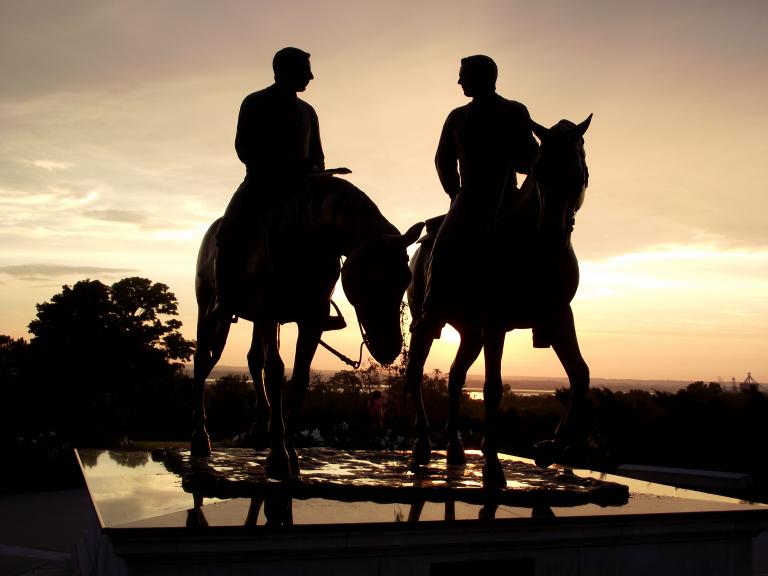
Located in front of the Nauvoo Illinois Temple, these 2003 statues of Joseph and Hyrum Smith show them on their way from Nauvoo, Illinois, to the Carthage Jail, where they would both be murdered by an anti-Mormon mob on 27 June 1844. The human figures are by Latter-day Saint sculptor Stanley J. Watts and the horses are by the Latter-day Saint sculptor Kim Corpany.
(Wikimedia Commons public domain images)
An article of mine of which I’m personally quite fond (and which I hope to pursue further and to expand in the future) has just gone up on the website of the Interpreter Foundation:
“Notes on Mormonism and the Trinity”
Abstract: With “awe, humility, and circumspection,” Daniel C. Peterson provides a useful summary and discussion of Latter-day Saint beliefs as they relate to traditional Christian conceptions of the Trinity. In particular, his discussions reveals the many nuances of the questions raised, including the precise nature of the unity of the three persons of the Godhead and how the overall conception relates to doctrines of salvation and practical discipleship, which continued to be a controversial issue in both the Eastern and Western Churches for centuries. Peterson argues that the Latter-day Saint doctrine affirms both biblical precedents and, to a degree, some modern theological trends such as social theories of the Trinity.
[Editor’s Note: Part of our book chapter reprint series, this article is reprinted here as a service to the LDS community. Original pagination and page numbers have necessarily changed, otherwise the reprint has the same content as the original.
See Daniel C. Peterson, “Notes on Mormonism and the Trinity,” in “To Seek the Law of the Lord”: Essays in Honor of John W. Welch, ed. Paul Y. Hoskisson and Daniel C. Peterson (Orem, UT: The Interpreter Foundation, 2017), 267–316. Further information at https://interpreterfoundation.org/books/to-seek-the-law-of-the-lord-essays-in-honor-of-john-w-welch-2/.]
I also want to call your attention to a fairly brief but very good interview with Kent Jackson (“From the Desk of Kurt Manwaring”) that is connected to his recent article (“Some Notes on Joseph Smith
and Adam Clarke”) in Interpreter: A Journal of Latter-day Saint Faith and Scholarship:
“10 Questions with Kent P. Jackson”
***
Yes, I’m grateful for the Prophet Joseph Smith, and for the Restoration that God began through him. #GiveThanks
Here are just a few of the notes on him that I’ve culled from Hyrum L. Andrus and Helen Mae Andrus, Personal Glimpses of the Prophet Joseph Smith (American Fork, Utah: Covenant Communications, 2009). I’ve already shared quite a few passages from Personal Glimpses. What follows is a miscellany of some that I had not yet featured here:
In an undated letter written to his wife Sarah Elizabeth Whiting somewhere between the dedication of the Manti Utah Temple in May 1888 and his own death in September 1896, and preserved now in the BYU Library, Warren Stone Snow related the following:
When I saw the persecution that Joseph had to undergo, my soul mourned, for I was brought in close connection to the many troubles he had to pass through by false brethren and wicked men. Wicked men hunted him like a wild doe on the mountains, for truly he had to flee before them and seek refuge in rocks and caverns and dens and holes in the earth, and be fed by the hands of his friends. (87)
I focus first on his character and personality.
In 1892, William Moore Allred recalled his first encounter with the Prophet for The Juvenile Instructor 27 (1 August 1892):
I first met the Prophet Joseph when I was fourteen years of age, as he was going to Zion’s Camp. I thought he had a very noble appearance, very kind and affectionate. (81)
A letter written by William Henry Kimball to Emmeline B. Wells on 20 January 1907 (and preserved today in the LDS Archives) relates the following about Joseph Smith:
He was of fine stature and noble in appearance. . . . He was kind, delighted to be with the young, played with them and taught them. His appearance commanded respect from all but the enemies of the Gospel of Christ. He knew no fear of man or anything but to do a wrong. (97)
In Eliza Westover’s letter to “Lew,” written on 2 July 1916 and archived in the BYU Library, the 89-year-old woman recalled that
Brother Joseph was a great lover of children. I never met him but I had a bow and one of his sweet smiles. (141)
In a document to be found in the BYU Library under the title “Asenath E. Browning and Isaac Vanwagnor Carling, by their daughter, Ellen Carling Chamberlain,” Asenath is quoted as saying that
One of my earliest memories was of the Prophet Joseph Smith coming to my childhood home. He picked me up and kissed me and said, “Whose pretty little girl is this?” (129)
Writing in the 1 January 1892 issue of The Juvenile Instructor 27, William Faucett remembered of Joseph Smith that
He was pleasant and kind. His character was unimpeachable among the Saints. They loved him, and he loved them. (155)
In January 1840, Joseph Smith visited the Brandywine Branch of the Church on his way from Philadelphia, and stayed and ate in the Whitesides home, where he then spoke to those who had gathered to hear him. Margaret Pierce Whitesides Young, by then a wife of Brigham Young, recorded her memories of that event on pages 76-77 of her journal, which now resides in the BYU Library:
I wish that I might describe my feelings at that meeting. Though they are fresh in my memory to-day, I cannot but fall short of expressing myself. So animated with loving kindness, so mild and gentle, yet big and powerful and majestic, was the Prophet, that to me, he seemed more than a man. I thought almost, that he was an angel.
We were all investigating; none of my people had yet entered the waters of baptism. However it was a great joy to us to entertain the Prophet Joseph Smith, and hear his wonderful words of wisdom. It was 2 o’clock in the morning when we permitted him to retire. We wanted to listen to him all night.
After he had gone from the room, my mother said, “I don’t see how anyone can doubt that he is a Prophet of God. They can see it in his countenance, which is so full of intelligence.”
Yes, truly,” my father replied. “He is a Prophet of God.”
The very next day, my mother was ready for baptism. The ice was six inches deep, but was cut, and the way was prepared . . . (89)
The “Autobiography of John Lowe Butler, 1808-1861,” archived in the BYU Library, recounts a time when he and others had successfully managed to rescue the Prophet from the clutches of a mob:
Sister Emma had sent Joseph out some clean clothes, but Joseph’s brethren were as dirty as he was, and he was not going to go clean and his brethren dirty. The dust on the road then was four or five inches deep. (102)
John D. Lee — a problematic person, I know, to say the least of him, but grinding no apparent axe here — recorded of Joseph Smith in his Mormonism Unveiled [1891] that
His countenance was that of a plain, honest man, full of benevolence and philanthropy, and void of deceit and hypocrisy. (112)
Now for a few items that are more or less connected to Joseph’s reception of divine revelation:
Nancy N. Tracy was a member of the Nauvoo Relief Society. In “A Short Sketch of the Life and Travels of Nancy N. Tracy,” which is conserved in the BYU Library, she recalls that Joseph Smith would sometimes visit its meetings:
Once in particular I remember Emma bringing him, and he prayed at the beginning of the meeting. He was full of the Spirit of God. His whole frame shook, and his face shone and looked almost transparent. (94)
In his early-1907 letter to Emmeline B. Wells, William Henry Kimball recalled that
In the house of Stephen Winchester, Mulholland Street, Nauvoo, Illinois, only weeks prior to their martyrdom, Joseph prophesied of the shedding of his and Hyrum’s blood to seal their testimonies. Then and there, he mapped the life and acts of Brigham Young until death. I can assure you it never failed. (97)
In the “History of Return Jackson Redden — Utah Pioneer of 1847,” written by his granddaughter Nita Redden Hampshire and held by the BYU Library, Return Redden is quoted as recalling that
One one occasion the Prophet Joseph sent me to get a warrant for his arrest. He told me that three men would be sleeping on the floor of a tavern, and that the arrest warrant would be under the saddle blanket of the man sleeping in the middle. The men would be guarded by a large, vicious dog. I was to go to the tavern after the men retired and remove the warrant and take it to him.
Joseph told me that neither the men nor the dog would wake up. I did as I was directed. The men and dog did not awaken. I took the warrant to the Prophet who said to me, “Never was a man so rightly named Return. No matter how difficult the task that I assign you, you do it and return safely.” (152)
The “Journal of Truman O. Angell,” who eventually became the principal architect of the Salt Lake Temple, is housed in the library at Brigham Young University. On pages 1-6, it relates the following two episodes relating to the construction of the Church’s first temple, in Kirtland, Ohio, in the 1830s:
One day while I was working on the Temple, Frederick G. Williams, one of President Smith’s counselors, came in, and the following dialogue took place in my presence. Carpenter Rolph asked, “Doctor, what do you think of the House?”
He answered, “It looks to me like the pattern precisely.” He then related the following:
“Joseph received the word for him to take his two counselors, myself and Sidney Rigdon, and come before the Lord, and he would show us the plan or model of the House to be built. We went upon our knees, called on the Lord, and the Building appeared within viewing distance, I being the first to discover it. Then all of us viewed it together. After we had taken a good look at the exterior, the building seemed to come right over us, and the make up of this hall seemed to coincide with what I there saw to a minutia.” . . .
On another occasion, Joseph came into the hall, and the leading mechanic, (by profession a carriage builder) wanted to seat the House contrary to what Joseph had proposed. Joseph assured him that he had seen the inside of every building that had been built unto the Lord upon the earth, and he hated to have to say so. (84, 85)
For some background on the episode related by Truman Angell, see my 2016 Deseret News column “The inspired plans for the Kirtland Temple.”
For discussion of the extraordinary and significant fact that “Many of Prophet’s revelations were shared experiences,” see my early-2011 Deseret News column of that title.
#GiveThanks
Church of Jesus Christ of Latter-day Saints
Margaret Pierce Whitesides Young
Previous Post

November 22, 2020
"A Fortunate Universe" #GiveThanks
Next Post
November 24, 2020 Utah's desert monolith and the God of the gaps
Browse Our Archives
Select a Category Uncategorized
Select a Month October 2026 September 2026 August 2026 July 2026 June 2026 May 2026 April 2026 March 2026 February 2026 January 2026 December 2025 November 2025 October 2025 September 2025 August 2025 July 2025 June 2025 May 2025 April 2025 March 2025 February 2025 January 2025 December 2024 November 2024 October 2024 September 2024 August 2024 July 2024 June 2024 May 2024 April 2024 March 2024 February 2024 January 2024 December 2023 November 2023 October 2023 September 2023 August 2023 July 2023 June 2023 May 2023 April 2023 March 2023 February 2023 January 2023 December 2022 November 2022 October 2022 September 2022 August 2022 July 2022 June 2022 May 2022 April 2022 March 2022 February 2022 January 2022 December 2021 November 2021 October 2021 September 2021 August 2021 July 2021 June 2021 May 2021 April 2021 March 2021 February 2021 January 2021 December 2020 November 2020 October 2020 September 2020 August 2020 July 2020 June 2020 May 2020 April 2020 March 2020 February 2020 January 2020 December 2019 November 2019 October 2019 September 2019 August 2019 July 2019 June 2019 May 2019 April 2019 March 2019 February 2019 January 2019 December 2018 November 2018 October 2018 September 2018 August 2018 July 2018 June 2018 May 2018 April 2018 March 2018 February 2018 January 2018 December 2017 November 2017 October 2017 September 2017 August 2017 July 2017 June 2017 May 2017 April 2017 March 2017 February 2017 January 2017 December 2016 November 2016 October 2016 September 2016 August 2016 July 2016 June 2016 May 2016 April 2016 March 2016 February 2016 January 2016 December 2015 November 2015 October 2015 September 2015 August 2015 July 2015 June 2015 May 2015 April 2015 March 2015 February 2015 January 2015 December 2014 November 2014 March 2014 August 2013 February 2012
Follow Us!
TAKE THE
Religious Wisdom Quiz
Who said "as for me and my house, we will serve the Lord"?
Select your answer to see how you score.
Paul Joshua Peter Abraham
Related posts from Sic et Non


Notes on Women, Priesthood, and General Conference

"The Book of Moses as a Temple Text"

TRENDING AT PATHEOS Latter-day Saint

'Super Scam Me' Exposes AI Jon Bon Jovi...
Leslie Pickett believed she was in a relationship with Jon Bon Jovi....

The Brazilian Remake of Kendricks' 'Flywheel' Opens in...
“Flywheel,” the story that launched the Kendrick Brothers’ filmmaking career is getting...

The Dangers of Gradual Accommodation (Winking at Sin)
Recently, the “law of gradualness” resurfaced during the opening of a weeklong,...

The Iron Gates and the Lion of the...
Yesterday, I didn't finish my report about, well, yesterday. So I'll...

The Image: On the Horror of Capitalism and...
The Image Then went the Pharisees, and took counsel how they might...

We are approaching the date of our new American national holiday: October...
view all Latter-day Saint blogs
Ad-Free & Subscriber Log-In Subscription Support
- About Us
- 2026 Calendar
- Videos
- Podcasts
- Library of World Religions
- Faith In Media Tracker
- Advertise With Us
- Write for Us
- Privacy Policy
- Terms of Service
- Do Not Sell My Data
- Contact Us
- Radiant Digital
- Manage Newsletter Subscriptions
- Unsubscribe From Notifications
- Sitemap
Copyright 2008-2026, Patheos. All rights reserved.
Subscription Support Ad-Free & Subscriber Log-In
Follow Patheos