
BuddhistCatholicContemplativeEvangelicalGeneral ChristianHinduJewishLatter-day SaintMuslimNew VisionsProgressive Christian
Beliefs
- Buddhist
- Catholic
- Contemplative
- Evangelical
- General Christian
- Hindu
- Jewish
- Latter-day Saint
- More Voices
- Muslim
- New Visions
- Pagan
- Progressive Christian
Topics
- Religion News
- Food and Religion
- Sports and Religion
- Religious Art
- Religious Music and Entertainment
- Religious Events
- History and Religion
- Style and Religion
- Politics and Religion
- Women in Religion
- Recreation Outdoors and Religion
- Business Finance and Religion
- Careers Workplace and Religion
- Education and Religion
- Family Parenting and Religion
- Health Fitness and Religion
- Home and Religion
- Relationships and Religion
- Technology and Religion
- Travel and Religion
Columnists
- Buddhist Columnists
- Business Finance and Religion Columnists
- Careers Workplace and Religion Columnists
- Catholic Columnists
- Contemplative Columnists
- Education and Religion Columnists
- Evangelists Columnists
- Family Parenting and Religion Columnists
- General Christian Columnists
- Health Fitness and Religion Columnists
- Hindu Columnists
- History and Religion Columnists
- Home and Religion Columnists
- Jewish Columnists
- More Voices Columnists
- Latter Day Columnists
- Muslim Columnists
- New Visions Columnists
- Nonreligious Columnists
- Pagan Columnists
- Politics and Religion Columnists
- Progressive Columnists
- Recreation Outdoors and Religion Columnists
- Relationships and Religion Columnists
- Religion News Columnists
- Religious Art Columnists
- Religious Events Columnists
- Religious Music and Entertainment Columnists
- Sports and Religion Columnists
- Style and Religion Columnists
- Technology and Religion Columnists
- Travel and Religion Columnists
- Women in Religion Columnists
Resource Library
- 2026 Calendar
- Library of World Religions
- The 100 Most Holy Places on Earth
- Patheos Answers
- Podcasts
- Videos
- Faith Leaders Database
- Anglican Episcopalian
- Bahai
- Baptist
- Buddhism
- Christianity
- Confucianism
- Eastern Orthodoxy
- Hinduism
- Holiness and Pentecostal
- ISKCON
- Islam
- Judaism
- Lutheran
- Methodist
- The Church of Jesus Christ of Latter-day Saints
- New Age
- Paganism
- Presbytarian and Reformed
- Protestantism
- Religion Behind the Scenes
- Roman Catholic
- Scientology
- Shia Islam
- Sikhism
- Sufism
- Sunni Islam
- Taoism
- Zen
- See all religions
Research Tools
 Ad-Free & Subscriber Log-In Subscription Support
Ad-Free & Subscriber Log-In Subscription Support
Follow Patheos 

- Trending:
- Forgiveness
- |
- Marriage
- |
- Consciousness
- |
- Death Penalty
- |
- Election
- |
- Halloween

- Home
- Latter-day Saint
- Jeremiah 1:5, Premortal Existence, the Status of the EModE Hypothesis, Latter-day Saints, and Sexuality
Jeremiah 1:5, Premortal Existence, the Status of the EModE Hypothesis, Latter-day Saints, and Sexuality
Last updated on: December 3, 2020 at 5:18 pm by Dan Peterson
Jeremiah 1:5, Premortal Existence, the Status of the EModE Hypothesis, Latter-day Saints, and Sexuality 2020-12-03T17:18:44-07:00 Dan Peterson
Patheos Explore the world's faith through different perspectives on religion and spirituality! Patheos has the views of the prevalent religions and spiritualities of the world.
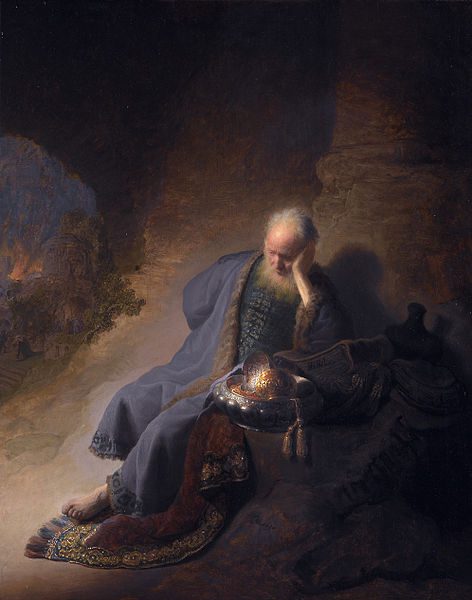
“Jeremiah Lamenting the Destruction of Jerusalem”
Rembrandt
(Wikimedia Commons public domain image)
An article written by Dana M. Pike has now appeared in Interpreter: A Journal of Latter-day Saint Faith and Scholarship:
“Formed in and Called from the Womb”
Abstract: Drawing on his deep knowledge of biblical Hebrew, Dana Pike gives us a close reading of Jeremiah 1:5, the most important Old Testament verse relating to the Latter-day Saint understanding of premortal existence of human spirits and the foreordination of prophets to their appointed callings. He shows that the plain sense of this verse cannot be easily dismissed: first, and consistent with Latter-day Saint understanding, God knew Jeremiah before he was conceived and that afterward, in a second phase that transpired in the womb, he was, “according to the Israelite perspective preserved in the Bible,” appointed to become a prophet.
[Editor’s Note: Part of our book chapter reprint series, this article is reprinted here as a service to the LDS community. Original pagination and page numbers have necessarily changed, otherwise the reprint has the same content as the original.
See Dana M. Pike, “Formed in and Called from the Womb,” in “To Seek the Law of the Lord”: Essays in Honor of John W. Welch, ed. Paul Y. Hoskisson and Daniel C. Peterson (Orem, UT: The Interpreter Foundation, 2017), 317–32. Further information at https://interpreterfoundation.org/books/to-seek-the-law-of-the-lord-essays-in-honor-of-john-w-welch-2/.]
***
I’ve just finished reading the fourth and final installment of the “pre-prints” that Drs. Stanford Carmack and Royal Skousen have recently been providing to the Interpreter Foundation, and writing a brief introduction to it (very closely resembling the introductions for the first three installments). I’ll shortly be sending it in for publication, and it should appear within a day or so.
I notice that a small handful of critics are chortling over what they claim to regard as the utter collapse and abandonment of the hypothesis that, at its roots, Book of Mormon English is primarily early modern in character. They are wrong. It has neither collapsed nor has it been abandoned. (Incidentally, several further articles on the topic are likely to appear over the next year or so in Interpreter: A Journal of Latter-day Saint Faith and Scholarship.) Moreover, since they affect to hold the false view that the Early Modern English or EModE hypothesis represents the sole motivation and the only significant result of the Book of Mormon Critical Text Project, rather than a striking and completely unexpected byproduct of it, some are claiming that the Project as a whole has been a failure, which it emphatically has not been.
With that as a background, I wrote last night to Drs. Carmack and Skousen for their reaction. From the exchange that ensued and with his kind permission, I share an email from Royal Skousen that I received this morning:
Stan and I are doing what we promised we would do in the introduction to The Nature of the Original Language [of the Book of Mormon], namely, to reconsider our findings as the databases got better (especially our access to the texts in ECCO). Here’s the quote from page 10 of NOL:
“In some cases, it has been difficult to decide which category to place a write-up in, especially when the databases are still not as developed as we would wish. Over time, further advances in the size and variety of the databases may lead us to change the categorization for some of these write-ups.”
So SOME of the items we thought were archaic (prior to 1740) are NOT, and we have identified these by citing examples. There is no reason to hide these findings. It should be pointed out that in the last of our four revised parts that many of these expressions were already identified as occurring in the 1700s and early 1800s, up to Joseph Smith’s time. Those examples that we gave explicit citations to in NOL are listed here in part 4 with arrows (there are 9 of them). They were put in that section 7 (Archaic Expressions) to show that they were also archaic. So here is a summary of the shifts in our thinking:
Section 1, Archaic Vocabulary: 26 remain archaic, 10 persist into the 1700s or later, 4 are re-created words, and 1 is biblical usage
Section 3, Archaic Phrases: 14 remain archaic, 14 persist into the 1700s or later, and 1 is biblical usage
Section 4, Archaic Grammar: 2 remain archaic, 12 persist into the 1700s or later (2 were identified with citations in NOL), and 1 is biblical usage
Section 7, Archaic Expressions: 7 remain archaic, 27 persist into the 1700s or later (9 were identified with citations in NOL), and 3 are influenced by biblical usage
One should notice that the shorter the example (individual word meanings and short phrases) the greater the odds that our initial analysis was correct. Grammatical items typically involve singular or plural usage, with syntax playing a role, and the same for expressions.
So the archaic hypothesis still holds, with nearly 50 examples restricted to archaic usage (Early Modern English, 1540s to the 1740s). The databases are out there for others to check. The critics of the archaic hypothesis should still be worried.
With best wishes, Royal
***
I had a great time with Martin Tanner last night on the Interpreter Radio Show. We discussed the First Vision — which will be the focus of second lesson in next year’s “Come, Follow Me” curriculum for the Sunday schools of the Church of Jesus Christ of Latter-day Saints — over the entire two hours of the program, not only for the portion of it dedicated to the Gospel Doctrine scripture roundtable. I don’t know how Martin felt or how anybody else will feel about it, but I thought it was an exceptionally good and enjoyable conversation. It should be up fairly soon, in archived form, on the website of the Interpreter Foundation.
***
Finally, I call this important discussion in an important Latter-day Saint journal to your notice:
Posted from Park City, Utah
Church of Jesus Christ of Latter-day Saints
Interpreter Journal Latter-day Saint Faith Scholarship
Next Post

November 30, 2020 Lifetime Honors Come to Two Former Colleagues
Browse Our Archives
Select a Category Uncategorized
Select a Month October 2026 September 2026 August 2026 July 2026 June 2026 May 2026 April 2026 March 2026 February 2026 January 2026 December 2025 November 2025 October 2025 September 2025 August 2025 July 2025 June 2025 May 2025 April 2025 March 2025 February 2025 January 2025 December 2024 November 2024 October 2024 September 2024 August 2024 July 2024 June 2024 May 2024 April 2024 March 2024 February 2024 January 2024 December 2023 November 2023 October 2023 September 2023 August 2023 July 2023 June 2023 May 2023 April 2023 March 2023 February 2023 January 2023 December 2022 November 2022 October 2022 September 2022 August 2022 July 2022 June 2022 May 2022 April 2022 March 2022 February 2022 January 2022 December 2021 November 2021 October 2021 September 2021 August 2021 July 2021 June 2021 May 2021 April 2021 March 2021 February 2021 January 2021 December 2020 November 2020 October 2020 September 2020 August 2020 July 2020 June 2020 May 2020 April 2020 March 2020 February 2020 January 2020 December 2019 November 2019 October 2019 September 2019 August 2019 July 2019 June 2019 May 2019 April 2019 March 2019 February 2019 January 2019 December 2018 November 2018 October 2018 September 2018 August 2018 July 2018 June 2018 May 2018 April 2018 March 2018 February 2018 January 2018 December 2017 November 2017 October 2017 September 2017 August 2017 July 2017 June 2017 May 2017 April 2017 March 2017 February 2017 January 2017 December 2016 November 2016 October 2016 September 2016 August 2016 July 2016 June 2016 May 2016 April 2016 March 2016 February 2016 January 2016 December 2015 November 2015 October 2015 September 2015 August 2015 July 2015 June 2015 May 2015 April 2015 March 2015 February 2015 January 2015 December 2014 November 2014 March 2014 August 2013 February 2012
Follow Us!
TAKE THE
Religious Wisdom Quiz
What Christian group emphasizes "The Inner Light" as guidance from God?
Select your answer to see how you score.
Baptists Methodists Pentecostals Quakers
Related posts from Sic et Non


Notes on Women, Priesthood, and General Conference

"The Book of Moses as a Temple Text"

TRENDING AT PATHEOS Latter-day Saint

In "Irreplaceable," our book on vocation and technology, Trevor Sutton and I...

I was strolling through the top floor of the brand new Parthenon...

What Does Gêvâh Mean For Kimberley Guifoyle &...
This week, a lot of the news is focused on Kimberly Guilfoyle....

INNER CIRCLE: Profound Mystery (Of Christ In All...
Ephesians 5:31-32 “For this reason, a man will leave his father and...

Do Not Rejoice When Your Enemy Falls: The...
Turning an execution into a public spectacle is a disturbing expression of...

'The Chosen' S6 Trailer: The Passion Gets Very...
Not many watching 'The Chosen' worry about spoilers, but just because they...
view all Latter-day Saint blogs
Ad-Free & Subscriber Log-In Subscription Support
- About Us
- 2026 Calendar
- Videos
- Podcasts
- Library of World Religions
- Faith In Media Tracker
- Advertise With Us
- Write for Us
- Privacy Policy
- Terms of Service
- Do Not Sell My Data
- Contact Us
- Radiant Digital
- Manage Newsletter Subscriptions
- Unsubscribe From Notifications
- Sitemap
Copyright 2008-2026, Patheos. All rights reserved.
Subscription Support Ad-Free & Subscriber Log-In
Follow Patheos