
BuddhistCatholicContemplativeEvangelicalGeneral ChristianHinduJewishLatter-day SaintMuslimNew VisionsProgressive Christian
Beliefs
- Buddhist
- Catholic
- Contemplative
- Evangelical
- General Christian
- Hindu
- Jewish
- Latter-day Saint
- More Voices
- Muslim
- New Visions
- Pagan
- Progressive Christian
Topics
- Religion News
- Food and Religion
- Sports and Religion
- Religious Art
- Religious Music and Entertainment
- Religious Events
- History and Religion
- Style and Religion
- Politics and Religion
- Women in Religion
- Recreation Outdoors and Religion
- Business Finance and Religion
- Careers Workplace and Religion
- Education and Religion
- Family Parenting and Religion
- Health Fitness and Religion
- Home and Religion
- Relationships and Religion
- Technology and Religion
- Travel and Religion
Columnists
- Buddhist Columnists
- Business Finance and Religion Columnists
- Careers Workplace and Religion Columnists
- Catholic Columnists
- Contemplative Columnists
- Education and Religion Columnists
- Evangelists Columnists
- Family Parenting and Religion Columnists
- General Christian Columnists
- Health Fitness and Religion Columnists
- Hindu Columnists
- History and Religion Columnists
- Home and Religion Columnists
- Jewish Columnists
- More Voices Columnists
- Latter Day Columnists
- Muslim Columnists
- New Visions Columnists
- Nonreligious Columnists
- Pagan Columnists
- Politics and Religion Columnists
- Progressive Columnists
- Recreation Outdoors and Religion Columnists
- Relationships and Religion Columnists
- Religion News Columnists
- Religious Art Columnists
- Religious Events Columnists
- Religious Music and Entertainment Columnists
- Sports and Religion Columnists
- Style and Religion Columnists
- Technology and Religion Columnists
- Travel and Religion Columnists
- Women in Religion Columnists
Resource Library
- 2026 Calendar
- Library of World Religions
- The 100 Most Holy Places on Earth
- Patheos Answers
- Podcasts
- Videos
- Faith Leaders Database
- Anglican Episcopalian
- Bahai
- Baptist
- Buddhism
- Christianity
- Confucianism
- Eastern Orthodoxy
- Hinduism
- Holiness and Pentecostal
- ISKCON
- Islam
- Judaism
- Lutheran
- Methodist
- The Church of Jesus Christ of Latter-day Saints
- New Age
- Paganism
- Presbytarian and Reformed
- Protestantism
- Religion Behind the Scenes
- Roman Catholic
- Scientology
- Shia Islam
- Sikhism
- Sufism
- Sunni Islam
- Taoism
- Zen
- See all religions
Research Tools
 Ad-Free & Subscriber Log-In Subscription Support
Ad-Free & Subscriber Log-In Subscription Support
Follow Patheos 

- Trending:
- Forgiveness
- |
- Marriage
- |
- Consciousness
- |
- Death Penalty
- |
- Election
- |
- Halloween

- Home
- Latter-day Saint
- “A Fortunate Universe” #GiveThanks
“A Fortunate Universe” #GiveThanks
Last updated on: November 22, 2020 at 4:50 pm by Dan Peterson
“A Fortunate Universe” #GiveThanks 2020-11-22T16:50:22-07:00 Dan Peterson
Patheos Explore the world's faith through different perspectives on religion and spirituality! Patheos has the views of the prevalent religions and spiritualities of the world.
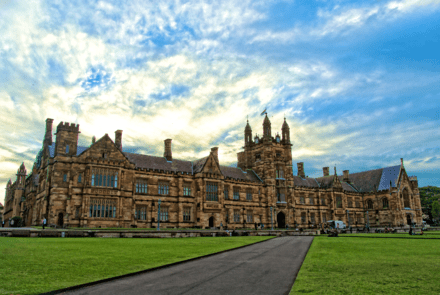
On the main quadrangle of the University of Sydney, with which the physicists, astronomers, and cosmologists Geraint Lewis and Luke Barnes are affiliated
(Wikimedia Commons public domain photo)
We should be thankful that we live, that there exist a planet and a cosmos permitting us to think, to love, and to thank.
Here are three science-related newspaper columns that I published in the Deseret News for past American Thanksgiving holidays:
“The miracle of Thanksgiving pies”
Jeff Lindsay, a vice president of the Interpreter Foundation who happens to hold a doctorate in chemical engineering, has recently posted a quite compatible blog entry, partially science-focused:
“A Most Appropriate Thanksgiving Message for This Day: President Nelson on the Power of Gratitude”
***
I will now continue somewhat in the same vein, with some lines based upon Geraint F. Lewis and Luke A. Barnes, A Fortunate Universe: Life in a Finely Tuned Cosmos (Cambridge: Cambridge University Press, 2016), 47-53,
First, you need to understand that a quark is any one of a number of subatomic particles that carry a fractional electric charge. Although they’ve been postulated as building blocks of the hadron, quarks haven’t actually been directly observed. Still, theoretical predictions based on their existence appear to have been experimentally confirmed. That’s really all the physics that you need to know for what follows:
The up and down quarks are, respectively, 4.5 times heavier than the electron and 9.4 times heavier. These aren’t the most obvious numbers, or the neatest, but they are fundamental to what’s called the Standard Model of particle physics. We can measure them, but we have no explanation for their specific values. Why are they what they are? We don’t know.
Nor does the situation necessarily get any clearer in other regions of the Standard Model. The other four quarks, for instance, are 190 times heavier than the electron, and 2495 times, and 8180 times, and 338,960 times heavier. And the muon and the tau are 206.768,284 and 3477.15 times heavier than the electron, respectively.
Do these particular and rather peculiar values have any special significance? How would the universe change if the relative masses of electrons, quarks, muons, and taus were slightly different? Is life so hardy and robust, so remarkably malleable, that it would simply take a somewhat different form? Will biology arise in virtually any universe?
No.
If we were to increase the mass of the down quark by a factor of about 70, it would very soon decay into what’s called a [Delta]++ particle — sorry, I can’t do Greek characters here — and we would find ourselves in what Lewis and Barnes call a “Delta-Plus-Plus Universe.” Since the extra positive charge would cause electromagnetic repulsion (such as we see when we try to bring the positive sides of two magnets together), such particles would be much less likely to bind to each other. Individual [Delta]++ particles would be able to capture two electrons (because of their negative charges) in order to create an element like helium. But this would be the only element in the universe. “Farewell, periodic table!” say Lewis and Barnes (50). And farewell, life! The universe in which we live permits something like sixty-one million chemical compounds of which we’re currently aware; the “Delta-Plus-Plus Universe” would permit just one element and absolutely no chemical reactions.
But suppose we increase the mass of the up quark by a factor of 130. Protons and neutrons will be replaced by just one kind of very stable particle made up of three down quarks, known as the [Delta]– particle. Within this Delta-minus universe, as Lewis and Barnes label it, with no neutrons to dilute the repulsive force of their powerfully negative charge, there will be just one uniform type of atom. However, there will be, potentially, one possible chemical reaction: If all electrons are replaced with their positively charged alter egos, positrons, two [Delta]-minus particles will be able to form a molecule. But that’s it. No life.
To create a hydrogen-only universe, we increase the mass of the down quark by at least a factor of three. In this hypothetical cosmos, neutrons will vanish. Even those in nuclei. “Once again,” comment Lewis and Barnes, “kiss your chemistry textbook goodbye, as we’d be left with one type of atom and one chemical reaction.” (51) No chemical activity. No biology.
“If you think the hydrogen universe is rather featureless,” write Lewis and Barnes, “let’s instead increase the mass of the up quark by a factor of 6.” (51) If we do this, protons fall apart. All protons decay into neutrons, positrons, and neutrinos. “This is by far the worst universe we’ve so far encountered,” comment Lewis and Barnes, with “no atoms, no chemical reactions. Just endless, featureless space filled with inert, boring neutrons.” (51) In other words, once again, no life.
But there are still other paths by which we might reach this sterile neutron universe. For example, we might decrease the mass of the down quark by just eight percent. In that case, protons in atoms would capture the electrons orbiting them. Atoms would dissolve into featureless neutrons. There would be no chemistry. And thus, no biology.
We’ve had relatively little to say thus far about electrons. But electrons and their antiparticles, positrons, are involved in the decay of neutrons and protons, so electrons, too, can sterilize a universe. For example, if we increase the mass of an electron by a factor of 2.5, we’re back in the completely dead neutron universe again. No life.
On page 52 of their book, Lewis and Barnes offer their Figure 12. (I can’t show it here, but I will attempt to describe it.). It’s about 2.0 inches wide by 3.35 inches tall, with a vertical axis representing the hypothetical masses of up and down quarks and a horizontal axis representing hypothetical electron masses, both measured in MeV or “megaelectronvolts.” Each point within the figure represents a different universe. If the reader throws a dart, the point where the dart hits marks a different hypothetical universe, with different mass ratios between electrons and down and up quarks. The grey regions of the figure show where the complex chemistry required for biological life simply cannot occur, divided between universes dominated only by protons (the hydrogen universe) or only neutrons. On the left side is a small triangular wedge marking the territory of the “acceptable” universes, the hypothetical universes in which potentially life-supporting chemical reactions might possibly occur. It is about 3/4 inch on its base with 1/2 inch sides. In it, there is a black dot that represents the “location” within these parameters of the actual universe that we know. Happily, we’re well within the white wedge. Remark Lewis and Barnes, “This, effectively, is the start of the fine-tuning journey.”
And, indeed, you might be pardoned if you found that relatively small wedge of life-permitting universes — perhaps 0.15 square inch — within a rectangle of seven life-forbidding square inches fairly impressive.
But their final comment on the figure is so significant and so stunning that I’ll simply quote it here:
An important part of this plot to keep a firm eye on is the limits of the axes. We plotted the quark difference from 0 to 7 MeV, and the electron mass from 0 to 4 MeV. This region is the interesting bit of the plot; the rest is boring and grey. If we wanted, instead, to get an impression of the smallness of the white, life-permitting region, we could extend the axes up to the mass of the largest quark we’ve observed: the top quark. To see this, add 4 kilometres of grey paper to the right, top, and bottom of the plot. (If you make this 10,000 acre plot, please send us a photo.)
If we extend to the limits of our experimental data, we’d mark 6.5 million MeV at the ends [of] a plot that could cover most of Tasmania, or all of Switzerland, or half of South Korea, or most of West Virginia, or two Death Stars, depending on which continent/universe you inhabit. (52-53)
#GiveThanks
***
I’ve just read — and thoroughly enjoyed — Fiona and Terryl Givens, All Things New: Rethinking Sin, Salvation, and Everything in Between (Meridian, ID: Faith Matters Publishing, 2020). Here’s one of the many passages that I liked and marked:
As Saints we should have no problem acknowledging the abundant “giftedness” that everywhere colors the Great Plan of Happiness from beginning to end. First, because Christ’s gift precedes rather than follows our need. Creation anticipates our arrival, His Atonement foresees our sorrows and suffering, and His Resurrection inaugurates our own. (154)
The idea that “Creation anticipates our arrival” reminds me very strongly of the famous statement made by the recently departed Anglo-American mathematical physicist Freeman Dyson (1923-2020), of the Institute for Advanced Study at Princeton:
The more I examine the universe and the details of its architecture, the more evidence I find that the universe in some sense must have known we were coming.
#GiveThanks
Previous Post

November 21, 2020
The Son of God? Or a poached egg? #GiveThanks
Browse Our Archives
Select a Category Uncategorized
Select a Month October 2026 September 2026 August 2026 July 2026 June 2026 May 2026 April 2026 March 2026 February 2026 January 2026 December 2025 November 2025 October 2025 September 2025 August 2025 July 2025 June 2025 May 2025 April 2025 March 2025 February 2025 January 2025 December 2024 November 2024 October 2024 September 2024 August 2024 July 2024 June 2024 May 2024 April 2024 March 2024 February 2024 January 2024 December 2023 November 2023 October 2023 September 2023 August 2023 July 2023 June 2023 May 2023 April 2023 March 2023 February 2023 January 2023 December 2022 November 2022 October 2022 September 2022 August 2022 July 2022 June 2022 May 2022 April 2022 March 2022 February 2022 January 2022 December 2021 November 2021 October 2021 September 2021 August 2021 July 2021 June 2021 May 2021 April 2021 March 2021 February 2021 January 2021 December 2020 November 2020 October 2020 September 2020 August 2020 July 2020 June 2020 May 2020 April 2020 March 2020 February 2020 January 2020 December 2019 November 2019 October 2019 September 2019 August 2019 July 2019 June 2019 May 2019 April 2019 March 2019 February 2019 January 2019 December 2018 November 2018 October 2018 September 2018 August 2018 July 2018 June 2018 May 2018 April 2018 March 2018 February 2018 January 2018 December 2017 November 2017 October 2017 September 2017 August 2017 July 2017 June 2017 May 2017 April 2017 March 2017 February 2017 January 2017 December 2016 November 2016 October 2016 September 2016 August 2016 July 2016 June 2016 May 2016 April 2016 March 2016 February 2016 January 2016 December 2015 November 2015 October 2015 September 2015 August 2015 July 2015 June 2015 May 2015 April 2015 March 2015 February 2015 January 2015 December 2014 November 2014 March 2014 August 2013 February 2012
Follow Us!
TAKE THE
Religious Wisdom Quiz
For all have _____ and come short of the glory of God.
Select your answer to see how you score.
Tried Believed Sinned Prayed
Related posts from Sic et Non


Learning more about a region of which I've...

From Serbia's "White City," Belgrade

TRENDING AT PATHEOS Latter-day Saint

The First Eucharistic Controversy: Christ’s Real Presence
For Catholics, the Eucharist is the source and summit of the Christian...

How to Make a Decision When You Can't...
Main point: It’s much more valuable to stay close to God so...

Archdiocese Hosts Military Marriage Retreat in Germany
RASTATT, Germany — The transient military lifestyle, with its frequent deployments and...

Nearly every morning, I make the drive to Detroit with my high-school-age...

The Real AI Story Is Adoption Without Trust
Artificial intelligence has crossed a political threshold. It is no longer a...

A new article, written by Jeff Lindsay and Gale L. Pooley,...
view all Latter-day Saint blogs
Ad-Free & Subscriber Log-In Subscription Support
- About Us
- 2026 Calendar
- Videos
- Podcasts
- Library of World Religions
- Faith In Media Tracker
- Advertise With Us
- Write for Us
- Privacy Policy
- Terms of Service
- Do Not Sell My Data
- Contact Us
- Radiant Digital
- Manage Newsletter Subscriptions
- Unsubscribe From Notifications
- Sitemap
Copyright 2008-2026, Patheos. All rights reserved.
Subscription Support Ad-Free & Subscriber Log-In
Follow Patheos