
BuddhistCatholicContemplativeEvangelicalGeneral ChristianHinduJewishLatter-day SaintMuslimNew VisionsProgressive Christian
Beliefs
- Buddhist
- Catholic
- Contemplative
- Evangelical
- General Christian
- Hindu
- Jewish
- Latter-day Saint
- More Voices
- Muslim
- New Visions
- Pagan
- Progressive Christian
Topics
- Religion News
- Food and Religion
- Sports and Religion
- Religious Art
- Religious Music and Entertainment
- Religious Events
- History and Religion
- Style and Religion
- Politics and Religion
- Women in Religion
- Recreation Outdoors and Religion
- Business Finance and Religion
- Careers Workplace and Religion
- Education and Religion
- Family Parenting and Religion
- Health Fitness and Religion
- Home and Religion
- Relationships and Religion
- Technology and Religion
- Travel and Religion
Columnists
- Buddhist Columnists
- Business Finance and Religion Columnists
- Careers Workplace and Religion Columnists
- Catholic Columnists
- Contemplative Columnists
- Education and Religion Columnists
- Evangelists Columnists
- Family Parenting and Religion Columnists
- General Christian Columnists
- Health Fitness and Religion Columnists
- Hindu Columnists
- History and Religion Columnists
- Home and Religion Columnists
- Jewish Columnists
- More Voices Columnists
- Latter Day Columnists
- Muslim Columnists
- New Visions Columnists
- Nonreligious Columnists
- Pagan Columnists
- Politics and Religion Columnists
- Progressive Columnists
- Recreation Outdoors and Religion Columnists
- Relationships and Religion Columnists
- Religion News Columnists
- Religious Art Columnists
- Religious Events Columnists
- Religious Music and Entertainment Columnists
- Sports and Religion Columnists
- Style and Religion Columnists
- Technology and Religion Columnists
- Travel and Religion Columnists
- Women in Religion Columnists
Resource Library
- 2026 Calendar
- Library of World Religions
- The 100 Most Holy Places on Earth
- Patheos Answers
- Podcasts
- Videos
- Faith Leaders Database
- Anglican Episcopalian
- Bahai
- Baptist
- Buddhism
- Christianity
- Confucianism
- Eastern Orthodoxy
- Hinduism
- Holiness and Pentecostal
- ISKCON
- Islam
- Judaism
- Lutheran
- Methodist
- The Church of Jesus Christ of Latter-day Saints
- New Age
- Paganism
- Presbytarian and Reformed
- Protestantism
- Religion Behind the Scenes
- Roman Catholic
- Scientology
- Shia Islam
- Sikhism
- Sufism
- Sunni Islam
- Taoism
- Zen
- See all religions
Research Tools
 Ad-Free & Subscriber Log-In Subscription Support
Ad-Free & Subscriber Log-In Subscription Support
Follow Patheos 

- Trending:
- Forgiveness
- |
- Marriage
- |
- Consciousness
- |
- Death Penalty
- |
- Election
- |
- Halloween

- Home
- Latter-day Saint
- “You cannot help but think of a Creator.”
“You cannot help but think of a Creator.”
Last updated on: October 12, 2020 at 2:20 pm by Dan Peterson
“You cannot help but think of a Creator.” 2020-10-12T14:20:16-06:00 Dan Peterson
Patheos Explore the world's faith through different perspectives on religion and spirituality! Patheos has the views of the prevalent religions and spiritualities of the world.
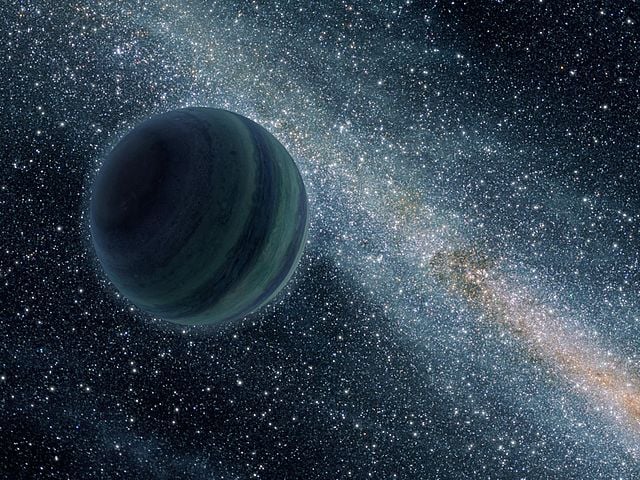
This artist’s conception illustrates a Jupiter-like planet alone in the dark of space, floating freely without a parent star. Astronomers recently uncovered evidence for ten such lone worlds, which are thought to have been “booted,” or ejected, from developing solar systems. The planet survey, called the Microlensing Observations in Astrophysics (MOA) project, scanned the central bulge of our Milky Way galaxy from 2006 to 2007. It used a 5.9-foot (1.8-meter) telescope at Mount John University Observatory in New Zealand, and a technique called gravitational microlensing. Astronomers estimate that free-floating worlds are more common than stars in our Milky Way galaxy, and perhaps in other galaxies, too.
Two interesting passages from my reading of Thomas Dubay, The Evidential Power of Beauty: Science and Theology Meet (San Francisco: Ignatius Press, 1999).
As one astronomer has put it, “A slight increase in nuclear forces would have resulted in stars made almost entirely of helium, stars which have a shorter lifespan, resulting in insufficient time for life, for man, to arise in the universe. On the other hand, a slight decrease in nuclear forces would have prevented the formation of carbon atoms and other necessary ingredients of life.”
George Sim Johnston puts it well when he writes of these breathtaking specificities that “if the cosmic expansion (at the Big Bang) had been a fraction less intense, it would have imploded billions of years ago; a fraction more intense, and the galaxies would not have formed. Picture a wall with thousands of dials; each must be at exactly the right setting — within a toleration of millionths — in order for carbon-based life to eventually emerge in a suburb of the Milky Way. You cannot help but think of a Creator.” A bit more explanation: The mass of the universe could not have been too great or galaxies could not have been formed, and if there could be no galaxies, there obviously could be neither stars nor planets circling stars. With no planets there could be no plant, animal, or human life. (213-214)
Physicist Stanley Jaki speaks of the “stunning details about the specificity of the universe ‘in the first three minutes'”, and he gets a bit more detailed. Noting that “specificity is the hallmark” of cosmological research as it goes beyond the baryon stage of the universe’s development, Jaki writes of more recent investigations into the matter-antimatter states: “In those cases we see the same story: the story of one cosmic specificity leading to another, and in staggeringly exact and specific quantitative terms. In the matter-antimatter states, for instance, ordinary matter particles must outnumber antimatter particles in the specifically exact ratio of one part in ten billion to let subsequent physical interactions issue in processes characteristic of our actually observed universe.” Amazing as this is, he adds that “at any stage, the slightest departure from the specificity as postulated would prevent the formation of galaxies and certainly the emergence of man.” (214)
Previous Post

October 11, 2020
Revision 6.7 "Gunpowder Empires" (B)
Next Post
October 11, 2020 "How to be a Good Apologist"
Browse Our Archives
Select a Category Uncategorized
Select a Month October 2026 September 2026 August 2026 July 2026 June 2026 May 2026 April 2026 March 2026 February 2026 January 2026 December 2025 November 2025 October 2025 September 2025 August 2025 July 2025 June 2025 May 2025 April 2025 March 2025 February 2025 January 2025 December 2024 November 2024 October 2024 September 2024 August 2024 July 2024 June 2024 May 2024 April 2024 March 2024 February 2024 January 2024 December 2023 November 2023 October 2023 September 2023 August 2023 July 2023 June 2023 May 2023 April 2023 March 2023 February 2023 January 2023 December 2022 November 2022 October 2022 September 2022 August 2022 July 2022 June 2022 May 2022 April 2022 March 2022 February 2022 January 2022 December 2021 November 2021 October 2021 September 2021 August 2021 July 2021 June 2021 May 2021 April 2021 March 2021 February 2021 January 2021 December 2020 November 2020 October 2020 September 2020 August 2020 July 2020 June 2020 May 2020 April 2020 March 2020 February 2020 January 2020 December 2019 November 2019 October 2019 September 2019 August 2019 July 2019 June 2019 May 2019 April 2019 March 2019 February 2019 January 2019 December 2018 November 2018 October 2018 September 2018 August 2018 July 2018 June 2018 May 2018 April 2018 March 2018 February 2018 January 2018 December 2017 November 2017 October 2017 September 2017 August 2017 July 2017 June 2017 May 2017 April 2017 March 2017 February 2017 January 2017 December 2016 November 2016 October 2016 September 2016 August 2016 July 2016 June 2016 May 2016 April 2016 March 2016 February 2016 January 2016 December 2015 November 2015 October 2015 September 2015 August 2015 July 2015 June 2015 May 2015 April 2015 March 2015 February 2015 January 2015 December 2014 November 2014 March 2014 August 2013 February 2012
Follow Us!
TAKE THE
Religious Wisdom Quiz
"A cheerful heart is good medicine" is found in what book?
Select your answer to see how you score.
Genesis Psalms Proverbs Matthew
Related posts from Sic et Non

This Wednesday, at 4 PM, Utah time

What if Wallace had prevailed, rather than Darwin?

Does mind derive from mindless matter?

TRENDING AT PATHEOS Latter-day Saint

The First Eucharistic Controversy: Christ’s Real Presence
For Catholics, the Eucharist is the source and summit of the Christian...

How to Make a Decision When You Can't...
Main point: It’s much more valuable to stay close to God so...

Archdiocese Hosts Military Marriage Retreat in Germany
RASTATT, Germany — The transient military lifestyle, with its frequent deployments and...

Nearly every morning, I make the drive to Detroit with my high-school-age...

The Real AI Story Is Adoption Without Trust
Artificial intelligence has crossed a political threshold. It is no longer a...

A new article, written by Jeff Lindsay and Gale L. Pooley,...
view all Latter-day Saint blogs
Ad-Free & Subscriber Log-In Subscription Support
- About Us
- 2026 Calendar
- Videos
- Podcasts
- Library of World Religions
- Faith In Media Tracker
- Advertise With Us
- Write for Us
- Privacy Policy
- Terms of Service
- Do Not Sell My Data
- Contact Us
- Radiant Digital
- Manage Newsletter Subscriptions
- Unsubscribe From Notifications
- Sitemap
Copyright 2008-2026, Patheos. All rights reserved.
Subscription Support Ad-Free & Subscriber Log-In
Follow Patheos