
BuddhistCatholicContemplativeEvangelicalGeneral ChristianHinduJewishLatter-day SaintMuslimNew VisionsProgressive Christian
Beliefs
- Buddhist
- Catholic
- Contemplative
- Evangelical
- General Christian
- Hindu
- Jewish
- Latter-day Saint
- More Voices
- Muslim
- New Visions
- Pagan
- Progressive Christian
Topics
- Religion News
- Food and Religion
- Sports and Religion
- Religious Art
- Religious Music and Entertainment
- Religious Events
- History and Religion
- Style and Religion
- Politics and Religion
- Women in Religion
- Recreation Outdoors and Religion
- Business Finance and Religion
- Careers Workplace and Religion
- Education and Religion
- Family Parenting and Religion
- Health Fitness and Religion
- Home and Religion
- Relationships and Religion
- Technology and Religion
- Travel and Religion
Columnists
- Buddhist Columnists
- Business Finance and Religion Columnists
- Careers Workplace and Religion Columnists
- Catholic Columnists
- Contemplative Columnists
- Education and Religion Columnists
- Evangelists Columnists
- Family Parenting and Religion Columnists
- General Christian Columnists
- Health Fitness and Religion Columnists
- Hindu Columnists
- History and Religion Columnists
- Home and Religion Columnists
- Jewish Columnists
- More Voices Columnists
- Latter Day Columnists
- Muslim Columnists
- New Visions Columnists
- Nonreligious Columnists
- Pagan Columnists
- Politics and Religion Columnists
- Progressive Columnists
- Recreation Outdoors and Religion Columnists
- Relationships and Religion Columnists
- Religion News Columnists
- Religious Art Columnists
- Religious Events Columnists
- Religious Music and Entertainment Columnists
- Sports and Religion Columnists
- Style and Religion Columnists
- Technology and Religion Columnists
- Travel and Religion Columnists
- Women in Religion Columnists
Resource Library
- 2026 Calendar
- Library of World Religions
- The 100 Most Holy Places on Earth
- Patheos Answers
- Podcasts
- Videos
- Faith Leaders Database
- Anglican Episcopalian
- Bahai
- Baptist
- Buddhism
- Christianity
- Confucianism
- Eastern Orthodoxy
- Hinduism
- Holiness and Pentecostal
- ISKCON
- Islam
- Judaism
- Lutheran
- Methodist
- The Church of Jesus Christ of Latter-day Saints
- New Age
- Paganism
- Presbytarian and Reformed
- Protestantism
- Religion Behind the Scenes
- Roman Catholic
- Scientology
- Shia Islam
- Sikhism
- Sufism
- Sunni Islam
- Taoism
- Zen
- See all religions
Research Tools
 Ad-Free & Subscriber Log-In Subscription Support
Ad-Free & Subscriber Log-In Subscription Support
Follow Patheos 

- Trending:
- Forgiveness
- |
- Marriage
- |
- Consciousness
- |
- Death Penalty
- |
- Election
- |
- Halloween

- Home
- Latter-day Saint
- Revision 8.1 “Apostles Rededicate the Holy Land”
Revision 8.1 “Apostles Rededicate the Holy Land”
Last updated on: October 24, 2020 at 12:00 pm by Dan Peterson
Revision 8.1 “Apostles Rededicate the Holy Land” 2020-10-24T12:00:24-06:00 Dan Peterson
Patheos Explore the world's faith through different perspectives on religion and spirituality! Patheos has the views of the prevalent religions and spiritualities of the world.
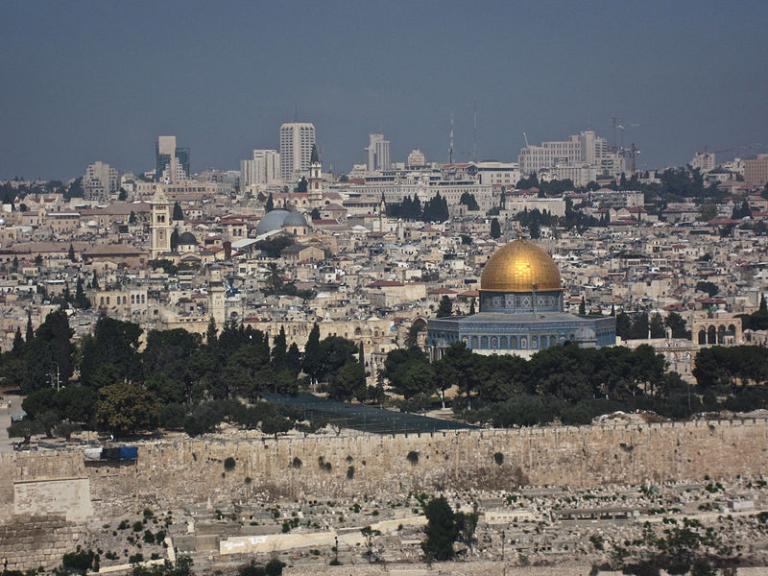
As Orson Hyde had before him, President George A. Smith offered his dedicatory prayer for Palestine on the Mount of Olives, east of Jerusalem. This is the modern view from the Mount, with the golden Dome of the Rock (one of the holiest buildings in the world for Muslims) in the foreground and, in the distance beyond it, the gray dome of the Church of the Holy Sepulcher (perhaps the holiest building in the world for hundreds of millions of Catholic and Orthodox Christians).
(Wikimedia Commons public domain image)
Note: For at least a while, based upon discussion with folks at Patheos, I’ll be experimenting with a new approach to my blogging: Fewer posts, but longer. We’ll see how it works.
When leadership of the Church of Jesus Christ of Latter-day Saints fell to the Quorum of the Twelve Apostles after the martyrdom of Joseph Smith, they faced one crisis after another. The Prophet was dead. Many of the Saints wondered what this meant and what it portended for the future of the Church. They would have been less than human if, for at least a moment, doubts had not crossed their minds. Enemies from the communities around Nauvoo were pressuring the Saints, often violently, to leave. Property held by members of the Church would have to be abandoned, and those who could get it cheap would enjoy huge advantages. Plans were underway to move thousands of people through hostile wilderness, across the plains and the Rocky Mountains to an essentially unknown land beyond the then-current borders of the United States. To make matters worse, militant anti-Mormons, who had already shown the cruelty of which they were capable, were threatening the freedom and the physical safety of the apostles themselves, making orderly planning very difficult.
In the midst of all this, the Twelve issued a proclamation to the world, which testified, among other things,
that the Jews among all nations are …commanded, in the name of the Messiah, to prepare to return to Jerusalem in Palestine, and to rebuild that city and temple to the Lord. And also to organize and establish their own political government, under their own rulers, judges and governors, in that country. For be it known unto them that we now hold the keys of the priesthood and kingdom which are soon to be restored unto them. Therefore let them also repent, and prepare to obey the ordinances of God.[1]
The process by which this commandment has begun to be fulfilled has been a long and complicated one, far beyond the scope of the present book. I have already offered a brief discussion of the Zionist movement and of the return of the Jews to Palestine. My intention in this chapter is to survey, again in a brief and inadequate way, the involvement of the Church in the gathering of the Jews and and its engagement with the Near East in general. However, I intend to glance not merely at past history in the region, but to attempt to discern, through the scattered scriptural and other clues that have been given to us, something of the future of the Church and the Near East in the divine plan. This is an ambitious undertaking, and a risky one. It must be stressed again that what I say here represents only my own reading of the information available.[2]
The Latter-day Saints and their leaders never lost the deep interest in the Near East, and especially in Palestine, that had been with them from the beginning. Even as they abandoned their temple in Illinois, they saw themselves as a modern-day Camp of Israel, led by an American Moses. However, this was no mere daydream or literary fancy. It was a reality of daily dirt and grit. Hard work required almost all their attention if they were to succeed in establishing Zion in the tops of the Rocky Mountains. Amid the demands of a forced exodus from Nauvoo, an historic and difficult trek westward, and the colonization of the Great Basin in the West, their energies were largely devoted to their own concerns. Hundreds of communities had to be established. Irrigation systems needed to be built. Sometimes, it was a matter of bare survival. Still, they remembered Palestine and the Near East, and that remembrance is illustrated in the names that they chose for many of their settlements and for the physical features of their new home in the western desert. When they saw a river that connected a fresh water lake to a vast lake of salt water, it was inevitable that they would call that river the “Jordan.” Towns bearing names like Enoch, Ephraim, Hebron, Jericho, Jerusalem, Little Zion,[2] Manasseh, Moab, Ophir, and Salem sprang up throughout areas of Mormon settlement. Mountains received biblical names such as Canaan, Carmel, Gog and Magog, Nebo, and Pisgah. In Sevier County, the settlers named a prominent rock formation “Solomon’s Temple.” In the southern part of Utah, a particularly spectacular area came to be known as Zion Canyon. But even though they remembered the land of Palestine, and continued to dream of its glorious future and to draw inspiration from events in its past, there was, for a long time, little that the Saints could do about the area in a practical way. For more than thirty years after Orson Hyde’s dedicatory prayer, Latter-day Saint activity was absent from the Holy Land.
When they were able to free themselves from the day-to-day demands of colonization and survival, however, the leaders of the Church acted to reestablish contact between the new capital city of God’s people in the New World and the ancient city of His people in the Old. In October of 1872, another apostolic mission was sent to Palestine, with the assignment of rededicating the Holy Land for the return of Judah. President George A. Smith, first counselor to Brigham Young, was selected to lead the group. He was accompanied by two members of the Quorum of the Twelve, Elders Lorenzo Snow and Albert Carrington, and by several other Latter-day Saints, including the poet and Relief Society leader Eliza R. Snow. The group’s journey to the Holy Land and back occupied eight months, considerably less time than Orson Hyde’s journey had required. (Improved transportation, including the newly completed transcontinental railroad in North America, played a major role in this.) Officially traveling as tourists rather than as missionaries, the company was able to enter countries from which Latter-day Saints had previously been barred.
[1] Printed in England and bound with The Latter-day Saints’ Millennial Star 6 (1845).
[2] 1 must repeat that, for information on the history of the Church in the Holy Land and in the Near East generally, I have been heavily (though not entirely) dependent upon Baldridge, Grafting In, and Barrett, The History of the Mormons in the Holy Land.
Church of Jesus Christ of Latter-day Saints
Previous Post

October 23, 2020
Bob: "There's light at the end of the tunnel." Bill: "WHAT tunnel?"
Next Post
October 25, 2020 Quantum Physics and Early Death
Browse Our Archives
Select a Category Uncategorized
Select a Month October 2026 September 2026 August 2026 July 2026 June 2026 May 2026 April 2026 March 2026 February 2026 January 2026 December 2025 November 2025 October 2025 September 2025 August 2025 July 2025 June 2025 May 2025 April 2025 March 2025 February 2025 January 2025 December 2024 November 2024 October 2024 September 2024 August 2024 July 2024 June 2024 May 2024 April 2024 March 2024 February 2024 January 2024 December 2023 November 2023 October 2023 September 2023 August 2023 July 2023 June 2023 May 2023 April 2023 March 2023 February 2023 January 2023 December 2022 November 2022 October 2022 September 2022 August 2022 July 2022 June 2022 May 2022 April 2022 March 2022 February 2022 January 2022 December 2021 November 2021 October 2021 September 2021 August 2021 July 2021 June 2021 May 2021 April 2021 March 2021 February 2021 January 2021 December 2020 November 2020 October 2020 September 2020 August 2020 July 2020 June 2020 May 2020 April 2020 March 2020 February 2020 January 2020 December 2019 November 2019 October 2019 September 2019 August 2019 July 2019 June 2019 May 2019 April 2019 March 2019 February 2019 January 2019 December 2018 November 2018 October 2018 September 2018 August 2018 July 2018 June 2018 May 2018 April 2018 March 2018 February 2018 January 2018 December 2017 November 2017 October 2017 September 2017 August 2017 July 2017 June 2017 May 2017 April 2017 March 2017 February 2017 January 2017 December 2016 November 2016 October 2016 September 2016 August 2016 July 2016 June 2016 May 2016 April 2016 March 2016 February 2016 January 2016 December 2015 November 2015 October 2015 September 2015 August 2015 July 2015 June 2015 May 2015 April 2015 March 2015 February 2015 January 2015 December 2014 November 2014 March 2014 August 2013 February 2012
Follow Us!
TAKE THE
Religious Wisdom Quiz
Which book contains the famous "Shepherd Psalm"?
Select your answer to see how you score.
Job Isaiah Proverbs Psalms
Related posts from Sic et Non


Notes on Women, Priesthood, and General Conference

"The Book of Moses as a Temple Text"

TRENDING AT PATHEOS Latter-day Saint

Swimfan: Forgotten Aughts Pleasures
This is a recovery effort. In 2002, My Big Fat Greek Wedding...

Top Three Anti-Catholic Lies About Catholicism
This is my initial transcript for the video, "THE 3 WORST...

Pope Leo Celebrates Mass for Nurses & Docs...
I don't have any idea how he did it, but Pope Leo...

The Sermon on the Mount, Part I: Matthew...
The Sermon on the Mount, Part I (Matthew 4:12-5:12) St. Matthew moves...

What's up from Crossway: Reviewing some of their latest A few weeks...

Janie Learns the Way of the Cross: A...
Teaching children about Jesus' Passion can be challenging. Many parents and educators...
view all Latter-day Saint blogs
Ad-Free & Subscriber Log-In Subscription Support
- About Us
- 2026 Calendar
- Videos
- Podcasts
- Library of World Religions
- Faith In Media Tracker
- Advertise With Us
- Write for Us
- Privacy Policy
- Terms of Service
- Do Not Sell My Data
- Contact Us
- Radiant Digital
- Manage Newsletter Subscriptions
- Unsubscribe From Notifications
- Sitemap
Copyright 2008-2026, Patheos. All rights reserved.
Subscription Support Ad-Free & Subscriber Log-In
Follow Patheos