
BuddhistCatholicContemplativeEvangelicalGeneral ChristianHinduJewishLatter-day SaintMuslimNew VisionsProgressive Christian
Beliefs
- Buddhist
- Catholic
- Contemplative
- Evangelical
- General Christian
- Hindu
- Jewish
- Latter-day Saint
- More Voices
- Muslim
- New Visions
- Pagan
- Progressive Christian
Topics
- Religion News
- Food and Religion
- Sports and Religion
- Religious Art
- Religious Music and Entertainment
- Religious Events
- History and Religion
- Style and Religion
- Politics and Religion
- Women in Religion
- Recreation Outdoors and Religion
- Business Finance and Religion
- Careers Workplace and Religion
- Education and Religion
- Family Parenting and Religion
- Health Fitness and Religion
- Home and Religion
- Relationships and Religion
- Technology and Religion
- Travel and Religion
Columnists
- Buddhist Columnists
- Business Finance and Religion Columnists
- Careers Workplace and Religion Columnists
- Catholic Columnists
- Contemplative Columnists
- Education and Religion Columnists
- Evangelists Columnists
- Family Parenting and Religion Columnists
- General Christian Columnists
- Health Fitness and Religion Columnists
- Hindu Columnists
- History and Religion Columnists
- Home and Religion Columnists
- Jewish Columnists
- More Voices Columnists
- Latter Day Columnists
- Muslim Columnists
- New Visions Columnists
- Nonreligious Columnists
- Pagan Columnists
- Politics and Religion Columnists
- Progressive Columnists
- Recreation Outdoors and Religion Columnists
- Relationships and Religion Columnists
- Religion News Columnists
- Religious Art Columnists
- Religious Events Columnists
- Religious Music and Entertainment Columnists
- Sports and Religion Columnists
- Style and Religion Columnists
- Technology and Religion Columnists
- Travel and Religion Columnists
- Women in Religion Columnists
Resource Library
- 2026 Calendar
- Library of World Religions
- The 100 Most Holy Places on Earth
- Patheos Answers
- Podcasts
- Videos
- Faith Leaders Database
- Anglican Episcopalian
- Bahai
- Baptist
- Buddhism
- Christianity
- Confucianism
- Eastern Orthodoxy
- Hinduism
- Holiness and Pentecostal
- ISKCON
- Islam
- Judaism
- Lutheran
- Methodist
- The Church of Jesus Christ of Latter-day Saints
- New Age
- Paganism
- Presbytarian and Reformed
- Protestantism
- Religion Behind the Scenes
- Roman Catholic
- Scientology
- Shia Islam
- Sikhism
- Sufism
- Sunni Islam
- Taoism
- Zen
- See all religions
Research Tools
 Ad-Free & Subscriber Log-In Subscription Support
Ad-Free & Subscriber Log-In Subscription Support
Follow Patheos 

- Trending:
- Forgiveness
- |
- Marriage
- |
- Consciousness
- |
- Death Penalty
- |
- Election
- |
- Halloween

- Home
- Latter-day Saint
- Revision 6.8 “The Modern Period, from 1800 to the Present”
Revision 6.8 “The Modern Period, from 1800 to the Present”
Last updated on: October 13, 2020 at 11:42 pm by Dan Peterson
Revision 6.8 “The Modern Period, from 1800 to the Present” 2020-10-13T23:42:59-06:00 Dan Peterson
Patheos Explore the world's faith through different perspectives on religion and spirituality! Patheos has the views of the prevalent religions and spiritualities of the world.
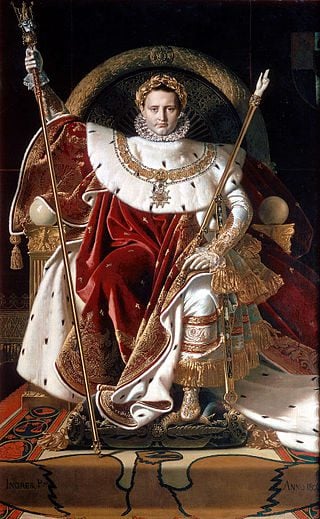
Napoleon on His Imperial Throne” (1806), just a few years after his invasion of Egypt
Jean Auguste Dominique Ingres
(Wikimedia Commons public domain image)
For convenience’s sake, Marshall Hodgson chose 1800 as the beginning of what he termed the “Modern Period” of Islamic history. But the event that he had in mind as marking the dawn of the Modern Period in the Middle East actually occurred in 1798. I quote from Paul Strathern’s fascinating Napoleon in Egypt:
The invasion of Egypt by Napoleon in the summer of 1798 was the first great seaborne invasion of the modern era. At the time, it may well have been the largest ever launched in the Western world — at least on a par with Xerxes’ vast Persian fleet which attacked Athens at the Battle of Salamis in 480 B.C., and certainly double the size of the sixteenth-century Spanish Armada which attempted to invade Elizabethan England. Yet unlike these predecessors, Napoleon’s invasion involved a long sea voyage of almost 2,000 miles. His armada consisted of 335 ships, ranging from towering battleships and fast frigates to lowly transports, from those bearing a cargo of just forty tons to those carrying over 400 tons. Each of these ships carried full crews, and in all the fleet was loaded with 1,200 horses, 171 field guns and an official roll-call of 35,000 soldiers. In fact, the number of soldiers was almost certainly nearer 40,000; Napoleon exploited the opportunity provided by four separate main embarkation ports — Toulon and Marseilles in France, Genoa and Civitavecchia in Italy — to surreptitiously increase the quota allowed him by the five-man Directory which ruled revolutionary France at the time. (1) . . . Napoleon spent much of the voyage . . . drawing up his plans for the invasion; this was his opportunity to emulate his hero, Alexander the Great. As he had confided to his secretary Bourrienne, prior to departure: “Europe is a molehill. . . . Everything here is worn out. My glory is slipping from my grasp, tiny Europe has not enough to offer. We must set off for the Orient; that is where all the greatest glory is to be achieved.”[1]
This was an ambitious undertaking, both militarily and politically. But, for all his many faults — I’m not even remotely a fan — Napoleon had ambitions far beyond the political and the military:
His primary [ostensible] purpose was to liberate the Egyptians from the oppressive rule of the Mamelukes. But this was only the beginning. Along with his soldiers he had brought with him a team of 167 hand-picked “savants”; these consisted of the young intellectual cream of France, comprising many of the country’s finest mathematicians, scientists, artists, writers and inventors. [2]
These were unexpected members of an armed expeditionary force, and the daily routine of the voyage was rather different than that of most conquering armadas:
Each morning Napoleon would decide upon a question for discussion that evening between himself, the senior savants and the generals traveling with him aboard L’Orient. Seated around a table, their faces dimly illuminated by lanterns, this collection of young ambitious soldiers and brilliant minds would discuss their leader’s chosen topics. These included “Is there life on other planets?,” “How will the world end?” and “How old is the earth?” (Ironically, the findings of the expedition would completely transform all previous knowledge of this latter subject.) . . . The debates would continue beneath the vast dome of the starlit heavens, as the ghostly looming canvases of the sails above them filled and slackened in the breeze. From the darkness all around came the shush of the passing waves and the creaking of the ship’s timbers as it shifted in the swell. . . . Occasionally Napoleon and his assembled staff and savants would listen to readings from various classic texts, which in turn would inspire their own topics for discussion. A reading from the Bible describing Joseph’s dream provoked a debate on whether dreams had meanings that could be interpreted. And after hearing a passage from Rousseau’s Discourse on the Origin of Inequality, there followed a debate lasting three nights on the social advantages and disadvantages of property.[3]
These “savants” would eventually create the enormously important multi-volume Description de l’Égypte — fully titled Description de l’Égypte, ou Recueil des observations et des recherches qui ont été faites en Égypte pendant l’expédition de l’armée française [“Description of Egypt, or the collection of observations and researches which were made in Egypt during the expedition of the French Army”]. The Description de l’Égypte is a series of publications that first began to appear in 1809 and continued until its final volume was issued in 1829. The goal of the project was to catalog all aspects of ancient and modern Egypt, including not only the country’s antiquities and its medieval monuments but its natural history. The volumes represent the collaborative effort of about 160 civilian scholars and scientists, along with that of roughly 2000 artists and technicians, including 400 engravers, and they mark the dawn of the serious modern study of Egyptian antiquities. Among other things, Napoleon’s expedition brought the famous tri-lingual Rosetta Stone to light, which, in turn, led to Jean-François Champollion’s decipherment of ancient Egyptian hieroglyphs. In certain respects, indeed, the results of the work of Napoleon’s savants retain considerable value still today.
And Napoleon was prepared to take any measures that he deemed necessary in order to fulfill his ambitions:
As the invasion fleet sailed east across the Mediterranean, Napoleon would lie in bed reading and dictating to Bourrienne. His principal reading was from the Koran. Like Alexander the Great before him, he intended to absorb the religion of the people over whom he would rule. He insisted that, if necessary, he himself was willing to become a Muslim — an intention that, at least initially, he would show every sign of wishing to fulfill. However, it should also be noted that in Napoleon’s shipboard library the Koran was shelved under “Politics.” At the same time, he also busied himself with dictating his “proclamation” to the Egyptian people:
In the name of Allah the merciful . . . People of Egypt, you will have been told that I come as an enemy of Islam. This is a lie . . . I have come to restore your rights and punish those who oppress you. . . . I worship God more than your oppressors; I respect Mohammed his prophet and the holy Koran. . . . The French are also true Moslems. The proof of this can be seen in the fact that they have marched against Rome and destroyed the throne of the Pope, who constantly incited the Christians to make war on all Moslems . . .
Prior to arrival, this proclamation would be translated into Arabic by one of the Orientalists amongst the savants and printed on the Arabic printing press which Napoleon was carrying on board L’Orient. (He had scoured Europe for an Arabic printing press; ironically, the only one he had managed to find was at the Papal Propaganda Office in Rome.) On arrival, he intended that his proclamation should be distributed amongst the Egyptians, and it was hoped that this would overcome the need for armed conflict. Such was to be the first step in the creation of his Oriental empire. As Napoleon later put it, when describing his feelings at this time: “I saw the way to achieve all my dreams. . . . I would found a religion, I saw myself marching on the way to Asia, mounted on an elephant, a turban on my head, and in my hand a new Koran that I would have composed to suit my needs. In my enterprises I would have combined the experiences of the two worlds, exploiting the realm of all history for my own profit.” [4]
[1] Paul Strathern, Napoleon in Egypt (New York: Bantam Books, 2008), 1, 3.
[2] Strathern, Napoleon in Egypt, 3.
[3] Strathern, Napoleon in Egypt, 4-5.
[4] Strathern, Napoleon in Egypt, 5-6.
Previous Post

October 11, 2020
"How to be a Good Apologist"
Next Post
October 12, 2020 "The Visions of Moses and Joseph Smith’s Bible Translation"
Browse Our Archives
Select a Category Uncategorized
Select a Month October 2026 September 2026 August 2026 July 2026 June 2026 May 2026 April 2026 March 2026 February 2026 January 2026 December 2025 November 2025 October 2025 September 2025 August 2025 July 2025 June 2025 May 2025 April 2025 March 2025 February 2025 January 2025 December 2024 November 2024 October 2024 September 2024 August 2024 July 2024 June 2024 May 2024 April 2024 March 2024 February 2024 January 2024 December 2023 November 2023 October 2023 September 2023 August 2023 July 2023 June 2023 May 2023 April 2023 March 2023 February 2023 January 2023 December 2022 November 2022 October 2022 September 2022 August 2022 July 2022 June 2022 May 2022 April 2022 March 2022 February 2022 January 2022 December 2021 November 2021 October 2021 September 2021 August 2021 July 2021 June 2021 May 2021 April 2021 March 2021 February 2021 January 2021 December 2020 November 2020 October 2020 September 2020 August 2020 July 2020 June 2020 May 2020 April 2020 March 2020 February 2020 January 2020 December 2019 November 2019 October 2019 September 2019 August 2019 July 2019 June 2019 May 2019 April 2019 March 2019 February 2019 January 2019 December 2018 November 2018 October 2018 September 2018 August 2018 July 2018 June 2018 May 2018 April 2018 March 2018 February 2018 January 2018 December 2017 November 2017 October 2017 September 2017 August 2017 July 2017 June 2017 May 2017 April 2017 March 2017 February 2017 January 2017 December 2016 November 2016 October 2016 September 2016 August 2016 July 2016 June 2016 May 2016 April 2016 March 2016 February 2016 January 2016 December 2015 November 2015 October 2015 September 2015 August 2015 July 2015 June 2015 May 2015 April 2015 March 2015 February 2015 January 2015 December 2014 November 2014 March 2014 August 2013 February 2012
Follow Us!
TAKE THE
Religious Wisdom Quiz
What is the main Christian church in Greece?
Select your answer to see how you score.
Greek Orthodox Catholic Lutheran Pentecostal
Related posts from Sic et Non

Islam in America or Islam versus America?

A basic working chronology of Islamic-era Iran

Actual Data and Actual Crusades

TRENDING AT PATHEOS Latter-day Saint

How to Make a Decision When You Can't...
Main point: It’s much more valuable to stay close to God so...

Archdiocese Hosts Military Marriage Retreat in Germany
RASTATT, Germany — The transient military lifestyle, with its frequent deployments and...

Nearly every morning, I make the drive to Detroit with my high-school-age...

The Real AI Story Is Adoption Without Trust
Artificial intelligence has crossed a political threshold. It is no longer a...

A new article, written by Jeff Lindsay and Gale L. Pooley,...

Swimfan: Forgotten Aughts Pleasures
This is a recovery effort. In 2002, My Big Fat Greek Wedding...
view all Latter-day Saint blogs
Ad-Free & Subscriber Log-In Subscription Support
- About Us
- 2026 Calendar
- Videos
- Podcasts
- Library of World Religions
- Faith In Media Tracker
- Advertise With Us
- Write for Us
- Privacy Policy
- Terms of Service
- Do Not Sell My Data
- Contact Us
- Radiant Digital
- Manage Newsletter Subscriptions
- Unsubscribe From Notifications
- Sitemap
Copyright 2008-2026, Patheos. All rights reserved.
Subscription Support Ad-Free & Subscriber Log-In
Follow Patheos