
BuddhistCatholicContemplativeEvangelicalGeneral ChristianHinduJewishLatter-day SaintMuslimNew VisionsProgressive Christian
Beliefs
- Buddhist
- Catholic
- Contemplative
- Evangelical
- General Christian
- Hindu
- Jewish
- Latter-day Saint
- More Voices
- Muslim
- New Visions
- Pagan
- Progressive Christian
Topics
- Religion News
- Food and Religion
- Sports and Religion
- Religious Art
- Religious Music and Entertainment
- Religious Events
- History and Religion
- Style and Religion
- Politics and Religion
- Women in Religion
- Recreation Outdoors and Religion
- Business Finance and Religion
- Careers Workplace and Religion
- Education and Religion
- Family Parenting and Religion
- Health Fitness and Religion
- Home and Religion
- Relationships and Religion
- Technology and Religion
- Travel and Religion
Columnists
- Buddhist Columnists
- Business Finance and Religion Columnists
- Careers Workplace and Religion Columnists
- Catholic Columnists
- Contemplative Columnists
- Education and Religion Columnists
- Evangelists Columnists
- Family Parenting and Religion Columnists
- General Christian Columnists
- Health Fitness and Religion Columnists
- Hindu Columnists
- History and Religion Columnists
- Home and Religion Columnists
- Jewish Columnists
- More Voices Columnists
- Latter Day Columnists
- Muslim Columnists
- New Visions Columnists
- Nonreligious Columnists
- Pagan Columnists
- Politics and Religion Columnists
- Progressive Columnists
- Recreation Outdoors and Religion Columnists
- Relationships and Religion Columnists
- Religion News Columnists
- Religious Art Columnists
- Religious Events Columnists
- Religious Music and Entertainment Columnists
- Sports and Religion Columnists
- Style and Religion Columnists
- Technology and Religion Columnists
- Travel and Religion Columnists
- Women in Religion Columnists
Resource Library
- 2026 Calendar
- Library of World Religions
- The 100 Most Holy Places on Earth
- Patheos Answers
- Podcasts
- Videos
- Faith Leaders Database
- Anglican Episcopalian
- Bahai
- Baptist
- Buddhism
- Christianity
- Confucianism
- Eastern Orthodoxy
- Hinduism
- Holiness and Pentecostal
- ISKCON
- Islam
- Judaism
- Lutheran
- Methodist
- The Church of Jesus Christ of Latter-day Saints
- New Age
- Paganism
- Presbytarian and Reformed
- Protestantism
- Religion Behind the Scenes
- Roman Catholic
- Scientology
- Shia Islam
- Sikhism
- Sufism
- Sunni Islam
- Taoism
- Zen
- See all religions
Research Tools
 Ad-Free & Subscriber Log-In Subscription Support
Ad-Free & Subscriber Log-In Subscription Support
Follow Patheos 

- Trending:
- Forgiveness
- |
- Marriage
- |
- Consciousness
- |
- Death Penalty
- |
- Election
- |
- Halloween

- Home
- Latter-day Saint
- Revision 6.7 “Gunpowder Empires” (B)
Revision 6.7 “Gunpowder Empires” (B)
Last updated on: October 11, 2020 at 2:18 pm by Dan Peterson
Revision 6.7 “Gunpowder Empires” (B) 2020-10-11T14:18:00-06:00 Dan Peterson
Patheos Explore the world's faith through different perspectives on religion and spirituality! Patheos has the views of the prevalent religions and spiritualities of the world.
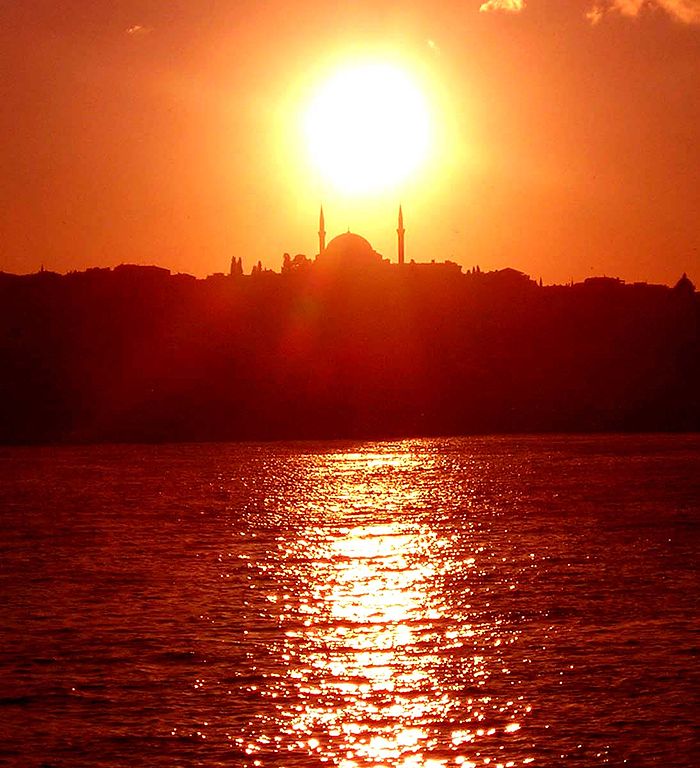
Sunset over Istanbul’s Golden Horn, in Turkey. (Wikimedia Commons public domain photograph)
The Ottomans had yet another military asset that served them well. That was the so-called Janissary Corps. (The name is from the Turkish yeni cheri, meaning “new troops.”) These were soldiers very much on the old mamluk model, but instead of being conscripted from central Asia, the janissaries were taken from the Christian villages of Anatolia and the Balkans. They converted to Islam and, like the mamluks, were personally loyal to the sultan himself, who was their owner. As in the case of the mamluks, their children were not allowed to become janissaries — in the beginning, anyway — being considered too soft. Interestingly, although no doubt some of the Christian villagers were horrified when they saw the sultan’s recruiters approaching, the evidence suggests that many effectively pushed their able-bodied young sons forward, hoping that they would be chosen, knowing that this was a path to advancement that would never be duplicated in the farmyard routine of the home village. The janissaries enjoyed exalted status in the empire. They earned enormous rewards and were the elite Ottoman military corps, rather like today’s Rangers, Seals, or Green Berets. They were one of the major reasons for the success of the Ottoman expansion.
The high point of the empire’s history is probably to be identified with Suleiman I—whose reign, from 1520 to 1566, overlapped that of England’s Henry VIII and the first part of the reign of Queen Elizabeth I. He is appropriately known as Suleiman the Magnificent. Suleiman conquered Hungary, northern Africa, and the Red Sea coast all the way down to Yemen. This left him in possession of the holy cities of Mecca and Medina, giving him immense prestige throughout the Islamic world as the protector of the most sacred shrines of his faith.
Prestige, of course, does not pay the bills or put food on the table. The economy of the Ottoman Empire was largely agrarian. Most Ottoman subjects were farmers. While most Westerners picture the Near East as one large desert, it is actually not. (Many parts of it are high and semiarid, but not desert. They are much like Utah, in fact, which also enjoys an undeserved reputation as nothing but desert.) The fertile areas of Egypt, Syria, and the region around the Black Sea produced large quantities of grain. Trade was also important, of course, and the Ottoman Empire fully exploited its location linking Asia and Europe. (Perhaps bicontinental Istanbul is not such a bad symbol, after all.) Chinese porcelains and European woolens, Persian silks, and spices from Asia were to be found in the covered bazaars of the empire, traveling back and forth across it. But the Ottomans were not only consumers and traders of other people’s crafts and arts, they were makers of their own. They were especially well known for their monumental architecture (which, unfortunately, could neither be transported nor traded), as well as for their carpet weaving (Ottoman rugs) and their beautiful tiles.
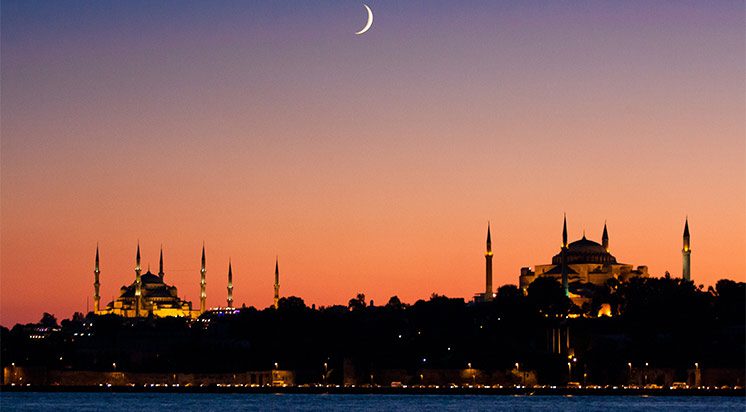
Another view of the oldest part of Istanbul. The magnificent Hagia Sophia is on the right. To the left is the Sultanahmet or Blue Mosque. (Wikimedia Commons public domain photograph)
This vast and industrious empire was presided over by an all- powerful sultan. (Appropriately enough, the title sultan comes from an Arabic word meaning “power.”) Fortunately for the Ottomans, they enjoyed ten successive sultans of astonishingly high competence (to name a few: Selim the Grim, Mehmet the Conqueror, and Suleiman the Magnificent). Each sultan had numerous wives and concubines and, therefore, numerous sons. Following his death, the sultan would be succeeded by his eldest son, the eldest son of a favorite wife, or simply by a favorite son previously designated. As can easily be imagined, this kind of situation led to constant and often brutal scheming. And those conspiracies were made worse by another Ottoman custom. The successful candidate for the sultanate often killed his rivals or, if feeling especially kind, confined them to the harim, the women’s quarters of the palace.[1] This raised the stakes considerably. To lose in the rivalry for the sultanate was to suffer lifetime house arrest or risk death. The Ottomans gave us the phrase “harem intrigue.”
Eventually, the reigning sultan sat so insecurely on his throne that even likely heirs to it were locked up in the harim. No longer could they be trusted with governorships or important military commands. There was the immediate danger that they would use those positions of power to hasten the retirement of the ruler and take his position. So, instead of coming to the throne after years of activity and learning in the far-flung regions of the empire, a new sultan would arise out of the women’s quarters of the palace. More likely than not, he was unacquainted with affairs of state, having been kept purposely out of touch with the real world. He was unqualified for rule and, not infrequently, demented.
The Ottoman Empire gradually but steadily declined over its last 300 years. Eventually, lingering well past the time when most people would have expected it to collapse, it became known as “the sick man of Europe.” (A sign of that decline, perhaps, came when the janissaries demanded and received permission for their sons to inherit their rank, thus greatly weakening the janissary corps.). Perhaps it was continuing on the sheer momentum given to it by its competent early leaders. Nevertheless, corruption, bloated bureaucracy, inflation, and a string of weak sultans who were just as incompetent as their predecessors had been competent took their toll. As at the time of the Abbasid Empire’s decline, more states began to gain independence, and there was nothing much that the sultan could do about it.
In 1571, the combined naval forces of Venice, Spain, and the Italian papal states nearly destroyed the Ottoman navy at the Battle of Lepanto. But, like an unexpectedly resilient boxer who is knocked down but manages to get back up, it rebounded. Indeed, the empire continued to pose a military threat to Europe for many more years. In 1683, desperate Austrian and Polish troops turned back an Ottoman siege of Vienna. This marked the end of Ottoman expansion.
However, the Ottomans left their mark on the Near East in general and on the Arab world in particular. Ottoman mosques, for example, with their distinctively tall, pencil-shaped minarets, dot the horizon of the region (though, unfortunately, many of these were deliberately destroyed during the recent troubles in the Balkans). But the most profound Ottoman impact was probably upon the government and social organization of the Near East. The various religious groups of the empire had been organized and represented under the “millet system” (from the Arabic word milla, meaning “religious community” or “denomination”). Under this system, each religious group, including Muslims, was represented before the government by its leader. People tended, naturally, to identify themselves as much by their religious affiliation—Druze, Shiite, Sunni, Maronite Christian, Jewish—as by their place of residence. This tendency helped to retard the growth of nationalism in the region. A man was not Lebanese, but Shiite. A woman in Baghdad might well view herself as a Sunni Muslim rather than Iraqi. Thus, nationalism came relatively late to the Near East, and many of the countries in the region today can be considered nations only by courtesy. They grew out of British and French map exercises rather than from the consciousness of the people. In Iraq, in Lebanon, and in the former Yugoslavia, we are now reaping what those shortsighted diplomats unwittingly sowed.
[1] This Arabic word, pronounced ha-REEM, is, as noted earlier, connected with the idea of forbiddenness and is often spelled harem in English.
Posted from Bountiful, Utah
Previous Post

October 10, 2020
"It was . . . intensely interesting"
Next Post
October 11, 2020 "You cannot help but think of a Creator."
Browse Our Archives
Select a Category Uncategorized
Select a Month October 2026 September 2026 August 2026 July 2026 June 2026 May 2026 April 2026 March 2026 February 2026 January 2026 December 2025 November 2025 October 2025 September 2025 August 2025 July 2025 June 2025 May 2025 April 2025 March 2025 February 2025 January 2025 December 2024 November 2024 October 2024 September 2024 August 2024 July 2024 June 2024 May 2024 April 2024 March 2024 February 2024 January 2024 December 2023 November 2023 October 2023 September 2023 August 2023 July 2023 June 2023 May 2023 April 2023 March 2023 February 2023 January 2023 December 2022 November 2022 October 2022 September 2022 August 2022 July 2022 June 2022 May 2022 April 2022 March 2022 February 2022 January 2022 December 2021 November 2021 October 2021 September 2021 August 2021 July 2021 June 2021 May 2021 April 2021 March 2021 February 2021 January 2021 December 2020 November 2020 October 2020 September 2020 August 2020 July 2020 June 2020 May 2020 April 2020 March 2020 February 2020 January 2020 December 2019 November 2019 October 2019 September 2019 August 2019 July 2019 June 2019 May 2019 April 2019 March 2019 February 2019 January 2019 December 2018 November 2018 October 2018 September 2018 August 2018 July 2018 June 2018 May 2018 April 2018 March 2018 February 2018 January 2018 December 2017 November 2017 October 2017 September 2017 August 2017 July 2017 June 2017 May 2017 April 2017 March 2017 February 2017 January 2017 December 2016 November 2016 October 2016 September 2016 August 2016 July 2016 June 2016 May 2016 April 2016 March 2016 February 2016 January 2016 December 2015 November 2015 October 2015 September 2015 August 2015 July 2015 June 2015 May 2015 April 2015 March 2015 February 2015 January 2015 December 2014 November 2014 March 2014 August 2013 February 2012
Follow Us!
TAKE THE
Religious Wisdom Quiz
True or False: Mark is the only Gospel that records Jesus asking 'Who touched my clothes?' after power went out from him.
Select your answer to see how you score.
FALSE TRUE
Related posts from Sic et Non

Islam in America or Islam versus America?

A basic working chronology of Islamic-era Iran

Actual Data and Actual Crusades

TRENDING AT PATHEOS Latter-day Saint

Janie Learns the Way of the Cross: A...
Teaching children about Jesus' Passion can be challenging. Many parents and educators...

Looking For Good Catholic Writing - October 2026
He alone extends the heavens, and he walks upon the waves of...

In "Irreplaceable," our book on vocation and technology, Trevor Sutton and I...

I was strolling through the top floor of the brand new Parthenon...

What Does Gêvâh Mean For Kimberley Guifoyle &...
This week, a lot of the news is focused on Kimberly Guilfoyle....

INNER CIRCLE: Profound Mystery (Of Christ In All...
Ephesians 5:31-32 “For this reason, a man will leave his father and...
view all Latter-day Saint blogs
Ad-Free & Subscriber Log-In Subscription Support
- About Us
- 2026 Calendar
- Videos
- Podcasts
- Library of World Religions
- Faith In Media Tracker
- Advertise With Us
- Write for Us
- Privacy Policy
- Terms of Service
- Do Not Sell My Data
- Contact Us
- Radiant Digital
- Manage Newsletter Subscriptions
- Unsubscribe From Notifications
- Sitemap
Copyright 2008-2026, Patheos. All rights reserved.
Subscription Support Ad-Free & Subscriber Log-In
Follow Patheos