
BuddhistCatholicContemplativeEvangelicalGeneral ChristianHinduJewishLatter-day SaintMuslimNew VisionsProgressive Christian
Beliefs
- Buddhist
- Catholic
- Contemplative
- Evangelical
- General Christian
- Hindu
- Jewish
- Latter-day Saint
- More Voices
- Muslim
- New Visions
- Pagan
- Progressive Christian
Topics
- Religion News
- Food and Religion
- Sports and Religion
- Religious Art
- Religious Music and Entertainment
- Religious Events
- History and Religion
- Style and Religion
- Politics and Religion
- Women in Religion
- Recreation Outdoors and Religion
- Business Finance and Religion
- Careers Workplace and Religion
- Education and Religion
- Family Parenting and Religion
- Health Fitness and Religion
- Home and Religion
- Relationships and Religion
- Technology and Religion
- Travel and Religion
Columnists
- Buddhist Columnists
- Business Finance and Religion Columnists
- Careers Workplace and Religion Columnists
- Catholic Columnists
- Contemplative Columnists
- Education and Religion Columnists
- Evangelists Columnists
- Family Parenting and Religion Columnists
- General Christian Columnists
- Health Fitness and Religion Columnists
- Hindu Columnists
- History and Religion Columnists
- Home and Religion Columnists
- Jewish Columnists
- More Voices Columnists
- Latter Day Columnists
- Muslim Columnists
- New Visions Columnists
- Nonreligious Columnists
- Pagan Columnists
- Politics and Religion Columnists
- Progressive Columnists
- Recreation Outdoors and Religion Columnists
- Relationships and Religion Columnists
- Religion News Columnists
- Religious Art Columnists
- Religious Events Columnists
- Religious Music and Entertainment Columnists
- Sports and Religion Columnists
- Style and Religion Columnists
- Technology and Religion Columnists
- Travel and Religion Columnists
- Women in Religion Columnists
Resource Library
- 2026 Calendar
- Library of World Religions
- The 100 Most Holy Places on Earth
- Patheos Answers
- Podcasts
- Videos
- Faith Leaders Database
- Anglican Episcopalian
- Bahai
- Baptist
- Buddhism
- Christianity
- Confucianism
- Eastern Orthodoxy
- Hinduism
- Holiness and Pentecostal
- ISKCON
- Islam
- Judaism
- Lutheran
- Methodist
- The Church of Jesus Christ of Latter-day Saints
- New Age
- Paganism
- Presbytarian and Reformed
- Protestantism
- Religion Behind the Scenes
- Roman Catholic
- Scientology
- Shia Islam
- Sikhism
- Sufism
- Sunni Islam
- Taoism
- Zen
- See all religions
Research Tools
 Ad-Free & Subscriber Log-In Subscription Support
Ad-Free & Subscriber Log-In Subscription Support
Follow Patheos 

- Trending:
- Forgiveness
- |
- Marriage
- |
- Consciousness
- |
- Death Penalty
- |
- Election
- |
- Halloween

- Home
- Latter-day Saint
- Revision 6.6 “Gunpowder Empires” (A)
Revision 6.6 “Gunpowder Empires” (A)
Last updated on: October 11, 2020 at 2:19 pm by Dan Peterson
Revision 6.6 “Gunpowder Empires” (A) 2020-10-11T14:19:19-06:00 Dan Peterson
Patheos Explore the world's faith through different perspectives on religion and spirituality! Patheos has the views of the prevalent religions and spiritualities of the world.
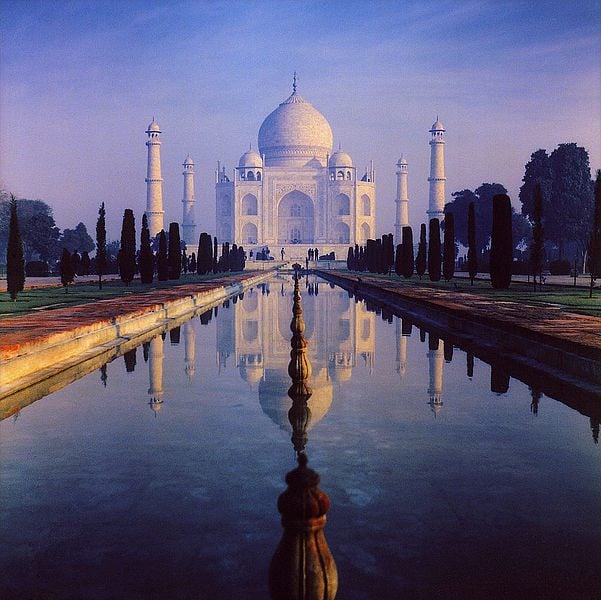
The Taj Mahal, near Agra, Uttar Pradesh, India, is the one thing Mughal that most Americans will recognize, even if they don’t know the term “Mughal.” (Wikimedia Commons public domain image)
The Period of the Gunpowder Empires (1500-1800)
As might be guessed from Hodgson’s title for this period, the important fact about the time was gunpowder. This new technology, borrowed from the West (but, ultimately, from China), allowed the existence of greater states and thus permitted greater centralization of power. Putting it less abstractly, the states that adopted the new military technology gobbled up the states that did not. What marks the period, then, is a partial recovery from the political fragmentation that was the special characteristic of the Middle Periods. But if that seems like a healthy development for the Muslims, it should be remembered that the period also saw the beginning of the spectacular rise of the West and its expansion in every direction. Muslim rulers were not aware of it yet, but their states were headed for turmoil.
Three notable Islamic empires flourished during the “Gunpowder Period.” These were the Mogul or Mughal Empire in India, the Safavid Empire in Persia, and the Ottoman Empire in the remainder of the Islamic world. I shall have something to say about each one of these.
As their name indicates, the Mughal or Mogul dynasty derived from Mongol stock, converted to the religion of Islam. They ruled most of India and Afghanistan during the 1500s and 1600s. The most glorious of their sultans was the great city-builder and patron of the arts Akbar the Great, who reigned from 1556 to 1605 and was thus a contemporary of Queen Elizabeth of England. But the best known fact about the Mughals in the West is unquestionably the building of the beautiful Taj Mahal, one of the world’s finest pieces of architecture, during the reign of Shah Jahan (1627-1658).
[Add some detail here on the Taj Mahal]
Early in the 1700s, the empire began to break up. Nevertheless, the Mughals continued to rule a small kingdom centered in the city of Delhi until the British conquest of India in the nineteenth century. It is worth stopping for a moment to consider the remarkable fact that the British were able to complete so stunning an achievement, to reflect that we are tempted simply to say “the British conquest of India” without being properly astonished at the improbability of it. Yet it is amazing to realize that the small island nation of Great Britain — controlled by the even smaller place called England — was able to conquer the entire Indian subcontinent, thousands of miles away, and to hold it for a long period of time. That they were able to do so is yet another example of the fact that disunity invites conquest. If the Indians had been united and the Mughal Empire intact, the British could never have dreamed of controlling that vast nation.
The Safavis, a Turkish tribe, gained control over areas of Iran in the late 1400s and early 1500s. But the official beginning of the Safavid Empire must be placed in the year 1501, when the tribe’s leader, Ismail Safavi, was crowned shah, or king. It is the Safavids who made Iran a Shiite nation and linked Shiism with the Persians in a firm bond that has never been challenged in the intervening centuries. In the nineteenth century, it was sometimes suggested that Persian Shiism reflected something innate in the Persian soul, a natural Indo-European reaction against Semitic Islam, as embodied in Sunnism. (Such belief in what might be called “racial essentialism” or even “race as destiny” was not unconnected with what eventually turned into the Nazi vision of Aryan or Indo-European supremacy — and its nightmarish genocidal extermination camps.)
The greatest ruler of the Safavid dynasty was Shah Abbas, who reigned between 1587 and 1629 and was thus himself a younger contemporary of Elizabeth I. He and his successors strongly supported architecture and the other arts, and—something that is considerably more rare—showed remarkably good taste in doing so. The blue and gold mosques of Iran, the Persian miniature paintings that were used to illustrate books of the period, and the magnificent carpets produced by the country’s craftsmen all testify to the remarkable legacy of civilization given to the world by Iran. In 1598, Shah Abbas made the city of Isfahan his capital and devoted himself to planning parks and mosques and large public squares. It rapidly became known as one of the world’s most beautiful cities. But beauty does not abide forever. In 1722, little more than a century after Shah Abbas, fierce Afghan armies invaded Iran and conquered the city, putting an end to the Safavid dynasty.
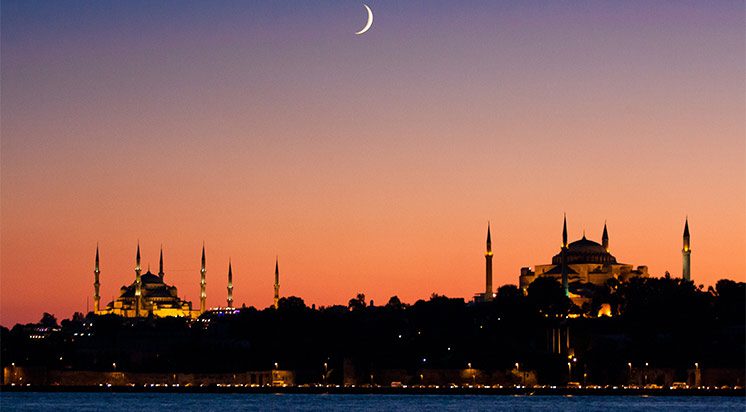
A view of the oldest part of Istanbul, formerly known as Constantinople (Wikimedia CC public domain image)
The most enduring Gunpowder Period state, however, was the Ottoman Empire. It began somewhere around the year 1300, and at least limped on until 1922. In the 1500s and 1600s, it was far and away the most powerful empire in the world; at its height it held not only Anatolia (modern Turkey) but also southwest Asia (Syria, Palestine, part of Iraq, the Arabian Peninsula), southeast Europe (including Greece and the Balkans), Egypt, and much of North Africa. The walls of the present-day Old City of Jerusalem–often mistaken by tourists for the long-gone walls of the biblical period–were actually built by its Turkish imperial masters.
The Ottomans were originally nomadic Turkic tribes from Central Asia who had been enlisted, as many Turks had been, to help fight the “infidel” Byzantines. They converted to Sunni Islam, as Turks generally did, and indeed became truly fearsome border warriors. But they soon realized that they could also fight on their own behalf. So why not carve out their own state? Their founder and first sultan was a man named Osman.[1] He inaugurated a series of successful rulers that, for sheer consistency of ability, has little parallel anywhere in world history. One of the first notable achievements of the Ottomans was the conquest of the city of Bursa in Anatolia (Asia Minor, or contemporary Turkey) in the year 1326. Bursa would serve as their capital until the conquest of Constantinople in the fifteenth century, and they adorned it with notable and distinctive buildings. But Ottoman expansion came at the expense of the Byzantines in Anatolia. This is not surprising, of course. It was their duty and their reason for having been brought to the region in the first place. Their efforts culminated in the seizure of Constantinople in 1453 and the collapse of the Byzantine Empire. From this point on, there was no Byzantine Empire left to fight, so the holy warriors of the Ottoman Empire turned their cannons and their muskets to the East, against their fellow Muslims.
But before we speak of the significant Ottoman impact on the Arab world, another of their opponents merits brief mention if only because he is famous in the West. It is a peculiar fame. Very few Westerners have any idea who this person really was, and many would not even recognize his title. He seems almost to have been a particular obsession of Mehmet II, the Conqueror, the man who had succeeded in taking Constantinople after centuries of Muslim daydreaming and failed attempts. Mehmet was never able to put an end to this man, who tormented him for years and finally died peacefully in bed. The man’s name was Vlad Tepish. He lived in a region known as Transylvania, or modern Romania. Vlad was also known as Vlad Dracul, “Vlad the Impaler,” because he had the endearing habit of impaling captured enemies on stakes. The legend of “Dracula”—or that portion of it that was not invented in Hollywood (and a large part of the vampire legend was, in fact, devised by Hollywood screenwriters)—seems to be derived from this cruel man.
For a long time after 1453, most Ottoman opponents were Muslim. (Certainly there were more Muslims than vampires.) In 1516, Syria fell to a successor of Mehmet II, a sultan known somewhat menacingly as Selim the Grim. The next year, 1517, saw the conquest of Egypt and the end of the Mamluks. One is almost inclined to pity them. They were, in a sense, prisoners of their own virtues. Their horseback heroism, so effective against the thirteenth-century Mongols, was pathetically (although perhaps nobly) out of date. When they defended Cairo against Selim’s armies, they took no cannons. They disdained artillery and firearms as beneath the dignity of a knight. And they were cut to shreds, as was anybody else who, for whatever reasons, failed to keep up with the times. Dignity and chivalry, as the armored knights of Europe also discovered, could not stand up to a peasant with a gun.
[1] This is the Turkish form of the Arabic name Uthman—the same as that of the third of the “rightly-guided caliphs” who succeeded the Prophet Muhammad—and it is from a distortion of his name that we derive the name of the empire itself, Ottoman.
Posted from Park City, Utah
Previous Post

October 10, 2020
"Dr. Ross, I could dance again."
Next Post
October 10, 2020 "You are never, ever alone."
Browse Our Archives
Select a Category Uncategorized
Select a Month October 2026 September 2026 August 2026 July 2026 June 2026 May 2026 April 2026 March 2026 February 2026 January 2026 December 2025 November 2025 October 2025 September 2025 August 2025 July 2025 June 2025 May 2025 April 2025 March 2025 February 2025 January 2025 December 2024 November 2024 October 2024 September 2024 August 2024 July 2024 June 2024 May 2024 April 2024 March 2024 February 2024 January 2024 December 2023 November 2023 October 2023 September 2023 August 2023 July 2023 June 2023 May 2023 April 2023 March 2023 February 2023 January 2023 December 2022 November 2022 October 2022 September 2022 August 2022 July 2022 June 2022 May 2022 April 2022 March 2022 February 2022 January 2022 December 2021 November 2021 October 2021 September 2021 August 2021 July 2021 June 2021 May 2021 April 2021 March 2021 February 2021 January 2021 December 2020 November 2020 October 2020 September 2020 August 2020 July 2020 June 2020 May 2020 April 2020 March 2020 February 2020 January 2020 December 2019 November 2019 October 2019 September 2019 August 2019 July 2019 June 2019 May 2019 April 2019 March 2019 February 2019 January 2019 December 2018 November 2018 October 2018 September 2018 August 2018 July 2018 June 2018 May 2018 April 2018 March 2018 February 2018 January 2018 December 2017 November 2017 October 2017 September 2017 August 2017 July 2017 June 2017 May 2017 April 2017 March 2017 February 2017 January 2017 December 2016 November 2016 October 2016 September 2016 August 2016 July 2016 June 2016 May 2016 April 2016 March 2016 February 2016 January 2016 December 2015 November 2015 October 2015 September 2015 August 2015 July 2015 June 2015 May 2015 April 2015 March 2015 February 2015 January 2015 December 2014 November 2014 March 2014 August 2013 February 2012
Follow Us!
TAKE THE
Religious Wisdom Quiz
Three friends came to comfort but ended up accusing. A fourth spoke with more wisdom. What were their names in order of arrival?
Select your answer to see how you score.
Zophar, Elihu, Eliphaz, and Bildad Elihu, Zophar, Bildad, and Eliphaz Bildad, Eliphaz, Elihu, and Zophar Eliphaz, Bildad, Zophar, and Elihu
Related posts from Sic et Non

Islam in America or Islam versus America?

A basic working chronology of Islamic-era Iran

Actual Data and Actual Crusades

TRENDING AT PATHEOS Latter-day Saint

Letters on Living the Faith by C.S. Lewis
Most of us met C.S. Lewis as a public intellectual. Mere Christianity....

When Halloween Unmasks Married Hearts
Written by Dr. David K. Ewen from Eternal Truth Bible College Behind...

Aristotle. He’s been called the father of logic, the father of the...

Methodist Central Hall and Westminster Abbey
Situated on the same square is Methodist Central Hall and Westminster Abbey. ...

57th Dove Awards Honor Dolly Parton, Crown New...
On gospel music’s biggest night, the 57th annual GMA Dove Awards honored...

The First Eucharistic Controversy: Christ’s Real Presence
For Catholics, the Eucharist is the source and summit of the Christian...
view all Latter-day Saint blogs
Ad-Free & Subscriber Log-In Subscription Support
- About Us
- 2026 Calendar
- Videos
- Podcasts
- Library of World Religions
- Faith In Media Tracker
- Advertise With Us
- Write for Us
- Privacy Policy
- Terms of Service
- Do Not Sell My Data
- Contact Us
- Radiant Digital
- Manage Newsletter Subscriptions
- Unsubscribe From Notifications
- Sitemap
Copyright 2008-2026, Patheos. All rights reserved.
Subscription Support Ad-Free & Subscriber Log-In
Follow Patheos