
BuddhistCatholicContemplativeEvangelicalGeneral ChristianHinduJewishLatter-day SaintMuslimNew VisionsProgressive Christian
Beliefs
- Buddhist
- Catholic
- Contemplative
- Evangelical
- General Christian
- Hindu
- Jewish
- Latter-day Saint
- More Voices
- Muslim
- New Visions
- Pagan
- Progressive Christian
Topics
- Religion News
- Food and Religion
- Sports and Religion
- Religious Art
- Religious Music and Entertainment
- Religious Events
- History and Religion
- Style and Religion
- Politics and Religion
- Women in Religion
- Recreation Outdoors and Religion
- Business Finance and Religion
- Careers Workplace and Religion
- Education and Religion
- Family Parenting and Religion
- Health Fitness and Religion
- Home and Religion
- Relationships and Religion
- Technology and Religion
- Travel and Religion
Columnists
- Buddhist Columnists
- Business Finance and Religion Columnists
- Careers Workplace and Religion Columnists
- Catholic Columnists
- Contemplative Columnists
- Education and Religion Columnists
- Evangelists Columnists
- Family Parenting and Religion Columnists
- General Christian Columnists
- Health Fitness and Religion Columnists
- Hindu Columnists
- History and Religion Columnists
- Home and Religion Columnists
- Jewish Columnists
- More Voices Columnists
- Latter Day Columnists
- Muslim Columnists
- New Visions Columnists
- Nonreligious Columnists
- Pagan Columnists
- Politics and Religion Columnists
- Progressive Columnists
- Recreation Outdoors and Religion Columnists
- Relationships and Religion Columnists
- Religion News Columnists
- Religious Art Columnists
- Religious Events Columnists
- Religious Music and Entertainment Columnists
- Sports and Religion Columnists
- Style and Religion Columnists
- Technology and Religion Columnists
- Travel and Religion Columnists
- Women in Religion Columnists
Resource Library
- 2026 Calendar
- Library of World Religions
- The 100 Most Holy Places on Earth
- Patheos Answers
- Podcasts
- Videos
- Faith Leaders Database
- Anglican Episcopalian
- Bahai
- Baptist
- Buddhism
- Christianity
- Confucianism
- Eastern Orthodoxy
- Hinduism
- Holiness and Pentecostal
- ISKCON
- Islam
- Judaism
- Lutheran
- Methodist
- The Church of Jesus Christ of Latter-day Saints
- New Age
- Paganism
- Presbytarian and Reformed
- Protestantism
- Religion Behind the Scenes
- Roman Catholic
- Scientology
- Shia Islam
- Sikhism
- Sufism
- Sunni Islam
- Taoism
- Zen
- See all religions
Research Tools
 Ad-Free & Subscriber Log-In Subscription Support
Ad-Free & Subscriber Log-In Subscription Support
Follow Patheos 

- Trending:
- Forgiveness
- |
- Marriage
- |
- Consciousness
- |
- Death Penalty
- |
- Election
- |
- Halloween

- Home
- Latter-day Saint
- Revision 6.16 “The Rise of Zionism” (B)
Revision 6.16 “The Rise of Zionism” (B)
Last updated on: October 21, 2020 at 9:23 pm by Dan Peterson
Revision 6.16 “The Rise of Zionism” (B) 2020-10-21T21:23:31-06:00 Dan Peterson
Patheos Explore the world's faith through different perspectives on religion and spirituality! Patheos has the views of the prevalent religions and spiritualities of the world.
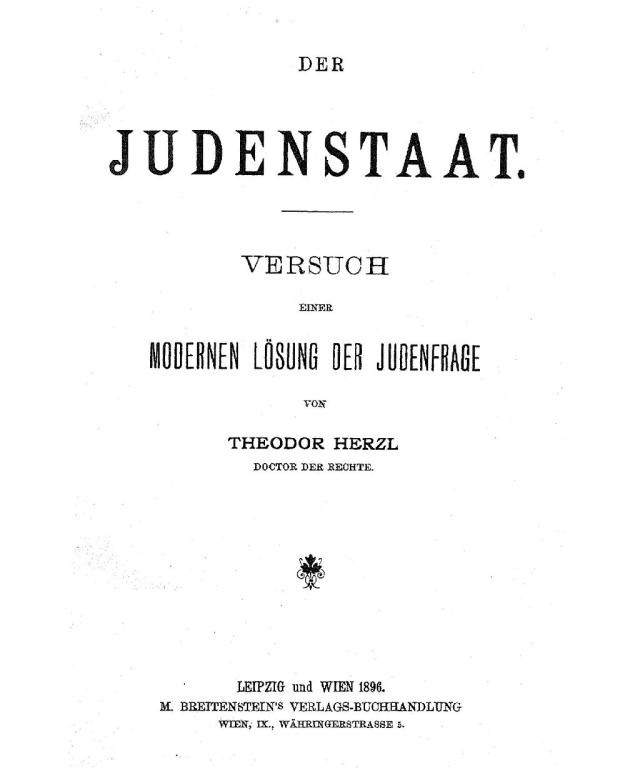
“The Jewish State: An Essay toward a Modern Resolution of the Jewish Question”
This book, in many ways, marks the beginning of the Zionist movement. (Wikimedia Commons public domain image)
In 1882, young Jews calling themselves “Lovers of Zion” began actively to promote immigration to Palestine among their people. This was the beginning of what came to be known as “practical Zionism,” which advocated building Jewish settlements in Palestine. (It was “practical” in the sense that it pushed for real action to implement the dream Jews had been dreaming for nearly two millennia.) Jews returning to Palestine in the late 1800s and early 1900s began the heavy work of draining swamps, digging wells, replanting forests, and reclaiming arid land for cultivation through the establishment of irrigation systems. Farm settlements, following various patterns of cooperative organization, began to appear throughout Palestine. These were an important part of Zionist colonization, since many of the Zionists were influenced by the socialist ideals and theories that were widespread among “progressive” European thinkers at the time.
“Political Zionism,” which went beyond merely calling for Jewish settlement in Palestine and sought the establishment of a Jewish state, was largely the creation of an Austrian journalist by the name of Theodor Herzl. Obviously, Theodor Herzl wasn’t the first Zionist, the first to dream of a Jewish return to Palestine, but he gave that dream life.
Born in 1860 in Hungary, in what is today eastern Budapest, Herzl grew up in a secular, German-speaking Jewish family. He was, in fact, a passionate lover of German culture, and his youthful hope was that, through education, Hungarian Jews like himself could shed what he regarded as their “shameful” Jewish characteristics, acquired over centuries of poverty, humiliation and persecution, and become fully European.
In his late teens, his family moved to Vienna, where he studied law at the university and even joined a German nationalist fraternity. After a brief legal career, he became a successful Paris-based journalist and a moderately successful playwright. He didn’t write about Jewish topics.
However, although some biographers dispute this, according to Herzl himself it was in Paris that the focus of his life changed. The notorious “Dreyfus affair,” in which the French Jewish army officer Albert Dreyfus — falsely accused of treason and of spying for Germany — was framed, convicted and imprisoned on Devil’s Island, convulsed France from 1894 until 1906. His Jewishness was a central factor in the case. Prominent figures such as the great stage actress Sarah Bernhardt, the poet Anatole France, and the mathematician Henri Poincare denounced the blatant anti-Semitism of the case. Most spectacularly, the vocal outrage of the great novelist Emile Zola led him to write a now famous open letter, J’accuse—”I accuse”—that brought the government’s wrath down upon him and forced him into hasty English exile. But it also helped to win Captain Dreyfus a new trial and, eventually, acquittal.
But Theodor Herzl later recalled mobs outside his hotel during the trial, chanting “Death to the Jews!” Himself a nonreligious Jew, he was shocked to the core. If anti-Semitism, prejudice against the Jews, could become so powerful in a modern, enlightened country like France, it seemed to him that things could only be worse elsewhere. The hope of many Jews to fit in, to assimilate and be accepted as Frenchmen and Germans and Englishmen just like anyone else, now appeared to Herzl to be an illusion. If, after nearly two thousand years of Christianity, it had not yet happened, there was good reason to believe that it never would. Concluding that anti-Semitism would never go away, that it could only be fled, and that, therefore, an independent Jewish state was urgently necessary, he embraced Zionism and his own Jewish identity.
The only possible solution, in Herzl’s view, was for Jews to create an independent Jewish state, in which they would not need to depend on the fickle goodwill of Christians. He decided to devote the rest of his life to that cause. It was Herzl, essentially, who put the international Zionist movement in motion. He worked tirelessly, appealing to Jewish leaders and the rulers of many nations, writing, speaking, and traveling indefatigably.
In 1896, he published a short but pivotal book entitled Der Judenstaat (“The Jewish State”) as a kind of charter for political Zionism, bearing the subtitle Versuch einer modernen Lösung der Judenfrage (“Proposal for a Modern Solution to the Jewish Question”). In it, he contended that Jews should leave Europe for Argentina or, even better, for their historic homeland in Palestine. There, free from bigots, they would be able to practice their religion and express their culture without oppression. (Late in life, Herzl also considered the east African territory of Uganda as a possible Jewish homeland.).
Enormously influential from the start, his book was also controversial. In fact, it still is, even among some Jews. Many secular Jews, for example, feared that Zionism endangered their efforts to integrate into European society, to be accepted and assimilated. (They didn’t see Hitler coming.) They feared, in fact, that it might make things worse. If Jews themselves were claiming that they were not really Germans, or not true Frenchmen, but had primary loyalty to another, foreign nation, how could they possibly complain when German and French anti-Semites accused them of precisely that? Many religious Jews saw in it an attempt to usurp the role of God and the Messiah. They rejected political Zionism on the belief that only God could or should restore the Jews to their ancient homeland.
To Herzl, though, Zionism was the Jews’ only realistic hope.
“The Jewish question,” he wrote, “persists wherever Jews live in appreciable numbers. Wherever it does not exist, it is brought in together with Jewish immigrants. We are naturally drawn into those places where we are not persecuted, and our appearance there gives rise to persecution. This is the case, and will inevitably be so, everywhere, even in highly civilised countries.”
“We have sincerely tried everywhere to merge with the national communities in which we live,” he said, “seeking only to preserve the faith of our fathers. It is not permitted us. In vain are we loyal patriots, sometimes superloyal; in vain do we make the same sacrifices of life and property as our fellow citizens; in vain do we strive to enhance the fame of our native lands in the arts and sciences, or her wealth by trade and commerce. In our native lands where we have lived for centuries we are still decried as aliens.”
Shortly thereafter, an international gathering of Zionists was planned for Munich, but Jewish opposition prevented that. So the First Zionist Congress was held in Basel, Switzerland, in 1897. It was a milestone; the movement that would eventually culminate in the establishment of the state of Israel was now well underway.
Although the Basel gathering elected him president, Herzl never saw his dream realized. He died of heart disease in 1904, shortly after his 44th birthday, and was buried in Vienna. “I wish to be buried in the vault beside my father,” he declared in his will, “and to lie there till the Jewish people shall take my remains to Israel.” In many respects, his short life must have seemed a failure. His widow died only three years after him. She was cremated and her ashes were misplaced. Of the three children produced by their unhappy marriage, one died of a heroin overdose, another by suicide, and the third was executed in the Nazi death camp at Theresienstadt. In 1946, his only grandchild jumped to his death from Washington, D.C.’s Massachusetts Avenue Bridge.
In 1949, though, a year after Israel’s founding, Theodor Herzl’s remains were moved from Austria to Jerusalem’s Mount Herzl, which had been named in his honor.
Church of Jesus Christ of Latter-day Saints
Next Post

October 21, 2020 On "sustainable societies" and hateful politics, with a note on sex
Browse Our Archives
Select a Category Uncategorized
Select a Month October 2026 September 2026 August 2026 July 2026 June 2026 May 2026 April 2026 March 2026 February 2026 January 2026 December 2025 November 2025 October 2025 September 2025 August 2025 July 2025 June 2025 May 2025 April 2025 March 2025 February 2025 January 2025 December 2024 November 2024 October 2024 September 2024 August 2024 July 2024 June 2024 May 2024 April 2024 March 2024 February 2024 January 2024 December 2023 November 2023 October 2023 September 2023 August 2023 July 2023 June 2023 May 2023 April 2023 March 2023 February 2023 January 2023 December 2022 November 2022 October 2022 September 2022 August 2022 July 2022 June 2022 May 2022 April 2022 March 2022 February 2022 January 2022 December 2021 November 2021 October 2021 September 2021 August 2021 July 2021 June 2021 May 2021 April 2021 March 2021 February 2021 January 2021 December 2020 November 2020 October 2020 September 2020 August 2020 July 2020 June 2020 May 2020 April 2020 March 2020 February 2020 January 2020 December 2019 November 2019 October 2019 September 2019 August 2019 July 2019 June 2019 May 2019 April 2019 March 2019 February 2019 January 2019 December 2018 November 2018 October 2018 September 2018 August 2018 July 2018 June 2018 May 2018 April 2018 March 2018 February 2018 January 2018 December 2017 November 2017 October 2017 September 2017 August 2017 July 2017 June 2017 May 2017 April 2017 March 2017 February 2017 January 2017 December 2016 November 2016 October 2016 September 2016 August 2016 July 2016 June 2016 May 2016 April 2016 March 2016 February 2016 January 2016 December 2015 November 2015 October 2015 September 2015 August 2015 July 2015 June 2015 May 2015 April 2015 March 2015 February 2015 January 2015 December 2014 November 2014 March 2014 August 2013 February 2012
Follow Us!
TAKE THE
Religious Wisdom Quiz
Which book tells the story of the Israelites' escape from Egypt?
Select your answer to see how you score.
Leviticus Genesis Numbers Exodus
Related posts from Sic et Non


Notes on Women, Priesthood, and General Conference

"The Book of Moses as a Temple Text"

TRENDING AT PATHEOS Latter-day Saint

Janie Learns the Way of the Cross: A...
Teaching children about Jesus' Passion can be challenging. Many parents and educators...

Looking For Good Catholic Writing - October 2026
He alone extends the heavens, and he walks upon the waves of...

In "Irreplaceable," our book on vocation and technology, Trevor Sutton and I...

I was strolling through the top floor of the brand new Parthenon...

What Does Gêvâh Mean For Kimberley Guifoyle &...
This week, a lot of the news is focused on Kimberly Guilfoyle....

INNER CIRCLE: Profound Mystery (Of Christ In All...
Ephesians 5:31-32 “For this reason, a man will leave his father and...
view all Latter-day Saint blogs
Ad-Free & Subscriber Log-In Subscription Support
- About Us
- 2026 Calendar
- Videos
- Podcasts
- Library of World Religions
- Faith In Media Tracker
- Advertise With Us
- Write for Us
- Privacy Policy
- Terms of Service
- Do Not Sell My Data
- Contact Us
- Radiant Digital
- Manage Newsletter Subscriptions
- Unsubscribe From Notifications
- Sitemap
Copyright 2008-2026, Patheos. All rights reserved.
Subscription Support Ad-Free & Subscriber Log-In
Follow Patheos