
BuddhistCatholicContemplativeEvangelicalGeneral ChristianHinduJewishLatter-day SaintMuslimNew VisionsProgressive Christian
Beliefs
- Buddhist
- Catholic
- Contemplative
- Evangelical
- General Christian
- Hindu
- Jewish
- Latter-day Saint
- More Voices
- Muslim
- New Visions
- Pagan
- Progressive Christian
Topics
- Religion News
- Food and Religion
- Sports and Religion
- Religious Art
- Religious Music and Entertainment
- Religious Events
- History and Religion
- Style and Religion
- Politics and Religion
- Women in Religion
- Recreation Outdoors and Religion
- Business Finance and Religion
- Careers Workplace and Religion
- Education and Religion
- Family Parenting and Religion
- Health Fitness and Religion
- Home and Religion
- Relationships and Religion
- Technology and Religion
- Travel and Religion
Columnists
- Buddhist Columnists
- Business Finance and Religion Columnists
- Careers Workplace and Religion Columnists
- Catholic Columnists
- Contemplative Columnists
- Education and Religion Columnists
- Evangelists Columnists
- Family Parenting and Religion Columnists
- General Christian Columnists
- Health Fitness and Religion Columnists
- Hindu Columnists
- History and Religion Columnists
- Home and Religion Columnists
- Jewish Columnists
- More Voices Columnists
- Latter Day Columnists
- Muslim Columnists
- New Visions Columnists
- Nonreligious Columnists
- Pagan Columnists
- Politics and Religion Columnists
- Progressive Columnists
- Recreation Outdoors and Religion Columnists
- Relationships and Religion Columnists
- Religion News Columnists
- Religious Art Columnists
- Religious Events Columnists
- Religious Music and Entertainment Columnists
- Sports and Religion Columnists
- Style and Religion Columnists
- Technology and Religion Columnists
- Travel and Religion Columnists
- Women in Religion Columnists
Resource Library
- 2026 Calendar
- Library of World Religions
- The 100 Most Holy Places on Earth
- Patheos Answers
- Podcasts
- Videos
- Faith Leaders Database
- Anglican Episcopalian
- Bahai
- Baptist
- Buddhism
- Christianity
- Confucianism
- Eastern Orthodoxy
- Hinduism
- Holiness and Pentecostal
- ISKCON
- Islam
- Judaism
- Lutheran
- Methodist
- The Church of Jesus Christ of Latter-day Saints
- New Age
- Paganism
- Presbytarian and Reformed
- Protestantism
- Religion Behind the Scenes
- Roman Catholic
- Scientology
- Shia Islam
- Sikhism
- Sufism
- Sunni Islam
- Taoism
- Zen
- See all religions
Research Tools
 Ad-Free & Subscriber Log-In Subscription Support
Ad-Free & Subscriber Log-In Subscription Support
Follow Patheos 

- Trending:
- Forgiveness
- |
- Marriage
- |
- Consciousness
- |
- Death Penalty
- |
- Election
- |
- Halloween

- Home
- Latter-day Saint
- Revision 6.1 “Decline and Response, ‘Party Kings’ and Crusaders”
Revision 6.1 “Decline and Response, ‘Party Kings’ and Crusaders”
Last updated on: October 7, 2020 at 4:35 pm by Dan Peterson
Revision 6.1 “Decline and Response, ‘Party Kings’ and Crusaders” 2020-10-07T16:35:31-06:00 Dan Peterson
Patheos Explore the world's faith through different perspectives on religion and spirituality! Patheos has the views of the prevalent religions and spiritualities of the world.
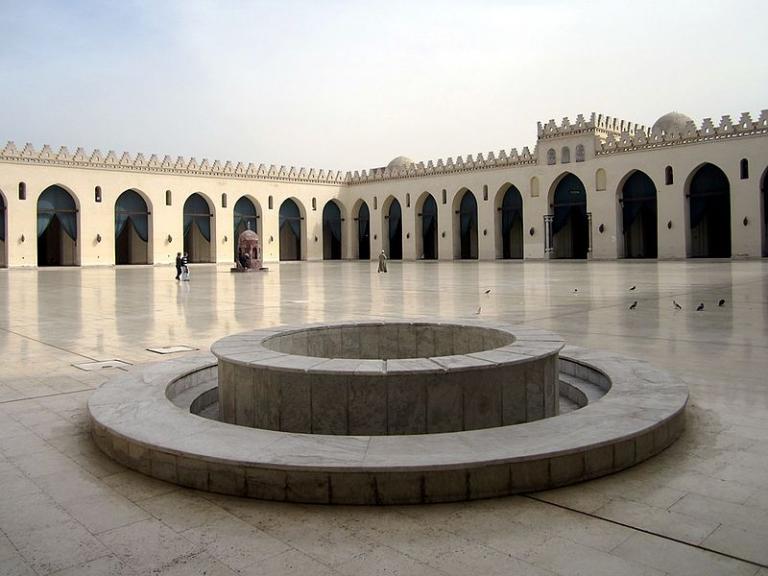
The Mosque of al-Hakim, built by the Fatimid sultan who reigned under the title of al-Hakim bi-Amr Allah (“The Ruler by the Command of God”) was built in AD 1013, and is one of the few major Fatimid structures remaining in Cairo.
(Wikimedia Commons public domain photo)
My manuscript now begins to treat what I call, following Marshall G. S. Hodgson, the “Early Middle Period,” which will last from AD 945 to AD 1258:
The so-called “Shiite Century” that followed the close of the High Caliphal period actually lasted for a little more than a hundred years, from 945 to 1055 A.D. But the complete takeover of the Islamic world by Shiites, hoped for by some and feared by others, never materialized. In fact, with the temporary exception of the Fatimid empire, based in Egypt, the Shiite states grew continuously smaller and smaller as ambitious military commanders broke away and tried to go it alone. In the eastern part of the Islamic world, the old Persian landed class resurfaced after several centuries of near-invisibility. These people, whose public language was Arabic, had been speaking Persian at home and felt more comfortable with it. Now that they again held political power, they felt themselves free to prefer their mother tongue publicly. If they were going to hire poets to glorify themselves and the life of their courts, they wanted poetry they could understand. So, in large areas, Persian was resurrected as a literary language. Now, however, it was written in Arabic script and enriched with thousands of loan-words from Arabic. Hence, it is called new Persian, or neo-Persian, to distinguish it from the ancient language of Darius and Cyrus and the Middle Persian that intervened. This is essentially the Persian language as it is spoken today in Iran. The most striking illustration of this resurgent Iranian nationalism, perhaps, is Firdawsi’s eleventh-century Shah-Nameh, the “Book of Kings.” Drawing on both history and mythology, the Shah-Nameh is a versified retelling of the struggle between Iran, the land of light, and its eternal enemy, “Turan.” It is generally regarded by Persian-speakers even today as their national epic. It has also, perhaps, established the manner in which many Iranians continue to view the outside world.
But the era of Shiite dominance was soon on the wane. The dynasties that had seized various parts of the Islamic world decayed and fell apart. Finally, between 1055 and 1092, hordes of Turks, sweeping down out of Central Asia, conquered the central Islamic lands. (The Ghaznavid Turkish dynasty already controlled the Afghan mountains and a substantial portion of northern India.) These Turks had been converted to Islam by Sunni missionaries, and, consequently, the Sunni state that they set up—known to history as the Great Saljuk empire—sounded the death knell to Shiite hopes in much of the Near East. (The Fatimids of Egypt held out until 1171.) For thirty- five years, the Great Saljuk empire was ruled by three extraordinarily competent kings, one after the other.[1] But then the process of political disintegration began again. It seemed as if the very air of the period would not tolerate political unity, and the Sunni Saljuk state could no more hold out against it than the Shiites before.
At the same time, in distant Spain, the surviving Umayyad caliphate, which had endured for so long after the Abbasid overthrow of the Umayyads in every other part of the empire, also collapsed. Muslim Spain, lovingly known to the Arabs as Andalusia, became a collection of warring city states, led by men known as “the party kings” (Arabic muluk at-tawaa’if; Spanish reyes taifas). They gained this title not because they liked a good time—although the historical record indicates that many of them did—but because they were always involved in political intrigue and alliances (or “parties”) against one another.
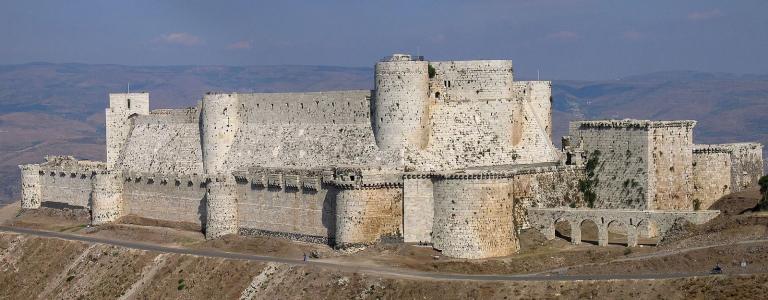
The so-called Krak des Chevaliers in Syria, built by Crusaders in the twelfth century
(Wikimedia Commons public domain image)
Meanwhile, as the Near East shattered into pieces, the Christian West was growing aggressive. On 26 November 1095, Pope Urban II convinced the princes and nobles of Catholic Christendom to join in a crusade of liberation against the Muslims who ruled the Holy Land. “Deus lo volt!” he cried. “God wills it!” Restless knights and landless aristocrats signed up enthusiastically for the new campaign, urged on by a zeal for holy war, a desire to make the pilgrimage to Jerusalem, and a burning ambition to carve out kingdoms for themselves in a new land. After a long and dangerous journey and after many fierce battles, the Crusaders arrived at the holy city of Jerusalem and laid siege to it in the summer of 1099. On the 15th of July, after a five-week siege, they breached the city’s final defenses and poured in. Every Muslim man, woman, and child in the city was put to the sword. Corpses and blood were literally knee-high on the temple mount, where Arabs hiding in the Mosque of al-Aqsa had received promises of mercy from the Europeans. The Jews of the city crowded into their chief synagogue, where they were burned alive. When nobody was left to kill, the Crusader princes rode solemnly to the Church of the Holy Sepulchre to give thanks to God for their glorious victory. Jerusalem had been restored to Christian rule.
The Crusaders enjoyed some success in the Near East, most of it short-lived, but the interesting fact about them for my purposes here is that the states they founded behaved in precisely the same manner as did other small states of the Early Middle Period. They could not unite together. They made ephemeral alliances with one another, and sometimes with Muslims against each other. And the Muslim states often sought alliances with the Crusader states against one another. As seems clear to us now, if the Near East had been united, the Crusades would have achieved little or no success. It was the division of the Muslims, the political vacuum created by the disintegration of the Abbasid empire, that invited the Crusaders in and permitted them to stay. (Many modern Arabs see Israel as simply the last of the Crusader states, as yet another invasion from the West, and they point out with some bitterness that, once again, it is the divisions among the Arabs that have permitted such a foreign presence to survive.) But the assimilation of the Crusaders to the pattern of Middle Period states in the Near East was not limited to their military and diplomatic behavior. When they arrived in the region, the Crusaders came into contact with a civilization that was far more advanced than that of Europe; thus, it is not surprising that they began to dress like Arabs, that they learned to speak Arabic, and that they absorbed much from their Muslim neighbors. In some ways, they behaved very much the way the Arabs had themselves, five centuries earlier. And when the various Crusaders and knightly orders returned to Europe, they brought with them some of the things that they had learned during their sojourn in the Arab world. (Among these were spices. Think how dull English food must have been when there were no spices at all!)
[1] The second of these was named Alp Arslan. As I’ve already mentioned, for the benefit of readers of C. S. Lewis’s Chronicles of Narnia, Arslan is the Turkish word for “lion.”
Posted from Park City, Utah
Next Post

October 5, 2020 Revision 6.2 "Meet the Middle Periods"
Browse Our Archives
Select a Category Uncategorized
Select a Month October 2026 September 2026 August 2026 July 2026 June 2026 May 2026 April 2026 March 2026 February 2026 January 2026 December 2025 November 2025 October 2025 September 2025 August 2025 July 2025 June 2025 May 2025 April 2025 March 2025 February 2025 January 2025 December 2024 November 2024 October 2024 September 2024 August 2024 July 2024 June 2024 May 2024 April 2024 March 2024 February 2024 January 2024 December 2023 November 2023 October 2023 September 2023 August 2023 July 2023 June 2023 May 2023 April 2023 March 2023 February 2023 January 2023 December 2022 November 2022 October 2022 September 2022 August 2022 July 2022 June 2022 May 2022 April 2022 March 2022 February 2022 January 2022 December 2021 November 2021 October 2021 September 2021 August 2021 July 2021 June 2021 May 2021 April 2021 March 2021 February 2021 January 2021 December 2020 November 2020 October 2020 September 2020 August 2020 July 2020 June 2020 May 2020 April 2020 March 2020 February 2020 January 2020 December 2019 November 2019 October 2019 September 2019 August 2019 July 2019 June 2019 May 2019 April 2019 March 2019 February 2019 January 2019 December 2018 November 2018 October 2018 September 2018 August 2018 July 2018 June 2018 May 2018 April 2018 March 2018 February 2018 January 2018 December 2017 November 2017 October 2017 September 2017 August 2017 July 2017 June 2017 May 2017 April 2017 March 2017 February 2017 January 2017 December 2016 November 2016 October 2016 September 2016 August 2016 July 2016 June 2016 May 2016 April 2016 March 2016 February 2016 January 2016 December 2015 November 2015 October 2015 September 2015 August 2015 July 2015 June 2015 May 2015 April 2015 March 2015 February 2015 January 2015 December 2014 November 2014 March 2014 August 2013 February 2012
Follow Us!
TAKE THE
Religious Wisdom Quiz
Who predicted the fall of Jerusalem?
Select your answer to see how you score.
Daniel Jeremiah Isaiah Jesus
Related posts from Sic et Non

Islam in America or Islam versus America?

A basic working chronology of Islamic-era Iran

Actual Data and Actual Crusades

TRENDING AT PATHEOS Latter-day Saint

When Halloween Unmasks Married Hearts
Written by Dr. David K. Ewen from Eternal Truth Bible College Behind...

Aristotle. He’s been called the father of logic, the father of the...

Methodist Central Hall and Westminster Abbey
Situated on the same square is Methodist Central Hall and Westminster Abbey. ...

57th Dove Awards Honor Dolly Parton, Crown New...
On gospel music’s biggest night, the 57th annual GMA Dove Awards honored...

The First Eucharistic Controversy: Christ’s Real Presence
For Catholics, the Eucharist is the source and summit of the Christian...

What a Stop Sign Can Teach Us About...
How to Make a Decision When You Can't Hear God Main point:...
view all Latter-day Saint blogs
Ad-Free & Subscriber Log-In Subscription Support
- About Us
- 2026 Calendar
- Videos
- Podcasts
- Library of World Religions
- Faith In Media Tracker
- Advertise With Us
- Write for Us
- Privacy Policy
- Terms of Service
- Do Not Sell My Data
- Contact Us
- Radiant Digital
- Manage Newsletter Subscriptions
- Unsubscribe From Notifications
- Sitemap
Copyright 2008-2026, Patheos. All rights reserved.
Subscription Support Ad-Free & Subscriber Log-In
Follow Patheos