
BuddhistCatholicContemplativeEvangelicalGeneral ChristianHinduJewishLatter-day SaintMuslimNew VisionsProgressive Christian
Beliefs
- Buddhist
- Catholic
- Contemplative
- Evangelical
- General Christian
- Hindu
- Jewish
- Latter-day Saint
- More Voices
- Muslim
- New Visions
- Pagan
- Progressive Christian
Topics
- Religion News
- Food and Religion
- Sports and Religion
- Religious Art
- Religious Music and Entertainment
- Religious Events
- History and Religion
- Style and Religion
- Politics and Religion
- Women in Religion
- Recreation Outdoors and Religion
- Business Finance and Religion
- Careers Workplace and Religion
- Education and Religion
- Family Parenting and Religion
- Health Fitness and Religion
- Home and Religion
- Relationships and Religion
- Technology and Religion
- Travel and Religion
Columnists
- Buddhist Columnists
- Business Finance and Religion Columnists
- Careers Workplace and Religion Columnists
- Catholic Columnists
- Contemplative Columnists
- Education and Religion Columnists
- Evangelists Columnists
- Family Parenting and Religion Columnists
- General Christian Columnists
- Health Fitness and Religion Columnists
- Hindu Columnists
- History and Religion Columnists
- Home and Religion Columnists
- Jewish Columnists
- More Voices Columnists
- Latter Day Columnists
- Muslim Columnists
- New Visions Columnists
- Nonreligious Columnists
- Pagan Columnists
- Politics and Religion Columnists
- Progressive Columnists
- Recreation Outdoors and Religion Columnists
- Relationships and Religion Columnists
- Religion News Columnists
- Religious Art Columnists
- Religious Events Columnists
- Religious Music and Entertainment Columnists
- Sports and Religion Columnists
- Style and Religion Columnists
- Technology and Religion Columnists
- Travel and Religion Columnists
- Women in Religion Columnists
Resource Library
- 2026 Calendar
- Library of World Religions
- The 100 Most Holy Places on Earth
- Patheos Answers
- Podcasts
- Videos
- Faith Leaders Database
- Anglican Episcopalian
- Bahai
- Baptist
- Buddhism
- Christianity
- Confucianism
- Eastern Orthodoxy
- Hinduism
- Holiness and Pentecostal
- ISKCON
- Islam
- Judaism
- Lutheran
- Methodist
- The Church of Jesus Christ of Latter-day Saints
- New Age
- Paganism
- Presbytarian and Reformed
- Protestantism
- Religion Behind the Scenes
- Roman Catholic
- Scientology
- Shia Islam
- Sikhism
- Sufism
- Sunni Islam
- Taoism
- Zen
- See all religions
Research Tools
 Ad-Free & Subscriber Log-In Subscription Support
Ad-Free & Subscriber Log-In Subscription Support
Follow Patheos 

- Trending:
- Forgiveness
- |
- Marriage
- |
- Consciousness
- |
- Death Penalty
- |
- Election
- |
- Halloween

- Home
- Latter-day Saint
- An atmospheric miracle
An atmospheric miracle
Last updated on: October 13, 2020 at 11:47 pm by Dan Peterson
An atmospheric miracle 2020-10-13T23:47:17-06:00 Dan Peterson
Patheos Explore the world's faith through different perspectives on religion and spirituality! Patheos has the views of the prevalent religions and spiritualities of the world.
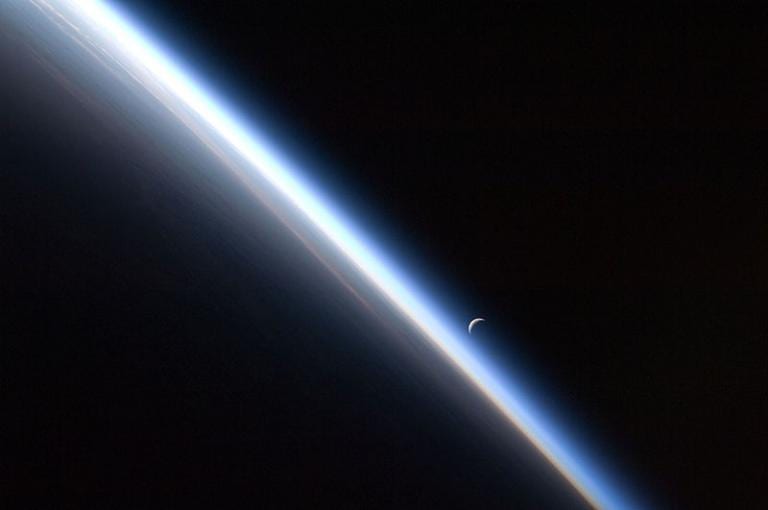
A setting last quarter crescent moon and the thin line of Earth’s atmosphere, photographed on 4 September 2010 by a member of the Expedition 24 crew as the International Space Station passes over central Asia.
(NASA public domain photograph)
Below, I share with you three passages from Thomas Dubay, The Evidential Power of Beauty: Science and Theology Meet (San Francisco: Ignatius Press, 1999):
Our earth’s atmosphere has been called a miracle. One of its traits is the composition of the air we breathe. If its makeup included 17 percent oxygen, we could not breathe at all; if it were 25 percent, we would burn up. It actually is 21 percent, exactly what we need. (215)
Here’s something that I myself threw together on that subject a couple of months ago:
Our terrestrial atmosphere is an exceedingly thin envelope or film surrounding Earth. Perhaps somewhat more than 99% of our air exists within a region no higher than thirty kilometers (or approximately eighteen miles) above sea level. Earth’s radius — the distance from its center to its surface or circumference — is 6400 kilometers (somewhat less than 4000 miles), which means that the thickness of that oxygenated region of our atmosphere is a bit less than 0.5% of earth’s radius, one half of one percent.
In fact, though, humans can’t survive beyond just a short distance above sea level. Federal regulations require the use of supplemental oxygen by pilots who fly more than 30 minutes at cabin pressure altitudes of 12,500 feet (roughly 3.8 kilometers) or higher. And at cabin altitudes above 14,000 feet (somewhat more than 4.25 kilometers), pilots must use oxygen at all times.
The phrase thin blue line is sometimes used to refer to the role of the police, who, in a healthy polity, hold chaos at bay and thus permit order and civilization to flourish. The term could perhaps be used even more appropriately to describe the function of our atmosphere, which allows not only civilization and order but sheer physical survival.
Our atmosphere as it exists today probably derives (as our oceans also do) from the “degassing” of the primitive semi-molten earth, supplemented by later additions belched up from volcanoes and emitted by hot springs. The atmosphere of early geologic times was made up of such gases as hydrogen, nitrogen, carbon monoxide, carbon dioxide, water vapor, and various forms of hydrogen chloride. The lighter gases (e.g., hydrogen) presumably escaped. Five hundred miles above the earth, our “atmosphere,” if it can still be called that, is composed of 50% helium and 50% hydrogen.
Somewhat later in our planet’s history, when living organisms developed that were capable of photosynthesis, they provided the oxygen that then permitted animal respiration and eventually the colonization of land, as well as providing the famous ozone layer that shields the earth (and us) from the sun’s ultraviolet radiation.
Evidence for this sequence of atmospheric development can be found, to some degree at least, in Precambrian rocks and a few fossils, which seem to suggest a transition from a largely oxygen-free environment to . . . well, to a free-oxygen environment.
Denser and, thus, heavier gases such as oxygen, carbon dioxide, nitrogen, and water vapor hang low in the current atmosphere, mostly within about three miles of the planet’s surface. They are essential to life. Above roughly three miles over sea level, we humans cannot usually function very well without supplemental oxygen.
Altogether, the gases in the atmosphere serve to insulate the earth by filtering out most cosmic radiation and, as mentioned, most of the sun’s ultraviolet radiation. They prevent large swings in temperature. They also burn up untold millions of meteors before those objects are able to collide with our planet. Again in these ways, they are essential to life.
Fortunately, too, our atmosphere probably deflects or reflects much interstellar “noise” into space. Without that, radio and television broadcasts would be effectively impossible, lost in an impenetrable wall of static. On its “underside,” though, our atmosphere partially reflects (rather than merely transmitting) radio waves, which makes communication by radio possible. Such communication is essential for the Interpreter Radio Show and, thus, for humanity in general.
***
If the mass of our largest planet, Jupiter, were 1 percent greater or less than it actually is, our solar system would be destabilized, and again we could not exist. (215)
***
To give us our four seasons and a humanly ideal temperature range, our earth is tilted at precisely the correct 23.5 degrees. . . .
New computer simulations show that the tilt of a planet with no sizeable moon “will wobble dramatically over periods of a few million years. The gravitational influence of Earth’s moon, by contrast, stabilizes our planet”, and this has much to do with the existence of life here at home. How does this happen? If Earth wobbled through the lack of the moon’s stabilizing effect, our winters could be 100 degrees colder and our summers 100 degrees warmer. These switches in temperature and seasons would, of course, wipe out animal and plant life. Our temperature and seasons are stable because of the precise tilt from the vertical, our spin axis of 23.5 degrees. Thus the moon with its just-right size makes our planet livable. It makes you and me possible. (215)
Previous Post

October 12, 2020
"The Visions of Moses and Joseph Smith’s Bible Translation"
Browse Our Archives
Select a Category Uncategorized
Select a Month October 2026 September 2026 August 2026 July 2026 June 2026 May 2026 April 2026 March 2026 February 2026 January 2026 December 2025 November 2025 October 2025 September 2025 August 2025 July 2025 June 2025 May 2025 April 2025 March 2025 February 2025 January 2025 December 2024 November 2024 October 2024 September 2024 August 2024 July 2024 June 2024 May 2024 April 2024 March 2024 February 2024 January 2024 December 2023 November 2023 October 2023 September 2023 August 2023 July 2023 June 2023 May 2023 April 2023 March 2023 February 2023 January 2023 December 2022 November 2022 October 2022 September 2022 August 2022 July 2022 June 2022 May 2022 April 2022 March 2022 February 2022 January 2022 December 2021 November 2021 October 2021 September 2021 August 2021 July 2021 June 2021 May 2021 April 2021 March 2021 February 2021 January 2021 December 2020 November 2020 October 2020 September 2020 August 2020 July 2020 June 2020 May 2020 April 2020 March 2020 February 2020 January 2020 December 2019 November 2019 October 2019 September 2019 August 2019 July 2019 June 2019 May 2019 April 2019 March 2019 February 2019 January 2019 December 2018 November 2018 October 2018 September 2018 August 2018 July 2018 June 2018 May 2018 April 2018 March 2018 February 2018 January 2018 December 2017 November 2017 October 2017 September 2017 August 2017 July 2017 June 2017 May 2017 April 2017 March 2017 February 2017 January 2017 December 2016 November 2016 October 2016 September 2016 August 2016 July 2016 June 2016 May 2016 April 2016 March 2016 February 2016 January 2016 December 2015 November 2015 October 2015 September 2015 August 2015 July 2015 June 2015 May 2015 April 2015 March 2015 February 2015 January 2015 December 2014 November 2014 March 2014 August 2013 February 2012
Follow Us!
TAKE THE
Religious Wisdom Quiz
What did the soldier dress Jesus in after he was accused?
Select your answer to see how you score.
Scarlet Robe Golden Robe Nothing Thorns
Related posts from Sic et Non

This Wednesday, at 4 PM, Utah time

What if Wallace had prevailed, rather than Darwin?
On the Origin of Life on Earth, and...

TRENDING AT PATHEOS Latter-day Saint

Methodist Central Hall and Westminster Abbey
Situated on the same square is Methodist Central Hall and Westminster Abbey. ...

57th Dove Awards Honor Dolly Parton, Crown New...
On gospel music’s biggest night, the 57th annual GMA Dove Awards honored...

The First Eucharistic Controversy: Christ’s Real Presence
For Catholics, the Eucharist is the source and summit of the Christian...

What a Stop Sign Can Teach Us About...
How to Make a Decision When You Can't Hear God Main point:...

Archdiocese Hosts Military Marriage Retreat in Germany
RASTATT, Germany — The transient military lifestyle, with its frequent deployments and...

Nearly every morning, I make the drive to Detroit with my high-school-age...
view all Latter-day Saint blogs
Ad-Free & Subscriber Log-In Subscription Support
- About Us
- 2026 Calendar
- Videos
- Podcasts
- Library of World Religions
- Faith In Media Tracker
- Advertise With Us
- Write for Us
- Privacy Policy
- Terms of Service
- Do Not Sell My Data
- Contact Us
- Radiant Digital
- Manage Newsletter Subscriptions
- Unsubscribe From Notifications
- Sitemap
Copyright 2008-2026, Patheos. All rights reserved.
Subscription Support Ad-Free & Subscriber Log-In
Follow Patheos