
BuddhistCatholicContemplativeEvangelicalGeneral ChristianHinduJewishLatter-day SaintMuslimNew VisionsProgressive Christian
Beliefs
- Buddhist
- Catholic
- Contemplative
- Evangelical
- General Christian
- Hindu
- Jewish
- Latter-day Saint
- More Voices
- Muslim
- New Visions
- Pagan
- Progressive Christian
Topics
- Religion News
- Food and Religion
- Sports and Religion
- Religious Art
- Religious Music and Entertainment
- Religious Events
- History and Religion
- Style and Religion
- Politics and Religion
- Women in Religion
- Recreation Outdoors and Religion
- Business Finance and Religion
- Careers Workplace and Religion
- Education and Religion
- Family Parenting and Religion
- Health Fitness and Religion
- Home and Religion
- Relationships and Religion
- Technology and Religion
- Travel and Religion
Columnists
- Buddhist Columnists
- Business Finance and Religion Columnists
- Careers Workplace and Religion Columnists
- Catholic Columnists
- Contemplative Columnists
- Education and Religion Columnists
- Evangelists Columnists
- Family Parenting and Religion Columnists
- General Christian Columnists
- Health Fitness and Religion Columnists
- Hindu Columnists
- History and Religion Columnists
- Home and Religion Columnists
- Jewish Columnists
- More Voices Columnists
- Latter Day Columnists
- Muslim Columnists
- New Visions Columnists
- Nonreligious Columnists
- Pagan Columnists
- Politics and Religion Columnists
- Progressive Columnists
- Recreation Outdoors and Religion Columnists
- Relationships and Religion Columnists
- Religion News Columnists
- Religious Art Columnists
- Religious Events Columnists
- Religious Music and Entertainment Columnists
- Sports and Religion Columnists
- Style and Religion Columnists
- Technology and Religion Columnists
- Travel and Religion Columnists
- Women in Religion Columnists
Resource Library
- 2026 Calendar
- Library of World Religions
- The 100 Most Holy Places on Earth
- Patheos Answers
- Podcasts
- Videos
- Faith Leaders Database
- Anglican Episcopalian
- Bahai
- Baptist
- Buddhism
- Christianity
- Confucianism
- Eastern Orthodoxy
- Hinduism
- Holiness and Pentecostal
- ISKCON
- Islam
- Judaism
- Lutheran
- Methodist
- The Church of Jesus Christ of Latter-day Saints
- New Age
- Paganism
- Presbytarian and Reformed
- Protestantism
- Religion Behind the Scenes
- Roman Catholic
- Scientology
- Shia Islam
- Sikhism
- Sufism
- Sunni Islam
- Taoism
- Zen
- See all religions
Research Tools
 Ad-Free & Subscriber Log-In Subscription Support
Ad-Free & Subscriber Log-In Subscription Support
Follow Patheos 

- Trending:
- Forgiveness
- |
- Marriage
- |
- Consciousness
- |
- Death Penalty
- |
- Election
- |
- Halloween

- Home
- Latter-day Saint
- When the neat world depicted by science fell apart
When the neat world depicted by science fell apart
Last updated on: September 24, 2020 at 12:44 am by Dan Peterson
When the neat world depicted by science fell apart 2020-09-24T00:44:27-06:00 Dan Peterson
Patheos Explore the world's faith through different perspectives on religion and spirituality! Patheos has the views of the prevalent religions and spiritualities of the world.
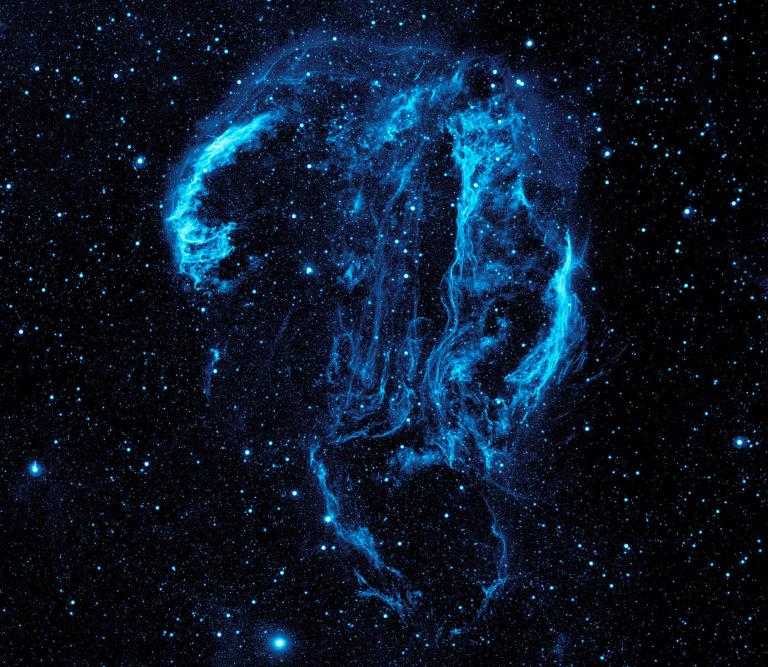
A public domain NASA ultraviolet image of the Cygnus Loop Nebula
It used to be that scientists and those influenced by them viewed the world as an assemblage of interlocking gears, a machine. This was the time of the Enlightenment and of “Rationalism.” The machine simply had to be disassembled and its various constituent parts examined, and then everything would be both understood and easy to control.
René Descartes (1596-1650) certainly viewed reality as somewhat machine-like, and the physics of Sir Isaac Newton (1642-1727) seemed to solidify the picture. The same eternal laws governed the fall of an apple and the motions of the planets. It all ran like a clockwork. Cause and necessary effect explained everything. If we only knew all of the beginning conditions we would be able to predict the end conditions with reliable certainty.
And this was true of humanity, as well. The title of the atheistic French physician and philosopher Julien La Mettrie’s 1747 book L’Homme machine (“Man a Machine”) summed it all up pretty well. There was no freedom. Anywhere. All was governed by necessity.
The world was very rapidly disenchanted. One puzzle after another was solved. God became superfluous. As the French mathematician and astronomer Pierre Simon de Laplace put it so memorably when, having been presented with Laplace’s mechanistic system of Newtonian celestial mechanics, Napoleon asked him what place remained for God: “Your Majesty, I have no need of that hypothesis.”
Newton’s model contributed enormously to the progress of science, brilliantly explaining the physical world that we see every day.
And Newtonian physics still has enormous value. But, as we’ve now come to understand, it also has limits. It explains only a portion of even physical reality. The universe is much more complex than the scientists and philosophers of the Enlightenment knew, and the mechanistic model is no longer adequate to what we understand today.
Newton himself may have sensed the limits of his system. Astonishing genius though he was, he realized that there was far more still to learn.
“I do not know what I may appear to the world,” he famously said, “but to myself I seem to have been only like a boy playing on the seashore, and diverting myself in now and then finding a smoother pebble or a prettier shell than ordinary, whilst the great ocean of truth lay all undiscovered before me.”
Still, Newton’s basic description of the world functioned really well for a long time. By the end of the nineteenth century, scarcely any major questions remained in physics. The mechanistic model required refinement, but nothing much beyond that. Apart from some details, everything appeared to be quite clear.
And then came a scientific earthquake.
As the twentieth century opened, scientists looking into the microcosm of the atom encountered phenomena that could not be reconciled with classical physics. It turned out that the microcosm wasn’t merely a mini-copy of the world of everyday life; it followed a completely different pattern.
Nobody was especially happy about this. Many scientists, in fact, were shocked and dismayed. Suddenly, the world seemed incomprehensible.
Classical physics had, for example, regarded the entire universe as made up of solid particles. Now, though, it appeared that this isn’t true at the very heart of things. The very smallest particles aren’t solid at all. They’re unstable appearances in a field of interrelationships. It’s not even clear, in fact, that they actually “exist” — or, if they do, in what form.
And energy and change don’t flow smoothly. Rather, they manifest themselves in small “packets,” or “quanta.” Electrons, for instance, frequently move from one orbit or energy level to another, but without crossing the space in between.
And the neat relationship of cause and effect seemed to break down. Chance, randomness, appeared in a way that classical physics simply couldn’t countenance. Subatomic particles move without cause. It’s never entirely clear what happens and when it’s happened. In fact, randomness becomes a fundamental feature of the cosmos on the subatomic level.
Uncertainty belongs, therefore, to the essence of nature at its most basic level.
This was frustrating to the great physicists of the first half of the twentieth century, but it opened the machine-like, deterministic universe entailed by Newton and Laplace up to a newly regained freedom.
(The above is a brief summary paraphrase of Lorenz Marti, Eine Hand voll Sternenstaub: Was das Universum über das Glück des Daseins erzählt [Freiburg, Basel, and Vienna: Verlag Herder, 2014], 77-82.)
***
Those who believe the COVID-19 pandemic to be a hoax, not quite as serious as a slight cold, that will disappear on the morning of Wednesday, 4 November 2020, need read no further. The scam-demic has only a few more weeks to run. Those who live in the real world, however, might find these links interesting:
“With COVID-19 cases still spiking, Utah County moves to higher restriction level”
“Flu “gets around the world when people travel, and there’s not much traveling going on.” But COVID-19 remains a threat, he warned “If you doubted that COVID was more infectious than flu, look at South Africa or Chile, where COVID is spreading like wildfire and flu isn’t spreading at all.””
“The Road Ahead: Charting the coronavirus pandemic over the next 12 months — and beyond”
Previous Post

September 23, 2020
Of seer stones and hearing angels sing
Next Post
September 24, 2020 Revision 5.11 "What the West Owes the East" (Take One)
Browse Our Archives
Select a Category Uncategorized
Select a Month October 2026 September 2026 August 2026 July 2026 June 2026 May 2026 April 2026 March 2026 February 2026 January 2026 December 2025 November 2025 October 2025 September 2025 August 2025 July 2025 June 2025 May 2025 April 2025 March 2025 February 2025 January 2025 December 2024 November 2024 October 2024 September 2024 August 2024 July 2024 June 2024 May 2024 April 2024 March 2024 February 2024 January 2024 December 2023 November 2023 October 2023 September 2023 August 2023 July 2023 June 2023 May 2023 April 2023 March 2023 February 2023 January 2023 December 2022 November 2022 October 2022 September 2022 August 2022 July 2022 June 2022 May 2022 April 2022 March 2022 February 2022 January 2022 December 2021 November 2021 October 2021 September 2021 August 2021 July 2021 June 2021 May 2021 April 2021 March 2021 February 2021 January 2021 December 2020 November 2020 October 2020 September 2020 August 2020 July 2020 June 2020 May 2020 April 2020 March 2020 February 2020 January 2020 December 2019 November 2019 October 2019 September 2019 August 2019 July 2019 June 2019 May 2019 April 2019 March 2019 February 2019 January 2019 December 2018 November 2018 October 2018 September 2018 August 2018 July 2018 June 2018 May 2018 April 2018 March 2018 February 2018 January 2018 December 2017 November 2017 October 2017 September 2017 August 2017 July 2017 June 2017 May 2017 April 2017 March 2017 February 2017 January 2017 December 2016 November 2016 October 2016 September 2016 August 2016 July 2016 June 2016 May 2016 April 2016 March 2016 February 2016 January 2016 December 2015 November 2015 October 2015 September 2015 August 2015 July 2015 June 2015 May 2015 April 2015 March 2015 February 2015 January 2015 December 2014 November 2014 March 2014 August 2013 February 2012
Follow Us!
TAKE THE
Religious Wisdom Quiz
True or False: Cornelius was a Roman centurion who was the first Gentile convert.
Select your answer to see how you score.
TRUE FALSE
Related posts from Sic et Non

"America's Most Neighborly City"? It's not in Switzerland


Does mind derive from mindless matter?

A note on some (rather atypical) recent reading
TRENDING AT PATHEOS Latter-day Saint

The Sermon on the Mount, Part I: Matthew...
The Sermon on the Mount, Part I (Matthew 4:12-5:12) St. Matthew moves...

What's up from Crossway: Reviewing some of their latest A few weeks...

Janie Learns the Way of the Cross: A...
Teaching children about Jesus' Passion can be challenging. Many parents and educators...

Looking For Good Catholic Writing - October 2026
He alone extends the heavens, and he walks upon the waves of...

In "Irreplaceable," our book on vocation and technology, Trevor Sutton and I...

I was strolling through the top floor of the brand new Parthenon...
view all Latter-day Saint blogs
Ad-Free & Subscriber Log-In Subscription Support
- About Us
- 2026 Calendar
- Videos
- Podcasts
- Library of World Religions
- Faith In Media Tracker
- Advertise With Us
- Write for Us
- Privacy Policy
- Terms of Service
- Do Not Sell My Data
- Contact Us
- Radiant Digital
- Manage Newsletter Subscriptions
- Unsubscribe From Notifications
- Sitemap
Copyright 2008-2026, Patheos. All rights reserved.
Subscription Support Ad-Free & Subscriber Log-In
Follow Patheos