
BuddhistCatholicContemplativeEvangelicalGeneral ChristianHinduJewishLatter-day SaintMuslimNew VisionsProgressive Christian
Beliefs
- Buddhist
- Catholic
- Contemplative
- Evangelical
- General Christian
- Hindu
- Jewish
- Latter-day Saint
- More Voices
- Muslim
- New Visions
- Pagan
- Progressive Christian
Topics
- Religion News
- Food and Religion
- Sports and Religion
- Religious Art
- Religious Music and Entertainment
- Religious Events
- History and Religion
- Style and Religion
- Politics and Religion
- Women in Religion
- Recreation Outdoors and Religion
- Business Finance and Religion
- Careers Workplace and Religion
- Education and Religion
- Family Parenting and Religion
- Health Fitness and Religion
- Home and Religion
- Relationships and Religion
- Technology and Religion
- Travel and Religion
Columnists
- Buddhist Columnists
- Business Finance and Religion Columnists
- Careers Workplace and Religion Columnists
- Catholic Columnists
- Contemplative Columnists
- Education and Religion Columnists
- Evangelists Columnists
- Family Parenting and Religion Columnists
- General Christian Columnists
- Health Fitness and Religion Columnists
- Hindu Columnists
- History and Religion Columnists
- Home and Religion Columnists
- Jewish Columnists
- More Voices Columnists
- Latter Day Columnists
- Muslim Columnists
- New Visions Columnists
- Nonreligious Columnists
- Pagan Columnists
- Politics and Religion Columnists
- Progressive Columnists
- Recreation Outdoors and Religion Columnists
- Relationships and Religion Columnists
- Religion News Columnists
- Religious Art Columnists
- Religious Events Columnists
- Religious Music and Entertainment Columnists
- Sports and Religion Columnists
- Style and Religion Columnists
- Technology and Religion Columnists
- Travel and Religion Columnists
- Women in Religion Columnists
Resource Library
- 2026 Calendar
- Library of World Religions
- The 100 Most Holy Places on Earth
- Patheos Answers
- Podcasts
- Videos
- Faith Leaders Database
- Anglican Episcopalian
- Bahai
- Baptist
- Buddhism
- Christianity
- Confucianism
- Eastern Orthodoxy
- Hinduism
- Holiness and Pentecostal
- ISKCON
- Islam
- Judaism
- Lutheran
- Methodist
- The Church of Jesus Christ of Latter-day Saints
- New Age
- Paganism
- Presbytarian and Reformed
- Protestantism
- Religion Behind the Scenes
- Roman Catholic
- Scientology
- Shia Islam
- Sikhism
- Sufism
- Sunni Islam
- Taoism
- Zen
- See all religions
Research Tools
 Ad-Free & Subscriber Log-In Subscription Support
Ad-Free & Subscriber Log-In Subscription Support
Follow Patheos 

- Trending:
- Forgiveness
- |
- Marriage
- |
- Consciousness
- |
- Death Penalty
- |
- Election
- |
- Halloween

- Home
- Latter-day Saint
- Revision 5.14 “What the West Owes the East” (Medicine and Other Sciences)
Revision 5.14 “What the West Owes the East” (Medicine and Other Sciences)
Last updated on: September 28, 2020 at 10:14 pm by Dan Peterson
Revision 5.14 “What the West Owes the East” (Medicine and Other Sciences) 2020-09-28T22:14:48-06:00 Dan Peterson
Patheos Explore the world's faith through different perspectives on religion and spirituality! Patheos has the views of the prevalent religions and spiritualities of the world.
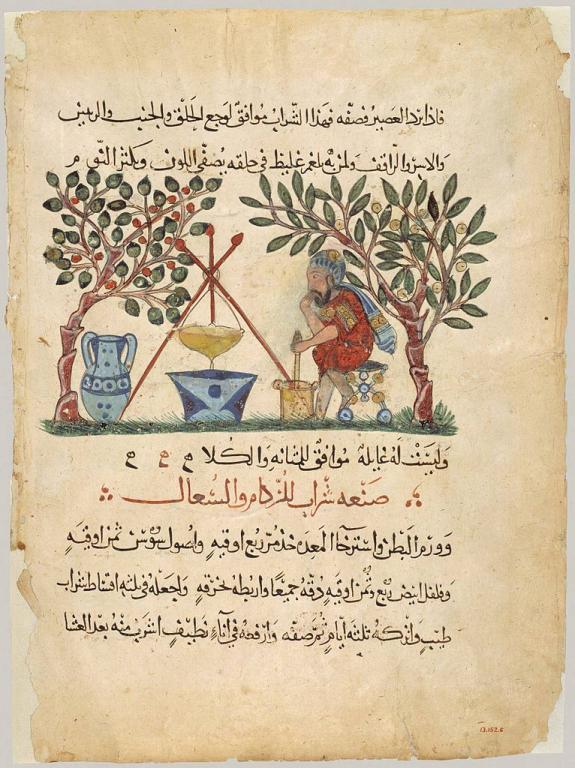
A page from a medieval Arabic manuscript on medicines. (Wikimedia Commons public domain image)
In medicine, the Western debt to the Arabs is every bit as great as in the fields already mentioned. The illustrious Montpelier medical school in France, for instance, was founded by Arab doctors fleeing from Spain during the Reconquista. Up to the end of the sixteenth century, the medical curriculum of European universities was based upon Avicenna’s great textbook al-Qanun (“The Canon”).
A brief listing of Arab innovations in the medical and biological sciences should serve to illustrate how creative they were in this area. Al-Razi, a leading philosopher and physician of the ninth and tenth centuries, was the first doctor to diagnose and correctly describe smallpox. Furthermore, he and Avicenna invented a therapeutic technique that they called al-ilaj al-nafsani, or “the spiritual cure.” It involved leading the patient back to forgotten memories as a step toward his or her recovery and it can easily be considered a ninth-century forerunner to psychoanalysis. By the tenth century, an Arab named al-Majusi had a rudimentary idea of the capillary system. At the same time, a prolific writer named al-Mas‘udi was speculating about the evolution of more complex animals from simpler ones. Was he a precursor of Darwin? Already in early medieval Baghdad, there were hospitals devoted to such specialties as ophthalmology, teaching and training new physicians, and caring for the insane. (And these early mental asylums were a far cry from the barbarous and inhuman places that came along much later in Europe, places like London’s St. Mary of Bethlehem hospital for lunatics, from which our word bedlam comes.) Ibn Khatib, a scholar and physician of fourteenth-century Grenada, was the first known person to recognize the fact of contagion.
During the Crusades, Frankish (Western) and Muslim doctors often worked side by side. The Muslims were appalled by what they saw. For a leg or an arm wound, the Europeans would cut the appendage off with an axe. Not surprisingly, the usual outcome of such “treatment” was either the patient’s instantaneous death or a lingering and painful demise from gangrene. Less drastic treatments, but no more effective in aiding recovery, included shaving the patient’s head, exorcism of the evil spirit that was causing his fever or his infection, or the incision of a cross in the afflicted part of his body to let the sickness, or injury-demon, out. It is small wonder that the Crusader states tended to adopt Arab ways. Once they got a feel for their new Near Eastern environment and realized how far advanced the Muslims were by whom they were surrounded, they were eager to learn. They wanted, after all, to live quality lives. Indeed, they simply wanted to live.
“In the sciences,” writes the German scholar Enno Littmann, “namely in medicine, mathematics, and the natural sciences, the Arabs (or, at least, the people who had adopted the Arabic language) were the master teachers [die Lehrmeister] of medieval Europe.”[1] We have already seen some evidence that this was true with regard to medicine and mathematics. I shall now present some materials on the other sciences, in which the debt is just as plain.
I have mentioned the Arab interest in navigation. Given the vastness of the Islamic world, next to which western Europe seems absurdly small, it was natural that their competence in navigation and geography would be high. They travelled extensively. Ibn Battuta, who lived during the fourteenth century, will serve as a spectacular example of this.[2] He was twenty years junior to Marco Polo and covered far more territory than that famous Italian ever did. It has been estimated that Ibn Battuta travelled seventy-five thousand miles, in an era lacking automobiles, jet aircraft, trains, or even steamships. His travels began, as did those of many others, with the pilgrimage to Mecca and Medina. But he went far beyond that. Leaving his native Morocco, he visited not only all of the Arab countries but also Turkey, Bulgaria, southern Russia, Iran, and and Central Asia. He lived several years in India and then served as an ambassador to China. Later, after returning to Morocco and (perhaps understandably) finding it a bit dull, he travelled to Iberia (Spain and Portugal), and to Mali and Niger in black, sub- Saharan Africa. He even visited the famous and remote city of Timbuktu. Ibn Battuta left behind him valuable memoirs that are increasingly treasured by historians as accurate depictions of the many exotic places he saw, places that are now irrecoverably gone or changed by modern technology and Westernization.
The Arabs were using compasses for navigation by the ninth or tenth century, considerably earlier than the Europeans. But their capacities went far beyond practical navigation. Roger II, the Norman ruler of Sicily, didn’t ask Western geographers to come to his capital of Palermo when he wanted to commission a great book on world geography. He summoned an Arab, instead. And the resulting book, al-Idrisi’s Kitab al-Rujari (“Roger’s Book”), is widely regarded as the best description of the world known to us from medieval times. It was an Arab by the name of Ahmad ibn Majid who navigated Vasco da Gama’s boat during da Gama’s famous and important circumnavigation of Africa. Later on, when Christopher Columbus was looking for Earth’s other pole—the one that Arab geographical theory predicted would lie opposite India or Mecca—he took along a Spanish Jew. Why? I suspect it was because Spanish Jews—remember their role as middlemen, or go-betweens, who helped to transmit Arab learning to the West?—were in the best position of anyone in post-Reconquista Spain to understand and apply Arab geographical and navigational learning. (The last Arab Muslims in Spain—those, at least, who didn’t conceal their faith—were expelled from that country in 1492.) Much of our knowledge of Africa before the great explorations of the nineteenth century (including the names of African animals like the gazelle and the giraffe) came from the Arabs, as well. Leo Africanus, the great sixteenth-century authority on that vast and difficult continent, was actually an Arab by the name of Hasan al-Wazzan.
[1] Enno Littmann, Morgenländische Wörter im Deutschen (Tübingen: Verlag von C. B. Mohr, 1924), 74.
[2] The name is pronounced “Ibn Bah-TOO-tah.”
Previous Post

September 26, 2020
Did David Whitmer heft the golden plates?
Next Post
September 27, 2020 "He was perfectly rational"
Browse Our Archives
Select a Category Uncategorized
Select a Month October 2026 September 2026 August 2026 July 2026 June 2026 May 2026 April 2026 March 2026 February 2026 January 2026 December 2025 November 2025 October 2025 September 2025 August 2025 July 2025 June 2025 May 2025 April 2025 March 2025 February 2025 January 2025 December 2024 November 2024 October 2024 September 2024 August 2024 July 2024 June 2024 May 2024 April 2024 March 2024 February 2024 January 2024 December 2023 November 2023 October 2023 September 2023 August 2023 July 2023 June 2023 May 2023 April 2023 March 2023 February 2023 January 2023 December 2022 November 2022 October 2022 September 2022 August 2022 July 2022 June 2022 May 2022 April 2022 March 2022 February 2022 January 2022 December 2021 November 2021 October 2021 September 2021 August 2021 July 2021 June 2021 May 2021 April 2021 March 2021 February 2021 January 2021 December 2020 November 2020 October 2020 September 2020 August 2020 July 2020 June 2020 May 2020 April 2020 March 2020 February 2020 January 2020 December 2019 November 2019 October 2019 September 2019 August 2019 July 2019 June 2019 May 2019 April 2019 March 2019 February 2019 January 2019 December 2018 November 2018 October 2018 September 2018 August 2018 July 2018 June 2018 May 2018 April 2018 March 2018 February 2018 January 2018 December 2017 November 2017 October 2017 September 2017 August 2017 July 2017 June 2017 May 2017 April 2017 March 2017 February 2017 January 2017 December 2016 November 2016 October 2016 September 2016 August 2016 July 2016 June 2016 May 2016 April 2016 March 2016 February 2016 January 2016 December 2015 November 2015 October 2015 September 2015 August 2015 July 2015 June 2015 May 2015 April 2015 March 2015 February 2015 January 2015 December 2014 November 2014 March 2014 August 2013 February 2012
Follow Us!
TAKE THE
Religious Wisdom Quiz
Who led the Israelites into battle against Jericho?
Select your answer to see how you score.
Moses Gideon Joshua David
Related posts from Sic et Non

Islam in America or Islam versus America?

A basic working chronology of Islamic-era Iran

What if Wallace had prevailed, rather than Darwin?

Actual Data and Actual Crusades
TRENDING AT PATHEOS Latter-day Saint

Archdiocese Hosts Military Marriage Retreat in Germany
RASTATT, Germany — The transient military lifestyle, with its frequent deployments and...

Nearly every morning, I make the drive to Detroit with my high-school-age...

The Real AI Story Is Adoption Without Trust
Artificial intelligence has crossed a political threshold. It is no longer a...

A new article, written by Jeff Lindsay and Gale L. Pooley,...

Swimfan: Forgotten Aughts Pleasures
This is a recovery effort. In 2002, My Big Fat Greek Wedding...

Top Three Anti-Catholic Lies About Catholicism
This is my initial transcript for the video, "THE 3 WORST...
view all Latter-day Saint blogs
Ad-Free & Subscriber Log-In Subscription Support
- About Us
- 2026 Calendar
- Videos
- Podcasts
- Library of World Religions
- Faith In Media Tracker
- Advertise With Us
- Write for Us
- Privacy Policy
- Terms of Service
- Do Not Sell My Data
- Contact Us
- Radiant Digital
- Manage Newsletter Subscriptions
- Unsubscribe From Notifications
- Sitemap
Copyright 2008-2026, Patheos. All rights reserved.
Subscription Support Ad-Free & Subscriber Log-In
Follow Patheos