
BuddhistCatholicContemplativeEvangelicalGeneral ChristianHinduJewishLatter-day SaintMuslimNew VisionsProgressive Christian
Beliefs
- Buddhist
- Catholic
- Contemplative
- Evangelical
- General Christian
- Hindu
- Jewish
- Latter-day Saint
- More Voices
- Muslim
- New Visions
- Pagan
- Progressive Christian
Topics
- Religion News
- Food and Religion
- Sports and Religion
- Religious Art
- Religious Music and Entertainment
- Religious Events
- History and Religion
- Style and Religion
- Politics and Religion
- Women in Religion
- Recreation Outdoors and Religion
- Business Finance and Religion
- Careers Workplace and Religion
- Education and Religion
- Family Parenting and Religion
- Health Fitness and Religion
- Home and Religion
- Relationships and Religion
- Technology and Religion
- Travel and Religion
Columnists
- Buddhist Columnists
- Business Finance and Religion Columnists
- Careers Workplace and Religion Columnists
- Catholic Columnists
- Contemplative Columnists
- Education and Religion Columnists
- Evangelists Columnists
- Family Parenting and Religion Columnists
- General Christian Columnists
- Health Fitness and Religion Columnists
- Hindu Columnists
- History and Religion Columnists
- Home and Religion Columnists
- Jewish Columnists
- More Voices Columnists
- Latter Day Columnists
- Muslim Columnists
- New Visions Columnists
- Nonreligious Columnists
- Pagan Columnists
- Politics and Religion Columnists
- Progressive Columnists
- Recreation Outdoors and Religion Columnists
- Relationships and Religion Columnists
- Religion News Columnists
- Religious Art Columnists
- Religious Events Columnists
- Religious Music and Entertainment Columnists
- Sports and Religion Columnists
- Style and Religion Columnists
- Technology and Religion Columnists
- Travel and Religion Columnists
- Women in Religion Columnists
Resource Library
- 2026 Calendar
- Library of World Religions
- The 100 Most Holy Places on Earth
- Patheos Answers
- Podcasts
- Videos
- Faith Leaders Database
- Anglican Episcopalian
- Bahai
- Baptist
- Buddhism
- Christianity
- Confucianism
- Eastern Orthodoxy
- Hinduism
- Holiness and Pentecostal
- ISKCON
- Islam
- Judaism
- Lutheran
- Methodist
- The Church of Jesus Christ of Latter-day Saints
- New Age
- Paganism
- Presbytarian and Reformed
- Protestantism
- Religion Behind the Scenes
- Roman Catholic
- Scientology
- Shia Islam
- Sikhism
- Sufism
- Sunni Islam
- Taoism
- Zen
- See all religions
Research Tools
 Ad-Free & Subscriber Log-In Subscription Support
Ad-Free & Subscriber Log-In Subscription Support
Follow Patheos 

- Trending:
- Forgiveness
- |
- Marriage
- |
- Consciousness
- |
- Death Penalty
- |
- Election
- |
- Halloween

- Home
- Latter-day Saint
- Revision 5.1 “The Emergence of Classical Arabic Civilization”
Revision 5.1 “The Emergence of Classical Arabic Civilization”
Last updated on: September 15, 2020 at 10:01 pm by Dan Peterson
Revision 5.1 “The Emergence of Classical Arabic Civilization” 2020-09-15T22:01:30-06:00 Dan Peterson
Patheos Explore the world's faith through different perspectives on religion and spirituality! Patheos has the views of the prevalent religions and spiritualities of the world.
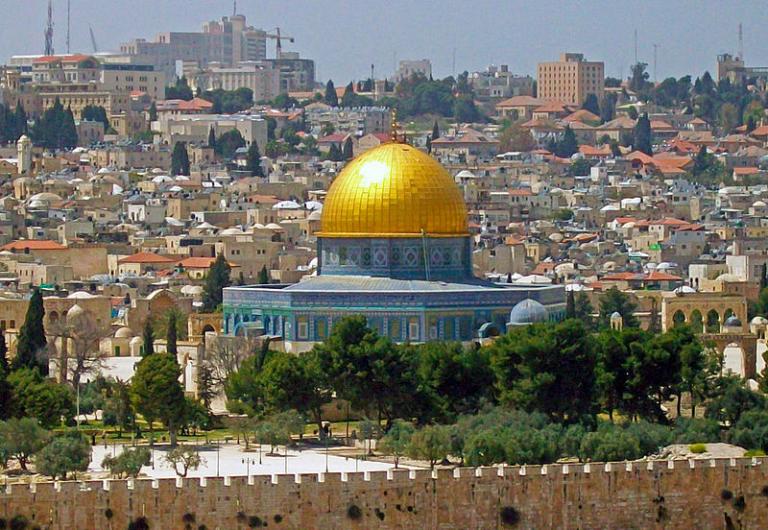
The Dome of the Rock, seen here from the Mount of Olives, is the oldest extant and intact Islamic building, and its construction is one of the markers of the commencement of Hodgson’s “High Caliphal Period.”
(Wikimedia Commons public domain image)
Classical Arabic Civilization
The late Marshall G. S. Hodgson, one of the greatest Western students of Islam of the past century, developed an outline of Islamic history that I find very helpful.[1] In it, he distinguishes seven different periods. Let me summarize them here.
First, Hodgson states, there was the “Pre-Islamic Period.” It isn’t hard to understand what this is about, since it simply refers to the years from earliest time up to about 570 A.D., when the Prophet Muhammad was born. The next interval, which he calls the “Formative Period,” extends from Muhammad’s birth up to 692 A.D.[2] Among other things, this is the time in which the most important document of Islam, the Qur’an, was revealed and recorded, and the time in which the Prophet himself and his first four successors (the “rightly guided caliphs”) established powerful examples of what it means to live as a Muslim. We have already discussed important items from the Formative Period. Hodgson labels the next distinct phase of Islamic history the “High Caliphal Period.” I will discuss it in more detail below but, briefly, it was during this period that the Arab or Islamic empire attained its greatest power and prosperity. Things fell apart by 945 A.D., and the Muslims entered what Hodgson terms the “Middle Periods” of their history, which lasted until 1500. (Hodgson divides this era in two. He distinguishes the “Early Middle Period” from the “Later Middle Period.”) When gunpowder and other modern technologies made it possible for certain innovative states to swallow up those around them, the Muslims entered a period of partial recentralization. This Hodgson terms the age of the “Gunpowder Empires.” Finally, at the beginning of the nineteenth century, Western imperialism entered the Islamic world—first in the person of Napoleon. With this, the Muslims moved into the Modern Period.
The High Caliphal Period
By the end of the seventh century, although institutions continued to be formed, the basic structures of Islamic belief and practice were pretty much in place. The Arabs who had poured out of the Arabian peninsula and launched their astonishing series of conquests had left the old local bureaucracies in control of day-to-day governance. The conquerors were uninterested in such lowly matters and probably had no competence anyway, since, as we have seen, the Arabian Peninsula really had no traditions of government in any recognizable sense. Thus, native Christians in one part of the new empire and Mazdaeans or Zoroastrians in the other continued to administer daily affairs in languages like Aramaic and Persian, just as they had in the years before the conquest.
Finally, in the late seventh century, Arabic was made the language of administration. This had notable consequences. Fluency in Arabic now became the passport to social advancement and prestige. People who wanted to get ahead in the new order had to learn it. This was relatively easy for speakers of Aramaic to do, since, as a Semitic language like Hebrew, it was closely related to Arabic. (The situation was similar to that of a speaker of Spanish having to learn Portuguese.) It is probably for this reason that Aramaic essentially died out. It was simply absorbed into the dominant language. Persian, on the other hand, is a language utterly unrelated to Arabic.[3] This made the speech of the conquerors perhaps more difficult for native Persian-speakers to learn, but it also led to a clear distinction between the native language and the learned second language that prevented Persian from assimilating to Arabic and simply vanishing or going extinct as Aramaic did. Thus, while Persian disappeared for a number of centuries from public or official use, it continued to be spoken at home. This is shown clearly by its reappearance in literary form around the year 1000 A.D. (Since then, of course, it has had a continuous history. Today, Persian is the language of the Islamic Republic of Iran.)
[1] In his stunningly brilliant three-volume work The Venture of Islam: Conscience and History in a World Civilization (Chicago: The University of Chicago Press, 1974).
[2] Hodgson has his reasons for choosing precisely this year as his cut-off date for the Formative Period, but they are beyond the scope of this book.
[3] I will refer throughout this book to Persian, rather than speaking of the language by its own native title, Farsi. It has become fashionable in some circles to talk of Farsi when speaking English, and some will no doubt be puzzled by my refusal to do so. But there is a simple reason for it: We do not usually talk in English about Deutsch or Francais or Español or al-‘Arabiyya. I see no point in making an exception for Persian.
Previous Post

September 14, 2020
Life on Venus? Intelligent Life on Earth?
Next Post
September 15, 2020 On my father's birthday
Browse Our Archives
Select a Category Uncategorized
Select a Month October 2026 September 2026 August 2026 July 2026 June 2026 May 2026 April 2026 March 2026 February 2026 January 2026 December 2025 November 2025 October 2025 September 2025 August 2025 July 2025 June 2025 May 2025 April 2025 March 2025 February 2025 January 2025 December 2024 November 2024 October 2024 September 2024 August 2024 July 2024 June 2024 May 2024 April 2024 March 2024 February 2024 January 2024 December 2023 November 2023 October 2023 September 2023 August 2023 July 2023 June 2023 May 2023 April 2023 March 2023 February 2023 January 2023 December 2022 November 2022 October 2022 September 2022 August 2022 July 2022 June 2022 May 2022 April 2022 March 2022 February 2022 January 2022 December 2021 November 2021 October 2021 September 2021 August 2021 July 2021 June 2021 May 2021 April 2021 March 2021 February 2021 January 2021 December 2020 November 2020 October 2020 September 2020 August 2020 July 2020 June 2020 May 2020 April 2020 March 2020 February 2020 January 2020 December 2019 November 2019 October 2019 September 2019 August 2019 July 2019 June 2019 May 2019 April 2019 March 2019 February 2019 January 2019 December 2018 November 2018 October 2018 September 2018 August 2018 July 2018 June 2018 May 2018 April 2018 March 2018 February 2018 January 2018 December 2017 November 2017 October 2017 September 2017 August 2017 July 2017 June 2017 May 2017 April 2017 March 2017 February 2017 January 2017 December 2016 November 2016 October 2016 September 2016 August 2016 July 2016 June 2016 May 2016 April 2016 March 2016 February 2016 January 2016 December 2015 November 2015 October 2015 September 2015 August 2015 July 2015 June 2015 May 2015 April 2015 March 2015 February 2015 January 2015 December 2014 November 2014 March 2014 August 2013 February 2012
Follow Us!
TAKE THE
Religious Wisdom Quiz
In 1 Timothy, what does Paul say is the root of all kinds of evil?
Select your answer to see how you score.
Pride Greed Money itself The love of money
Related posts from Sic et Non

Islam in America or Islam versus America?

A basic working chronology of Islamic-era Iran

Actual Data and Actual Crusades

TRENDING AT PATHEOS Latter-day Saint

A new article, written by Jeff Lindsay and Gale L. Pooley,...

Swimfan: Forgotten Aughts Pleasures
This is a recovery effort. In 2002, My Big Fat Greek Wedding...

Top Three Anti-Catholic Lies About Catholicism
This is my initial transcript for the video, "THE 3 WORST...

Pope Leo Celebrates Mass for Nurses & Docs...
I don't have any idea how he did it, but Pope Leo...

The Sermon on the Mount, Part I: Matthew...
The Sermon on the Mount, Part I (Matthew 4:12-5:12) St. Matthew moves...

What's up from Crossway: Reviewing some of their latest A few weeks...
view all Latter-day Saint blogs
Ad-Free & Subscriber Log-In Subscription Support
- About Us
- 2026 Calendar
- Videos
- Podcasts
- Library of World Religions
- Faith In Media Tracker
- Advertise With Us
- Write for Us
- Privacy Policy
- Terms of Service
- Do Not Sell My Data
- Contact Us
- Radiant Digital
- Manage Newsletter Subscriptions
- Unsubscribe From Notifications
- Sitemap
Copyright 2008-2026, Patheos. All rights reserved.
Subscription Support Ad-Free & Subscriber Log-In
Follow Patheos