
BuddhistCatholicContemplativeEvangelicalGeneral ChristianHinduJewishLatter-day SaintMuslimNew VisionsProgressive Christian
Beliefs
- Buddhist
- Catholic
- Contemplative
- Evangelical
- General Christian
- Hindu
- Jewish
- Latter-day Saint
- More Voices
- Muslim
- New Visions
- Pagan
- Progressive Christian
Topics
- Religion News
- Food and Religion
- Sports and Religion
- Religious Art
- Religious Music and Entertainment
- Religious Events
- History and Religion
- Style and Religion
- Politics and Religion
- Women in Religion
- Recreation Outdoors and Religion
- Business Finance and Religion
- Careers Workplace and Religion
- Education and Religion
- Family Parenting and Religion
- Health Fitness and Religion
- Home and Religion
- Relationships and Religion
- Technology and Religion
- Travel and Religion
Columnists
- Buddhist Columnists
- Business Finance and Religion Columnists
- Careers Workplace and Religion Columnists
- Catholic Columnists
- Contemplative Columnists
- Education and Religion Columnists
- Evangelists Columnists
- Family Parenting and Religion Columnists
- General Christian Columnists
- Health Fitness and Religion Columnists
- Hindu Columnists
- History and Religion Columnists
- Home and Religion Columnists
- Jewish Columnists
- More Voices Columnists
- Latter Day Columnists
- Muslim Columnists
- New Visions Columnists
- Nonreligious Columnists
- Pagan Columnists
- Politics and Religion Columnists
- Progressive Columnists
- Recreation Outdoors and Religion Columnists
- Relationships and Religion Columnists
- Religion News Columnists
- Religious Art Columnists
- Religious Events Columnists
- Religious Music and Entertainment Columnists
- Sports and Religion Columnists
- Style and Religion Columnists
- Technology and Religion Columnists
- Travel and Religion Columnists
- Women in Religion Columnists
Resource Library
- 2026 Calendar
- Library of World Religions
- The 100 Most Holy Places on Earth
- Patheos Answers
- Podcasts
- Videos
- Faith Leaders Database
- Anglican Episcopalian
- Bahai
- Baptist
- Buddhism
- Christianity
- Confucianism
- Eastern Orthodoxy
- Hinduism
- Holiness and Pentecostal
- ISKCON
- Islam
- Judaism
- Lutheran
- Methodist
- The Church of Jesus Christ of Latter-day Saints
- New Age
- Paganism
- Presbytarian and Reformed
- Protestantism
- Religion Behind the Scenes
- Roman Catholic
- Scientology
- Shia Islam
- Sikhism
- Sufism
- Sunni Islam
- Taoism
- Zen
- See all religions
Research Tools
 Ad-Free & Subscriber Log-In Subscription Support
Ad-Free & Subscriber Log-In Subscription Support
Follow Patheos 

- Trending:
- Forgiveness
- |
- Marriage
- |
- Consciousness
- |
- Death Penalty
- |
- Election
- |
- Halloween

- Home
- Latter-day Saint
- Revision 4.19 “Some Similarities between the Qur’an and Latter-day Saint Scripture” (Part 2)
Revision 4.19 “Some Similarities between the Qur’an and Latter-day Saint Scripture” (Part 2)
Last updated on: September 6, 2020 at 2:25 pm by Dan Peterson
Revision 4.19 “Some Similarities between the Qur’an and Latter-day Saint Scripture” (Part 2) 2020-09-06T14:25:16-06:00 Dan Peterson
Patheos Explore the world's faith through different perspectives on religion and spirituality! Patheos has the views of the prevalent religions and spiritualities of the world.
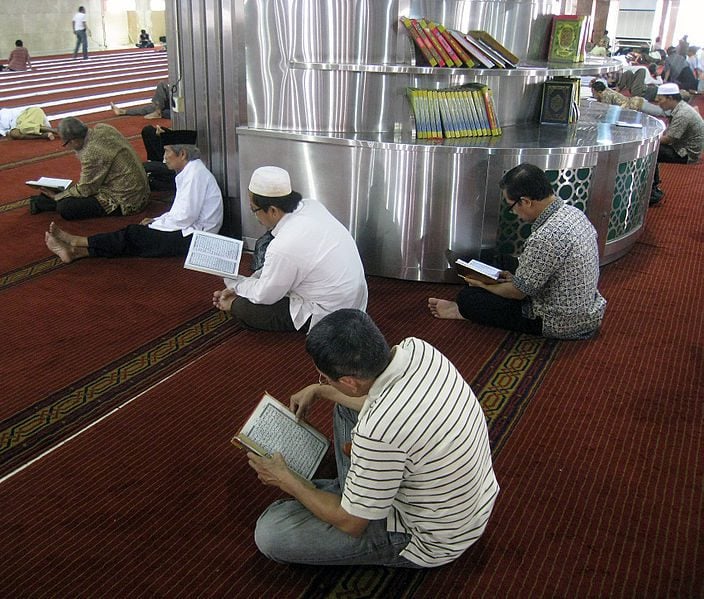
Reading the Qur’an in an Indonesian mosque after prayer
(Wikimedia Commons public domain photo by Gunawan Kartapranata)
The entire twelfth chapter of the Qur’an is devoted to a beautiful retelling of the story of Joseph of Egypt. It is the only chapter of the Qur’an that is entirely occupied by a single narrative.
The story of Moses is one of the more commonly repeated in the Qur’an.[1] Saul, David, and Solomon are also mentioned.[2]
The Qur’an knows the biblical stories of David and Goliath, as well as the parable Nathan tells to David in 2 Samuel 11-12. King David is a great revelator in the Qur’an. “To David We gave the Psalms.”[3] Moreover, Solomon appears in the Qur’an not only as a great king of Israel but also as a magician, just as he does in post-biblical Jewish lore. And at one point the Qur’an seems to make Solomon the star of a story that the Bible connects with Gideon instead.[4]
It is not only the stories of the Old Testament or Hebrew Bible that seem to find their counterparts in the Qur’an; the New Testament has Qur’anic parallels as well. A parable similar to that of the ten virgins occurs.[5] The miraculous birth of John the Baptist is alluded to at several points.[6] So, too, is the story of Mary, including Gabriel’s annunciation to her of the advent of the Savior and the virgin birth of Jesus.[7] Certain Western scholars have seen a reminiscence of the institution of the eucharist or sacrament and the miracle of loaves and fishes.[8]
Many of the similarities are verbal. There are passages in the Qur’an that are virtually identical to passages in the Bible.[9] Thus, when the Qur’an talks about the ruins of past civilizations, destroyed for their disobedience to God and to the prophets he had sent to them, it comments that “your Lord would not have ruined those cities without just cause, had their inhabitants been righteous men.”[10] It rejects the notion that God prefers one people over another because of their lineage or ancestry. “The noblest of you in God’s sight,” it says, “is he who fears Him most.”[11] This is reminiscent of the justification given by the Book of Mormon for the expulsion of the Canaanites by the children of Israel:
And now, do ye suppose that the children of this land, who were in the land of promise, who were driven out by our fathers, do ye suppose that they were righteous? Behold, I say unto you, Nay. Do ye suppose that our fathers would have been more choice than they if they had been righteous? I say unto you, Nay. Behold, the Lord esteemeth all flesh in one; he that is righteous is favored of God. But behold, this people had rejected every word of God, and they were ripe in iniquity.[12]
The Qur’an’s view of human hardheartedness is very close to that found in the Latter-day Saint scriptures. “When misfortune befalls a man, he prays to Us standing, sitting, and lying down. But as soon as We relieve his affliction he pursues his former ways, as though he never prayed for Our help.”[13] This could serve as a summary of Nephite history, but its applicability is not only to past dispensations. “In the day of their peace,” said the Lord about the persecuted Saints in 1833 Missouri, “they esteemed lightly my counsel; but, in the day of their trouble, of necessity they feel after me.”[14] This leads occasionally to a highly negative view of human nature, which contrasts us unfavorably with inanimate nature: “If We had sent down this Qur’an upon a mountain, thou wouldst have seen it humbled, split asunder out of the fear of God.”[15] The prophet Mormon seems to have held a similar opinion: “O how great is the nothingness of the children of men; yea, even they are less than the dust of the earth. For behold, the dust of the earth moveth hither and thither, to the dividing asunder, at the command of our great and everlasting God. Yea, behold at his voice do the hills and the mountains tremble and quake.”[16] Nevertheless, despite their persistent rebellion against the will of God, the wicked seem to be quite serene in both the Qur’an and the Book of Mormon. “They declare: ‘The Fire will never touch us—except for a few days.’”[17]
“And there shall also be many which shall say: Eat, drink, and be merry; nevertheless, fear God—he will justify in committing a little sin; yea, lie a little, take the advantage of one because of his words, dig a pit for thy neighbor; there is no harm in this; and do all these things, for tomorrow we die; and if it so be that we are guilty, God will beat us with a few stripes, and at last we shall be saved in the kingdom of God.”[18]
Like the Bible, the Qur’an distinguishes between rocky soil and the deep soil in a garden, as a parable for the distinction between believers and unbelievers.[19] But the believers comprehend the parables of God, while unbelievers do not understand what they mean.[20] Part of the problem is that unbelievers hold family and kin dearer than true religion. The Qur’an advises against this, just as Jesus does.[21] But if believers choose to serve God first, he will intervene on their behalf. “If God be for us,” asks the apostle Paul, “who can be against us?”[22] “If God helps you,” declares the Qur’an, “none can overcome you. If He abandons you, who then can help you?”[23] “Keep your covenant,” Allah says, “and I will be true to Mine.”[24] This is similar to what God told Joseph Smith: “I, the Lord, am bound when ye do what I say; but when ye do not what I say, ye have no promise.”[25]
[1] See, for example, 2:40-71, 246-48; 5:20-26; 7:103-75; 10:75-93; 19:51-53; 20:10-98; 26:10-69; 27:7-14; 28:3-46, 76-82; 40:23-53; 43:46-56; 79:15-26.
[2] 2:249-53; 27:15-44; 34:12-14; 38:21-26.
[3] 4:163; 17:55.
[4] Compare 2:249 with Judges 7:2-7.
[5] 57:12-15; compare Matthew 25:1-13.
[6] 3:38-41; 19:2-15; 21:89-90.
[7] 3:35_37,42-51; 19:16-34.
[8] 5:112-15.
[9] It might be of interest to compare the 55th chapter of the Qur’an with Psalm 136. However, such a comparison is beyond the scope of the present book.
[10] 11:117.
[11] 49:13.
[12] 1 Nephi 17:33-35.
[13] 10:12; compare 30:33-34; 39:8.
[14] Doctrine and Covenants 101:8.
[15] 59:21 (Arberry).
[16] Helaman 12:7-9.
[17] 2:80; compare 3:24.
[18] 2 Nephi 28:8.
[19] 2:264-65. Compare Matthew 13:3-9, 18-23; Mark 4:3-9, 14-20; Luke 8:5-8, 11-15.
[20] 2:26. Compare Matthew 13:10-17; Mark 4:11-12; Luke 8:10.
[21] 9:23 24. Compare Matthew 10:34-37.
[22] Romans 8:31.
[23] Romans 8:31. Qur’an 3:160.
[24] 2:40.
[25] Doctrine and Covenants 82:10.
Church of Jesus Christ of Latter-day Saints
Previous Post

September 5, 2020
Shared Revelations
Next Post
September 6, 2020 A friend's statement of faith
Browse Our Archives
Select a Category Uncategorized
Select a Month October 2026 September 2026 August 2026 July 2026 June 2026 May 2026 April 2026 March 2026 February 2026 January 2026 December 2025 November 2025 October 2025 September 2025 August 2025 July 2025 June 2025 May 2025 April 2025 March 2025 February 2025 January 2025 December 2024 November 2024 October 2024 September 2024 August 2024 July 2024 June 2024 May 2024 April 2024 March 2024 February 2024 January 2024 December 2023 November 2023 October 2023 September 2023 August 2023 July 2023 June 2023 May 2023 April 2023 March 2023 February 2023 January 2023 December 2022 November 2022 October 2022 September 2022 August 2022 July 2022 June 2022 May 2022 April 2022 March 2022 February 2022 January 2022 December 2021 November 2021 October 2021 September 2021 August 2021 July 2021 June 2021 May 2021 April 2021 March 2021 February 2021 January 2021 December 2020 November 2020 October 2020 September 2020 August 2020 July 2020 June 2020 May 2020 April 2020 March 2020 February 2020 January 2020 December 2019 November 2019 October 2019 September 2019 August 2019 July 2019 June 2019 May 2019 April 2019 March 2019 February 2019 January 2019 December 2018 November 2018 October 2018 September 2018 August 2018 July 2018 June 2018 May 2018 April 2018 March 2018 February 2018 January 2018 December 2017 November 2017 October 2017 September 2017 August 2017 July 2017 June 2017 May 2017 April 2017 March 2017 February 2017 January 2017 December 2016 November 2016 October 2016 September 2016 August 2016 July 2016 June 2016 May 2016 April 2016 March 2016 February 2016 January 2016 December 2015 November 2015 October 2015 September 2015 August 2015 July 2015 June 2015 May 2015 April 2015 March 2015 February 2015 January 2015 December 2014 November 2014 March 2014 August 2013 February 2012
Follow Us!
TAKE THE
Religious Wisdom Quiz
Who was Isaac's wife?
Select your answer to see how you score.
Sarah Rebekah Rachel Leah
Related posts from Sic et Non


Notes on Women, Priesthood, and General Conference

"The Book of Moses as a Temple Text"

TRENDING AT PATHEOS Latter-day Saint

How to Make a Decision When You Can't...
Main point: It’s much more valuable to stay close to God so...

Archdiocese Hosts Military Marriage Retreat in Germany
RASTATT, Germany — The transient military lifestyle, with its frequent deployments and...

Nearly every morning, I make the drive to Detroit with my high-school-age...

The Real AI Story Is Adoption Without Trust
Artificial intelligence has crossed a political threshold. It is no longer a...

A new article, written by Jeff Lindsay and Gale L. Pooley,...

Swimfan: Forgotten Aughts Pleasures
This is a recovery effort. In 2002, My Big Fat Greek Wedding...
view all Latter-day Saint blogs
Ad-Free & Subscriber Log-In Subscription Support
- About Us
- 2026 Calendar
- Videos
- Podcasts
- Library of World Religions
- Faith In Media Tracker
- Advertise With Us
- Write for Us
- Privacy Policy
- Terms of Service
- Do Not Sell My Data
- Contact Us
- Radiant Digital
- Manage Newsletter Subscriptions
- Unsubscribe From Notifications
- Sitemap
Copyright 2008-2026, Patheos. All rights reserved.
Subscription Support Ad-Free & Subscriber Log-In
Follow Patheos