
BuddhistCatholicContemplativeEvangelicalGeneral ChristianHinduJewishLatter-day SaintMuslimNew VisionsProgressive Christian
Beliefs
- Buddhist
- Catholic
- Contemplative
- Evangelical
- General Christian
- Hindu
- Jewish
- Latter-day Saint
- More Voices
- Muslim
- New Visions
- Pagan
- Progressive Christian
Topics
- Religion News
- Food and Religion
- Sports and Religion
- Religious Art
- Religious Music and Entertainment
- Religious Events
- History and Religion
- Style and Religion
- Politics and Religion
- Women in Religion
- Recreation Outdoors and Religion
- Business Finance and Religion
- Careers Workplace and Religion
- Education and Religion
- Family Parenting and Religion
- Health Fitness and Religion
- Home and Religion
- Relationships and Religion
- Technology and Religion
- Travel and Religion
Columnists
- Buddhist Columnists
- Business Finance and Religion Columnists
- Careers Workplace and Religion Columnists
- Catholic Columnists
- Contemplative Columnists
- Education and Religion Columnists
- Evangelists Columnists
- Family Parenting and Religion Columnists
- General Christian Columnists
- Health Fitness and Religion Columnists
- Hindu Columnists
- History and Religion Columnists
- Home and Religion Columnists
- Jewish Columnists
- More Voices Columnists
- Latter Day Columnists
- Muslim Columnists
- New Visions Columnists
- Nonreligious Columnists
- Pagan Columnists
- Politics and Religion Columnists
- Progressive Columnists
- Recreation Outdoors and Religion Columnists
- Relationships and Religion Columnists
- Religion News Columnists
- Religious Art Columnists
- Religious Events Columnists
- Religious Music and Entertainment Columnists
- Sports and Religion Columnists
- Style and Religion Columnists
- Technology and Religion Columnists
- Travel and Religion Columnists
- Women in Religion Columnists
Resource Library
- 2026 Calendar
- Library of World Religions
- The 100 Most Holy Places on Earth
- Patheos Answers
- Podcasts
- Videos
- Faith Leaders Database
- Anglican Episcopalian
- Bahai
- Baptist
- Buddhism
- Christianity
- Confucianism
- Eastern Orthodoxy
- Hinduism
- Holiness and Pentecostal
- ISKCON
- Islam
- Judaism
- Lutheran
- Methodist
- The Church of Jesus Christ of Latter-day Saints
- New Age
- Paganism
- Presbytarian and Reformed
- Protestantism
- Religion Behind the Scenes
- Roman Catholic
- Scientology
- Shia Islam
- Sikhism
- Sufism
- Sunni Islam
- Taoism
- Zen
- See all religions
Research Tools
 Ad-Free & Subscriber Log-In Subscription Support
Ad-Free & Subscriber Log-In Subscription Support
Follow Patheos 

- Trending:
- Forgiveness
- |
- Marriage
- |
- Consciousness
- |
- Death Penalty
- |
- Election
- |
- Halloween

- Home
- Latter-day Saint
- Revision 4.18 “Some Similarities between the Qur’an and Latter-day Saint Scripture” (Part 1)
Revision 4.18 “Some Similarities between the Qur’an and Latter-day Saint Scripture” (Part 1)
Last updated on: September 6, 2020 at 12:09 am by Dan Peterson
Revision 4.18 “Some Similarities between the Qur’an and Latter-day Saint Scripture” (Part 1) 2020-09-06T00:09:16-06:00 Dan Peterson
Patheos Explore the world's faith through different perspectives on religion and spirituality! Patheos has the views of the prevalent religions and spiritualities of the world.
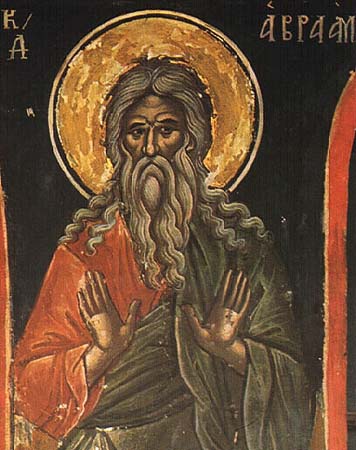
The patriarch Abraham in an anonymous icon
(Wikimedia Commons public domain)
Some readers will already have noticed a number of similarities between the Qur’an and the standard works of The Church of Jesus Christ of Latter-day Saints. And, indeed, there are many. The present section will highlight some of them. In this regard, perhaps the most obvious feature of the Qur’an is the fact that it contains many of the same stories and refers to many of the same historical figures that are familiar to the West from the pages of the Bible.
The Qur’an speaks, for instance, about the fall of Lucifer and the temptation and fall of Adam and Eve.[1] It is familiar with the story of Adam’s naming of the animals and the conflict between Cain and Abel.[2] The story of Noah appears more than once.[3] Job is mentioned, as is a figure called Idris, who is universally identified by Muslim commentators with Enoch.[4] Even Jonah is mentioned.[5]
Told often, and in considerable detail, are the stories of Abraham and his nephew Lot, including the miraculous annunciation of Isaac, Abraham’s near-sacrifice of his son, and the destruction of Sodom and Gomorrah.[6] The story of Abraham’s youthful renunciation of his idolatrous family and people is favored and referred to numerous times throughout the Qur’an.[7] The Qur’anic retelling of the story, however, contains a number of interesting details that either do not occur in the Bible or are not emphasized at all. Abraham appears in the Qur’an as a watcher of the skies, much as he does in the third chapter of the Book of Abraham. And the prayer for wisdom and righteousness that the Qur’anic Abraham offers seems to parallel his quest as recorded in Abraham 1:2. Some details are even amusing, as in the following dialogue between the patriarch and an unidentified royal idol worshiper:
Have you not heard of him who argued with Abraham about his Lord because He had bestowed upon him the Kingdom?
Abraham said: “My Lord is He who has power to give life and to cause death.”
“I, too,” replied the other, “have power to give life and to cause death.”
“God brings up the sun from the east,” said Abraham. “Bring it up yourself from the west.”[8]
A personal favorite of mine, however, is a story to which the Qur’an merely alludes, without telling it all in detail.[9] This is the story of Abraham and the idols of his father, with which some Latter-day Saint readers will already be familiar, from the book called Jasher:
Attempting to demonstrate to his father Terah the futility of worshiping idols, Abraham one day went into his father’s shrine with a hatchet and hacked all of the gods to pieces—except for their chief. Then, before leaving the room, he placed the hatchet in the hands of the still-intact chief god. His father, hearing the noise of violent chopping in his private sanctuary, ran and met Abraham at the door. Pushing past his son, Terah went into the shrine. There he found all the idols fallen down and broken, while the chief idol still stood with the hatchet in its hand. He was furious. Knowing his son’s attitude toward idolatry and having seen his son emerging from the shrine, he naturally demanded to know what Abraham had done to the gods of his father. But Abraham denied having anything to do with the destruction of the idols. “No,” he said, “it was the chief god who did it, out of jealousy when the other, subordinate gods had tried to beat him to the meat offering.” Terah roared with anger. “You are lying!” he told his son. “These gods are just wood and stone. I made them myself!” How could they possibly have done anything like what Abraham had described? “Ah,” said Abraham, “but that is precisely the point! They are merely wood and stone, which can neither hear nor speak nor act. So why pray to them?”[10]
I have already spoken about the common assumption that the Qur’an identifies the son of Abraham who was nearly sacrificed upon Mount Moriah as Ishmael, rather than the Bible account’s Isaac. We have seen, though, that the Qur’an nowhere names the son who came so near to human sacrifice. And, in fact, the Qur’an has a great respect for Isaac. Of Abraham, the God of the Qur’an says, “We gave him Isaac and Jacob and bestowed on his descendants prophethood and the Scriptures.”[11] Clearly, this passage teaches the continuation of the prophetic gift in the Jewish line, through Jacob or Israel. Ishmael appears in the Qur’an and is treated with immense respect as a chosen servant of God and a messenger, but Isaac is described as a prophet.[12]
[1] 2:30_39; 7:11-25; 15:26-44; 17:61-65; 20:115-23; 38:71-85.
[2] 2:31-33; 5:27-31.
[3] As at 10:71-73; 11:25-49.
[4] 21:83-84; 19:56-57, with perhaps a hint of his translation. Idris is pronounced with a hissing “s,” as Ih-DREES.
[5] 37:139-49; 68:48-50.
[6] 11:69-83; 17:50-77; 27:54-58; 29:28-35; 37:99-111, 113-38; 51:24-37; 54:33-40.
[7] For instance, at 6:74-79; 19:41-50; 21:51-72; 26:70-102; 37:83-98.
[8] 2:258.
[9]. This is the usual Qur’anic approach. It frequently refers to stories that it presumes its audience will already find familiar. This somewhat elliptical or allusive quality of the Qu’ran is probably the main reason that many Western readers find the book so off-putting.
[10] This story is told at Jasher 11:16-51. See The Book of Jasher (Thousand Oaks, CA: Artisan Sales, 1990), 25-27. This translation of the Book of Jasher first appeared in 1840. It was reprinted, at Salt Lake City, in 1887.
[11] 29:27; compare 4:54.
[12] 19:54-55; 37:112.
Church of Jesus Christ of Latter-day Saints
Previous Post

September 4, 2020
So what DOES Saturn's largest moon smell like?
Next Post
September 5, 2020 "Why the 'COVID-19 killed only 6%' argument is wrong"
Browse Our Archives
Select a Category Uncategorized
Select a Month October 2026 September 2026 August 2026 July 2026 June 2026 May 2026 April 2026 March 2026 February 2026 January 2026 December 2025 November 2025 October 2025 September 2025 August 2025 July 2025 June 2025 May 2025 April 2025 March 2025 February 2025 January 2025 December 2024 November 2024 October 2024 September 2024 August 2024 July 2024 June 2024 May 2024 April 2024 March 2024 February 2024 January 2024 December 2023 November 2023 October 2023 September 2023 August 2023 July 2023 June 2023 May 2023 April 2023 March 2023 February 2023 January 2023 December 2022 November 2022 October 2022 September 2022 August 2022 July 2022 June 2022 May 2022 April 2022 March 2022 February 2022 January 2022 December 2021 November 2021 October 2021 September 2021 August 2021 July 2021 June 2021 May 2021 April 2021 March 2021 February 2021 January 2021 December 2020 November 2020 October 2020 September 2020 August 2020 July 2020 June 2020 May 2020 April 2020 March 2020 February 2020 January 2020 December 2019 November 2019 October 2019 September 2019 August 2019 July 2019 June 2019 May 2019 April 2019 March 2019 February 2019 January 2019 December 2018 November 2018 October 2018 September 2018 August 2018 July 2018 June 2018 May 2018 April 2018 March 2018 February 2018 January 2018 December 2017 November 2017 October 2017 September 2017 August 2017 July 2017 June 2017 May 2017 April 2017 March 2017 February 2017 January 2017 December 2016 November 2016 October 2016 September 2016 August 2016 July 2016 June 2016 May 2016 April 2016 March 2016 February 2016 January 2016 December 2015 November 2015 October 2015 September 2015 August 2015 July 2015 June 2015 May 2015 April 2015 March 2015 February 2015 January 2015 December 2014 November 2014 March 2014 August 2013 February 2012
Follow Us!
TAKE THE
Religious Wisdom Quiz
Though commanded to prophesy, I could not speak or warn the people until God opened my mouth. What affliction kept me silent?
Select your answer to see how you score.
A disease Paralysis Fear Muteness
Related posts from Sic et Non


"The Book of Moses as a Temple Text"


TRENDING AT PATHEOS Latter-day Saint

Swimfan: Forgotten Aughts Pleasures
This is a recovery effort. In 2002, My Big Fat Greek Wedding...

Top Three Anti-Catholic Lies About Catholicism
This is my initial transcript for the video, "THE 3 WORST...

Pope Leo Celebrates Mass for Nurses & Docs...
I don't have any idea how he did it, but Pope Leo...

The Sermon on the Mount, Part I: Matthew...
The Sermon on the Mount, Part I (Matthew 4:12-5:12) St. Matthew moves...

What's up from Crossway: Reviewing some of their latest A few weeks...

Janie Learns the Way of the Cross: A...
Teaching children about Jesus' Passion can be challenging. Many parents and educators...
view all Latter-day Saint blogs
Ad-Free & Subscriber Log-In Subscription Support
- About Us
- 2026 Calendar
- Videos
- Podcasts
- Library of World Religions
- Faith In Media Tracker
- Advertise With Us
- Write for Us
- Privacy Policy
- Terms of Service
- Do Not Sell My Data
- Contact Us
- Radiant Digital
- Manage Newsletter Subscriptions
- Unsubscribe From Notifications
- Sitemap
Copyright 2008-2026, Patheos. All rights reserved.
Subscription Support Ad-Free & Subscriber Log-In
Follow Patheos